Korea's Health Ministry Funded a Quantum Nanosensor for Cancer-Drug Heart Damage: the KRW 8 Billion ARPA-H RFP5 Award of 31 August 2026
A patient starting anticancer therapy that carries cardiac risk is assessed before the first dose and then watched during it. The 2022 cardio-oncology guideline of the European Society of Cardiology, written with the European Hematology Association, ESTRO and the International Cardio-Oncology Society, recommends a baseline cardiovascular risk assessment using the HFA-ICOS score for every patient due to receive a potentially cardiotoxic therapy, and a baseline troponin or natriuretic peptide reading where those markers will be followed. Echocardiography and blood-based biomarkers are the main tools for assessment and monitoring. Both report on the heart as an organ. Both report once something at the tissue level has changed.
Practical takeaway. Korea's health ministry, not its science ministry, is now buying quantum sensing, and it bought it against a named clinical indication, and announced it that way. That changes who the eventual counterparty is: a hospital procurement office and a device regulator, on the timeline of a 4.5-year award.
What the Ministry of Health and Welfare selected on 31 August 2026, after a call that closed on 1 July
On 31 August 2026 Korean outlets reported the selection of a consortium led by Son Seok-kyun of Kyung Hee University's Department of Physics for a new Korean ARPA-H challenge: RFP5, quantum sensing-based ultra-high-sensitivity early diagnosis technology development. The award is KRW 8 billion over four and a half years. The administering chain is worth stating precisely, because it is the unusual part: the project is run by the Ministry of Health and Welfare through the Korea Health Industry Development Institute, specifically its K-Health Future Promotion Team.
RFP5 was not a standalone quantum call. The ministry opened nine challenges on 1 June 2026 with applications closing on 1 July and selection targeted for that month. The other eight are ordinary health-system problems: a vaccine platform aiming at ten years of immunity, latent-infection prevention, AI-linked rare disease treatment, blood purification in cancer management, a brain-computer interface for elderly mental health, making unmeasured elderly pain and itching visible, an agentic AI orchestration platform for healthcare, and a regional AI cancer management network. Quantum sensing entered that list as one health problem among nine, competing for the same money as a vaccine.
How a molecular quantum nanosensor and a cardiac organoid chip are meant to make one measurement
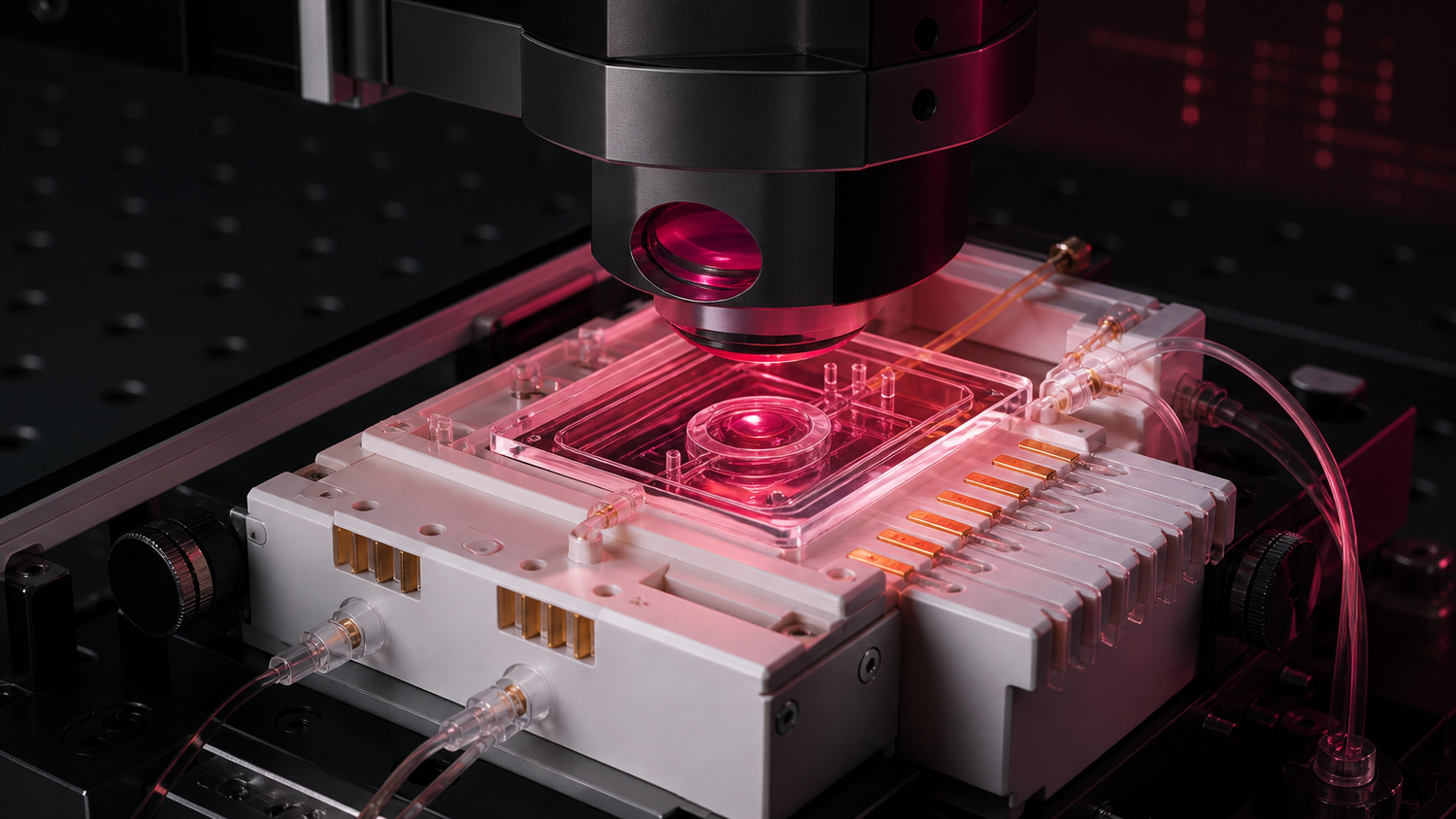
The proposed instrument has two halves that only work coupled. The first is a biocompatible molecular quantum nanosensor, which the consortium abbreviates MoQN. The second is a cardiac organoid on an organ-on-a-chip platform: heart tissue grown from cells, perfused, kept alive on a microfluidic cartridge. The sensor sits in that tissue and reports what the consortium calls elusive bio-signals, from which it intends to derive early warning signals.
Three quantities are specified: intracellular oxidative stress, local temperature and metabolic activity. That list is the tell. Reactive oxygen species and thermal load inside a cell sit below the resolution of an echocardiogram, and they are upstream of what a troponin assay measures — troponin appears in blood once cardiac myocytes have been injured enough to release it. The premise of the award is that a physical signal precedes that release, small enough that only a quantum sensor operating inside the tissue can read it. Nitrogen-vacancy centers in diamond, which Korea University holds in the work split, are the established route to exactly that class of measurement: magnetometry and nanoscale thermometry at the single-cell scale.
Which of the six institutions holds which part, and what the split shows
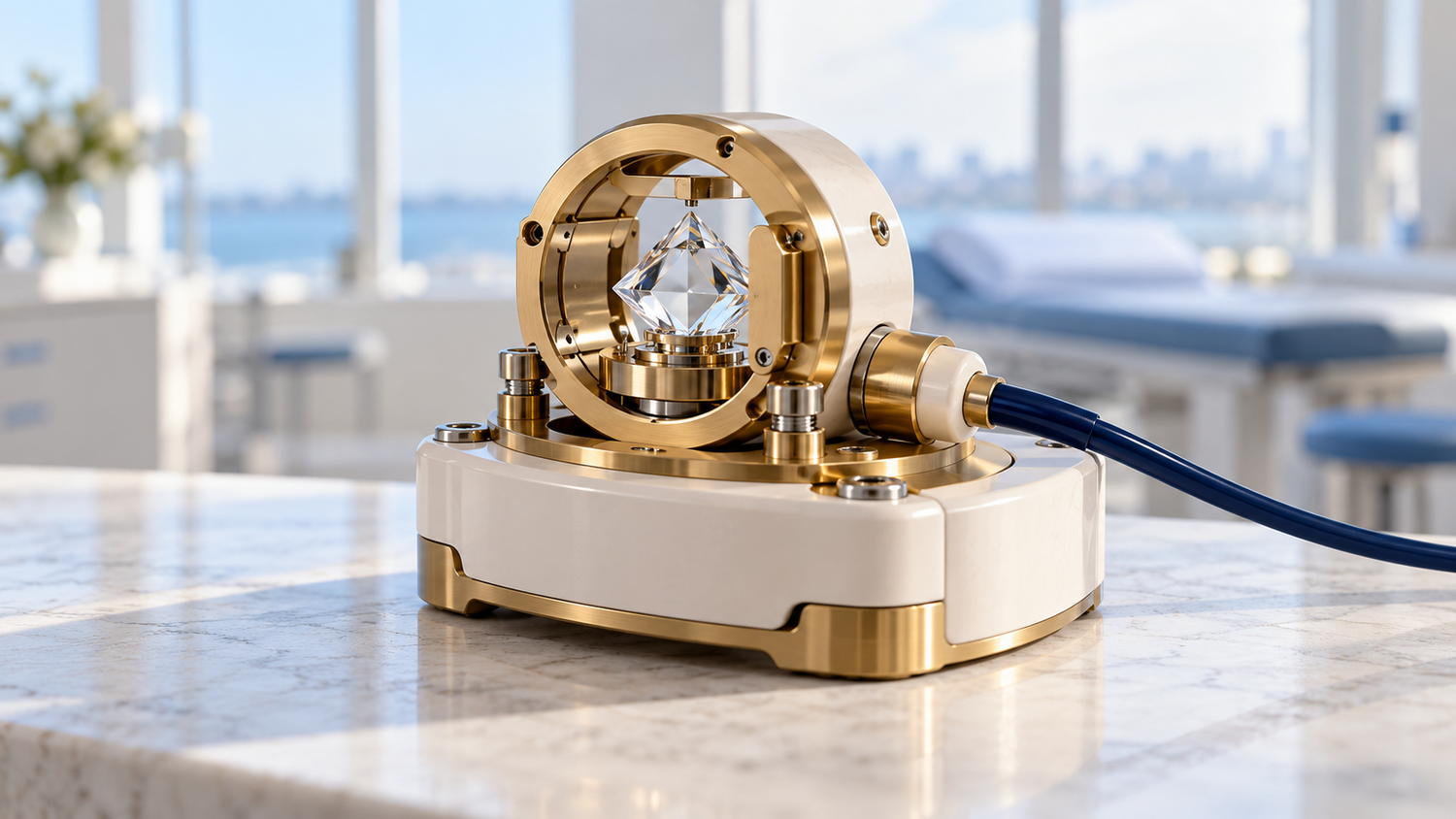
The functional division is published, and it reads as an engineering plan. Kyung Hee University develops the nanosensor and builds the overall quantum sensing platform. Kyung Hee University Medical Center supplies the cardiac organoid disease models and the biological validation. Chosun University handles the spin-Hamiltonian work, quantum signal interpretation and AI analysis. The Korea Electronics Technology Institute builds the MEMS and microfluidic chip and integrates the sensor into it. Korea University runs NV-center quantum sensing and cross-validation. LCI Bio holds the medical-platform linkage and the prototype and commercialization route.
Two features of that list matter more than the institutional names. A commercialization partner is inside the consortium from the start, which is what a health ministry buying a device would want. And cross-validation is a funded role held by a different institution than the one building the sensor. The consortium can be checked against itself, which is the reason the Korean quantum drug-design programme this blog covered on 19 August was worth taking seriously — that programme published the order of operations it would follow, ending in a laboratory. This one publishes the division of labour and puts a second NV-center group in the position to disagree with the first.
Why the funder being a health ministry changes what the instrument must deliver
Quantum sensing has been funded for years by research councils, defence agencies and science ministries, and those programmes are typically announced on a physical figure: femtotesla per root hertz, millikelvin resolution, a number in a paper. What the Ministry of Health and Welfare announced for this award is an indication. The stated entry point is anticancer-drug cardiotoxicity, which is a clinical indication with an existing standard of care and existing guideline monitoring. Cardioprotection in that setting runs on two tracks. Some of it is preventive, applied to patients assessed as high risk before dysfunction appears: liposomal anthracycline formulations, and dexrazoxane, whose FDA label ties its use to cumulative doxorubicin dose in patients who will continue to receive doxorubicin. The rest is a response after detection, including dose reduction and heart-failure treatment. The award aims at the point before either track has anything to act on.
An instrument aimed at that indication eventually meets a device regulator. It has to demonstrate that the early warning signal it derives predicts something a clinician would act on, and that acting earlier changes an outcome. Routes exist for a device with no comparable predecessor: the FDA's De Novo classification request was created for exactly that case, and in Europe an innovative device goes through conformity assessment under the Medical Device Regulation or the IVDR, carried out by a notified body designated for the purpose. What does not exist is quantum-specific assessment guidance, or a precedent decision on a diagnostic claim resting on a quantum-sensed intracellular measurement. The 4.5-year duration is long for a technology programme and short for establishing that precedent, and the gap between those two clocks is the real risk in the award.
Korea funded the design side in the same season through a different ministry entirely. In the Ministry of SMEs and Startups' 2026 pharma-bio venture collaboration programme, D&D Pharmatech and Quantum Intelligence were selected to find an oral α4β7 integrin candidate, pairing a quantum-mechanics-based AI design platform with D&D's ORALINK oral peptide delivery: KRW 1.358 billion over 24 months, July 2026 to June 2028. Design in one ministry, measurement in another, both dated, both with named deliverables.
How Quentir Reads It
The consequential fact in this award is the budget line it came through. A health ministry commissions against morbidity, and its procurement officers ask what a device changes for a patient. That question has a different answer horizon than the one a physics funder asks, and it drags a whole regulatory apparatus into a field that has so far been able to publish its way forward.
Set this next to the pattern we have been tracking in cryptography, where the migration calendars are being written by supervisors and procurement offices, with the standards bodies arriving afterwards. The same inversion is now visible in quantum medicine, one year earlier in the technology's life. Capability is being purchased before the category has a regulatory definition, and the purchaser is a ministry whose mandate is care delivery. Our reading of what quantum technology does to medical confidentiality duties assumed regulators would arrive first. On this evidence they will arrive second, and they will arrive to find a funded consortium with a prototype and a commercialization partner already in place.
For anyone holding a portfolio position in quantum sensing or in cardio-oncology diagnostics, the practical consequence is that Korea has now created a dated comparator. In four and a half years there will be either a device or a documented failure, with named institutions attached to each part of it, and the failure will be as informative as the device. That is more than most national quantum programmes will produce in the same window.
Everything this post links to — the Korean awards, the European supervisory calendars, the national quantum programmes we have reconstructed week by week — sits in one archive under the All-access membership, which is where the cross-references between a health ministry's procurement and a financial supervisor's deadline actually become usable. The running coverage stays free on Quentir Intelligence.
One question is worth putting to any institution that will eventually buy an instrument like this: when the early warning signal disagrees with the troponin result, which one stops the chemotherapy? Nobody has had to answer that yet, and the answer to it will decide whether the instrument is used.
Sources: Veritas Alpha, “Kyung Hee University Professor Son Seok-kyun's team selected for the Korean ARPA-H task ‘quantum sensing-based ultra-high-sensitivity early diagnosis technology development’”, 31 August 2026 (the KRW 8 billion figure, the 4.5-year duration, the six participating institutions and their assigned roles, and the anticancer-drug cardiotoxicity entry point are taken from this report); Dae Han News on the same selection, 31 August 2026, carrying the MoQN and cardiac organoid organ-on-chip design description; Ministry of Health and Welfare press release announcing nine new Korean ARPA-H projects, 1 June 2026, giving the application window to 1 July 2026 and the full list of nine challenges; Uihaksinmun on the same nine-project call, June 2026; 2022 ESC Guidelines on cardio-oncology, European Heart Journal, volume 43, issue 41, developed with the EHA, ESTRO and IC-OS, for the HFA-ICOS baseline risk assessment and baseline biomarker recommendations, with the American College of Cardiology's key-points summary, 29 August 2022, for the statement that echocardiography and blood-based biomarkers are the main monitoring methods; US Food and Drug Administration, dexrazoxane for injection prescribing information, for the cumulative-doxorubicin-dose condition on its use; FDA, De Novo Classification Request, and the European Commission's page on notified bodies for medical devices, for the existing assessment routes for a device with no comparable predecessor; The Bio News on D&D Pharmatech's selection under the Ministry of SMEs and Startups programme, August 2026, for the α4β7 project budget, term and ORALINK pairing. Pages read 31 August 2026.
Published intelligence, built to inform your own decisions. Published: August 31, 2026.