
Prof. Mauritz Kop Brings Quantum Governance to TUM's Public Interest Technology Course With Urs Gasser and Fabienne Marco
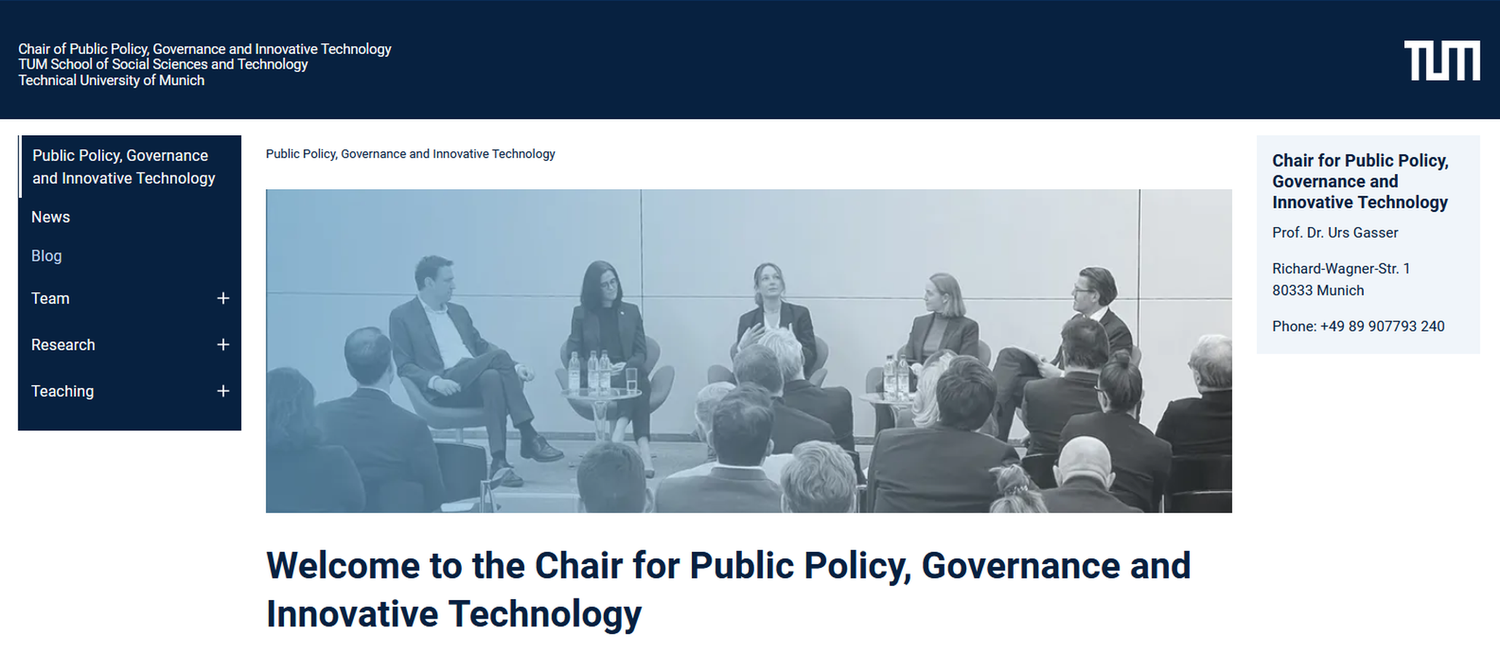
On August 24, 2026, Prof. Mauritz Kop taught a Quantum-ELSPI overview to students at the Technical University of Munich (TUM), together with Urs Gasser, Rector of the Hochschule für Politik München and Dean of the TUM School of Social Sciences and Technology, and Fabienne Marco, Head of the Quantum Social Lab at the TUM Think Tank. The session was part of an intensive, one-week Public Interest Technology course piloted in TUM's new Data & Society master's program and hosted by Gasser's Chair for Public Policy, Governance and Innovative Technology. Kop, founder of the Stanford Center for Responsible Quantum Technology (Stanford RQT) and of Quentir, brought quantum technology into a course about how engineers and scientists can build technology that serves people, society, and the planet.
For Quentir, the course shows an educational model with real promise: technically trained students learning to connect the capabilities they can build with the institutions, incentives, and people those capabilities will affect. The AIRecht account of the same session, Prof. Mauritz Kop Teaches Quantum-ELSPI Overview to TUM Students, sets out the four pillars of the framework; this article follows the wider course and what it means for the people who will build and govern quantum technology.
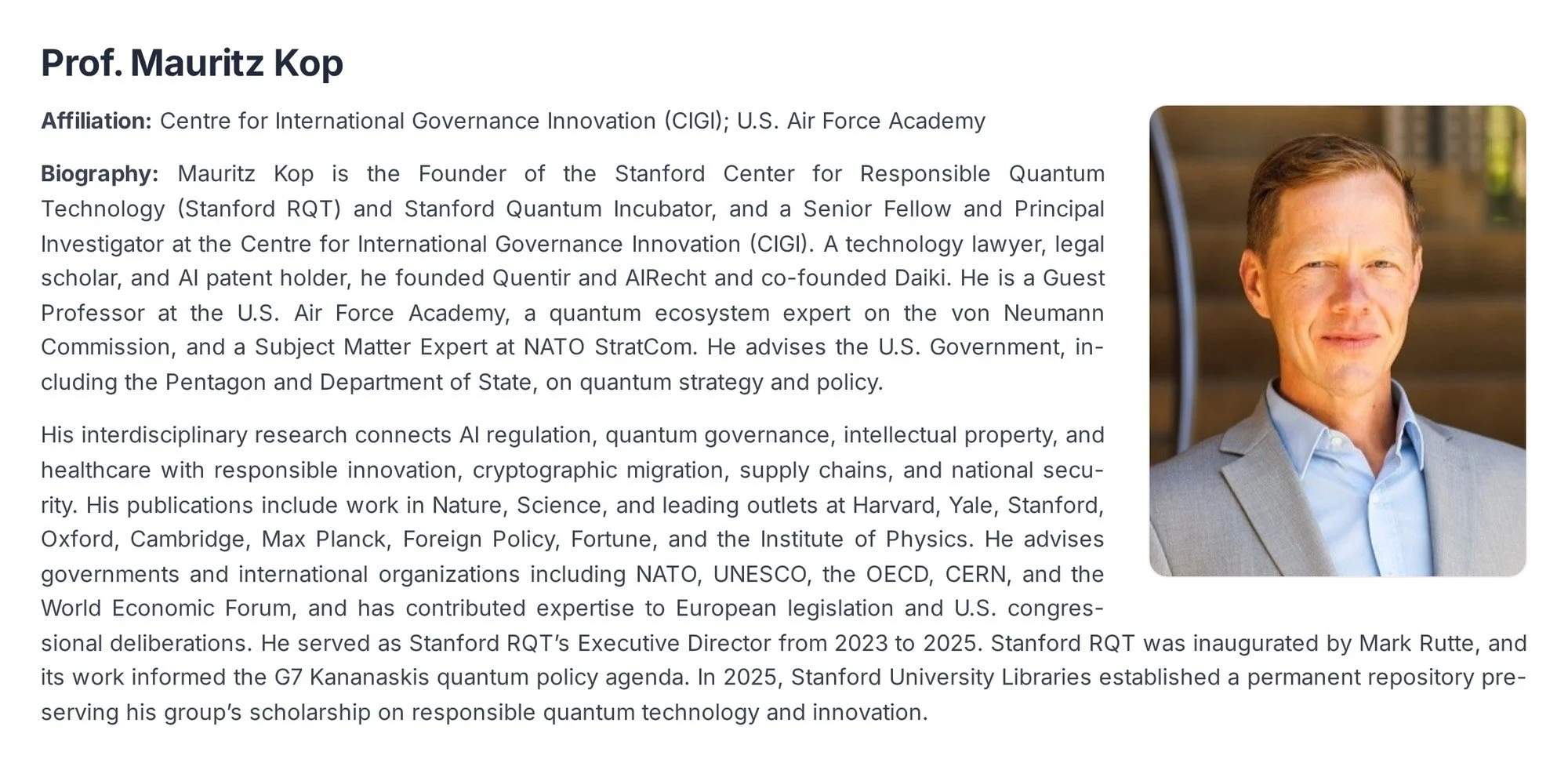
Kop introduced the students to Quantum-ELSPI, the research field he developed and set out in his 2023 Digital Society article Quantum-ELSPI: A Novel Field of Research, which examines the ethical, legal, social, and policy implications of quantum technology; the session's teaching materials gave particular attention to socioeconomic questions. Kop is a Senior Fellow and Principal Investigator at the Centre for International Governance Innovation and a Guest Professor at the U.S. Air Force Academy. He advises the U.S. Government, including the Pentagon and the Department of State, on quantum strategy and policy, and his teaching connects that policy experience with his research on responsible quantum technology.
Where Quantum-ELSPI Comes From: Kop's Stanford–Oxford Collaboration With Luciano Floridi, 2021–2023
Quantum-ELSPI grew out of a Stanford–Oxford collaboration in 2021 and 2022 between Kop, then a fellow at Stanford Law School, and the philosopher Luciano Floridi, then at the Oxford Internet Institute and now founding director of the Digital Ethics Center at Yale University. Kop guest-edited a topical collection on Quantum-ELSPI for Digital Society, the Springer Nature journal edited by Floridi, which invited cross-disciplinary work from law, economics, ethics, sociology, philosophy of science, and quantum information science.
The collection brought together pioneering contributions from three continents. Miriam Wimmer and Thiago Guimarães Moraes wrote from Brazil on quantum computing, digital constitutionalism, and the right to encryption, asking how fundamental rights can be protected when quantum capabilities develop unevenly between countries. Eline De Jong proposed an anticipatory approach to preparing society for the quantum age in Own the Unknown, and Elija Perrier set out models of governance for quantum information technologies in The Quantum Governance Stack. Kop's introductory article, Quantum-ELSPI: A Novel Field of Research (2023), mapped the emerging body of work and defined Quantum-ELSPI as a metaparadigm that connects research on quantum technology with research on the societal questions it raises. That foundation runs through the Stanford RQT frameworks and through Kop's teaching, from Stanford and the U.S. Air Force Academy to TUM.
Engineering for People, Society, and the Planet
TUM's Data & Society program starts with students who already have a STEM background. Its stated purpose is to help them analyze and shape technological developments in relation to human behavior, social needs, and political conditions. Academic Program Director Jürgen Pfeffer helped develop this interdisciplinary setting; in his account of the course, Gasser credits Pfeffer with envisioning and putting the new program into practice.
Technical students bring the ability to model, measure, and implement. Public Interest Technology asks them to extend those abilities to questions whose answers cannot be optimized against a single metric. Whose needs define the problem? Which costs disappear from the dashboard? Who can contest a decision once it has been automated?
New America's definition of Public Interest Technology explicitly describes technology expertise that encompasses ethical, legal, policy, and societal understanding alongside engineering. TUM's pilot puts that ambition into a teaching format that can connect disciplines through concrete cases. The intensive format gives students practice in examining public-interest questions they will encounter in research laboratories, companies, and public institutions.
Public Interest, Participation, and Accountability in Gasser's Pilot Course
In his LinkedIn reflection, Gasser describes a course ranging across competing understandings of the public interest, digital rights, GovTech, CivicTech, digital public infrastructure, public-interest AI, and technology and democracy. Questions of power, participation, accountability, design, and difficult real-world trade-offs returned throughout the week.
Gasser emphasizes that public-interest commitments should inform institutions, incentives, and design choices from the outset, with opportunities for challenge, learning, and revision.
For an engineering project, that suggests a practical discipline. State the intended public benefit. Identify the groups affected, including those who do not use the system voluntarily. Explain how competing claims will be assessed. Establish who can change the design when evidence challenges the original assumptions. These are Quentir's own implications of the course's framing.
Six Cases That Make Governance Concrete
The cases Gasser lists ranged from OpenAI's governance crisis, AlphaFold, and mRNA vaccines to India's Aadhaar identity system, Ushahidi's crisis-mapping platform, and vTaiwan. The following discussion offers Quentir's interpretation of the governance questions these six cases raise.
OpenAI's November 2023 leadership crisis offers a starting point for asking how a mission survives disagreements over institutional authority. The company's announcement of Sam Altman's return and a new initial board records a concrete reorganization. The wider teaching question concerns the relationship between a stated public mission and the mechanisms that let people enforce it.
AlphaFold, whose protein-structure prediction results were published in Nature in 2021, and mRNA vaccines invite a different inquiry. A scientific advance and its public value are connected through access, infrastructure, expertise, and deployment. The analytical question is how a breakthrough becomes a broadly usable benefit, and who remains dependent on others to use it.
Aadhaar places identity infrastructure alongside questions about inclusion, privacy, and recourse. Ushahidi approaches information from another direction: gathering and mapping reports from communities during crises. Its own account of deployment in Haiti describes reports of trapped people, medical emergencies, and urgent needs. Here, public value depends on whether information reaches someone able to act, and whether its reliability can be assessed.
vTaiwan combines online and offline consultation, using tools including Pol.is to support deliberation. It makes participation part of a process that connects citizens, experts, and government. For emerging technologies, the comparison raises an important design question: what gives public input influence over the decision that follows?
A Course Connected to Practitioners
The guest contributors Gasser thanks include John Palfrey, Philipp S. Mueller, Nicklas Berild Lundblad, Gray Manicom, Malte Will, Kai Zenner, Sara Rendtorff-Smith, Sofie Schönborn, Fabro Steibel, Nicole Manger, Christian Fieseler, and Markus B. Siewert, alongside Kop and Marco. Gasser describes contributions from philanthropy, industry, government, international organizations, think tanks, and academia.
Palfrey, president of the MacArthur Foundation, provides a particularly relevant intellectual connection. With Gasser, he authored Interop: The Promise and Perils of Highly Interconnected Systems, published by Basic Books in 2012. The book examines interoperability as a source of opportunity and risk. For a public-interest project, the book also shows how connecting institutions can redistribute authority and create dependencies that deserve scrutiny.
The breadth of contributors gave the pilot contact with the institutions students may later work in or seek to change. Gasser credits Rojin Abdipour and Andras Molnar with helping turn the idea into the inaugural course, and acknowledges the support of Sanhit Mehta, Anja Trautmann, MohaNed Bahr, Noha Lea Halim, and the team. That organizational work matters in an interdisciplinary course, where connecting different professions requires preparation as well as a syllabus.
Kop's Quantum-ELSPI Teaching at TUM: Medicine, Security, and the Quantum Social Lab
In this wider course, quantum offers a way to examine public-interest decisions while important technical and institutional arrangements are still developing.
Consider a proposed quantum application in medicine. An assessment must ask what it improves over an available alternative, under which conditions that improvement holds, and who can access it. In security, the benefits of protecting sensitive capabilities must be assessed alongside the effects of restrictions on research and cooperation. The public-interest question changes with the use case; the requirement to explain and test the decision remains.
At the TUM Think Tank, the Quantum Social Lab develops and tests quantum governance frameworks and examines policy through the ELSPI lens. Marco leads the lab, with Gasser as Principal Investigator. Its research, university teaching, and public engagement give students several ways to explore the societal implications of quantum technology, and they place governance questions inside the development process, where students can see how a funding condition, interface, or procurement requirement affects what eventually gets built.
Kop, Gasser, and Marco: From the 2023 Festival of Ideas to XPANSE Abu Dhabi and the 2025 Quantum Forum
The August session continues Kop and Gasser's research collaboration, which produced their March 2023 paper Towards Responsible Quantum Technology, and whose public engagements include the November 2023 inaugural Festival of Ideas at TUM's Raitenhaslach Monastery brought Kop and Gasser together on quantum, AI, and the future of governance, with Kop presenting a live quantum-art demonstration. In November 2024 the three met again in the United Arab Emirates at XPANSE 2024 in Abu Dhabi, where Marco moderated the panel Global Policy Frameworks for Quantum Technology, featuring Kop, Gasser, and Hoda Al Khzaimi of New York University Abu Dhabi, at a forum that also welcomed Nobel laureates Sir Roger Penrose, Steven Chu, and Anton Zeilinger. In January 2025 Kop gave the keynote on quantum governance frameworks at the International Quantum Forum at TU Munich, hosted by Marco's Quantum Social Lab.
The collaboration also has a strong publication record. Gasser and Kop co-authored, with Eline De Jong, A call for responsible quantum technology in Nature Physics (2024), Kop is first author of Ten Principles for Responsible Quantum Innovation, published in Quantum Science and Technology in 2024 with Gasser among its co-authors, and with Mateo Aboy and I. Glenn Cohen they co-authored the 2025 Science paper proposing a standards-first approach to quantum governance. The three bring that shared research and policy experience directly into the classroom.
Further Reading on Quantum Governance and Responsible Innovation
Several works make useful further reading alongside this account. Jack Stilgoe, Richard Owen, and Phil Macnaghten's 2013 article, Developing a Framework for Responsible Innovation, identifies anticipation, reflexivity, inclusion, and responsiveness as connected dimensions of responsible innovation. It offers a vocabulary for asking whether an innovation process can learn from the people and conditions it encounters.
Sasha Costanza-Chock's Design Justice: Community-Led Practices to Build the Worlds We Need, published by MIT Press in 2020, adds attention to who participates in design and how benefits and burdens are distributed. Read alongside Interop, it connects system architecture to the social arrangements through which design choices acquire legitimacy.
For quantum specifically, Kop and Tracey Forrest's CIGI Policy Brief No. 222, Global Quantum Governance: From Principles to Practice, develops a multilayered approach linking responsible innovation to international coordination, standards, and security-sufficient openness. The paper provides a bridge from public-interest principles to institutions capable of applying them.
How Quentir Reads It
Quentir's recent articles on Kop's forthcoming ACM PQQS appearance, Quantum Innovation 2026 in Japan, the University of Virginia's Co-Opting AI: Quantum event, and CIGI's Quantum Nexus workshop follow related questions into cryptography, industrial capacity, geopolitics, and allied strategy. The TUM course adds the educational foundation: preparing people to work across those settings without losing sight of whom technology should serve.
The CIGI Emerging Scholars program provides a complementary example of learning through policy research and mentorship. TUM brings technically trained students into public-interest reasoning; the Canadian program connects emerging researchers to concrete quantum-policy questions. Both make room for a generation whose professional judgment will help determine how advanced capabilities enter public life.
Gasser closes his reflection by inviting others who teach, or plan to teach, Public Interest Technology to compare notes. That invitation follows the course's own premise. Education in this field should remain open to experience, disagreement, and revision. Kop's Quantum-ELSPI session brought his research on responsible quantum technology into Gasser's Public Interest Technology pilot, and teaching alongside Gasser and Marco connected that scholarship with TUM's work on policy, engineering, and the societal implications of quantum technology.
Sources and Further Reading
- TUM Data & Society master's program
- Urs Gasser on the Public Interest Technology course (LinkedIn)
- TUM Think Tank, Quantum Social Lab
- AIRecht: Prof. Mauritz Kop Teaches Quantum-ELSPI Overview to TUM Students
- AIRecht: Mauritz Kop at XPANSE 2024 Abu Dhabi
- Gasser, De Jong and Kop, A call for responsible quantum technology, Nature Physics (2024)
- Kop et al., Ten Principles for Responsible Quantum Innovation (2024)
- Stilgoe, Owen and Macnaghten, Developing a Framework for Responsible Innovation (2013)
- Costanza-Chock, Design Justice (MIT Press, 2020)
- Kop and Forrest, Global Quantum Governance: From Principles to Practice, CIGI Policy Brief No. 222 (2026)
- Kop, Quantum-ELSPI: A Novel Field of Research, Digital Society (2023)
- Aboy, Gasser, Cohen and Kop, Quantum technology governance: A standards-first approach, Science (2025)
- Digital Society (Springer Nature), Topical Collection: Quantum ELSPI, guest editor Mauritz Kop
Published intelligence, built to inform your own decisions. Published: October 9, 2026.