A Silicon Camera Reads an Infrared Band It Cannot See
Quentir Defense Monitor
Evidence-based insights for quantum defense and security. Published by Quentir Systems LLC · August 22, 2026.
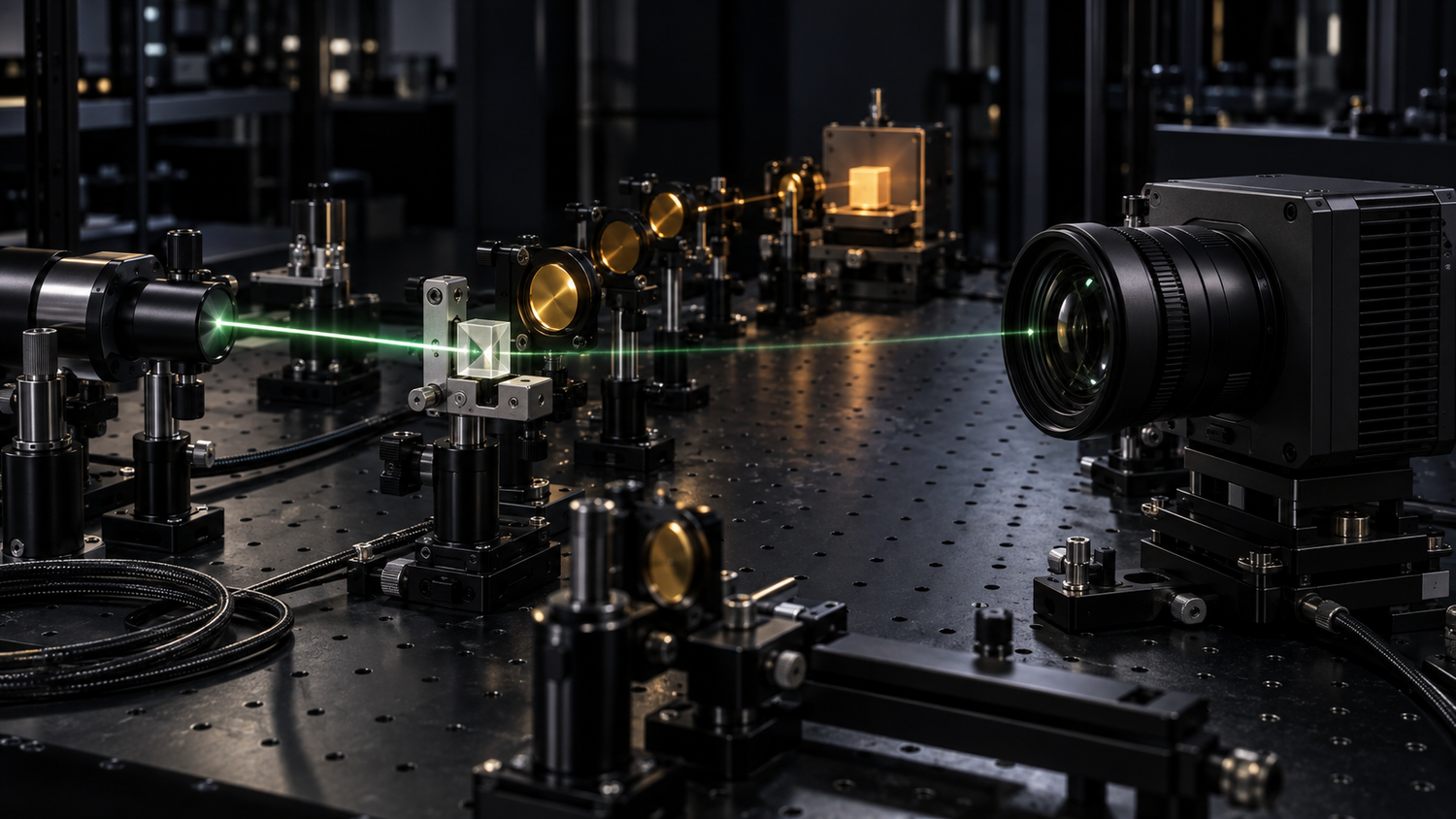
Thermal scopes, targeting pods and infrared search systems configured to work in the dark by reading the long-wavelength light warm objects give off depend on detectors that can read that light, and those detectors are among the most expensive and tightly controlled components in the sensing world. A team at Imperial College London has now demonstrated wide-field imaging across 6 to 10 micrometers, deep in the thermal infrared, using a specialized Peltier-cooled silicon scientific camera rather than a cryogenically cooled infrared focal-plane detector. The infrared light that probes the scene is never detected at all. The camera records visible light that stayed inside the instrument, and quantum interference carries the infrared picture across.
In a paper posted to arXiv on August 20, Vladimir Kornienko, Nathan Gemmell, Caiyi Liu, Asteria Chen, Chris Phillips and Rupert Oulton report images with more than 8,000 resolvable elements at a wavelength of 8 micrometers, acquired in as little as 10 seconds, at room temperature, with an imaging performance the authors place roughly 100 times beyond the background-limited infrared photodetection limit that constrains conventional thermal cameras. In the experiment, the silver-thiogallate nonlinear crystal was pumped with 50 milliwatts of continuous-wave laser light, and a cooled silicon scientific camera recorded a band it would be blind to if that infrared light ever reached it.
The technique is called quantum imaging with undetected photons, and its defense interest is easy to state. The mid- and long-wave infrared is where military sensing lives: it is the band of thermal signatures, of missile plumes, and of the molecular absorption lines that identify a chemical across a distance. Reading that band today means cooled semiconductor detectors with cryocoolers attached. A route that eliminates the cryogenically cooled infrared focal-plane detector, while retaining a specialized cooled visible camera, changes the cost and logistics arithmetic of instruments built on it.
The photons that never come back
The underlying physics was demonstrated in 2014, when Anton Zeilinger's group in Vienna published a Nature experiment showing that an object could be imaged with light that never touched the camera. A nonlinear crystal, pumped by a laser, produces photons in correlated pairs: one visible photon, called the signal, and one partner at a longer wavelength, called the idler. In the Vienna interferometer, a pair could be born in either of two crystals. The idler from the first crystal passed through the object and was overlapped with the possible idler from the second crystal, while the visible signal photons were combined at the camera. Because the two possible histories could not be told apart, whatever the idler learned about the object appeared in the visible-photon interference pattern. The idler was then simply discarded. The folded Imperial setup instead sends the idler through the object on a double pass. As the Vienna authors put it, knowledge can be extracted by, and about, a photon that is never detected.
For a decade the practical catch was scale. Demonstrations probed the near infrared or covered fields of view too small to call imaging in any operational sense. The Imperial team's contribution is to push the undetected wavelength deep into the thermal band while keeping a wide field. Their silver thiogallate crystal is phase-matched non-collinearly, meaning signal and idler leave the crystal at an angle to the pump, and that geometry lets the instrument support thousands of independent spatial modes at once across a circular field of view roughly 30 millimeters wide. At 8 micrometers they measure a resolution of 297 micrometers and count over 8,000 resolvable elements in a single image. A holographic readout scheme collapses what previously took a half hour of phase scanning into a 10 second single-frame acquisition. Every one of those infrared photons goes unrecorded; the silicon camera sees only their visible partners, at wavelengths where silicon sensors are at their best.
Quantum pillar: sensing (imaging in low light). Use posture: dual-use. Technology readiness: TRL 4 of 9. The Imperial team assembled a complete wide-field infrared imaging interferometer and validated it on test targets under laboratory conditions, with no realistic scene, standoff range or field trial demonstrated yet.
What the thermal band costs today
To see why a program office should care, look at what reading this band currently requires. The emission from objects at everyday temperatures peaks within the 8 to 14 micrometer atmospheric window, and high-performance imaging there or in the neighboring mid-wave band has meant photon detectors made from narrow-gap semiconductors such as mercury cadmium telluride, held at cryogenic temperatures by an integrated cooler. Industry guidance on choosing between the infrared bands is blunt about the consequences: cooled architectures carry higher acquisition costs, added weight and power, and a cryocooler that needs regular servicing through its life. Vendors of long-range surveillance systems make the same point from the other side, marketing uncooled long-wave cameras precisely on the absence of cryocooler maintenance and replacement cycles. The uncooled alternative, the microbolometer, trades away sensitivity and speed to escape the cooler. That trade space, cooled and costly against uncooled and slower, has framed thermal imaging procurement for thirty years.
The Imperial result sketches a third corner. Detection moves to a specialized visible-band silicon camera, Peltier-cooled but not cryogenically cooled like an infrared focal-plane detector, and inherits two decades of investment in visible-band sensors. Because the measurement is interferometric, ambient thermal glow does not blind it. Conventional photon detectors staring into the 6 to 10 micrometer band face detector-originated noise and thermal flux from the scene: cooling suppresses the detector noise, but the scene background can saturate even a cooled detector. Uncooled microbolometers also detect this band, with the sensitivity and speed tradeoffs described above. The undetected-photon arrangement registers only photons correlated with its own source, which is how it lands 100 times past the background limit at room temperature. The band the team chose matters as well. Those wavelengths span the molecular fingerprint region, where compounds absorb at characteristic lines, and the instrument is spectrally selective by construction. The applications the authors name, chemical sensing, materials analysis and label-free biological imaging, translate in a defense setting into standoff chemical identification and the inspection of materials and coatings that reveal themselves only in the thermal band.
One more number deserves attention. The infrared light actually illuminating the object totals about 0.2 picowatts, roughly a millionth of a millionth of a flashlight. Imaging at that level is photon-starved almost by definition, and it represents very low emitted probe power, whose detectability against realistic surveillance sensors was not tested. Who gains from all this is genuinely dual-use: the same physics serves a hospital microscope, a semiconductor inspection line, a chemical-weapons inspector's bench and an ISR payload designer, and nothing in the published work points it at one user over another.
Between a foil mask and a fielded sensor
The distance from this bench to a program of record is real, and worth stating precisely. The demonstration is active imaging: the instrument supplies its own infrared illumination and reads what comes back, so it answers a different question than the passive thermal imagers on rifles and turrets that read a target's own emitted heat. Nothing here images a warm vehicle at a kilometer. The objects were shadow masks cut in thin metal foil, positioned within the instrument's own optical path, across a field of view that fits in a palm. Resolution of 297 micrometers suits microscopy and bench inspection, and the authors note that the number of usable spatial modes falls as the probed wavelength grows longer, so the deepest infrared costs the most image detail. High-fidelity multi-frame imaging still takes tens of minutes, with the 10 second figure belonging to the single-frame holographic mode. The paper is also new to arXiv and has peer review ahead of it.
What the result does establish is that wide-field imaging in the 6 to 10 micrometer band with cooled infrared detectors removed from the chain is now a laboratory fact, with numbers attached. The watch items for a defense reader follow directly. A video-rate demonstration would open real-time inspection. Imaging of actual chemical samples with spectral discrimination, rather than metal masks, would move the fingerprint-region promise from implication to evidence. Any demonstration at meters of standoff would begin the conversation about fieldable geometry. Whether removing the cryogenically cooled infrared focal-plane array changes procurement or export-control logic will require a full component and cost analysis of a system that, in this demonstration, still uses a laboratory Ti:sapphire laser, a nonlinear crystal and a specialized cooled visible camera. A buyer does not need to act on this paper. A buyer does need to know that the assumption underneath thermal-band procurement, that serious infrared performance implies a cryogenically cooled infrared focal-plane detector, now has a published, quantified exception growing in a London laboratory.
Sources
Primary source: Vladimir Kornienko, Nathan Gemmell, Caiyi Liu, Asteria Chen, Chris Phillips and Rupert Oulton of Imperial College London, 'Wide-field mid- to long-wave infrared imaging with undetected photons,' arXiv:2608.20015, August 20, 2026. Other material from Lemos et al., Nature 512, 409 (2014), and infrared-camera industry guidance from LightPath Technologies and Infiniti Electro-Optics.