Arda Atomics Builds a Nuclear Magnetic Resonance Gyroscope to Find North for Radars Without GPS, Announced 15 October 2026 Under SPRIND's Quantum-Driven Intelligence Funke With HENSOLDT, TRL 4
Quentir Defense Monitor
Evidence-based insights for quantum defense and security. Published by Quentir Systems LLC · October 19, 2026.
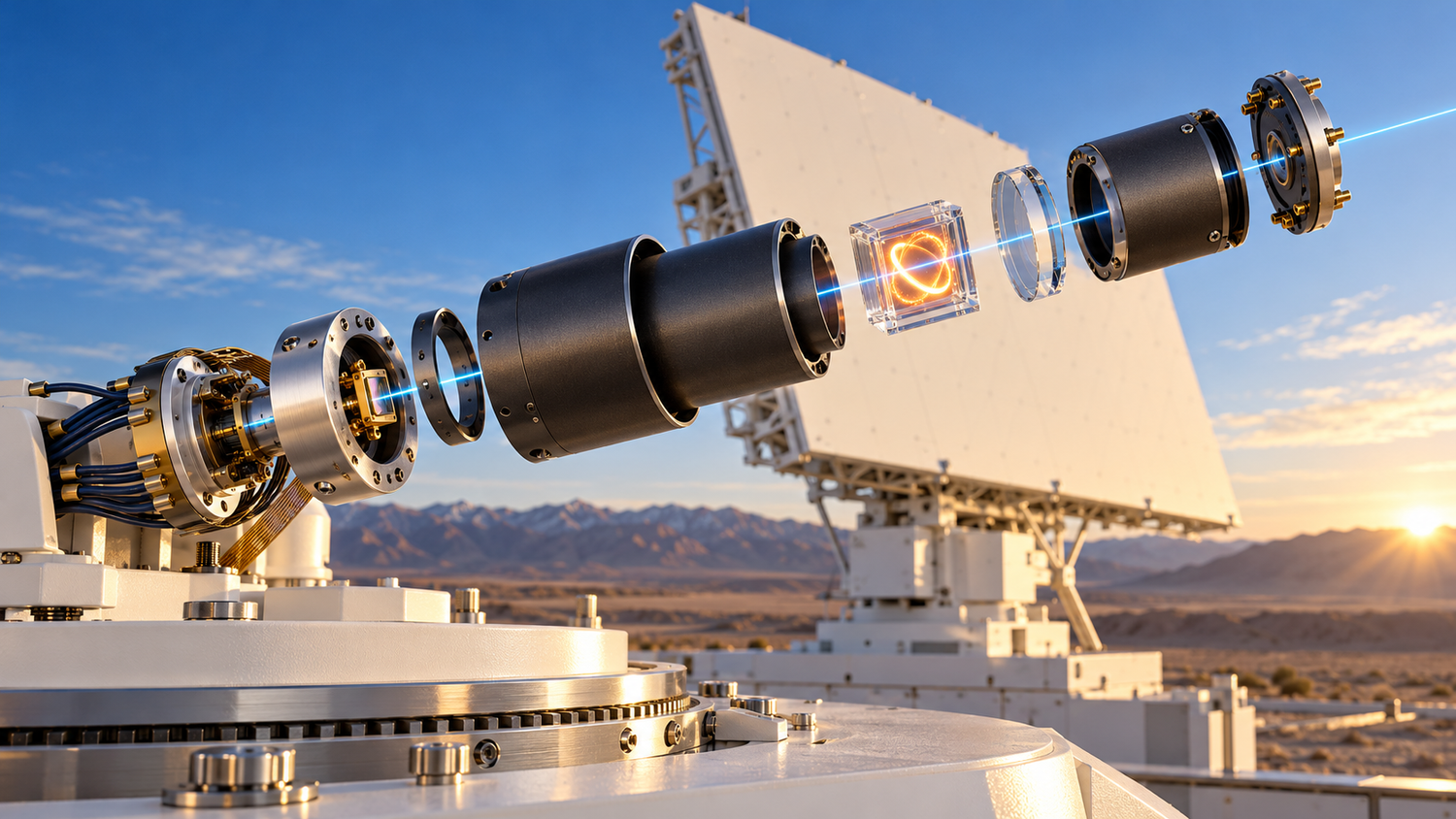
On October 15, 2026, Arda Atomics, the Stuttgart quantum sensing subsidiary of the laser group TRUMPF, said it is developing a nuclear magnetic resonance gyroscope that lets a radar or air-defense system find geographic north without any satellite signal, inside the Quantum-Driven Intelligence funding round of Germany's Federal Agency for Disruptive Innovation, SPRIND. The company is working with the radar maker HENSOLDT to define what performance such a sensor must reach to beat the inertial and satellite methods air-defense radars rely on today, and it says precise north alignment of a mobile system can currently take several minutes.
Every radar that tracks a drone or a cruise missile reports the target's bearing relative to its own orientation, so a radar that does not know where north is produces tracks that cannot be shared, handed off or fused. A sensor that measures the rotation of the Earth directly, and derives north from it with no outside reference, would take that dependency on satellite navigation off the table for every mobile sensor in a force. This post reads what the company statement, the funding page and the laboratory and space trail behind it establish for a program office.
What Arda Atomics announced on 15 October 2026: a north-finding quantum gyroscope for radars, with HENSOLDT, under SPRIND's Quantum-Driven Intelligence funding round
The announcement, carried by the German defense trade site Defence Network and attributed to Arda Atomics as source, frames the problem plainly. Modern air defense begins with the question of where north is, because only a radar that knows its position and orientation exactly can detect and track an object and classify the threat correctly. Today that north alignment comes from satellite navigation or conventional inertial sensors. Electronic warfare can jam or spoof the first, and the second drifts over time or needs elaborate calibration. Arda Atomics proposes a third route: a nuclear magnetic resonance gyroscope, or NMRG, that measures the Earth's rotation and determines geographic north from it. The Earth itself becomes the reference.
Two goals are stated. The first is independence from GPS, so a radar can be aligned when no external navigation signal is available. The second is time to readiness. Managing director Jan Thiele says a quantum gyroscope could shorten the minutes a precise north alignment takes today, which for a mobile battery means the system is operational sooner and detects threats earlier. Inside the SPRIND project, Arda Atomics and HENSOLDT are analyzing real deployment scenarios of radar and air-defense systems to set the performance a quantum gyroscope has to reach before it adds value over current solutions.
The funding vehicle is specific. SPRIND's Quantum-Driven Intelligence Funke is a six-month competition that began on September 20, 2026 with up to 15 teams, each receiving up to 200,000 euros in its first stage; after four months a jury selects up to ten teams for a second two-month stage worth up to 100,000 euros each. The call asks teams to show how quantum sensing improves an existing system or analysis by combining a quantum sensor's data with other sources, and it lists security systems among the application areas. SPRIND's page lists thirteen teams, Arda Atomics among them. The sums are small by defense-program standards, so what the round buys is a requirements study and a demonstrator.
Quantum pillar: sensing (inertial navigation and PNT). Use posture: defensive. Technology readiness: TRL 4 of 9, Quentir's assessment of the laboratory instrument. The gyroscope exists as laboratory hardware whose VCSEL-pumped version matched its reference lasers on the bench, while the radar north-finding function announced here has no published test against a real system yet.
How a nuclear magnetic resonance gyroscope finds north: xenon spins in a MEMS vapor cell, a VCSEL at 795 nanometers and the QYRO CubeSat due in 2027
The physics is older than the company. Rotation is sensed through the precession of nuclear spins, in practice two isotopes of xenon held in a small glass cell with rubidium vapor. A laser polarizes the rubidium, the rubidium polarizes the xenon nuclei, and a magnetic field sets those nuclei precessing at a frequency fixed by natural constants. When the cell rotates, the measured precession frequency shifts by exactly the rotation rate, and the two xenon isotopes let the instrument cancel the magnetic field it cannot otherwise distinguish from rotation. That is the same two-species trick Quentir described when a cold-atom comagnetometer reached a fitted 60-second spin-coherence time, with xenon in a warm cell instead of ytterbium in an optical lattice. The vapor-cell approach needs no cryogenic cooling, and its scale is fixed by natural constants rather than by calibration.
The company's public hardware trail runs through space rather than through radar. In a press release of January 30, 2026, the Ferdinand-Braun-Institut in Berlin described the QYRO project, in which Arda Atomics, founded in January 2026 as a TRUMPF spin-off and successor to Q.ANT's atomic gyroscope work, acts as system integrator. FBH supplied 795-nanometer VCSEL lasers as pump and probe sources, TRUMPF's photonics unit packaged them for space, and Bosch Research built the MEMS vapor cell holding the rubidium and xenon along with the signal processing. The institute reports that the VCSEL-based gyroscope reached the same sensitivity as the bulkier distributed-feedback reference laser modules, at higher optical efficiency and lower power, which is what allows a compact sensor. The planned flight payload is to fly on a CubeSat in a mission the DLR Galileo Competence Center launches in 2027. Laser-subsystem qualification and sensor vibration tests are complete, while final payload qualification and integration remain future work. DLR's project page puts the research budget at around 28 million euros, mostly from the federal research ministry, with the goal of validating the gyroscope against commercial reference systems in orbit.
That trail is what places the development on the ladder. The instrument is real and has been assembled and tested in a laboratory against reference hardware, which supports Quentir's assessment of the laboratory instrument at TRL 4. The north-finding radar function announced on October 15 sits behind that: no published figure for bias stability or angle random walk accompanies the announcement, no field test with a radar is described, and the HENSOLDT work is explicitly a requirements analysis. A buyer should read the announcement as a stated intent backed by a working laboratory instrument.
What a GPS-free north reference would let an air-defense force do, who gains from it, and what still separates the announcement from a program
Read as capability, the development is defensive in the sense the Monitor uses: it protects a force's own sensing by holding orientation when satellite signals are denied or spoofed. A fixed radar still has to know north to the accuracy of its own beam, and a mobile radar has to recover that knowledge every time it stops. A north error of one milliradian places a target one meter off for every kilometer of range, which at 100 kilometers is a 100-meter error in a shared track, and jamming the navigation signal that supplies the alignment degrades the whole sensor without touching the radar itself.
The arithmetic of gyrocompassing shows why the sensor's quality decides the outcome. The Earth turns at 15.04 degrees per hour, and the horizontal component a stationary instrument can use to find north shrinks with latitude: about 9.7 degrees per hour at 50 degrees north. To align to one milliradian at that latitude, the gyroscope's error must be below about 0.01 degrees per hour, and the drift that matters is the slow bias rather than the fast noise, because noise averages out over the alignment time while bias does not. That is the parameter the SPRIND study has to pin down, and it is the parameter the announcement does not yet give.
A public comparison point exists. At the Institute of Navigation's Joint Navigation Conference 2026, Northrop Grumman and its partners described a strategic-grade nuclear magnetic resonance gyroscope built under the Defense Innovation Unit's Transition of Quantum Sensors program against requirements from the US Air Force, Space Force and Navy. Its projected initial specifications are angle random walk below 250 microdegrees per root-hour, bias instability below 250 microdegrees per hour and scale factor instability below 0.5 parts per million, with an expected operating envelope of rotation rates to 500 degrees per second, 4 g acceleration tolerance and at least 250 hertz bandwidth, all with optical state preparation and readout using commercial lasers. If those specifications are achieved, one milliradian of north at mid-latitude would be reachable in seconds of averaging, and the bias would leave a margin of more than an order of magnitude. Those are the projected numbers a European buyer will hold up against whatever Arda Atomics publishes, and they mark the distance between a program stating projected specifications against written service requirements and a six-month round whose requirements study is still under way.
Who gains is clear enough. A German and European air-defense supply chain gets a domestic source of an atomic inertial sensor, with TRUMPF, Bosch and FBH behind the components and HENSOLDT defining the use. The same sensor serves satellites, aircraft and ships, so the dual-use market, including the 2027 CubeSat, is what makes the volume and price work for a defense buyer.
What separates the press statement from a program office relying on it is a short list. First, performance: a published bias instability and angle random walk for the current unit, and the north-finding accuracy and time-to-align measured on a real radar pedestal. Second, environment: an NMR gyroscope is sensitive to temperature and stray magnetic fields, and a radar pedestal is a hot, vibrating, magnetically noisy place, so shielding and thermal design decide whether laboratory numbers survive. Third, integration: HENSOLDT's role is a requirements study, and no contract, platform or integration date has been announced. Fourth, money: the SPRIND sums are hundreds of thousands of euros, so a production sensor needs a follow-on vehicle, whether a Bundeswehr program, a European Defence Fund call or a company decision. The sources establish a credible laboratory instrument, a clear operational problem, a serious radar partner and a funded six-month study. They do not yet establish a sensor that finds north on a radar in the field.
Sources
Primary source: Arda Atomics' announcement of October 15, 2026, as carried by Defence Network (CPM publishing group) with the statements of managing director Jan Thiele and the HENSOLDT collaboration. Other material: SPRIND's Quantum-Driven Intelligence Funke page (stage dates, team counts, funding, selected teams); the Ferdinand-Braun-Institut's press release of January 30, 2026 on the QYRO VCSEL-pumped NMR gyroscope; DLR's QYRO project page (budget, CubeSat mission, 2027 launch); the ION JNC 2026 abstract by Northrop Grumman, Freedom Photonics and the University of Wisconsin-Madison on the DIU Transition of Quantum Sensors gyroscope. The gyrocompassing arithmetic, the capability reading and the buyer questions are Quentir analysis.