Army Research Laboratory and University of Maryland Chain 21 Laser-Written Microresonators on One Glass Fiber Into a Topological Photonic Simulator, Nature Communications, 29 September 2026, TRL 3
Quentir Defense Monitor
Evidence-based insights for quantum defense and security. Published by Quentir Systems LLC · October 12, 2026.
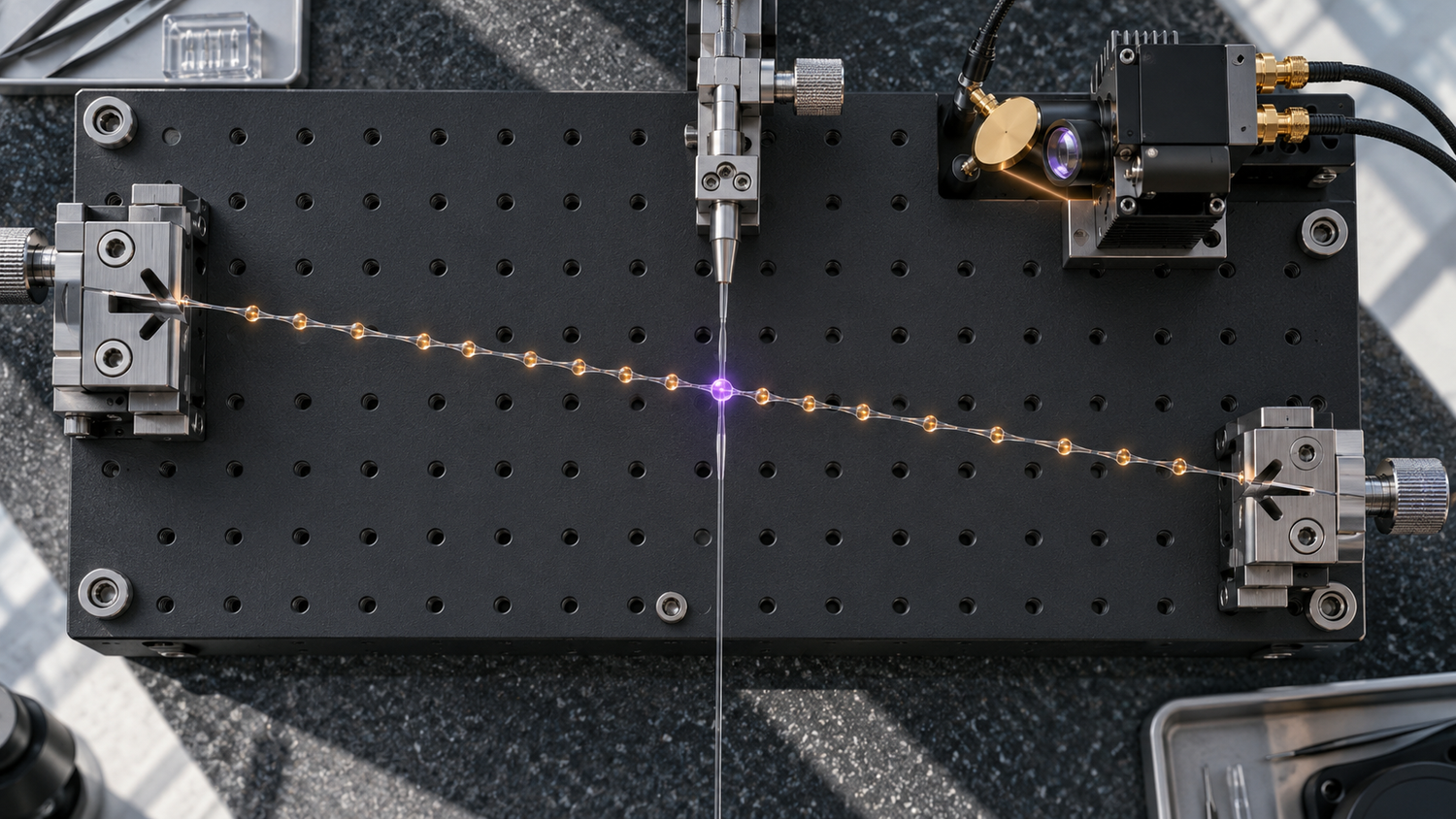
On September 29, 2026, Nature Communications published a paper by Nathaniel Fried, Dashiell Vitullo and Avik Dutt, working between the DEVCOM Army Research Laboratory in Adelphi, Maryland, and the University of Maryland in College Park. They wrote 21 microscopic resonators onto the surface of one standard glass fiber with a carbon dioxide laser and used the chain to simulate a topological insulator. In a separate ten-site SSH2 device, localized defects consistent with scattering, possibly from surface impurities, caused no notable edge-mode changes. The paper is open access, and the laboratory's public affairs office issued a release the same day that framed the work as fundamental quantum research with a path to lighter gear and more robust signals for soldiers. SAE Media Group's Mobility Engineering Technology carried a version of that release in the second week of October, which is how it reached the defense trade press and this lane's evidence pool.
Each laser-written bump traps light as a whispering-gallery resonator, neighboring bumps couple to one another, and the chain as a whole behaves like a one-dimensional crystal with two different internal patterns meeting at a domain wall. The authors used that chain to reproduce the band structure of Su-Schrieffer-Heeger lattices, the textbook route into topological photonics. This post reads the result as a simulation capability: what was built, how the chain simulates a material, what the Army says the platform is for, and how far the measured spectrogram sits from anything a program office could rely on.
What Fried, Vitullo and Dutt built in Adelphi and College Park: 21 laser-written resonators on one fiber, matched to about 40 picometers
The platform is called surface nanoscale axial photonics, or SNAP. A section of fused-silica fiber is exposed to 30 millisecond pulses from a 5 watt carbon dioxide laser. The heat lets the glass relax into a lower-stress state, which raises the fiber's effective radius in the exposed section by a few nanometers. That tiny dilation is enough to trap a series of optical modes along the fiber axis at that spot. Repeat the exposure at intervals of about 100 to 130 micrometers and the trapped modes of adjacent bumps overlap, so light can hop from one site to the next.
The paper is candid that the first exposure is unpredictable, since the stress release is inconsistent and the radius change after any single pulse cannot be forecast. What the platform offers instead is cheap correction. Each resonator can be characterized and then trimmed with further laser heat, the trim is local to that resonator and non-volatile, and once set it needs no power to hold. The authors contrast this with photonic integrated circuits made by planar lithography, which need active tuning elements and a continuous power draw to compensate for nanometer-scale fabrication error. Their figures for the fiber platform are propagation losses below 0.001 decibels per centimeter and intrinsic quality factors above one hundred million.
For the 21-site device, the fundamental modes of the resonators were equalized to within a standard deviation of about 0.5 nanometers in effective radius, which corresponds to about 40 picometers in resonance wavelength. The measured couplings between neighbors in the fifth axial mode family of the five-site device in Figure 3 were about 12 and 36 picometers, equivalent to 1.5 and 4.5 gigahertz, against design predictions of 8 and 30 picometers. The 21-site heterojunction was optimized around q=3, with detuning uncertainty comparable to its couplings. These measurements show the matching challenge for a usable simulator: the sites have to be low in loss and matched in frequency at the same time, a combination that chip-based photonic simulators find hard to reach without active control.
The measurement is a tapered optical microfiber laid across the sample at right angles, with the transmission through the taper read as a function of both wavelength and position along the fiber. The result is a spectrogram in which each resonator's modes appear as dips and the collective supermodes of the chain appear as bands.
How the chain simulates a topological insulator: Su-Schrieffer-Heeger lattices, a domain wall between two patterns, and edge modes unchanged by localized defects in the ten-site SSH2 device
The Su-Schrieffer-Heeger model is the simplest lattice with a topological phase. Sites are coupled by alternating strong and weak hops, and depending on which hop sits at the end of the chain, a mode either appears localized at the edge or it does not. That edge mode is protected by the structure of the bulk, which is why topological systems are of interest for routing light around defects. Fried, Vitullo and Dutt first built a five-site version with spacings alternating between 125 and 100 micrometers, fitted its spectrogram to a tight-binding model, and used the fitted parameters to design the larger device.
The larger device is the paper's main contribution. Twenty-one frequency-matched resonators form a junction between a two-site-per-cell lattice, with spacings of 100 and 125 micrometers, and a four-site-per-cell lattice with spacings of 100, 105, 100 and 130 micrometers. The authors call this a heterojunction, borrowing the semiconductor term for an interface between two materials, and they note that junctions between higher-order lattices of this kind had not been well studied in theory. Reading the result required a generalized method, built around what the paper calls sublattice displacements, a local and basis-independent quantity that reduces to the familiar winding number and Zak phase for the two-site case. One of the method's findings is cautionary: an interface between two lattices can host modes that look topological in the spectrogram and are in fact artifacts of how the interface was implemented.
The most useful single observation for a defense reader is a small one. The measured spectrogram of the ten-site SSH2 device in Figure 1 shows localized distortions at two positions along the fiber, consistent with scattering, possibly from surface impurities such as dust. The resonances that cross those positions show broadened linewidths. The edge modes do not change in any notable way. That is the property topological photonics is sold on, observed on a glass fiber with localized defects whose cause remains uncertain.
Quantum pillar: simulation (materials and energetics). Use posture: dual-use. Technology readiness: TRL 3 of 9. The work is an experimental proof of concept on real hardware, a single 21-site fiber device characterized on an optical bench that reproduces abstract lattice models rather than any specific material of defense interest, with no packaged instrument, no environmental testing and no demonstration of the navigation or communications uses the Army release describes, which is the third rung of the shared ladder.
What the Army says the platform is for, and what the paper itself tests: resilient fiber networks, GPS-free quantum navigation and materials simulation
The release quotes Vitullo on three future uses: military networks with faster and more resilient communications, future quantum navigation sensors that do not rely on GPS, and a foundation for simulating advanced materials that are hard to model by other means. It adds a size, weight and power argument, since the fiber devices need no cooling and no vacuum chamber, and it places the work in a laboratory quantum program running since the early 1990s that led to ARL's 2023 designation as one of four Army Quantum Information Science Research Centers.
The paper tests exactly one of those three. Its stated purpose is analogue Hamiltonian simulation, the use of an easily controlled physical system to mimic the Hamiltonian of a harder one. Here the simulated systems are topological insulator models, and the light used to probe them is ordinary classical light from a tunable laser. Nothing in the paper exchanges a quantum state, distributes a key, or measures acceleration or rotation. The communications and navigation claims are the laboratory's reading of where a low-loss, trimmable, room-temperature resonator chain could be useful next. The paper's own closing direction is nonlinear optics and synthetic dimensions, in which the frequency or angular momentum of light stands in for extra spatial dimensions.
That gap between release and paper is normal for a laboratory press office, and it is why the readiness panel above places the work on the third rung. A reader who wants the navigation story should look where it is being tested on real platforms. Quentir's earlier survey of quantum navigation leaving the bench covers atom interferometers and magnetic navigation flown on aircraft and ships, a different maturity from a spectrogram of a fiber. The same laboratory's diamond clock work with UC Berkeley, covered in this lane earlier, shows how ARL tends to publish: a fundamental result first, with the field application stated as a direction rather than a demonstration.
Who gains from an open fiber simulator, and what stands between a bench spectrogram and a program office
The posture reading is dual-use, for a plain reason. The paper is open access, the arXiv preprint has been public since January 8, 2026, and the fabrication route needs a carbon dioxide laser, standard telecom fiber and a tapered microfiber probe. Any photonics group with that equipment can reproduce the device, and the methods section is written to allow it. The value the Army describes is defensive in character, since more robust signals and GPS-independent navigation are about holding one's own capability under interference, while the materials-simulation value serves civil and military users alike. No adversary is disadvantaged by this publication and none is excluded from it.
What the result would let a force do, if the downstream claims hold, is carry light-routing components that keep working when the fiber is bent, dirty or imperfect, with no active tuning and no power draw to maintain the configuration. The localized-defect observation in the ten-site SSH2 device is the first small piece of evidence for tolerance of imperfections, with surface impurities only a possible cause. What it lets a research establishment do today is run topological lattice models on a bench at a fraction of the cost of a lithographic photonic chip, which is the use the paper actually demonstrates and the reason this post files it under simulation.
Between the published spectrogram and a procurement decision, several things still stand. The device is a single one-dimensional chain measured by a microfiber held against it; there is no packaging, no fiber-pigtailed input and output, and no account of how the resonators hold their trim under temperature cycling or vibration, the conditions a vehicle-mounted component meets first. The simulated models are textbook lattices rather than any propellant, armor or structural material with a defense application, so the materials-simulation claim describes a platform rather than a result. The heterojunction analysis carries its own warning that some interface modes can be artifacts, so the method for reading these devices is still being built alongside the devices. And the navigation and communications applications have no experimental content in this paper at all.
For a program office, the practical read is that SNAP is a low-cost, trimmable simulator platform with a credible first topological result from a laboratory with a long quantum program and a CRADA with the University of Maryland behind it. The work, funded through the NSF CAREER award, the NSF QuSeC-TAQS program, the NSF-DEVCOM INTERN program and the Department of Defense SMART scholarship, is early and honest about its own uncertainties. The developments to look for next are a nonlinear or synthetic-dimension result on the same fiber, a packaged device with environmental data, and a sensing demonstration that uses the chain rather than merely describes one.
Sources
Primary source: Nathaniel Fried, Dashiell L. P. Vitullo and Avik Dutt (DEVCOM Army Research Laboratory, Adelphi, Maryland, and the University of Maryland, College Park), "Multiband topological heterojunctions on the surface nanoscale axial photonics platform," Nature Communications 17, 10071, published September 29, 2026, open access, https://www.nature.com/articles/s41467-026-76041-1. Other material: DEVCOM Army Research Laboratory Public Affairs release of September 29, 2026 (army.mil article 295765); Mobility Engineering Technology (SAE Media Group) republication, October 2026; arXiv preprint 2601.05434, submitted January 8, 2026.