Creotech Quantum Signs a 2.33 Million Euro ESA Contract to Take Superconducting Nanowire Detectors for Satellite QKD Ground Stations to TRL 5 in 24 Months, Announced 21 September 2026
Quentir Defense Monitor
Evidence-based insights for quantum defense and security. Published by Quentir Systems LLC · September 23, 2026.
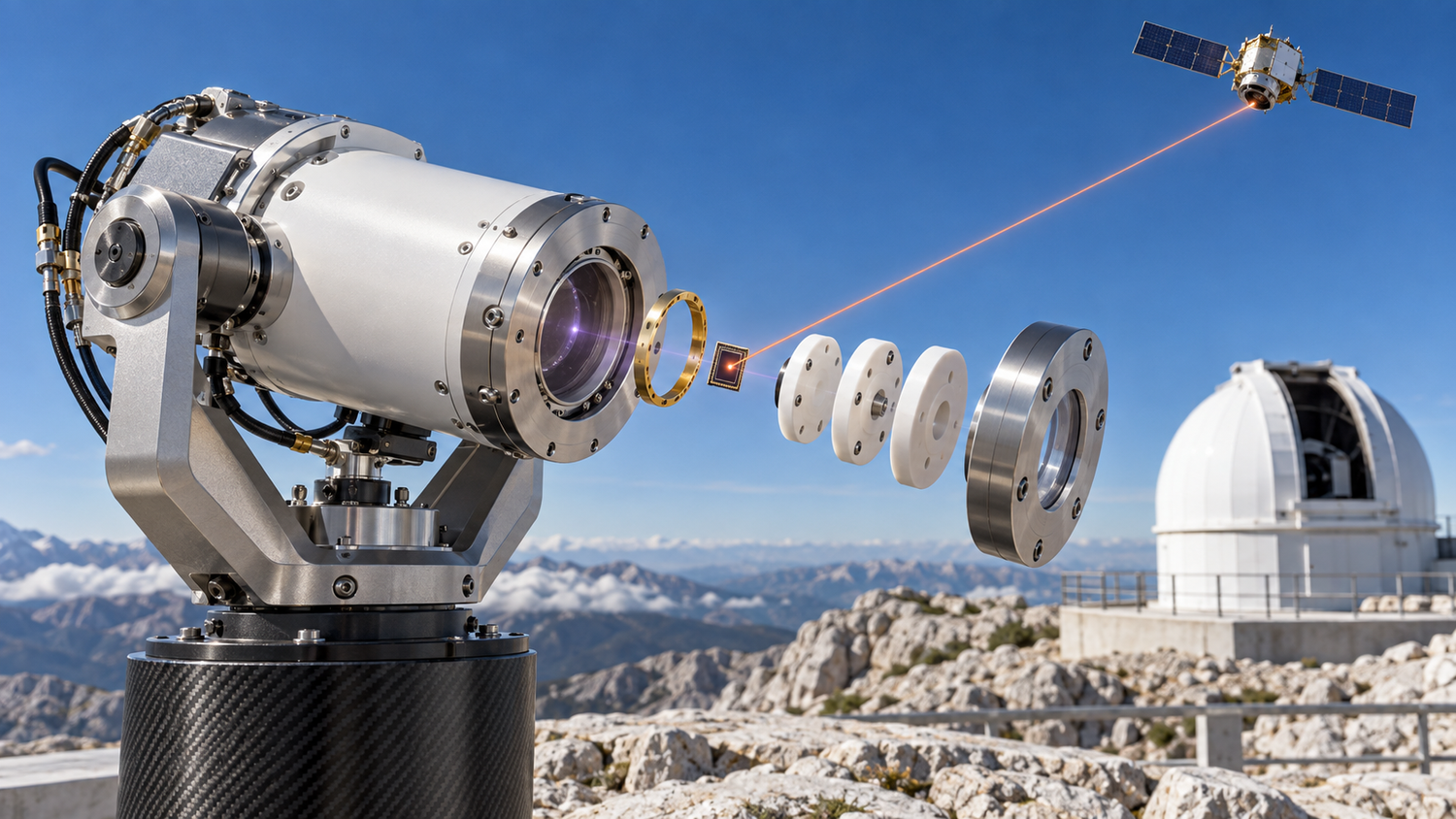
On September 21, 2026, Creotech Quantum S.A., a Warsaw Stock Exchange company spun out of the Polish satellite builder Creotech Instruments, announced a contract with the European Space Agency to design, manufacture and demonstrate a new generation of superconducting nanowire single-photon detectors for the ground stations that will receive quantum keys from satellites. The project's full title is "Single Photon Detector Based on Superconducting Nanowire (SNSPD) Technology for Laser Communication and Quantum Key Distribution (QKD) Applications," shortened to HRQKD. Its total value is 2.33 million euros, of which 1.2 million euros covers Creotech Quantum's own work. The project runs 24 months toward a detector demonstrated at Technology Readiness Level 5, meaning functionality shown in conditions close to the intended industrial use.
For a defense reader the interest is in where the money lands. Europe's satellite key distribution program has drawn most of its public attention to the space segment: the Eagle-1 satellite, its quantum payload, its launch. A key distributed from orbit is only as good as the receiver that catches it, and the receiver is the part of the link a ministry owns, sites, guards and maintains. The company's announcement is a procurement signal about that ground segment.
What Creotech Quantum announced with ESA on 21 September 2026: 2.33 million euros, a consortium lead, and a TRL 5 detector demonstrator in 24 months
The communiqué states the structure plainly. Creotech Quantum leads the consortium and is responsible for the detector's electronics and software, for testing, and for the product development strategy that follows the demonstration. The other consortium members do not appear in the release. The deliverable is a set of superconducting nanowire single-photon detector prototypes of very high sensitivity, demonstrated in conditions resembling their two target settings: ground stations that receive quantum signals from satellites for key distribution, and optical communication systems that must recover data from extremely weak light, with future lunar bases and outer solar system missions cited as examples.
HRQKD is the third ESA contract on this detector line. The first, announced by Creotech Instruments in February 2023 as the Quantum Key Distribution High Rate Detector Predevelopment, carried a total value of 799,128.07 euros, of which 399,734.58 euros went to Creotech as consortium leader, with the Technical University of Munich as partner. That release described the detector's primary role as a component of the future satellite key distribution network, with deep-space communication second. According to the September 2026 communiqué, the two earlier contracts produced proof-of-concept prototypes, and HRQKD exists to carry them to a demonstrator close enough to commercialization to enter European programs.
Anna Kamińska, the company's chief executive, framed the target market in the same release: the detector as a critical component for the space, telecommunications, defense and critical infrastructure sectors, with European programs such as IRIS² as the intended destination. That framing describes one component serving civil and military buyers alike, which is the posture reading below.
Why ground-station detector performance matters for Eagle-1, and how a nanowire counts single photons
Eagle-1 is a potential mission application for a receiver of this kind, but the available sources do not establish it as the destination of the HRQKD deliverable. The European Space Agency's Eagle-1 page describes it as the first European space-based quantum key distribution system, built by a consortium of more than 20 European firms led by SES, with Tesat Spacecom of Germany constructing the quantum key payload and SITAEL of Italy the satellite platform. The German Aerospace Center is upgrading an optical ground terminal for the mission and a Dutch team is developing a new one. Launch is due in late 2026 or early 2027, followed by three years of in-orbit validation that will supply mission data to the European Quantum Communication Infrastructure, the EU initiative for a sovereign quantum-secure network across the member states.
A satellite QKD downlink is an exercise in scarcity. The payload encodes key bits on individual photons, the beam spreads and scatters through the atmosphere, and the ground telescope collects a small fraction of what was sent during a pass lasting minutes. Whatever arrives must be counted one photon at a time, with few false counts and timing precise enough to match each detection to its pulse. A superconducting nanowire does this by holding a wire a few nanometers thick just below its superconducting transition; one absorbed photon breaks the superconductivity for an instant, and the readout electronics time-stamp the resulting voltage pulse. Quentir's Defense lane covered the state of the art in this detector class when NIST widened its nanowire detectors to 0.1 millimeter and cut dark counts by ten orders of magnitude; the HRQKD contract is about turning that class of physics into a receiver product with European ownership of its electronics and software.
Creotech also has a separate detector and QKD receiver role in a ground station under construction, making that project a potential field application for the detector technology being advanced under HRQKD, although the available sources do not establish that it will receive the HRQKD deliverable. In January 2026 the Polish research institute NASK began PIONIER-Q-SAT, a 9.9 million euro EuroQCI project running to mid-2029 that will build a mobile optical ground station for quantum key distribution with Eagle-1 and a cross-border link between Poland and Lithuania, with the Poznań Supercomputing and Networking Center, the Military University of Technology and Kaunas University of Technology as partners. Creotech's part, worth about 0.4 million euros, is the single-photon detector and QKD receiver, now to be delivered by Creotech Quantum. On the transmitter side, Quentir's blog read how ESA's QKDSat photon source passed space qualification in Valencia this month, so both ends of European satellite QKD links are being developed in the same season.
Quantum pillar: networking (satellite QKD). Use posture: dual-use. Technology readiness: assessed at TRL 5 of 9 as the contract target, pending demonstration against the governing readiness requirements. The item is a development contract announcement: its stated aim is a detector demonstrated in a representative environment within 24 months, and the earlier proof-of-concept prototypes it builds on have no published performance figures.
Who gains from a European nanowire receiver for satellite QKD: the dual-use reading for a program office
What a working receiver of this kind would let a force do is specific. A ministry or a deployed headquarters with a suitable optical ground station could take symmetric keys from a national or EU satellite pass without depending on terrestrial fiber it does not control, and could refresh the keys of its link encryptors from a source whose secrecy rests on measured photon statistics. A mobile station of the PIONIER-Q-SAT type extends that to a site chosen in the week of need. When integrated into a properly authenticated, validated QKD system, it can make useful later recovery of secret keys from recorded key exchange traffic more difficult, including for an adversary with a cryptanalytically relevant quantum computer. QKD does not prevent an adversary from recording classical traffic, and its security depends on authentication and sound implementation. Because the same detector serves faint-signal optical communication, the receiver that catches quantum keys can also catch high-rate optical downlinks from platforms whose radio bandwidth is exhausted.
The posture is dual-use in the sense of the Monitor's capability map. The detector protects the operator's own communications, which is defensive; the same component serves civil telecommunications under IRIS², the EU's secure connectivity constellation, scientific deep-space links and commercial optical ground stations, and the company lists all of these markets in one sentence. Nothing in the development offers an attacker a way into an adversary's links. The strategic gain lies in the supply chain: the satellite QKD ground segment of a sovereign network is only sovereign if the receiver's detector, electronics and software come from inside the bloc, and HRQKD is an explicit attempt to put a European vendor on that list.
What stands between a 24-month ESA development contract and a receiver a program office can rely on
The first gap is measurement. The announcement gives no detection efficiency, no dark count rate, no timing jitter and no operating wavelength for the existing prototypes or for the HRQKD target. Those four numbers set the secret key rate a ground station can extract from a satellite pass, and until Creotech Quantum or ESA publishes them the receiver cannot be compared with detectors already on the market. TRL 5 is a goal, and the communiqué describes it as one.
The second gap is the operating environment. A superconducting nanowire runs at a few kelvin inside a closed-cycle cryocooler, which is routine on an optics bench and a serious engineering matter in a container on a truck. A mobile station of the PIONIER-Q-SAT type would expose a receiver to vibration, power limits and field maintenance, and that project runs to mid-2029, but the available sources do not establish that it will deploy the HRQKD deliverable. The third gap is the satellite itself. Eagle-1 has not flown; its launch window is late 2026 or early 2027 and its validation campaign lasts three years. Moving from a detector component demonstrated in a representative environment to a station that can close a link with a real payload requires system integration and operational validation against the element's requirements and relevant environment. The pass schedule, cloud cover and daylight will decide how much key a single ground station can bank per week. Those constraints belong to satellite QKD as a class, which is why a buyer plans a satellite link as a supplement to terrestrial key delivery.
The fourth gap is the consortium. The release says who leads and what Creotech Quantum does, and nothing about who builds the nanowire chips, who supplies the cryogenics and who owns the resulting intellectual property. A buyer who cares about sovereignty of the European quantum key distribution supply chain will want that list before reading the project as a domestic capability.
What the sources establish is a funded, scheduled and scoped development: a European vendor with two prior ESA detector contracts, a separate ground-station role in a EuroQCI project, and now 2.33 million euros to reach a demonstrator by late 2028. What they do not establish is that the HRQKD deliverable is assigned to Eagle-1 or PIONIER-Q-SAT, any measured performance, any partner list or any flight-tested link. The results to watch for are a published detector specification from the HRQKD team, the first Eagle-1 downlink to a European ground station, and the PIONIER-Q-SAT mobile station's first key exchange between Poland and Lithuania.
Sources
Primary source: Creotech Quantum S.A., company communiqué of September 21, 2026, "Creotech Quantum liderem projektu dla nowej generacji bezpiecznej komunikacji kwantowej i optycznej," as published by Strefa Inwestorów, with statements by chief executive Anna Kamińska. Other material: the European Space Agency's Eagle-1 mission page; Creotech Instruments' February 2023 release on the QKD High Rate Detector Predevelopment contract with ESA and the Technical University of Munich; the European Commission's EuroQCI policy page; the European Commission's IRIS² secure connectivity page.