CSIRO Delivers Two Entangled-Photon Quantum Light Sources to Australia's Defence Science and Technology Group for an Intended Tamper-Evident Ground-to-Satellite Timing Link
Quentir Defense Monitor
Evidence-based insights for quantum defense and security. Published by Quentir Systems LLC · September 8, 2026.
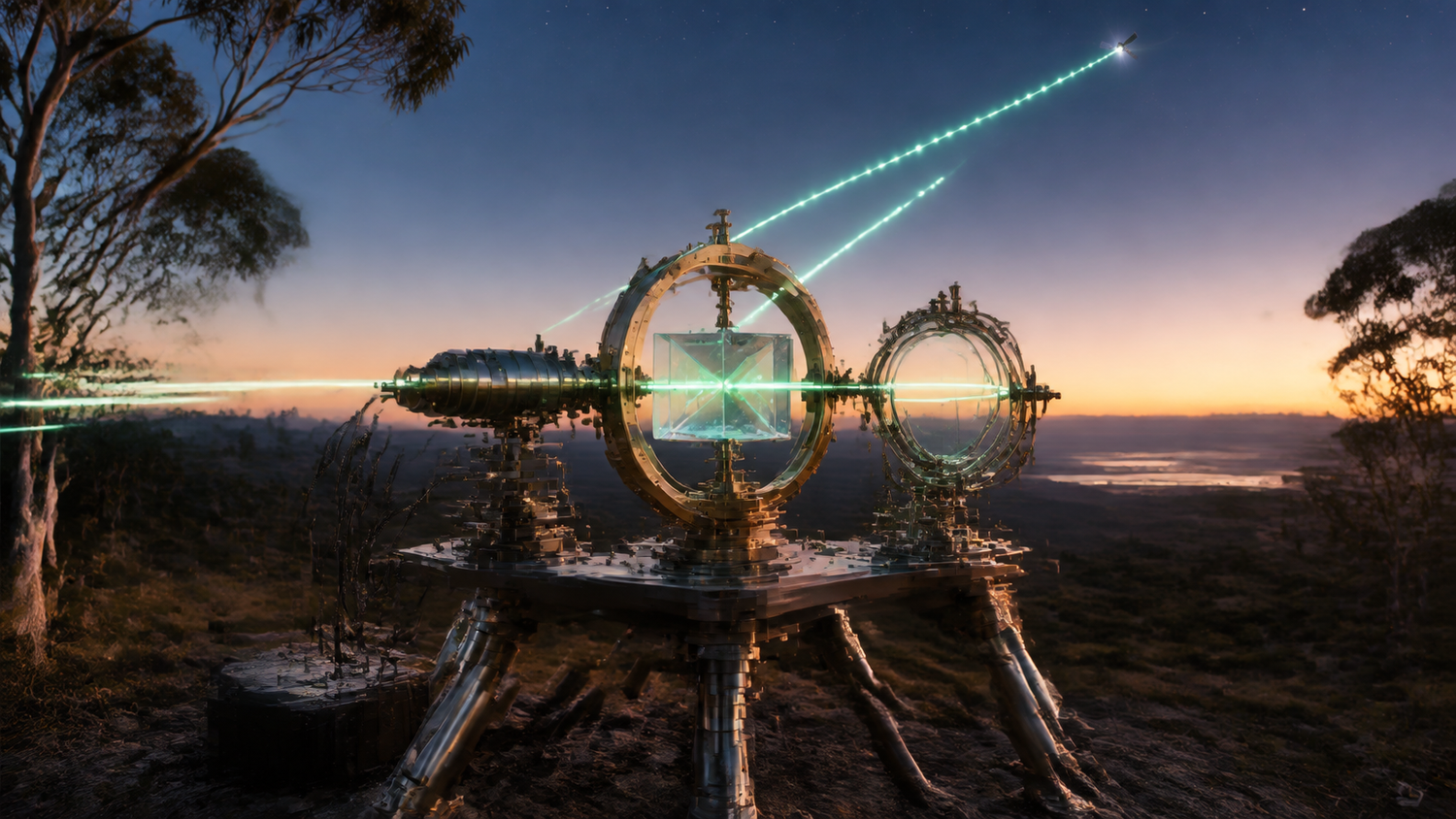
In July 2026, Australia's national science agency CSIRO announced the delivery of two portable entangled-photon devices, each called a Quantum Light Source, to the Defence Science and Technology Group in Adelaide. The devices are intended to address a problem most navigation coverage skips past: before a force can know where it is, its systems must agree on what time it is, and the time signal almost everything currently trusts arrives from the same satellite constellations that adversaries have learned to jam and fake. The CSIRO release describes a proposed link in which one photon of an entangled pair stays inside an optical ground station while its twin travels to a satellite payload hundreds of kilometers overhead. CSIRO claims that attempted interference would disturb the shared quantum state in a detectable way, but the delivery of the two sources does not establish an operational ground-to-satellite timing link or validate that claim end to end.
That intended physical tamper evidence is the capability being pursued. Conventional radio timing that lacks adequate signal authentication can be vulnerable to modification, replay, delay, or counterfeit signals, while properly authenticated protocols can reject some modification and replay attacks. CSIRO intends entangled photons to provide another means of detecting interference, but entanglement alone does not authenticate endpoints or make every imposed delay detectable, and the complete protocol would still require appropriate classical authentication. CSIRO's technical lead Dr Matt Broome called the delivery "a significant milestone in the development of quantum-secure time transfer in Australia," and the practical point of the milestone is that the source hardware now sits with a defense customer instead of remaining solely with its developer.
This briefing reads the delivery as a defense capability component: what the devices are, why authenticated time matters more to military networks than most position headlines suggest, how the approach differs from the holdover clocks and inertial sensors other programs are flying, and what still separates two delivered photon sources from a timing service a program office can rely on.
What CSIRO handed to the Defence Science and Technology Group: a glass-cube entangled-photon source engineered from Heriot-Watt University's laboratory design
Each Quantum Light Source is a high-flux generator of entangled photon pairs. Photons are produced inside an inner box, and a specialized glass cube takes oppositely travelling photon pairs and puts them into an entangled state. In the intended architecture, one photon of each pair remains at the ground station and the other rides an optical link to a satellite. CSIRO proposes comparing measurements on both sides as part of quantum time transfer, with disturbances to the expected correlations serving as evidence of interference once the complete protocol and link have been implemented and validated.
The design lineage runs through Heriot-Watt University in Scotland, whose source concept CSIRO set out to carry from the laboratory into fieldable form. The engineering claim in the release is about that packaging: the sources are described as compact and portable, ready for use outside a controlled optics laboratory, which is the step that separates a laboratory design from equipment a defense laboratory can put through trials. Australian Defence Magazine's report places the work inside a Defence Science and Technology Group led program on secure timing for satellite-denied environments, and adds the local context that jamming hardware, while illegal to operate in Australia, circulates through illicit channels, and that spoofing grows easier as software-defined radio tools spread.
What was delivered is the light source, and a light source is one element of a link. The release shows no satellite payload receiving those photons in orbit, no field trial schedule, and no figures for pair rate, link loss, or achievable timing precision. Those absences set the readiness level further down this page, and they are the honest shape of a program that has delivered a source component intended for a larger ground-to-satellite architecture.
Why authenticated time is the quiet dependency: the power grid, the banking system and encrypted military networks all sequence themselves on satellite clocks
Satellite navigation constellations are, functionally, atomic clocks in orbit; the position fix is computed from timing differences. That is why the civilian world's exposure runs through time as much as through place. Power utilities use satellite timing to synchronize phase measurements across a grid, banks use it to sequence transactions, and telecommunications networks use it to align their cells. The Cybersecurity and Infrastructure Security Agency states in its program for positioning, navigation and timing that nearly all critical infrastructure sectors rely on accurate PNT information. That reliance makes the integrity and availability of timing signals a critical-infrastructure concern.
The military dependency is tighter still. Frequency-hopping radios agree on hop timing before they can hear each other. Encrypted networks stamp and order their traffic. Coordinated sensors also depend on clocks that keep separated systems in step. A force whose time reference can be faked does not merely wander off its map; its sensors and communications degrade in ways that are hard to distinguish from equipment fault. GPS jamming and spoofing are current operational concerns, and Australian Defence Magazine reports that GNSS interference is occurring globally and that jamming devices remain available through illicit channels.
Quantum pillar: networking (network time synchronization). Use posture: defensive. Technology readiness: the photon-source hardware is assessed here at TRL 4 of 9, pending verification against the governing readiness rubric. The two sources were delivered and described by CSIRO as portable and ready for use outside a controlled optics laboratory, but the cited releases do not report the environment or results of validation testing, and the complete ground-to-satellite timing architecture has not been demonstrated with a payload in orbit.
How an entangled timing link differs from an encrypted one, and from the holdover clocks and inertial sensors other programs are flying
Most work on satellite-denied operation accepts that the external signal can be lost and builds independence from it. Chip-scale and optical atomic clocks let a platform hold accurate time locally through an outage. This Monitor has also covered two cold-atom clocks and a distributed radar network. Quantum inertial sensors do the same for position: the United Kingdom flew Infleqtion's cold-atom system and Tiqker optical clock on a QinetiQ RJ100 in May 2024, in flight trials funded with nearly 8 million pounds by UK Research and Innovation, toward a national goal of quantum navigation on aircraft by 2030.
The CSIRO approach addresses a different part of the problem. Holdover clocks drift, and a platform that free-runs for days eventually needs to resynchronize against something it can trust. CSIRO intends an entanglement-based link to help detect interference when trusted time is redistributed after contact is re-established. Establishing endpoint identity and protecting the accompanying classical communications would still require a defined authentication protocol. The two approaches could compose: local clocks ride through the outage, while a validated timing link supplies a shared reference after contact returns. That is what distinguishes this delivery from the alternative PNT programs it will be compared against, and it is why authentication and interference detection must be evaluated separately from accuracy. The field-hardening step matters for the same reason: entangled-photon sources have historically demanded laboratory conditions, though that boundary is moving in research elsewhere too, as when a sunlight-pumped source produced entangled pairs outdoors. Delivering two sources in transportable form is the specific engineering achievement a defense customer can now test.
What still stands between two delivered photon sources and a timing service the Australian Defence Force can rely on
Read as capability, the posture here is defensive. The intended gainer is whichever force can keep its networks synchronized and its infrastructure sequenced while an adversary works to corrupt the shared time reference, and the device offers its holder no corresponding way to degrade anyone else's signals. CSIRO frames the work as sovereign capability, meaning Australia would hold its own critical timing infrastructure rather than depending on foreign systems, a framing that matches the allied investment in quantum PNT visible in the UK trials above.
The distance to an operational service is real and worth stating precisely. Nothing public shows entangled photons from these sources closing a link with a satellite in orbit; the receiving payload, the optical terminals, the atmospheric loss budget, the endpoint authentication, and the complete timing protocol are all still to be demonstrated together. Daylight operation, weather and pointing stability decide how often such a link is actually available, and none of those figures has been published. There is no announced field trial schedule, no cost, and no integration path into existing ground station infrastructure. A program office should therefore treat this as what the evidence shows: a source component of an intended authenticated timing architecture, built to a deliverable standard, now in the hands of the defense laboratory whose job is to run trials. The questions to put to the program next are the availability figures under real sky conditions and the date of the first ground-to-orbit demonstration, because those two numbers will help determine whether authenticated quantum time transfer becomes a fielded layer of allied PNT resilience or remains an undemonstrated architecture.
Sources
Primary source: CSIRO, 'Using quantum entanglement to secure ground-to-satellite timing,' July 2026, including remarks by CSIRO technical lead Dr Matt Broome. Other material: Australian Defence Magazine's July 6, 2026 report; CISA's positioning, navigation, and timing program page; UKRI's May 2024 account of the Infleqtion Q-INS flight trials.