DAS Photonics' Faint Pulse Source Passes Space Qualification for ESA's QKDSat, Europe's Satellite Key Distribution Mission
Quentir Defense Monitor
Evidence-based insights for quantum defense and security. Published by Quentir Systems LLC · September 1, 2026.
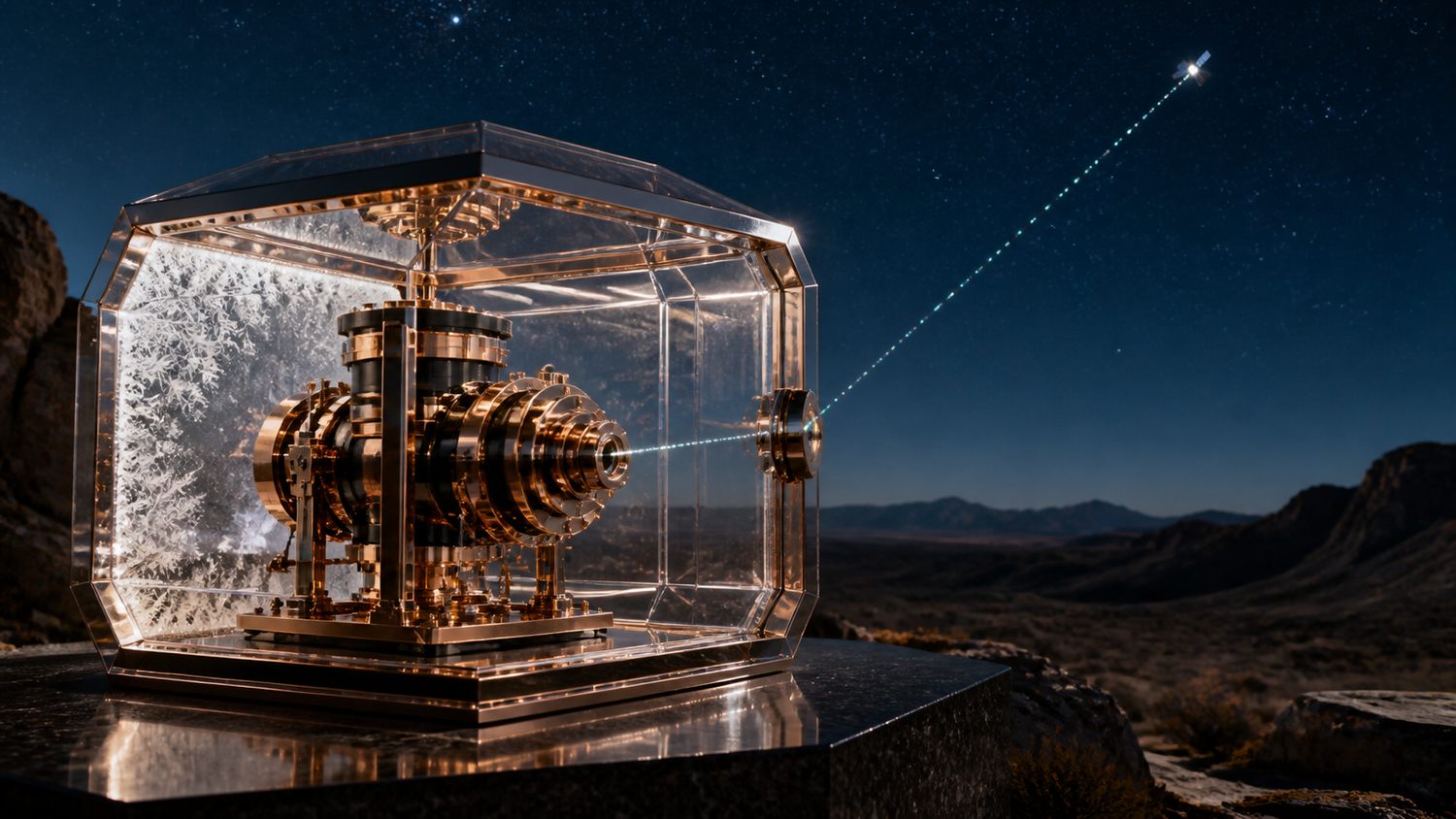
The optical heart of Europe's first pre-operational satellite mission for quantum key distribution has passed its space qualification. DAS Photonics, a photonic systems developer in Valencia and part of the Spanish EM&E Group, completed the qualification campaign of the Quantum Faint Pulse Source it designed for QKDSat, the European Space Agency mission that will distribute encryption keys from orbit, and handed the qualified engineering model to satellite prime contractor Redwire Europe for testing with the rest of the quantum payload.
ESA announced the milestone on September 1, 2026, through its Directorate of Resilience, Navigation and Connectivity. The Engineering Qualification Model went through functional and environmental testing against the requirements of the European Cooperation for Space Standardization, the ECSS rulebook that decides whether hardware is fit to fly. "Europe's future depends on trusted, secure communications, and space has a central role to play in delivering them," said Laurent Jaffart, who directs the Resilience, Navigation and Connectivity directorate. Marta Beltrán, Space Director at DAS Photonics, called the campaign a key milestone for the company and for European quantum-secure communications.
A pulse source sounds modest next to a full satellite, yet this subsystem is the component that makes the mission quantum at all. Every encryption key QKDSat delivers will begin life as a train of faint laser pulses prepared inside this unit, and every security property the mission claims will trace back to how faithfully those pulses are produced.
What a Faint Pulse Source Does On Board a Quantum Key Distribution Satellite
Quantum key distribution encodes the bits of a future encryption key on individual quantum states of light, usually single photons or laser pulses attenuated until they carry, on average, less than one photon each. The physics does the security work: measuring a quantum state disturbs it, so an eavesdropper who intercepts pulses in transit leaves a detectable trace. Sender and receiver compare a sample of what was sent against what arrived, estimate how much information could have leaked and either distill a clean key or discard the exchange. The strength of the method is that interception attempts show up in the error statistics before any key is put to use.
The Faint Pulse Source is the machine that prepares those states. In ESA's description, it generates faint optical pulses with the precise properties the key distribution protocol requires and carries built-in security protection mechanisms that support the mission's end-to-end security. The Spanish trade press adds an engineering detail worth holding on to: Infodefensa reports that the source is a software-focused design producing digitally adjustable pulses, so one flight unit can serve different protocol settings instead of freezing a single configuration into hardware. Attenuated-laser sources are the workhorse of practical QKD because they are far simpler to build and qualify than true single-photon emitters, and mature protocol techniques exist to close the openings that occasional multi-photon pulses would otherwise create.
Space matters here because of what optical fiber does to single photons. Photon loss in fiber grows exponentially with distance, and a quantum signal cannot be amplified along the way without destroying the states that carry the key, so conventional operational point-to-point terrestrial QKD links generally stay within a few hundred kilometers. A satellite trades all that fiber loss for one pass through the atmosphere and can connect ground stations separated by continental distances. That is the case for satellite quantum key distribution, and it is why Europe's route to long-range key delivery runs through a spacecraft rather than a longer cable.
Who Builds QKDSat: Honeywell Aerospace, Redwire Europe and Partners in Six States
QKDSat is an ESA Partnership Project led by Honeywell Aerospace under the agency's ARTES telecommunications effort. When Redwire won the satellite contract in April 2026, the company said it would build the spacecraft in Belgium on its Hammerhead platform with the ADPMS-3 avionics suite and design the QKD payload, while Honeywell in Canada develops the optical terminals. The industrial team spans six member and participating states, with British Telecom and Colt Technology Services attached on the network side. The DAS Photonics source is one subsystem of that payload, and its development was co-funded through an ARTES Industrial Competitiveness contract between ESA and the company.
The mission's stated job is pre-operational service, a phrase a buyer should read precisely. QKDSat is meant to demonstrate satellite-based key distribution for governments, critical infrastructure operators and commercial users, running close enough to a real service to expose the questions a fielded system must answer: how many keys per pass, at what availability, into which ground stations, at what cost per key. ESA's release gives no launch date, and the flight hardware still lies ahead of the qualified engineering model.
Quantum pillar: networking (satellite QKD). Use posture: defensive. Technology readiness: assessed at TRL 6 of 9, pending verification against the governing readiness rubric. An engineering qualification model of the flight design completed functional and environmental testing against applicable ECSS space requirements, while the flight model, payload integration, launch and key delivery through a real atmosphere all still lie ahead.
What ECSS Qualification of an Engineering Model Establishes, and What It Leaves Open
An Engineering Qualification Model is the build that proves a design rather than the unit that flies. A qualification campaign under ECSS subjects it to functional and environmental testing against applicable mechanical, thermal and vacuum requirements. Passing establishes something specific: the engineering model has completed functional and environmental qualification against the applicable ECSS requirements. It does not establish how the source behaves alongside the optical terminal, the payload computer and the pointing system, which is exactly the end-to-end testing the model now undergoes at Redwire Europe. Beyond that sit the flight model itself, integration on the spacecraft, launch and commissioning, and then the numbers that decide whether the service is real: secret key delivered per ground station pass, under real weather, with real background light.
Read as defense capability, satellite key distribution is a protection technology through and through. What it would let a government or a force do is refresh symmetric encryption keys between sites separated by thousands of kilometers without relying on couriers for each refresh or on quantum-vulnerable schemes such as RSA and elliptic-curve cryptography to establish those keys. QKD still requires an authenticated classical channel, bootstrapped through a pre-shared secret, PKI or another authentication mechanism. Who gains is whoever operates the ground stations and the spacecraft: the capability hardens the operator's own communications and enables no action against anyone else's systems, which is why this Monitor reads the posture as defensive rather than dual-use, even though the intended user base spans civil government, infrastructure operators and commercial carriers.
One architectural fact belongs in any procurement conversation about this class of mission. In a prepare-and-measure design, the spacecraft itself produces the key material that two ground stations later share, so the platform operates as a trusted node: the security of every delivered key rests on the integrity of the satellite and its supply chain, and the laws of physics protect the links, never the node. That is the context in which the embedded protection mechanisms ESA highlights in the DAS Photonics source earn their place, and it is why a program office evaluating satellite QKD should ask as many questions about payload custody, build provenance and on-board key handling as about photon counts.
Where QKDSat Sits Beside SAGA and EuroQCI in Europe's Secure Connectivity Build-Out
QKDSat is one piece of a larger European architecture. In October 2025, ESA signed a 50 million euro contract with Thales Alenia Space for the preliminary design of SAGA, the space segment of the European Union's planned quantum communication infrastructure, EuroQCI, which is intended to link national quantum networks across member states. QKDSat plays the nearer-term role in that picture: a single mission carrying key distribution to the pre-operational stage while the infrastructure effort defines what a constellation-grade service would require.
For a reader weighing this field, the value of September's milestone is its concreteness. Much of satellite QKD lives in road maps and design studies; a qualification campaign closed under ECSS discipline, with hardware physically delivered to a prime contractor, is a checkable event with an accountable supplier behind it. It also says something about the European supply chain: a subsystem design of this class, qualified through an engineering model with protection mechanisms built in, now exists at a company in Valencia, and the capability to produce such units is itself strategic ground in a field where China has flown quantum payloads since 2016.
What to watch next is equally concrete. The end-to-end payload campaign at Redwire Europe will show whether the qualified source performs within the full optical chain. A launch manifest entry would put a date under the mission. And the first published key rates from orbit, whenever they come, will turn QKDSat from an engineering story into a service a communications planner can price against couriers and crypto-agile networks. Each of those steps is public, checkable and worth a line in any quantum communications watch list.
Sources
Primary source: the European Space Agency's Directorate of Resilience, Navigation and Connectivity, announcing the Faint Pulse Source qualification for QKDSat (September 1, 2026), with statements from Laurent Jaffart of ESA and Marta Beltrán of DAS Photonics. Other material: Infodefensa's report on the DAS Photonics qualification (September 1, 2026); Via Satellite's report on Redwire's QKDSat spacecraft contract (April 2026); ESA's announcement of the SAGA preliminary design contract with Thales Alenia Space (October 2025).