QuINSiDa Lab Demonstration Targets Free-Space QKD, LiFi and Encryption for Harbors, Ships and Fiberless Sites
Quentir Defense Monitor
Evidence-based insights for quantum defense and security. Published by Quentir Systems LLC · August 31, 2026.
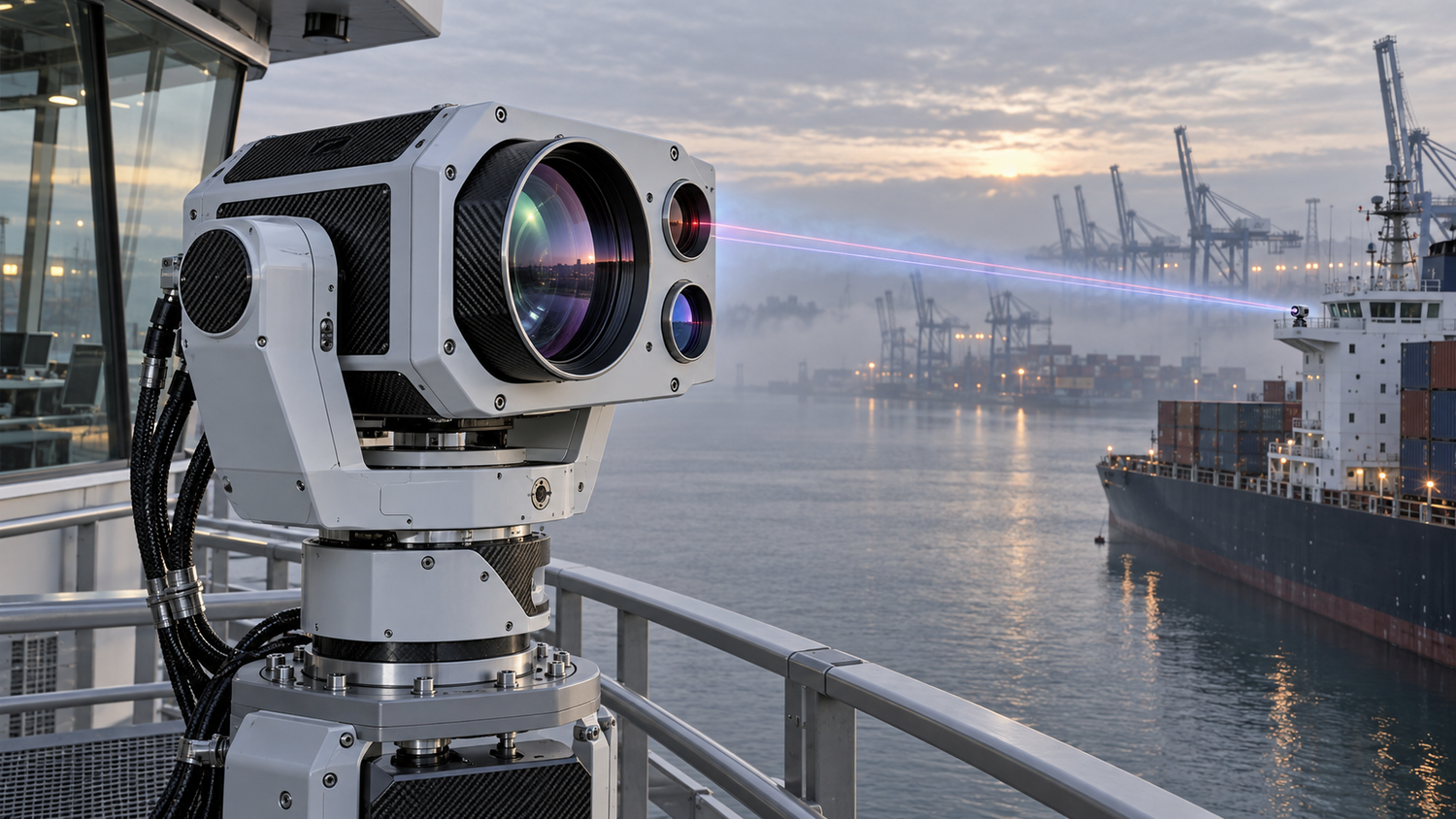
Two engineers at the Bavarian quantum security firm KEEQuant, Corentin Gut and Ulrich Eismann, published an account on August 31, 2026, in Laser Focus World of what their German research consortium built when it took quantum key distribution out of the fiber and into open air. The project is called QuINSiDa, six partners strong, and its laboratory demonstration in Fürth this May combined two different kinds of free-space quantum key distribution with LiFi broadband data transport, key management, encryption and network monitoring in a single working wireless stack. The German Federal Ministry of Research, Technology and Space funded the work under its Q-LAN initiative for local quantum communication networks.
The problem is mundane and stubborn. Fiber reaches most fixed infrastructure eventually, and it never reaches a ship at anchor, a vehicle on the move, a temporary command post or the far side of a harbor basin where trenching is impossible. QuINSiDa demonstrates how this integrated multi-vendor architecture can deliver encryption keys with the eavesdropping detection that quantum physics provides without requiring glass in the ground. Its answer is to send the keys by light through the air, along the same line of sight that carries the ordinary data traffic.
Three Wavelengths in One Line of Sight: What KEEQuant, Fraunhofer IPMS and Fraunhofer IOF Assembled
The stack runs three optical channels through one shared free-space environment without letting them disturb each other. KEEQuant, the consortium coordinator, adapted its commercial continuous-variable QKD devices, which work at the 1550-nanometer telecom wavelength, for operation over an open-air link instead of fiber. Fraunhofer IOF contributed a discrete-variable QKD system running at 810 nanometers, a second and independent key-distribution physics in the same architecture. Fraunhofer IPMS supplied the LiFi terminals in the 850-to-940-nanometer range along with the pointing, acquisition and tracking subsystem that finds the opposite terminal and holds the beams on it. Wavelength separation plus optical and spectral filtering keep the three channels apart. Around the optics, TELCO TECH integrated the encryption, Infosim brought the monitoring and network management workflows, and BESCom carried the use cases, so the result behaves like a communications system rather than a physics experiment.
The choice of the telecom band for the continuous-variable channel is the load-bearing engineering decision. Continuous-variable QKD builds on the component base of coherent optical communications: narrow-linewidth lasers, modulators, efficient photodiodes, coherent receivers and mature digital signal processing. That is the path to smaller, cheaper, manufacturable terminals. It also pays a physics dividend outdoors, because the coherent receiver's local oscillator acts as an extremely narrow spectral filter, making the detector selective against stray photons from sunlight, sky background and reflections, exactly the enemies of a quantum signal in open air. The authors add that KEEQuant has brought a QKD system onto photonic integrated chips and sells it commercially, which points toward terminals small enough for platforms with hard size, weight and power limits, and toward ruggedized, tamper-resistant housings for field use.
The Fraunhofer IPMS announcement of May 26, 2026 confirms the architecture, places the demonstration in the laboratory, and lists maritime operations, harbor infrastructure, industrial campuses, aviation and temporary secure networks as the deployment terrain.
Why a Harbor, a Ship and a Forward Site Would Want Encryption Keys Delivered by Light
Read as capability, the demonstration is about key logistics for places fiber cannot serve. Symmetric encryption is only as trustworthy as the delivery of its keys, and today keys reach fiberless sites by courier, by pre-loading before a platform departs, or by public-key exchange over radio, using either legacy algorithms threatened by quantum computers or post-quantum algorithms designed to resist them. A line-of-sight optical link that distributes keys with physical-layer eavesdropping detection gives a force an integrated multi-vendor option alongside existing free-space and satellite QKD approaches: fresh keys, delivered continuously, to a platform in visual range. In a correctly authenticated and characterized implementation, certain disturbances to the quantum states can reveal an intercept attempt. Riviera Maritime Media read the demonstration exactly this way, describing the consortium's system as a route to encrypted links between ships and shore antennas that needs neither fiber nor radio.
The optical medium itself carries a quieter military virtue. A narrow infrared beam between two terminals produces no radio-frequency emission for an adversary to detect, direction-find or jam from outside the beam path, and intercepting it requires access to that beam path. In a properly authenticated and characterized QKD implementation, certain resulting disturbances can be detected. LiFi in the same stack lets the protected data ride beside the keys. For harbor protection, pier-side replenishment, dispersed operations from temporary sites, or cross-campus links between secure buildings, the offer is quantum-secure communications that appear and disappear with the line of sight, leaving no cable to cut and no radio-frequency spectrum footprint to manage.
The posture reading is defensive. Everything this system does protects one's own traffic; it degrades no adversary system and senses nothing beyond its own beam alignment. The same equipment would serve any operator, civilian port authority or navy alike, and the value flows to whoever must keep confidential traffic confidential across a gap that fiber cannot bridge.
Quantum pillar: networking (quantum key distribution links). Use posture: defensive. Technology readiness: TRL 4 of 9. A complete multi-vendor stack of QKD, LiFi, key management, encryption and monitoring ran together in a laboratory demonstration, and outdoor range, weather endurance and certification testing all still lie ahead of it.
What the BSI and Three Partner Agencies Still Require Before QKD Guards Classified Traffic
A buyer weighing this demonstration should read it beside the joint position paper on quantum key distribution from Germany's Federal Office for Information Security, written with the French cybersecurity agency ANSSI, the Netherlands National Communications Security Agency and the Swedish NCSA. The four agencies conclude that QKD is suitable today only for niche use cases, that it is not yet sufficiently mature from a security perspective, and that the clear priority for the vast majority of users is migration to post-quantum cryptography and strong symmetric keying. Their reasoning bears directly on free-space systems: QKD requires authentication of its classical channel, which must itself come from post-quantum or symmetric cryptography, its range and infrastructure demands are severe, and no certification scheme yet exists under which a national authority would approve a QKD product for protecting classified traffic.
The QuINSiDa authors do not dispute this; their Laser Focus World piece places QKD inside a hybrid future alongside post-quantum cryptography, classical symmetric encryption and authentication, aiming at future cybersecurity certification. The honest frame for a program office is therefore layered defense for long-lived secrets. Post-quantum algorithms are the mandatory baseline that every network can adopt now; a quantum channel adds an independent physical layer whose security rests on different assumptions, for the small set of links where the data must stay confidential for decades and the infrastructure investment is justified. A line-of-sight optical stack lowers the second barrier, because it asks for two terminals and a clear view instead of a dedicated dark fiber, and the modular, standards-based interfaces the consortium demonstrated between five vendors' modules are precisely what a certification and procurement process eventually needs.
What the announcement does not supply are the performance figures that turn an architecture into a data sheet. Neither the article nor the press release states secret-key rates, achievable link distances, availability statistics or behavior under fog, rain, haze and turbulence, the standard adversaries of every free-space optical system. Those numbers exist for fiber CV-QKD and for other free-space trials; for this integrated stack they remain to be published.
What a Program Office Can Take From Fürth, and the Three Results Worth Watching Next
Three things stand established. First, interoperability: continuous-variable QKD, discrete-variable QKD, LiFi, key management, encryption and monitoring from six different organizations worked together through standard interfaces, which matters because single-vendor lock-in has been a persistent objection to quantum communication procurement. Second, coexistence: a 1550-nanometer quantum channel, an 810-nanometer quantum channel and a broadband LiFi band shared one optical environment under active beam tracking without mutual interference. Third, a manufacturing path: telecom-band components and photonic integration give continuous-variable QKD a credible route to terminals a platform integrator could actually house.
Three results would move this from a laboratory stack toward the readiness a fielding decision needs. An outdoor campaign across a real harbor or campus link, with key rates and availability published against measured weather, would establish the operating envelope. A demonstration on a moving platform, using the pointing and tracking subsystem against ship motion, would test the maritime use case the partners themselves put forward. And progress under the emerging European evaluation work on QKD implementation security would address the certification gap the four agencies identify. The consortium has put a genuinely integrated architecture on the bench with public provenance, federal funding and six accountable partners. The distance between that bench and a pier is now a matter of field trials, published numbers and certification, and each of those is checkable when it comes.
Sources
Primary source: Corentin Gut and Ulrich Eismann of KEEQuant GmbH, writing in Laser Focus World on free-space QKD connectivity, August 31, 2026. Other material: the Fraunhofer IPMS press release on the QuINSiDa demonstration (May 26, 2026); KEEQuant's project announcement; Riviera Maritime Media's maritime applications report (May 28, 2026); the joint BSI, ANSSI, NLNCSA and Swedish NCSA position paper on quantum key distribution.