DRDO Tests a Quantum Key Distribution Platform on the Live Network of the Proof and Experimental Establishment at Chandipur, 14 October 2026, to Secure Artillery and Armored Weapon Trial Telemetry
Quentir Defense Monitor
Evidence-based insights for quantum defense and security. Published by Quentir Systems LLC · October 14, 2026.
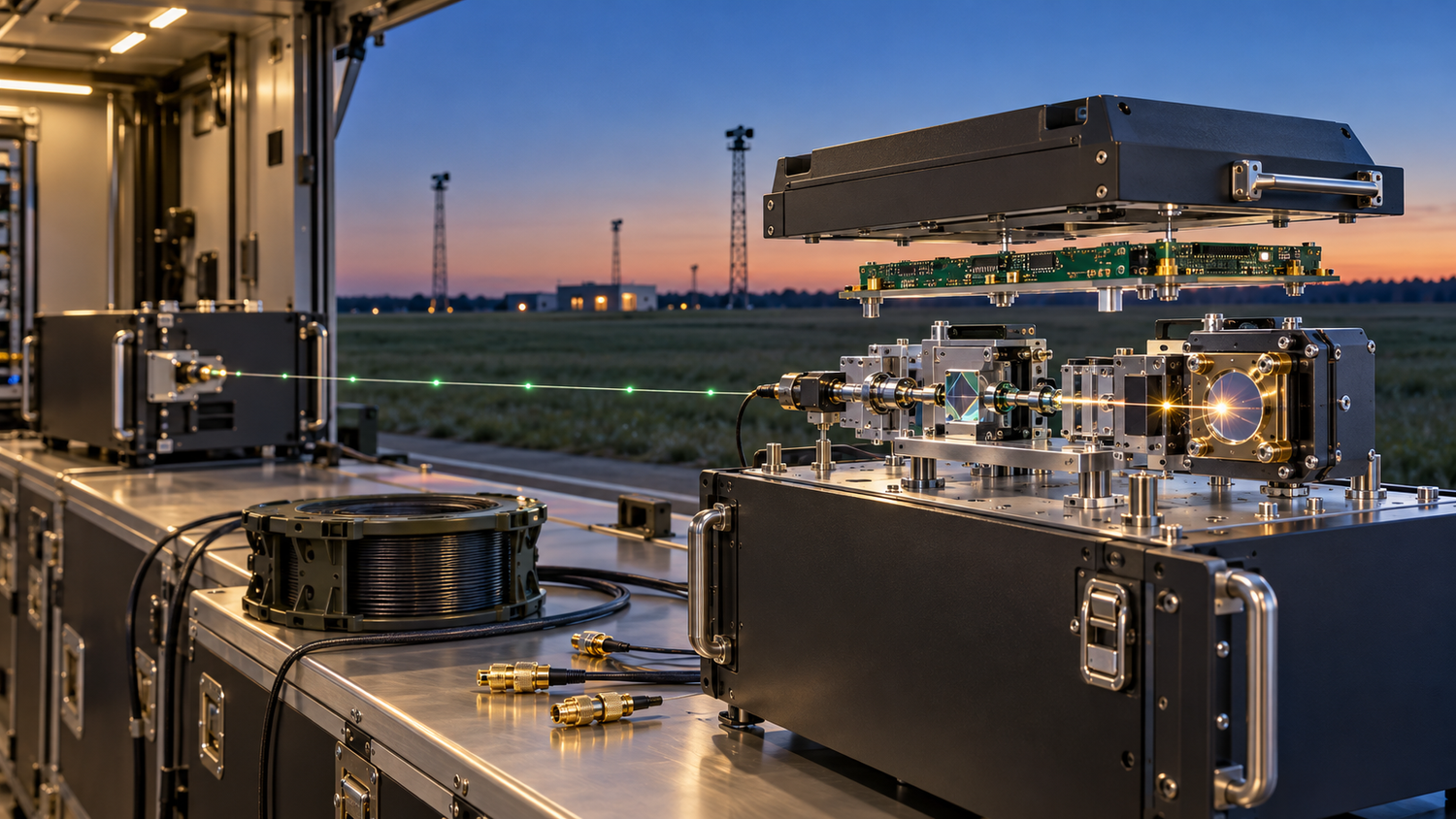
On October 14, 2026, India's Defence Research and Development Organisation (DRDO) announced that it had configured and tested a quantum key distribution platform on the live network of the dynamic test ranges at its Proof and Experimental Establishment (PXE) at Chandipur in Odisha. The platform was designed and developed under DRDO's Microelectronic Devices, Computational Systems and Cyber Security cluster, with the Bengaluru company Taqbit Labs as production partner. DRDO describes the purpose in one sentence: to fortify the real-time observations and weapon trial telemetry that artillery and armored weapon tests generate.
That sentence is the reason this post exists. Most quantum key distribution news describes a link between two cities, a bank and its data center, or a laboratory and a rooftop. This one describes a defense laboratory putting a quantum link to work on an operational network that carries the most sensitive data a weapons program produces before fielding: how a gun, a round or an armored vehicle actually performed on the range. The announcement is short, it gives no performance figures, and it says nothing about the scale of what was secured. It still marks a step that matters for a program office, because it places the technology where it is meant to live.
What DRDO announced on October 14, 2026, and what its production partner Taqbit Labs brings
The primary source is DRDO's own announcement on X, posted at 05:04 UTC on October 14, 2026, which reads that DRDO "successfully configured and tested Quantum Key Distribution (QKD) platform in the live network of the dynamic test ranges at Proof and Experimental Establishment (PXE), Chandipur" and that this "demonstrates the adept use case of QKD to fortify the real-time critical observations and telemetry associated with Artillery and Armoured Weapon tests and evaluation." The same text adds that the platform "will aptly provide unconditional security added with eavesdropping detection."
Vijay Mohan's report for The Tribune, published the same morning, describes what the Chandipur network carries: artillery and armored platform trials produce large amounts of critical real-time data, including telemetry, sensor readings, performance parameters and technical observations, and that data moves between instrumentation sites on the range. The Tribune also links today's test to the July 2026 completion of military field trials of a scalable, fiber-based QKD system built with the same partner.
Those July trials are the second piece of context. Janes reported on July 16, 2026, that DRDO had completed military field trials of a fiber-based system with Taqbit Labs, a company that has worked with DRDO on QKD since 2020. Janes quoted Taqbit's chief executive, Animesh Aaryan, as saying that customized QKD units had been built for both brownfield and greenfield deployments so that defense establishments could move to a posture resistant to quantum attack without giving up performance. Janes also described Taqbit's two protocol families, coherent one-way and differential phase shift, and cited a coherent one-way key rate of 1 kilobit per second at 22 decibels of link loss with a maximum range beyond 100 kilometers. Those figures come from the vendor, were published before the Chandipur test, and are the only throughput numbers in the public file.
Why artillery and armored weapon trial telemetry is worth a quantum key, and who gains from protecting it
A proving ground is an intelligence target in its own right. PXE Chandipur evaluates guns, mortars, rockets, tank guns and their ammunition, along with armor plates, turrets and infantry combat vehicles, for the Indian armed forces. Every firing produces muzzle velocity, chamber pressure, trajectory and dispersion data, impact and penetration results, and the performance of protection systems under fire. An adversary who reads that stream learns the real performance envelope of a weapon years before it is fielded, and learns which trials failed. The capability DRDO describes is therefore defensive in the plain sense used by this lane: it is intended to protect a force's own data, on its own network, from interception. Protection against undetected tampering additionally requires message authentication or authenticated encryption, which the announcement does not describe.
Quantum key distribution serves that need in a specific way. The quantum channel carries key material as single photons or weak pulses. Under the protocol's security assumptions, measurements in transit can introduce disturbances that the two ends assess through error statistics, rejecting key material when security criteria are not met. Noise also contributes to those errors, so an elevated error rate does not by itself establish that someone tapped the fiber. The encryption of the telemetry itself is conventional, usually a symmetric cipher fed by the quantum-derived key. What the quantum link adds is a key supply whose security can rest on physics rather than on assumptions about an adversary's computing power, subject to the protocol assumptions, secure implementation and authenticated classical communication. For a test range, monitoring those error statistics can support security checks, but it is not a reliable standalone alarm identifying interception.
The posture is defensive and the beneficiary is the data owner. The same platform would serve a bank or a telecom operator, and DRDO's own text names finance and telecommunications as sectors where the technology applies, which is why the lane's capability map would call the underlying product dual-use. The Chandipur use case, as announced, is a defense establishment protecting defense data, and that is how this post reads it.
Quantum pillar: networking (quantum key distribution links). Use posture: defensive. Technology readiness: TRL 7 of 9 is an editorial estimate, conditional on the unverified assumption that the tested platform was a near-final system. DRDO states that the platform was configured and tested on the live operational network of a working proving ground after military field trials in July 2026, which establishes an operational environment but does not establish near-final system maturity; system qualification evidence is absent, and routine operational use with published performance figures has not been claimed.
From Prayagraj to Vindhyachal in February 2022 to Chandipur in October 2026: the four-year path DRDO and IIT Delhi walked
DRDO's quantum communication work has a public trail. On February 23, 2022, the Press Information Bureau announced that a joint team from DRDO and IIT Delhi had demonstrated a QKD link between Prayagraj and Vindhyachal in Uttar Pradesh, a distance of more than 100 kilometers, over commercial-grade optical fiber already in the field. The release described the result as indigenous technology for bootstrapping a military-grade communication security key hierarchy and reported sifted key rates of up to 10 kilohertz. A later PIB release of November 26, 2024, from the DRDO Industry Academia Centre of Excellence at IIT Delhi added entanglement-based QKD over 50 kilometers of fiber in the laboratory and 8 kilometers on campus, and free-space entanglement distribution over 80 meters in the open. In May 2025, DRDO opened a Quantum Technology Research Centre in Delhi with experimental platforms for validating QKD techniques, spearheaded by its Scientific Analysis Group.
Read in sequence, the trail runs from a long-distance demonstration over field fiber, through laboratory and campus entanglement work, to a July 2026 military field trial and now an operational-network test at a proving ground. That is the ladder a buyer wants to see, and it is the ladder other armed forces are climbing at the same time. Quentir's reading of Brazil's Army inaugurating a 12 kilometer QKD link between its technology center and the Ministry of Defense on September 30, 2026, described the same pattern: a university-developed system, an army laboratory, and a first link between two buildings the army already owns. India's version runs on a range rather than between ministries, and it protects trial data rather than headquarters traffic, which makes it the more unusual use case of the two.
The production-partner arrangement matters for the same reason. A laboratory demonstration proves physics. A platform with a named manufacturer, built in customized brownfield and greenfield variants, is something a procurement office can write into a contract. The July trials and the October test are the two points at which DRDO has publicly moved from the first to the second.
What the announcement does not say, and what the UK NCSC and the Dutch strategy mean for a program office weighing QKD
The public file leaves four questions open. First, scale: DRDO does not say how many nodes were connected, over what distance, or at what key rate the Chandipur platform ran. The only published key rate is the vendor figure of 1 kilobit per second at 22 decibels. With a symmetric cipher such as AES, that key rate does not directly limit payload throughput: a 256-bit key can protect substantially more than 256 bits of telemetry, with key consumption depending on rekeying policy. A one-time pad instead requires one key bit per payload bit. Without the encryption scheme and rekeying policy, the figure does not establish a telemetry bandwidth limit or a need for a hybrid scheme. Second, what was encrypted: "fortify" could mean every telemetry stream or a single pilot link. Third, authentication: the quantum channel distributes keys, and the classical channel that coordinates it must be authenticated by some other means, which the announcement does not describe. Fourth, assurance: no independent evaluation of the platform's implementation security is public.
These are Quentir's four questions for this deployment; the authentication and assurance questions overlap with concerns Western authorities raise when they decline to endorse QKD for government use. The UK's National Cyber Security Centre, in its quantum security technologies whitepaper updated August 5, 2025, states that it will not support the use of QKD for government or military applications, because QKD does not provide authentication, because integrating specialized hardware with existing networks adds complexity, and because secure implementations against elevated threats remain hard to build. It recommends post-quantum cryptography as its preferred mitigation. The Netherlands took a similar line in its national quantum strategy of October 5, 2026, which Quentir read as post-quantum deadlines from 2026 to 2035 with no role for QKD in government systems.
DRDO's announcement offers a possible setting for addressing that debate: a single-purpose use on a test-range network. If the deployment has few nodes, dedicated fiber, physical security at both ends and a data owner able to fund special-purpose equipment for a small number of links, the authentication and infrastructure objections could be easier to meet than on an open national backbone. Those deployment details have not been disclosed. If QKD has a defensible niche in defense networks, a range meeting those conditions could be one. DRDO's own text also leaves room for post-quantum algorithms on existing platforms, and Taqbit sells both, so a hybrid is a possibility, but those facts do not establish that the Indian program is building one.
What stands between today's announcement and a program office relying on it is the published evidence a buyer would need: node count and distance on the live network, the sustained key rate under range conditions, how the classical channel is authenticated, and an evaluation of the hardware by someone other than its maker. None of that is in the file yet. What is in the file is a defense laboratory, a named manufacturer, a six-year partnership, a 100 kilometer field demonstration, a military field trial and an operational-network test, all on the public record and all pointing in the same direction. For a reader comparing national QKD programs, India's has reached the point at which it protects real defense data, and that is more than most can say.
Sources
Primary source: Defence Research and Development Organisation (DRDO), official announcement on X (@DRDO_India), October 14, 2026, 05:04 UTC, https://x.com/DRDO_India/status/2110235284323602775, with its full statement as carried by ANI the same day. Other material: Vijay Mohan, The Tribune, October 14, 2026; Janes, July 16, 2026, on the DRDO and Taqbit Labs military field trials; Press Information Bureau release 1800648 of February 23, 2022, on the DRDO and IIT Delhi 100 kilometer link, with later PIB releases of November 26, 2024 (2077600) and May 27, 2025 (2131757); UK National Cyber Security Centre, quantum security technologies whitepaper, August 5, 2025.