Brazil's Army Inaugurated a 12 km Quantum Key Distribution Link Between CITEx and the Ministry of Defense on 30 September 2026: What the Rede Quandanga Demonstration Shows and What It Leaves Open
Quentir Defense Monitor
Evidence-based insights for quantum defense and security. Published by Quentir Systems LLC · October 1, 2026.
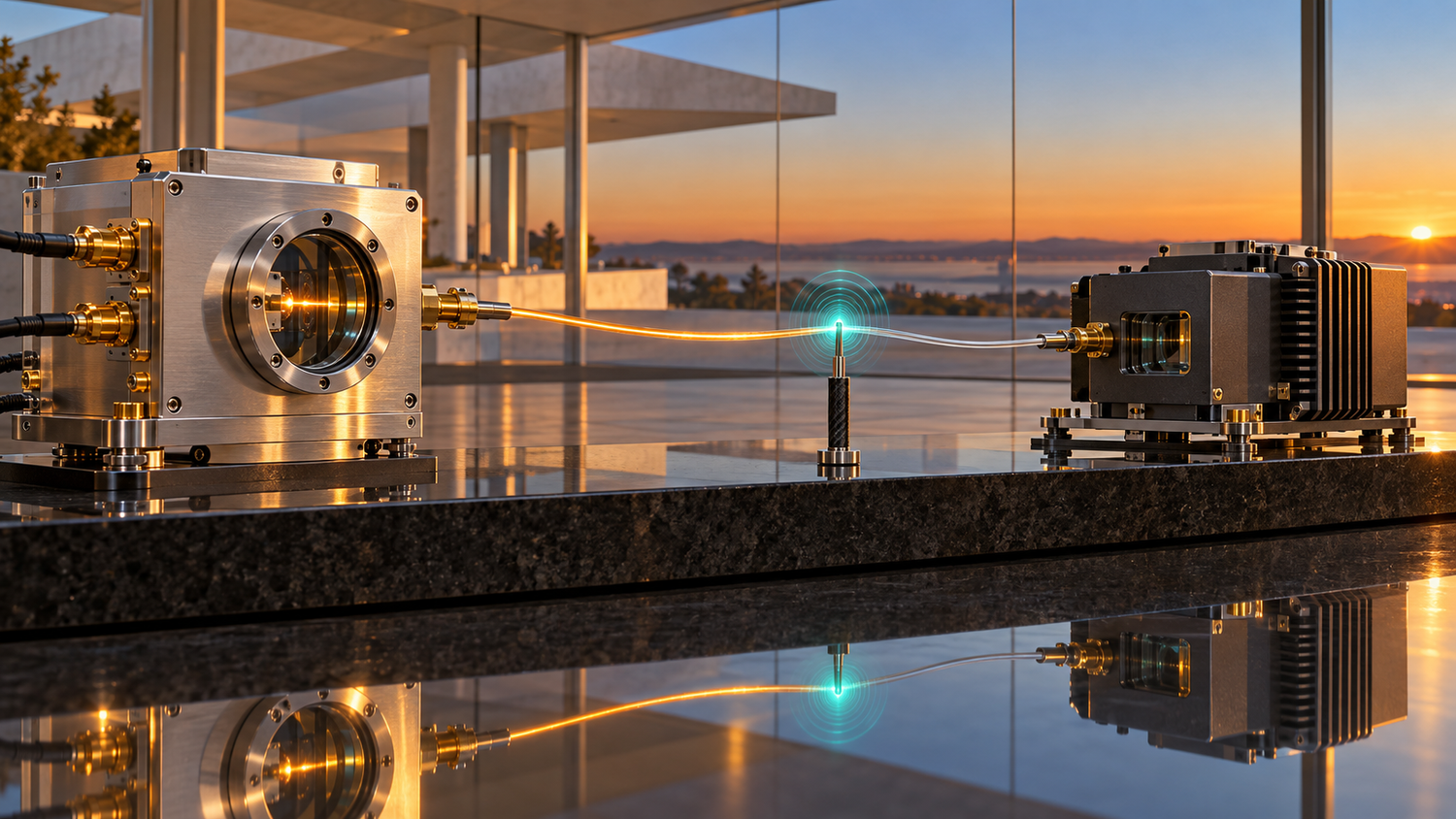
On Wednesday, September 30, 2026, the Brazilian Army switched on a quantum communication link between its Integrated Telematics Center, CITEx, and the Ministry of Defense in Brasília, and on October 1 its communications office published the account this post reads. The link runs over 12 kilometers of optical fiber, which the Army calls the longest quantum connection yet made on that kind of fiber in Brazil, and it was inaugurated alongside a new network operations and security center for EBNet, the Army's private corporate network. The research behind it comes from the Instituto Militar de Engenharia, IME, in Rio de Janeiro, whose project team integrated an imported quantum key distribution device with a Brazilian encryption unit for the first time. For a defense reader the story is less about distance than about posture: a national army has moved a quantum key link out of the laboratory and onto the fiber between its own headquarters-level sites, and has said so in public.
The Army's release, written by First Lieutenant Igor of the Army Social Communication Center, describes two events held at CITEx that day: the inauguration of a quantum communication network between computers, which the release presents as the safest and furthest-developed form of digital data transmission available, and the activation of the Network Operations and Security Center of the Army Telematics System, which for the first time concentrates monitoring and operation of the Army's private corporate network in one place. General Hertz Pires do Nascimento, head of the Army's Department of Science and Technology, attended with members of the Army High Command and set both launches beside the Guardião Cibernético 8.0 cyber defense exercise as evidence of the Army's technology effort.
What the Army says happened at CITEx on 30 September 2026: a 12 km fiber link, a staged intrusion against two channels and an imported QKD unit paired with a Brazilian encryptor
IME has named the inaugurated connection the Rede Quandanga de Comunicação Quântica. It joins CITEx to the Ministry of Defense over 12 kilometers of optical fiber. The launch was marked by a demonstration in which digital data was sent two ways, over a conventional connection and over the quantum one, while both were subjected to simulated cyber intrusions. According to the release, the conventional channel was breached, and the quantum connection identified and stopped the intrusion attempts immediately. The release gives no further technical detail about the staged attack, the key rate or the duration of the test, so the demonstration should be read as a launch-day proof that the chain works end to end rather than as a published measurement.
The architecture is the detail a buyer will care about most. Colonel Vítor Andrezo, the project manager for the network, told the Army that the connection uses an imported device to supply the quantum channel and the secret keys, working together with a Brazilian cryptographic device, and that IME carried out the first integration of the two. That split is a familiar one. Commercial QKD transmitters and receivers are built by a handful of vendors, and a national force that wants sovereign control of its traffic keeps the encryptor, the box that actually protects the data with those keys, in domestic hands.
The second launch belongs to the same story. The Network Operations and Security Center, subordinate to CITEx, is described by its chief, Brigadier General Rodolfo Roque Salguero de La Vega Filho, as able to process the full daily data volume of the Army Telematics System for more proactive monitoring of EBNet. A quantum key link between two fixed sites is only as useful as the network operations discipline that decides which traffic rides on it.
How Rede Quandanga grew out of IME's Rede Hermes Quântica: 40 km of spooled fiber, a 120 km nominal reach and the planned CBPF and PUC-Rio links
The trade outlet Defesa em Foco, which published its own account the same morning, places the link in the research line IME had already disclosed. Researchers attached to IME's Rede Hermes Quântica, a network aimed at defense applications, had activated a system able to run the complete quantum key distribution cycle, first on fiber spools adding up to 40 kilometers of simulated distance, using equipment with a nominal reach of up to 120 kilometers. IME announced as next steps a real 1.7 kilometer link to the Centro Brasileiro de Pesquisas Físicas and a future connection of about 8 kilometers to PUC-Rio. The 12 kilometer Brasília link jumps past both of those planned Rio de Janeiro hops.
Defesa em Foco is careful about what the milestone means. It writes that a defense quantum network must be treated as a future objective rather than an available capability, that consolidation will depend on more tests, infrastructure integration, personnel training and validation at larger scale, and that IME wants to extend Rede Hermes Quântica to metropolitan links and later to the Amazon region over the fibers of the Programa Amazônia Conectada. The outlet also states plainly that QKD adds a layer to the distribution of keys while servers, equipment, software and users stay exposed to every other kind of attack.
The policy anchor is public too. In Portaria GM-MD nº 840 of February 14, 2025, the Ministry of Defense published its list of critical technologies for national defense, meant to steer research and development across the Ministry and the Armed Forces. The annex carries a quantum line reading secure quantum communications and quantum sensors, and a separate cryptography line for post-quantum algorithms. A link between the Army's telematics center and the Ministry that commissioned that list is a direct answer to its own first quantum entry, and the second entry explains why the encryptor beside the QKD box matters as much as the box.
Quantum pillar: networking (quantum key distribution links). Use posture: defensive. Technology readiness: TRL 6 of 9. A commercial QKD unit and a Brazilian encryptor ran as one system over 12 kilometers of deployed fiber between two real defense sites under a staged intrusion, yet the Army presents the event as an inauguration and demonstration, publishes no key rate, availability or traffic figures, and Defesa em Foco calls an operational defense quantum network a future objective.
What a 12 km quantum key link would let a force do, who gains, and why the posture reads defensive
Read as capability, the link does one specific thing. It lets two fixed sites agree on fresh symmetric keys through a channel whose physics exposes interception, so the encryptor between them can protect command, control and administrative traffic without relying on the public-key mathematics that a future cryptographically relevant quantum computer is expected to break. For a ministry and its army, the first users are the long-lived secrets: personnel, logistics, procurement and planning data that would still be sensitive if an adversary stored today's ciphertext and decrypted it a decade from now. The gain sits wholly with the defender. Nothing in a key link degrades anyone else's sensing, navigation or communications, and nothing in it finds or strikes a target, which is why the panel reads defensive rather than dual-use.
The reference points for what such a link can sustain exist in the open literature, and they are modest. A seven-node research network over existing fiber in Nicosia reported 99.1 percent mean scheduled-link availability across 73 days, a figure the Monitor covered when the Cyprus University of Technology posted its results, and a 70 kilometer rural link serving a health kiosk delivered on the order of 12.7 secure bits per second, as the Medicine Monitor read in its village health kiosk post. These comparisons do not establish the Brasília link's key rate or loss margin, and the Army has not yet published its own numbers.
The posture also has a doctrinal edge that a Brazilian program office will have to argue through. The United Kingdom's NCSC, the national cyber security authority, in its Quantum networking technologies paper of August 5, 2025, states that QKD does not provide authentication, that it must be combined with other cryptographic services, that integrating quantum and classical components with existing network infrastructure is harder than ordinary software integration, and that the NCSC will not support the use of QKD for government or military applications, naming post-quantum cryptography as the mitigation it recommends. Brazil's Ministry of Defense has placed both technologies on its critical list, so the question in Brasília is one of layering, and post-quantum authentication for the QKD classical channel is a possible design choice, pending evidence of actual support in the IME system.
What still stands between the Rede Quandanga launch and a program office relying on it: authentication, assurance of the imported box, published performance and reach beyond one hop
The first gap is authentication. A QKD link bounds an adversary's knowledge of the final key under protocol assumptions, conditional on classical-channel authentication and implementation assurance; it cannot by itself prove who sits at the far end. Every deployed QKD system therefore starts from a pre-shared secret or a classical signature, and the choice of that signature decides whether the whole chain resists a quantum computer. The Army release does not say how the Brasília link authenticates its classical channel. The second gap is the imported unit. The quantum channel and the keys come from a foreign device, and the security of QKD in practice rests on the implementation, with detector blinding, Trojan-horse probing of the transmitter and side channels in the electronics all documented in the research literature. A sovereign encryptor protects the data, and an assurance process for the box that makes the keys still has to be built or bought.
The third gap is evidence. The release describes a successful demonstration against simulated intrusion and claims the link is the longest of its kind in Brazil, and both statements can be true while leaving a buyer with no key rate, no uptime, no fiber loss budget and no statement of what traffic the link now carries. The fourth gap is topology. Twelve kilometers between two fixed buildings is the natural first hop; the planned Rio links are shorter; the Amazon ambition is far longer than 120 kilometers and will need trusted intermediate nodes, each of which becomes a place where keys exist in the clear and must be guarded physically. That is the step at which quantum key networks stop being a cryptographic choice and start being a facilities and personnel program.
Set against those gaps, the honest reading is still favorable. A national army has installed a quantum key link on its own fiber between two real sites, shown it to its high command under a staged attack, kept the encryptor domestic, and said in public where the research goes next. The next public step that would change the entry is a short technical note from IME or CITEx giving the link's loss, key rate and availability over a month of real traffic.
Sources
Primary source: Exército Brasileiro, Centro de Comunicação Social do Exército (First Lieutenant Igor), "Exército avança em Comunicação Quântica e ativa Centro de Operações e Segurança de Rede do sistema de telemática," published October 1, 2026. Other material: Defesa em Foco, "Exército realiza primeiro enlace quântico com o Ministério da Defesa," October 1, 2026; Ministério da Defesa, Portaria GM-MD nº 840 of February 14, 2025 (critical technologies for national defense); NCSC (United Kingdom), "Quantum networking technologies," version 1.0, August 5, 2025.