The Dutch Government-Wide Quantum Strategy, 5 October 2026: Submarine-Finding Sensors, GPS-Free Navigation, Purple NECtar Challenges and a 2045 Defense Target With No New Budget
Quentir Defense Monitor
Evidence-based insights for quantum defense and security. Published by Quentir Systems LLC · October 17, 2026.
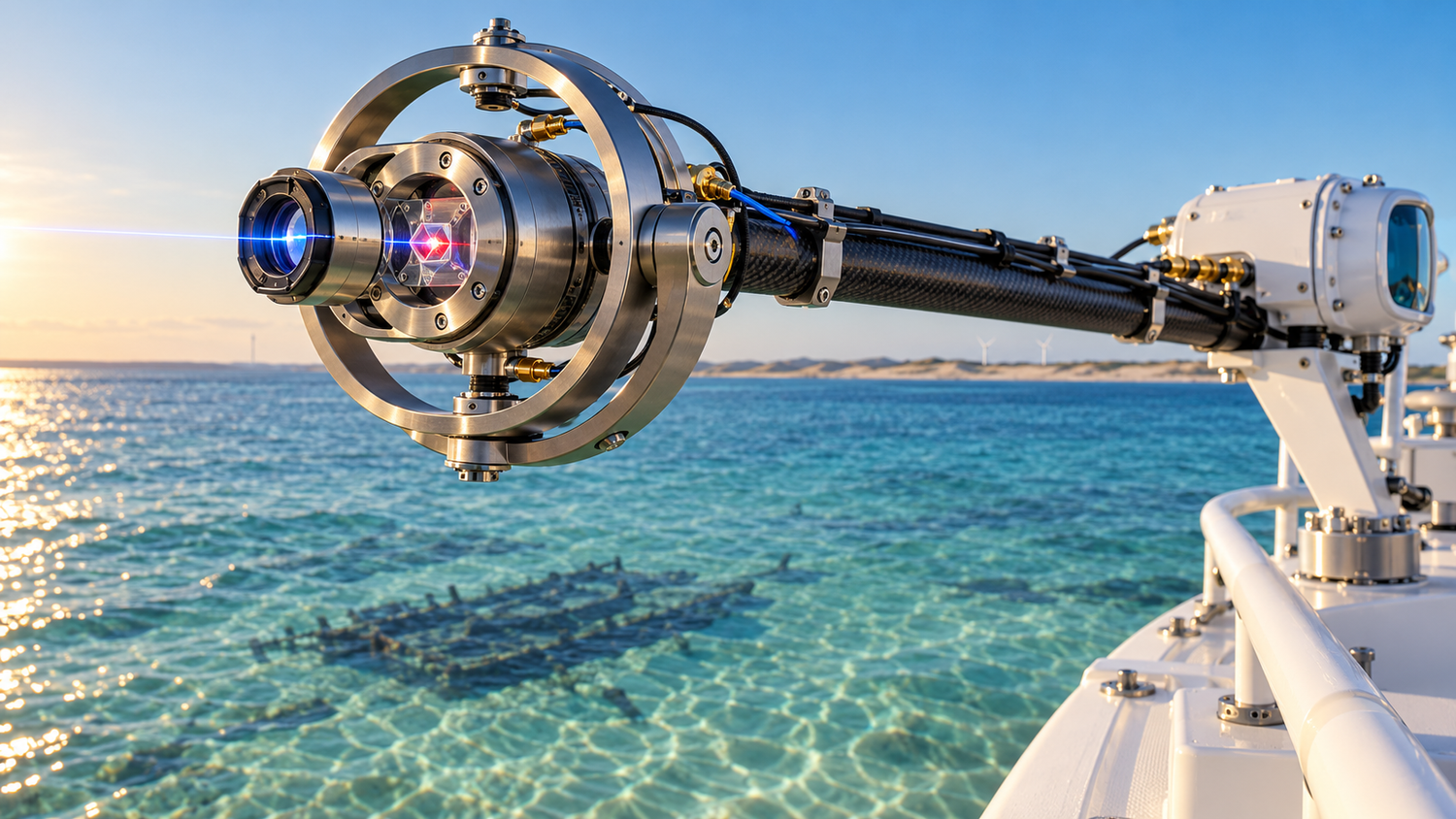
On October 5, 2026, Heleen Herbert, the Dutch Minister of Economic Affairs and Climate, and State Secretary Willemijn Aerdts sent the Rijksbrede Quantumstrategie, the government-wide quantum strategy, to both chambers of parliament. The 73-page document was written with eight other ministries, Defense among them, and sets one ambition: by 2035 the Netherlands is to be a technological leader in quantum, strategically autonomous and resilient. The next morning the Ministry of Defense published its own reading of the strategy under the headline Vol inzetten op quantum voor veiligheid, full commitment to quantum for security, and listed what it expects from the technology: navigation without dependence on GPS, superior sensors for precise detection, and the ability to find submarines.
Quentir's general blog has already read the strategy's cryptography chapter, its eight-year migration estimate and its rejection of quantum key distribution for government information security. This post reads the other half of the security chapter, section 4.2, which is the part a defense buyer will be asked about: what the Dutch state says it will do with quantum sensing and computing for the armed forces, which instruments it names, which dates it sets, and what it declines to commit.
What the 5 October 2026 strategy says about submarines, sea mines and underground structures
The strategy's security chapter opens with a threat assessment that reads quantum sensing as a disruptor of existing military balances. In its own words, highly sensitive quantum sensors could in time be used to detect submarines, sea mines or other military assets better, or to detect underground structures and critical infrastructure, and this could change deterrence and relations in military domains. The same paragraph warns that such sensors can support refined forms of surveillance and intelligence gathering, with consequences for privacy, human rights and the international legal order. That is a dual-use reading written by the government itself, and it is the frame for everything that follows.
The Defense Ministry's October 6 note turns the same physics into opportunity. Quantum navigation that measures the Earth's magnetic field would let units orient themselves where GPS is jammed, which the ministry describes as easy to do in conflict areas, and a submarine deep under water or a low-observable aircraft still distorts the local mass or magnetic field. Those two sentences point at two instruments, the magnetometer and the gravimeter, and at two missions, GNSS-denied navigation and the detection of things an adversary wants to keep hidden. The ministry's text calls the result a decisive operational advantage. The strategy document is more careful: it speaks of what sensors could do in time, and it places its own concrete action in a challenge program rather than in a fielded system.
Neither document gives a sensitivity figure, a range, a platform or a trial date. For comparison, the NATO roadmap published a week earlier puts QUESTOR sea trials for GNSS-denied positioning in 2026 and 2027 on a calendar, and the Dutch strategy describes its own NATO role as an active contribution to the alliance's Transatlantic Quantum Community, which the Netherlands chairs from May 2026 through May 2027. The strategy therefore links the Dutch sensing ambition to allied programs rather than to a national demonstrator of its own.
Quantum pillar: sensing (gravimetry and magnetometry). Use posture: dual-use. Technology readiness: not applicable. The development is a national strategy and its defense chapter, a policy instrument that names magnetic and gravity sensing for submarine detection and GPS-free navigation as goals without placing any Dutch device, trial or sensitivity figure on the readiness ladder.
Section 4.2's three action lines: use cases from 2027, roadmaps, and the Purple NECtar Quantum Challenges
Section 4.2 carries the title "the Netherlands can deploy quantum technology to safeguard national security and international stability" and sets out three action lines. The first is an inventory. The ministries of Infrastructure and Water Management and of Finance have already surveyed possible quantum applications for their own cyber security, and from 2027 all departmental and interdepartmental use cases for quantum computing, communication and sensing in defense, intelligence, crisis management, disaster response and essential services are to be discussed in the existing interdepartmental quantum consultation. The strategy says this should produce a shared picture of where the technology adds value in the security chain, where risks lie, and where restraint or scaling down is needed.
The second action line is roadmaps per use case, each stating the technological steps from research to scaling, the partners, the required infrastructure such as laboratories and testbeds, the risks, and the legal and ethical conditions. The strategy points to two experiences as the first such roadmaps. Several government services gained hands-on experience with measurement-device-independent quantum key distribution in the OCINed project under the European EuroQCI program, and Defense works with knowledge institutes and industry under its Defense Strategy for Industry and Innovation 2025-2029.
The third action line is the one with hardware behind it. The strategy states that in 2025 the Ministry of Defense launched the Purple NECtar Quantum Challenges, which it describes as pairing ten concrete quantum challenges with ten unclassified defense cases so that military end users test the operational value of proposed solutions, knowledge of the state of the art grows, and new ideas are drawn from the ecosystem. NEC stands for Network Enabled Capabilities, and the strategy says the emphasis lay on sensing and computing, in close consultation with military end users.
The public trail behind that paragraph is thinner than the paragraph. The Holland High Tech page the strategy cites, the Defense SDIR Challenges for Purple NECtar 2025, lists eight challenges from the Ministry of Defense and its Materiel and IT Command, of which one is quantum: Quantum PNT Gravimetry, with a submission deadline of April 14, 2025. Separately, in February 2025 the same command selected six organizations, including QuiX Quantum, Fermioniq, QuantaMap, Qubitrium, Deltares and CUbIQ Technologies, for an eight-month Quantum Challenges program whose results were to be shown at the Purple NECtar event in November 2025. Ten challenges against ten cases may well be the count across both tracks, but no public document Quentir could find lists them, and the strategy publishes no outcome: no winning solution, no follow-up assignment, no measured performance. A reader who wants to know what the gravimetry challenge produced has to ask the ministry.
The 2045 target, the EU cryptography clock, and why chapter 8 says there is no new money
Section 4.2.3 states the Defense Ministry's long horizon. Citing its own industry and innovation strategy, the document says that by 2045 Defense will be able to deploy quantum technology safely and responsibly to gain strategic, tactical or operational advantage, and that in the coming years it will accelerate toward high-technology military capabilities and competencies, with the Purple NECtar challenges as a main instrument to bring the pull from military capability needs and the push from technology together. Defense is also to keep identifying military applications of quantum, with other departments, knowledge partners and industry, and internationally through the European Union and NATO.
The dates in the rest of the security chapter belong to cryptography, and they are borrowed. The government commits to the EU's coordinated implementation roadmap for the transition to post-quantum cryptography, published on June 23, 2025, which asks member states to complete high-risk use cases by the end of 2030 and as much of the rest as feasible by 2035. The Dutch strategy adds its own milestones along that path: risk management and a cryptography policy per organization by the end of 2026, migration plans and pilots by the end of 2027, procurement requirements by the end of 2028, high-risk use cases migrated and software and firmware using post-quantum cryptography by default by the end of 2030. It also notes that sectoral rules or international agreements, including NATO agreements, can be a reason for a government organization to deviate from the national schedule, which matters for weapon systems and long-lived platforms, the very systems the chapter itself calls hard to migrate.
Set beside those cryptography dates, the sensing and computing side of the chapter has one firm date, the 2027 start of structured use-case discussions, one chairmanship, and one target twenty years out. Chapter 8, on follow-up, explains why. The actions in the strategy are already under way or are to be fitted within existing departmental budgets. Several actions are explorations, and an exploration may show that additional funding is needed later. If sufficient means are not found, the document says, the ambitions will be adjusted. The strategy carries no appropriation of its own for defense quantum sensing, and the EUR 614.9 million the government's announcement cites is the earlier National Growth Fund allocation to Quantum Delta NL, which predates the strategy and funds research and the ecosystem. It contains no defense procurement line. Parliament is to receive a progress report every year from 2027.
For a defense reader the capability reading is dual-use, and the strategy says so. The same magnetometer that keeps a Dutch frigate oriented without satellites is the sensor class that finds a submarine's hull, and the strategy's own threat paragraph says potential adversaries will use the same technology. What the Netherlands adds to the field with this document is governance: an interdepartmental use-case process, a roadmap format, a NATO chairmanship, and an end-user-tested challenge track that exists and has one gravimetry problem in public view. What it does not add is a demonstrator, a sensitivity figure or a funded program. A buyer following Dutch quantum sensing should therefore watch three things. The first progress report in 2027. The published outcome, if any, of the Purple NECtar gravimetry and quantum challenges. And whether the next defense budget turns chapter 8's conditional language into a line item.
Sources
Primary source: Rijksbrede Quantumstrategie (73 pages), sent to both chambers of the Dutch parliament on October 5, 2026 by Minister Heleen Herbert and State Secretary Willemijn Aerdts on behalf of nine ministries including Defense (Eerste Kamer 26 643, S), read in full, in particular chapter 4, section 4.2, Tabel 2 and chapter 8. Other material: Rijksoverheid news release of October 5, 2026; Ministerie van Defensie news item 'Vol inzetten op quantum voor veiligheid' of October 6, 2026; Holland High Tech, Defense SDIR Challenges for Purple NECtar 2025 (March 21, 2025); European Commission, Coordinated Implementation Roadmap for the Transition to Post-Quantum Cryptography (June 23, 2025). The comparison with the February 2025 Quantum Challenges selection, the posture reading and the buyer questions are Quentir analysis.