Entanglement Survives 62 Kilometers of Ordinary Aerial Fiber
Quentir Defense Monitor
Evidence-based insights for quantum defense and security. Published by Quentir Systems LLC · August 8, 2026.
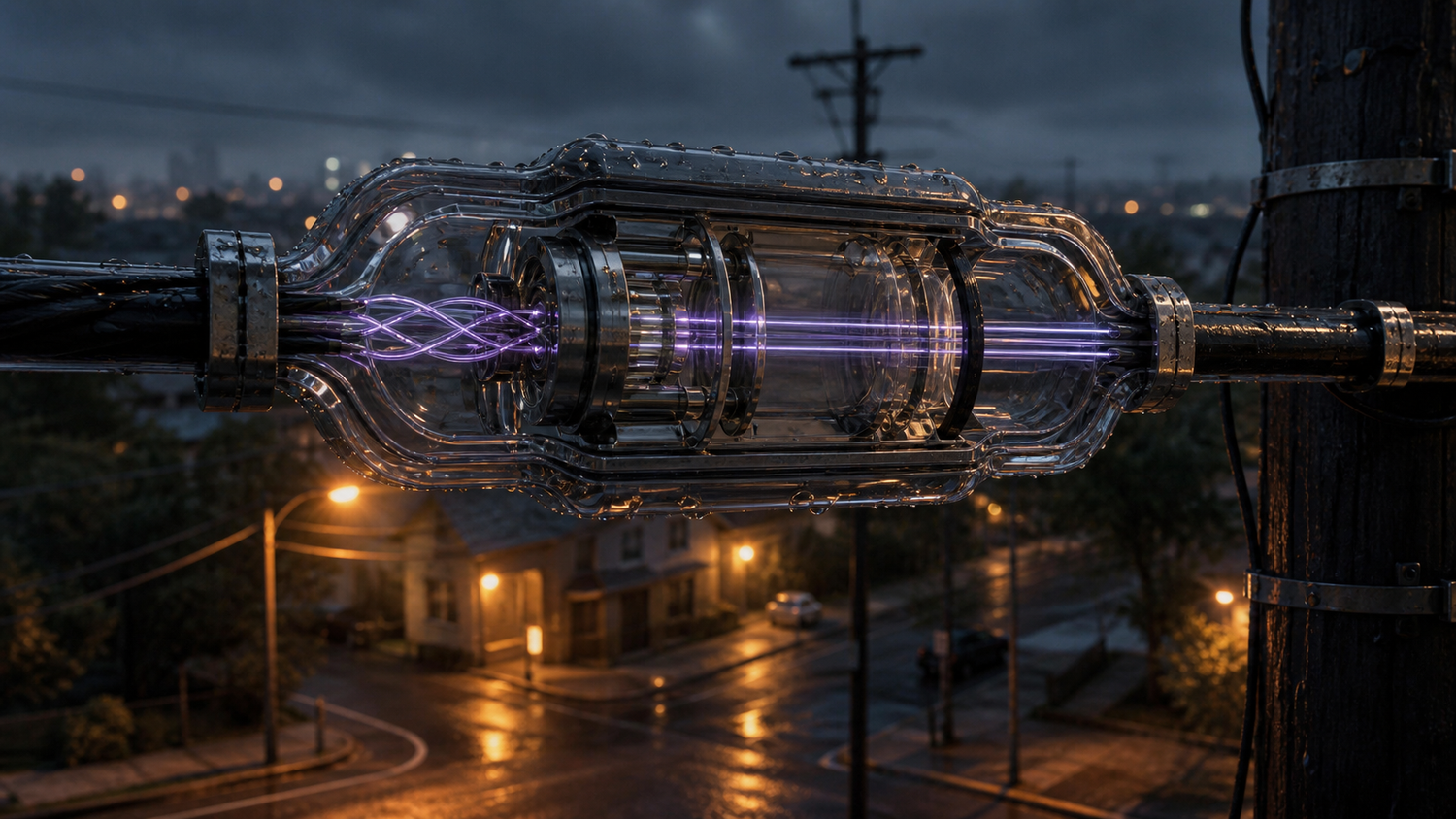
In early 2025, pairs of entangled photons began riding a commercial fiber line strung from utility poles across the Maryland suburbs of Washington, DC. That line expands in the afternoon heat, contracts at night and swings in the wind, and the fragile quantum connection between the photons survived the trip anyway. Researchers from the National Institute of Standards and Technology, the Joint Quantum Institute and the Brooklyn company Qunnect distributed entanglement over 62 kilometers of that fiber across a 24-hour trial — in time-multiplexed distribution windows, with 92.8 percent of the period available for distribution and the remainder reserved for compensation — and have now published the result in a peer-reviewed engineering journal.
The NIST announcement frames the work as a step toward a future quantum network, and that is accurate. The more immediate reading, and the reason it belongs in a defense briefing, is about infrastructure. Every serious plan for quantum communications between fixed sites has carried an unwelcome line item: dedicated fiber, engineered and buried for the purpose, because the deployed telecom plant was assumed too noisy for quantum states. This experiment attacks that assumption directly, on some of the least forgiving fiber available.
NIST physicist Oliver Slattery, one of the authors, put the conditions plainly: "It's about as bad a connection as you can possibly have." Most of the run dangles from poles. Passing weather, temperature swings and even birds landing on the cable all disturb the glass, and each disturbance twists the polarization states in which the entanglement is encoded. The study's lead author, Yicheng Shi, calls the experiment a stress test of quantum networking systems, and the phrase is the right frame for what a defense reader should take from it.
What the stress test actually showed
The team generated polarization-entangled photon pairs with a commercial source, kept one photon of each pair in the NIST laboratory and sent its partner through 62 kilometers of leased commercial fiber to a second laboratory at the University of Maryland in College Park. The full technical record appears in the Journal of Optical Communications and Networking, and the headline numbers are worth stating exactly. The link delivered about 1,500 entangled photon pairs per second. Over a continuous 24-hour period it distributed entanglement 92.8 percent of the time, spending the remaining 7.2 percent on correction, and a statistical test confirmed that the photon pairs measured at the two ends remained genuinely entangled.
The correction is the interesting engineering. A pair of stabilization devices built by Qunnect, a company whose stated mission is converting existing telecommunications infrastructure into quantum networks, sent classical reference light down the same fiber, measured how the fiber had rotated its polarization at the far end and applied the exact inverse transformation in real time. The quantum states were never read, which would destroy them. The fiber's misbehavior was measured on sacrificial light and undone before it could erase the entanglement. That is what polarization stabilization means in practice, and it is the component that turns bad fiber into usable fiber.
The distance is deliberately unremarkable. A European collaboration reported in Nature Communications in 2022 that it had distributed entanglement over a 248-kilometer buried fiber link between Austria and Slovakia for 110 hours. Buried fiber, however, is thermally and mechanically quiet. The Maryland link is four times shorter and far noisier, and that inversion is the point: the experiment traded distance for realism, exposing the link to exactly the environment a working network would have to tolerate.
Quantum pillar: networking (quantum key distribution links). Use posture: defensive. Technology readiness: TRL 5 of 9. A quantum link ran for 24 hours on real deployed aerial telecom fiber under live environmental stress, which is validation in a realistic setting, still short of an end-to-end key distribution demonstration.
What a force would actually gain
Entanglement distribution is the substrate under several capabilities, and the nearest one is key distribution. In entanglement-based protocols, two sites measure their halves of shared photon pairs and distill matching secret keys, with interception revealed statistically, as shifted correlations and elevated error rates when the two sites compare measurements over an authenticated classical channel, before a single message ever depends on the key. The value described is protective in character. A stabilized entangled link hardens one's own communications; it degrades nothing on the adversary's side, which is why the posture reading above is defensive rather than dual-use. For a military user the relevant scenario is the fixed high-value pair: a command site and a data center, a laboratory and a launch facility, joined by fiber that already exists.
That last clause is where this experiment changes the calculus. If entanglement can be maintained on leased aerial telecom fiber, then a quantum key distribution link between two defense sites becomes a question of leased fiber and endpoint equipment rather than civil engineering: no trench, no new right of way. The trial still used a leased fiber pair — reference light shared the quantum fiber in alternation and a second parallel fiber carried timing — so coexistence with production traffic on a single lit fiber remains to be demonstrated. The 2022 European result already hinted at this for quiet buried routes; the Maryland result extends it to the messy overhead plant that actually connects most installations. The same property matters for allied and national quantum network programs, which can now plan backbone segments over infrastructure they lease rather than construct.
Further out, the same stabilized links are the plumbing for capabilities beyond secrecy. Entangled photons distributed between sites can synchronize clocks, link sensors into arrays with a shared quantum reference and eventually connect quantum processors. Those applications sit lower on the readiness ladder than key distribution, and none of them was demonstrated here. What was demonstrated is the transport layer they all share, and transport on real fiber has been the persistent bottleneck.
The distance between a field trial and a program office
An honest reading of the numbers keeps the enthusiasm bounded. Some 1,500 entangled pairs per second is a respectable physics result and a thin communications resource; after measurement, sifting and error correction, the usable secret-key rate on such a link would refresh the keys of ordinary symmetric encryption comfortably — bulk traffic needs only a comparatively tiny key stream — while sitting orders of magnitude below the payload-rate key material a one-time-pad design would demand. The trial distributed entanglement and verified it statistically. It did not run a full key distribution protocol end to end, did not authenticate its classical channel and did not integrate with any operational cryptographic system. Each of those steps is understood engineering, and each still has to be shown on this class of link.
The policy headwind is equally real. The UK NCSC, the British government's cybersecurity authority, states flatly that it "will not support the use of QKD for government or military applications," pointing instead to post-quantum cryptography, and allied security agencies have taken similar public positions. The reasoning is about the surrounding system: hardware trust, denial-of-service exposure and the fact that algorithmic migration covers most traffic at far lower cost. A program office weighing this technology should read those positions as the current procurement reality. Post-quantum algorithms remain the migration path for the force at large, a judgment this lane has examined across the crypto-agility spine many times.
The markers to watch from here are concrete. The first is an end-to-end key exchange on this class of stabilized aerial link, with a published secret-key rate rather than a photon count. The second is duration: 24 hours proves the stabilization concept, while a network operator will want months of unattended uptime of the kind the Austrian team approached underground. The third is independent evaluation, because a security instrument enters procurement through someone else's adversarial testing, and no such assessment of a stabilized aerial link exists in public yet.
What the Maryland stress test changes is the cost side of a narrower ledger. Physical-layer key distribution has always been a niche instrument for links whose secrets must outlive any algorithm, and the dominant objection has been that the niche required building bespoke infrastructure. A demonstration that the existing overhead plant can carry entanglement through wind and weather, corrected by rack-mounted commercial hardware from a small New York company, converts one hard objection into an engineering schedule. The buyer's question moves from whether the fiber must be built to when the endpoints mature, and that is a question the readiness ladder can track year by year. For a reader following quantum networking for defense, the sensible posture is unchanged vigilance: migrate cryptography on the published national timelines, and watch stabilized entanglement links as the infrastructure signal they have now become.
Sources
Primary source: Yicheng Shi, Oliver Slattery and colleagues at NIST, the Joint Quantum Institute and Qunnect, in the Journal of Optical Communications and Networking; other material from the NIST announcement, Neumann et al. in Nature Communications, the UK NCSC and Qunnect.