IonQ Receives $7.5 Million Phase 2 Funding From AFRL, 27 October 2026, to Add Free-Space Optical Links and Quantum Frequency Converters to the Rome, New York Quantum Network
Quentir Defense Monitor
Evidence-based insights for quantum defense and security. Published by Quentir Systems LLC · November 2, 2026.
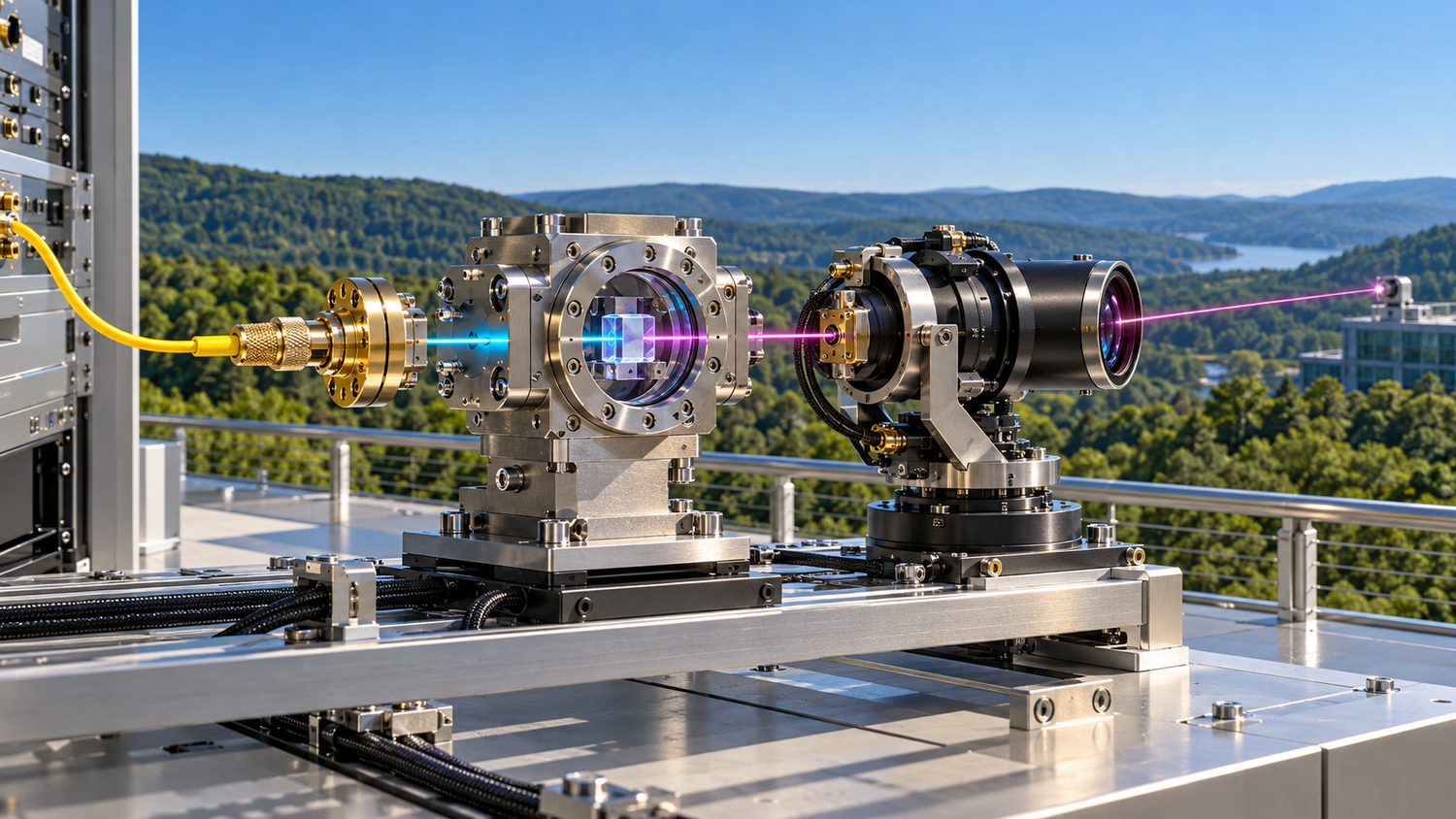
IonQ said on 27 October 2026 that the Air Force Research Laboratory has released $7.5 million of follow-on funding for the second phase of the quantum network the company delivered to AFRL's Information Directorate in Rome, New York. The company's release describes Phase 1 as the core physical network foundation and Phase 2 as the hardware and software that let different kinds of quantum systems connect across non-laboratory environments. Four items make up the award: free-space optical links with automatic pointing, acquisition and tracking for entanglement distribution over line-of-sight channels in the telecom C-band; two quantum frequency converter modules for interoperability across heterogeneous quantum and classical hardware; O-band-compatible network hardware with enhanced polarization controls and upgraded quantum network interface cards; and on-premises control software for automated self-tests, real-time monitoring, failure handling, experiment execution and results export. Jordan Shapiro, IonQ's president for the quantum platform, said the funding "validates IonQ's full-stack approach" and that the company is "unlocking new domains for quantum networking by going to free space optics."
Two facts in the release frame everything that follows. The money is part of an older commitment: IonQ states that the Phase 2 award was contemplated within the $21.1 million collaboration announced in January 2025 and is not supplemental. And the release carries no performance figure for the network as it stands today, no entanglement rate, no fidelity and no link distance. This post reads the award as a quantum networking capability under the networking pillar, in the entanglement distribution sub-branch, explains why AFRL's Rome campus is the natural place for it, and sets out what separates a funded upgrade list from a network a program office can rely on.
What IonQ's 27 October 2026 release establishes about Phase 2: four upgrades inside the $21.1 million envelope announced in January 2025
The January 2025 release set the frame. IonQ, acting through Qubitekk, the quantum networking company it had just acquired, announced a $21.1 million project with AFRL's Quantum Information Science and Technology Branch at the Information Directorate, to be built at the Innovare Advancement Center in Rome. The deliverables were high-performing network access points for interoperability between quantum computers and networked devices, networking hardware compatible with existing telecommunications infrastructure, and free-space optical links connecting ground stations to uncrewed aerial systems. Michael Hayduk, the directorate's deputy director, said advancing quantum technology was crucial to maintaining the nation's technological leadership. The October 2026 release reads as the second installment of that list. The fiber link is the Phase 1 foundation; the free-space terminals, the converters and the control plane are the Phase 2 work.
Each Phase 2 item answers a specific engineering problem. A free-space optical terminal with pointing, acquisition and tracking carries entangled photons through the air between two points that no fiber joins, and keeps the beam on a receiver that may be moving. Quantum frequency converters translate the photons a trapped ion emits, in the visible or near-infrared, to the C-band and O-band wavelengths that standard telecom fiber carries with low loss, so that trapped-ion nodes, other quantum hardware and classical equipment can share one fiber plant. The upgraded interface cards and polarization controls hold photon polarization steady across fiber and air, which is what entanglement distribution with polarization-encoded photons requires. The control software turns a physics experiment into a system an operator can start, monitor and recover without a physicist at the bench.
Between the two releases sits the result that makes Phase 2 credible. On 14 April 2026 IonQ announced that it had photonically interconnected two independent trapped-ion quantum systems and generated entanglement between them, in a joint project partly funded by AFRL under case number AFRL-2026-1742. That release gave no distance, rate or fidelity either, and the October release cites it as the milestone on which Phase 2 builds.
Why AFRL's Information Directorate in Rome, New York is the host: the 2021 research-center designation, the Innovare fiber testbed built by Qunnect and the 2023 Extreme Computing Facility
Rome was chosen for a reason. AFRL said in August 2023 that the Information Directorate had been designated in 2021 as the Quantum Information Science Research Center for the Air Force and the Space Force, and that the Senate defense appropriations bill carried $44 million for the directorate, including $10 million for a distributed quantum networking testbed and quantum cloud computing environment and $4 million for next-generation ion-trap computing. The ribbon was cut on the directorate's Extreme Computing Facility on 8 August 2023, with two laboratories for quantum computing, networking and security inside it.
The fiber the network runs on predates IonQ's contract. The Griffiss Institute reported on 2 December 2022 that Qunnect had built the Quantum Research Fiber Testbed at Innovare, turning ordinary telecom fiber made available through Oneida County into quantum-ready channels, under two AFRL Small Business Technology Transfer awards spanning 2020 to 2022. Qunnect's demonstration on that fiber held polarization stabilized above 95 percent fidelity for 24 hours with 98 percent channel uptime. That is the environment into which IonQ's Phase 1 link was delivered, and the one in which Phase 2's O-band hardware and polarization controls will be judged.
IonQ's wider AFRL business gives the award its scale. The company announced a $54.5 million agreement with AFRL in September 2024 for computing and networking research, and Quantum Computing Report's account of the Phase 2 award sets the $7.5 million alongside that agreement, the on-site trapped-ion computer at Rome and IonQ's work under DARPA's Heterogeneous Architectures for Quantum program on diamond quantum memories. Read together, the Phase 2 award is a modest sum inside a relationship that already runs to tens of millions of dollars and several years.
Quantum pillar: networking (entanglement distribution and repeaters). Use posture: dual-use. Technology readiness: not applicable. For the reader this means the development is a funded contract phase whose free-space terminals, frequency converters and control software have no published demonstration yet, so the ladder cannot be applied to them, while the Phase 1 fiber link and the April 2026 two-computer entanglement that already exist are placed separately in the Register.
Why the panel reads networking (entanglement distribution and repeaters), dual-use and readiness not applicable
The pillar is networking because every Phase 2 item exists to move entangled photons between nodes: through air, across wavelength bands and across hardware types. The sub-branch is entanglement distribution and repeaters, in the sense of Quentir's capability map, because the converters and the free-space terminals extend entanglement distribution beyond the single fiber link of Phase 1 to a second medium and to hardware of a different kind. No repeater is in the award; the memory work sits in the separate DARPA program. This lane's earlier reading of the Haldar, Guha, Towsley and Rozpędek repeater-chain simulation set out why a chain of memories is the step that follows links like this one.
The posture is dual-use. The same converters, interface cards and control software would serve a commercial carrier joining quantum processors over its own fiber, and the release's own analogy is to classical routers sharing data across the internet. The Air Force interest is specific and defensive in character: line-of-sight quantum channels described as secure, and, in the January 2025 framing, links between ground stations and uncrewed aircraft. Both readings fit the published text, which is what dual-use means on the map.
Readiness is not applicable because the development is a contract phase. The Phase 1 fiber link and the April 2026 two-computer entanglement exist as hardware, and the paid Register places them on the ladder on their own evidence. The free-space terminals and converters funded on 27 October 2026 have no published result. Placing an upgrade list on the ladder would be placing a promise, and the Monitor places results.
What free-space links and frequency converters would let a force do: joining trapped-ion nodes to telecom fiber and to platforms no fiber reaches
For a defense buyer the capability has two layers. The first is distributed quantum computing. Entanglement between separate processors lets them work as one larger machine, and networking quantum computers has been a stated goal of the Rome program since the 2021 designation. The second is secure communication. Entanglement distributed over a line-of-sight channel can feed key generation or teleportation protocols between two sites, and a free-space terminal with pointing, acquisition and tracking is the component that takes a quantum link off the fiber plant and onto a mast, a vehicle or an aircraft. That is the path from a laboratory in Rome to the kind of node a service would eventually want to connect, and the January 2025 release said so in plain words when it listed links from ground stations to uncrewed aerial systems.
Quantum frequency conversion is the quiet enabler. A trapped-ion qubit emits at a wavelength that fiber attenuates heavily. Converting that photon to the C-band or O-band without destroying its quantum state is what lets a quantum node use the fiber a carrier already owns, and the O-band choice matters because classical traffic in many metropolitan networks already sits there, so quantum and classical signals can share plant. Two converter modules means two nodes, which is enough for a two-node field link and no more. A buyer reading the award should see a pair, and plan for the third and fourth node as a separate purchase.
What stands between the award and a program office relying on it: published rates and fidelities, a free-space result in weather and daylight, a second hardware type, uptime and a repeater
Five items are absent from what has been published, and each is checkable when it appears. The first is numbers: an entanglement rate and a fidelity across the Phase 1 fiber link, which neither the April nor the October release gives. The second is a free-space result at Rome, with the distance, the daylight conditions and the weather stated, because atmospheric turbulence and background light set the link budget and a terminal that works at dusk over a kilometer may not work at noon over ten. The third is interoperability shown with a second hardware type, since a converter proves heterogeneity only when something other than a trapped ion sits at the far end. The fourth is availability from the automated control plane over weeks, in the way Qunnect reported 24-hour stability in 2022, because a network a unit relies on is judged by uptime rather than by a best run. The fifth is a route to a repeater, since without quantum memories the reach of entanglement stays inside one link's loss budget, and the DARPA diamond-memory work is the nearest candidate.
What the sources support is this. AFRL holds a quantum network on real fiber in Rome, two commercial trapped-ion computers have been entangled under an AFRL case number, and $7.5 million of money already committed in 2025 now goes to taking that network into the air and across hardware types. The capability a force would gain, a quantum link that leaves the fiber plant and joins unlike machines, is the right next step and remains, for now, a funded plan. The first published figure from a free-space terminal in Rome will be the moment to place it on the ladder.
Sources
Primary source: IonQ, "IonQ Awarded $7.5 Million Follow-On Funding from AFRL to Advance Full-Stack Quantum Networking," press release, College Park, Maryland, 27 October 2026. Other material: IonQ's release of 13 January 2025 on the $21.1 million AFRL project through Qubitekk; IonQ's release of 14 April 2026 on the two-computer photonic interconnect (AFRL-2026-1742); AFRL's release of 15 August 2023 on the Extreme Computing Facility and the 2021 Quantum Information Science Research Center designation; the Griffiss Institute's release of 2 December 2022 on Qunnect's Quantum Research Fiber Testbed at Innovare; Quantum Computing Report, 27 October 2026. The capability reading, the posture argument, the readiness decision and the buyer milestones are Quentir analysis.