Quantinuum's Helios Holds a Distance-7 Color Code at Five Logical Errors per Million Rounds, 19 October 2026: What 73 Barium Ions per Logical Qubit Change in the RSA-2048 Clock, TRL 3
Quentir Defense Monitor
Evidence-based insights for quantum defense and security. Published by Quentir Systems LLC · October 21, 2026.
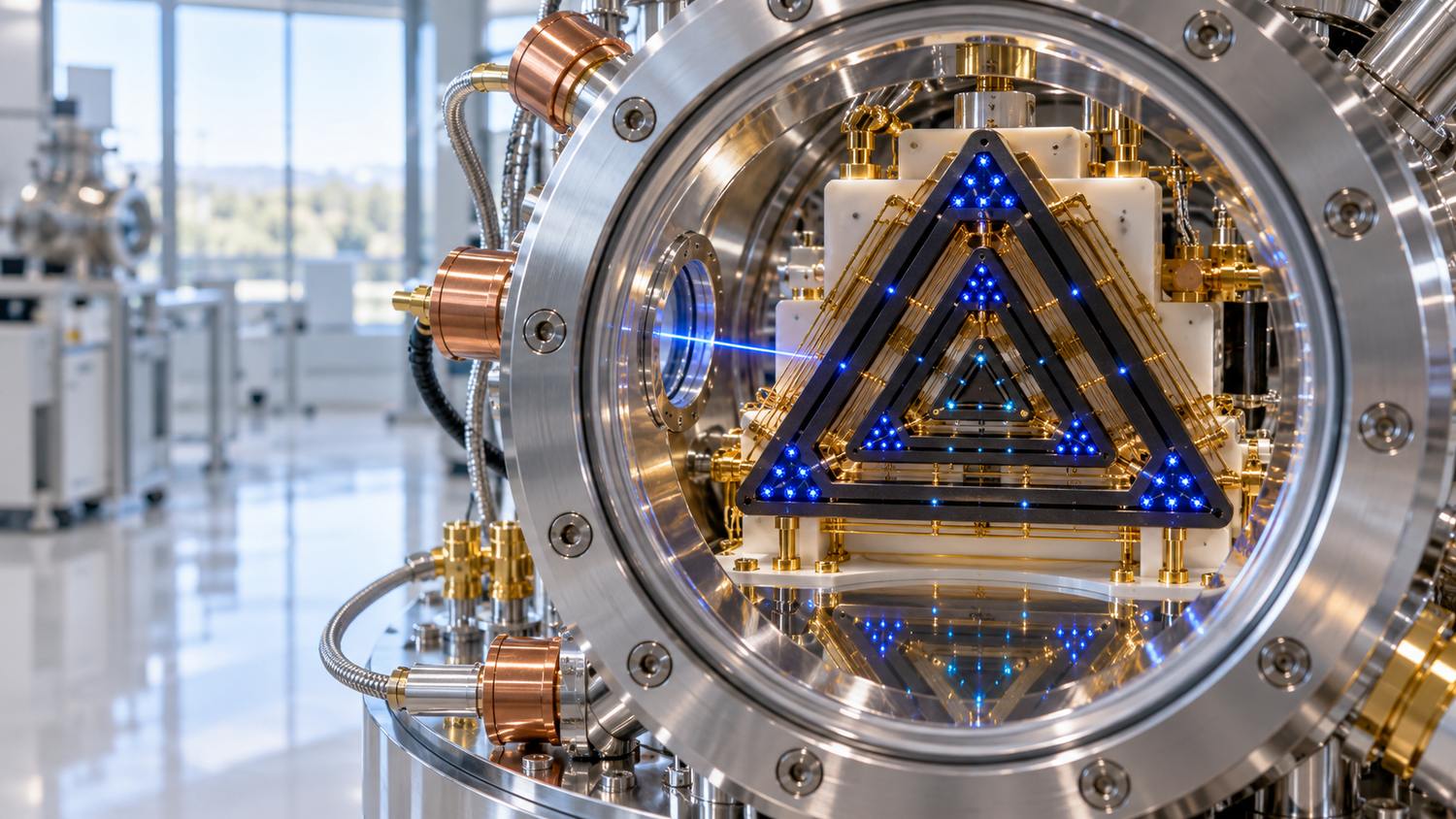
On October 19, 2026, Quantinuum announced that its Helios trapped-ion computer had held an error-corrected logical qubit at a logical error rate of 5 × 10⁻⁶ per round of error correction, five errors in a million rounds, using a distance-7 triangular color code. The press release calls the figure ten times better than the company's own September result and a hundred times better than any published figure from a superconducting processor. The technical claims sit in a 22-page preprint by Ali Lavasani, Adam P. Reed and 21 colleagues at Quantinuum's sites in Broomfield, Colorado, and London, which the company posted under the address quantinuum.com/fault-tolerance-by-2029. This post reads that preprint for what it establishes, what it leaves open, and what it changes in the arithmetic a defense buyer uses to date the end of RSA-2048.
The defense relevance is direct. The only quantum workload a program office is obliged to plan around today is cryptanalysis: running Shor's algorithm against the public-key cryptography that protects long-lived classified material, command links and signed firmware. Every published estimate of what that attack costs rests on two numbers from error-correction experiments, the logical error rate a code block can hold and the time one round of correction takes. Quantinuum has just moved the first number. It has said little about the second.
What the Helios experiment measured: distances 3, 5 and 7, 20 rounds of correction, 29,000 shots at distance 7
The experiment encodes one logical qubit in a triangular color code, a family in which the qubits sit on the vertices of a honeycomb pattern drawn inside an equilateral triangle. A distance-3 block needs 13 ions, a distance-5 block 37, and a distance-7 block 73, counting both the data qubits and the syndrome qubits that read out errors. Helios has 98 barium-137 ions in total, so the team ran six distance-3 blocks in parallel, two distance-5 blocks, and a single distance-7 block, each for 20 rounds of syndrome extraction before readout.
The results form a clean ladder. The logical error rate per round fell from 5.5 × 10⁻⁴ at distance 3 to 3.8 × 10⁻⁵ at distance 5 and 5 × 10⁻⁶ at distance 7, with the distance-7 figure resting on three failures in 29,000 shots and carrying a one-sigma interval of plus 4 and minus 2 in the last digit. The suppression factor, the ratio by which errors shrink each time the distance grows by two, came out at 12. For comparison, Google's surface-code memory experiment on Willow in 2024 reported a suppression factor of 2.14 and a distance-7 error of 0.143 percent per cycle. The Helios distance-7 figure is roughly 290 times lower than that Google number. The press release claims a more modest hundredfold margin over published superconducting results and does not identify which Google figure it measures against.
Two engineering choices carry most of the improvement. Barium ions can leak out of the two hyperfine levels that define the qubit into six neighboring levels, and a leaked ion silently corrupts every gate it touches. The team added a mid-circuit optical repump that returns leaked population to the qubit subspace without adding time to the circuit, plus a swap-based scheme that rotates data qubits out for fresh syndrome qubits every three rounds. The paper also reports that the same hardware holds a logical two-qubit Clifford gate at 7 × 10⁻⁵ error at distance 5, with a suppression factor of 9 between distances 3 and 5, so the result covers computation and memory alike.
The headline figures come from Tesseract, a near-optimal most-likely-error decoder that is too slow for real-time use. The team therefore trained two neural-network decoders on emulator data and ran them on the hardware syndromes without fine tuning. Both reproduced the below-threshold scaling, and the paper states their inference latency at a few hundred microseconds, an order of magnitude faster than the syndrome extraction rate. That clause is the only clock the preprint offers, and the next section turns on it.
Quantum pillar: computing (cryptanalysis). Use posture: dual-use. Technology readiness: TRL 3 of 9. A single logical qubit survived 20 rounds of correction on a commercial trapped-ion processor, which is an experimental proof of concept for the error-corrected memory and Clifford gates that any cryptanalytic circuit would need, with no algorithm run on the encoded qubits and no magic-state layer yet demonstrated below threshold.
Why five errors per million moves the RSA-2048 estimate on one axis and leaves the other untouched
The reference point for defense planning is Craig Gidney's 2025 estimate that a 2048-bit RSA key could be factored in less than a week with fewer than one million noisy qubits. That figure assumes a physical error rate of 0.1 percent, a surface-code cycle time of one microsecond, a planar grid with nearest-neighbor connections, and a control system that reacts within ten microseconds. The qubit count follows from the distance each code block needs to hold a circuit of billions of operations within its error budget, and that distance is set by the suppression factor.
Helios changes that term. A suppression factor of 12 means each step of two in distance buys more than an order of magnitude, where Google's 2.14 bought a factor of two. A logical error budget that forces a large distance on a surface code with weak suppression could, on the Helios scaling, be met at a far smaller distance, which is why the preprint says scaled trapped-ion processors could reach application-relevant performance with substantially smaller code blocks than other modalities indicate. The paper's own stated horizon is megaquop-scale computation, a million logical operations, and the authors say the result approaches rather than reaches it. A Shor circuit for RSA-2048 needs billions of logical operations, so the gap between the demonstrated memory and the cryptanalytic workload remains three orders of magnitude in operation count.
The second axis is speed, and here the preprint is silent in a way a buyer should notice. Gidney's week rests on a one-microsecond cycle. The Helios paper reports that its neural decoders, running at a few hundred microseconds per round, are an order of magnitude faster than syndrome extraction, which puts a Helios round in the millisecond range. A circuit that takes a week at one microsecond per cycle would take on the order of a thousand weeks at one millisecond per cycle, unless the architecture recovers the difference through parallelism or through the all-to-all connectivity that lets the color code run every Clifford gate transversally. Quantinuum has published nothing on how its planned Apollo machine, which the press release places in 2029 and the preprint does not mention, would close that gap. A trapped-ion result that lowers the qubit count is therefore good news for the size of a hypothetical cryptanalytic machine and no news at all for how long it would have to run.
What stands between a color-code memory and a code-breaking machine: magic states, scale, and the two deadlines already on the calendar
The preprint lists the missing piece itself. A universal circuit encoded in the color code has three non-trivial components: magic-state preparation, two-qubit Clifford gates and syndrome extraction. Helios has now shown the last two below threshold. Magic-state preparation below threshold on a color code is the stated next step, and it is the same layer that Google addressed on the superconducting side in its magic-state cultivation paper in Science on October 15. Each company has demonstrated the component the other has not yet reported, and neither has run a full Clifford-plus-T circuit below threshold with real-time decoding.
Scale is the second gap. The distance-7 block consumed 73 of 98 ions, so Helios can hold exactly one logical qubit at that quality. Gidney's circuit needs on the order of a thousand logical qubits held simultaneously at the error budget of a week-long run. The September C4-Helix result on the same machine, which packed two logical qubits into twenty ions, points the other way on the trade between overhead and error rate. A buyer reading the two Quantinuum results together should see a vendor that can hold one excellent logical qubit or a handful of good ones, on a 98-ion machine, with a roadmap to 2029 for the universal system.
The third gap is the one that matters least to physics and most to a program office: the calendar. NIST's draft transition report, IR 8547, deprecates 112-bit-security algorithms such as RSA-2048 and P-256 after 2030 and disallows all quantum-vulnerable public-key algorithms after 2035. Those dates were set before Helios existed and do not move with it. What the Helios result does is remove one argument for sliding them: the claim that trapped ions could never reach the error rates a cryptanalytic machine would need. The remaining arguments, operation count and clock speed, are live, and a buyer who wants to put a year on Q-day should ask a vendor for the round time and the logical operation count before asking for the qubit count.
Who gains from the result, and what a buyer should ask Quantinuum before 2030
The posture reading is dual-use, and the preprint supports no narrower reading. A fault-tolerant trapped-ion machine of the kind Apollo is meant to be would serve simulation of energetic materials and optimization of logistics as readily as factoring. The offensive reading, that this brings a code-breaking machine closer, is true on the qubit-count axis and unproven on the time axis. The defensive reading, that it strengthens the case for finishing post-quantum migration by the dates NIST has set, follows directly. The same tension ran through the Monitor's reading of the 813-logical-qubit figure that Circle lifted from the ECDSA.fail leaderboard in September: a logical qubit count without a clock is half an estimate.
For a buyer, three questions separate the published result from a planning assumption. First, what is the wall-clock time of one syndrome extraction round on Helios, and what does Quantinuum project for Apollo? The preprint implies milliseconds and states nothing. Second, what is the logical error rate of a color-code magic state on this hardware, and does it scale below threshold? The authors list this as their next experiment, and until it is published the T-gate layer of any cryptanalytic circuit has no trapped-ion data point at all. Third, how many distance-7 blocks can a successor machine hold at once, and at what suppression factor once ions are transported across a larger trap? Google's 2024 paper found rare correlated error events about once an hour, and a 20-round memory experiment cannot reveal an error floor of that kind.
What the preprint establishes is narrow and solid: on October 19, 2026, a commercial trapped-ion machine held a logical qubit at five errors per million rounds with a suppression factor of 12, with neural-network decoders fast enough for real-time use and with the methods and the shot counts published. What it does not establish is a date. The post-quantum migration deadlines of 2030 and 2035 stand on their own, and this result gives a defense buyer one more reason to treat them as the earlier edge of the window, with the trapped-ion clock speed as the open question that decides whether the 2029 machine, if it arrives, would be a research instrument or a threat.
Sources
Primary source: Lavasani, Reed and colleagues (Quantinuum), "Quantum error correction well below the color code threshold," preprint at quantinuum.com/fault-tolerance-by-2029, with Quantinuum's press release of October 19, 2026. Other material: Google Quantum AI, arXiv 2408.13687; Craig Gidney, Google Research 2025; NIST IR 8547 (ipd). Analysis by Quentir.