QuPrayog's Rubidium-87 CPT Atomic Clock at IISER Pune Reports 3 Parts in 10 Billion at One Second and 2 Parts in 100 Billion at 1,000 Seconds Against ISRO's RAFS Tender: TRL 4
Quentir Defense Monitor
Evidence-based insights for quantum defense and security. Published by Quentir Systems LLC · November 23, 2026.
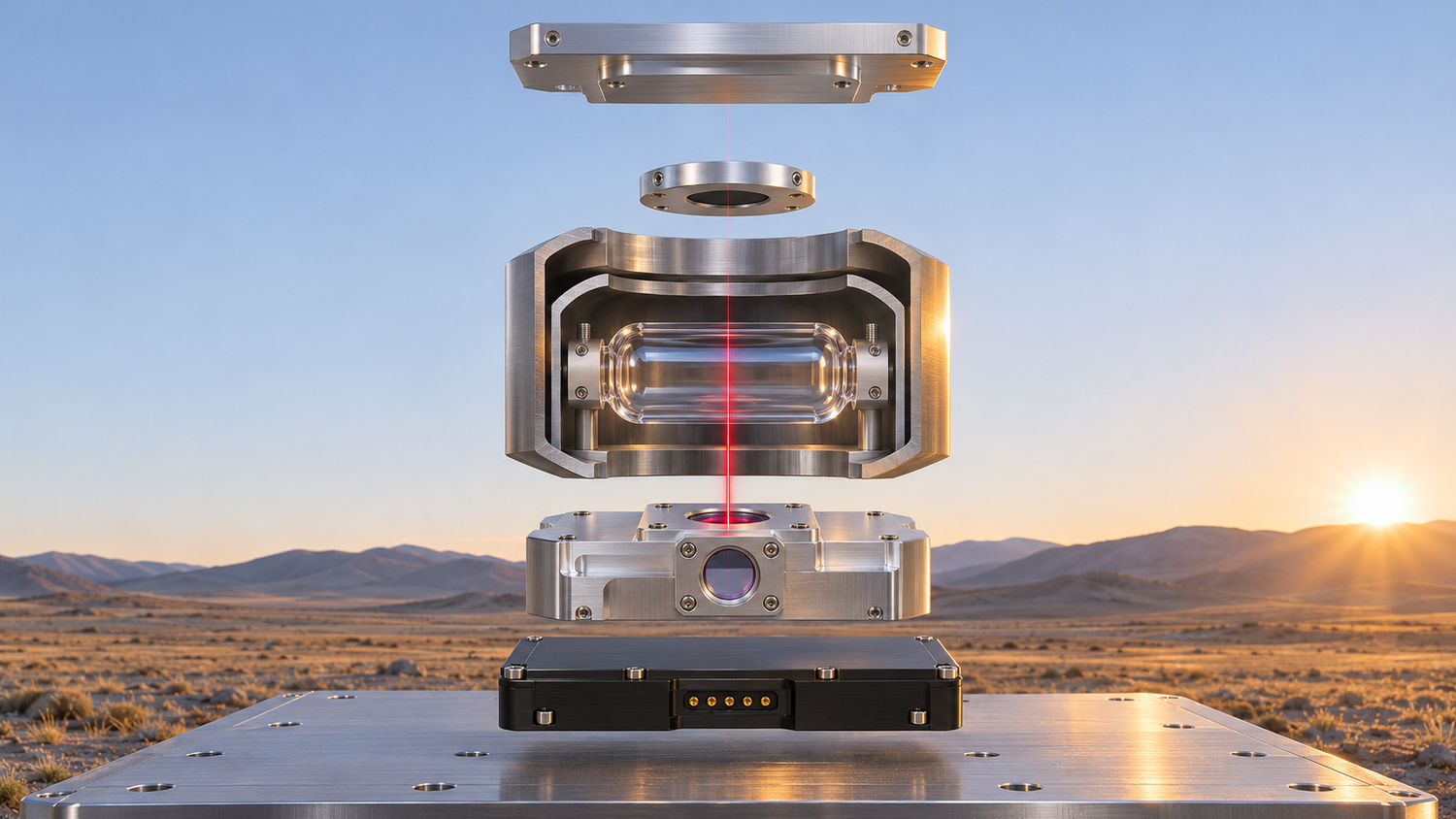
QuPrayog, a startup incubated at the I-HUB Quantum Technology Foundation of the Indian Institute of Science Education and Research in Pune, told the press on 21 November 2026 that it has built a laboratory-scale atomic clock around rubidium-87 atoms interrogated by laser light, and that bench tests showed a fractional frequency stability of about 3 parts in 10 billion over one second, improving to about 2 parts in 100 billion over 100 to 1,000 seconds. The company completed the prototype in seven months, says the clock improved an ordinary crystal oscillator's stability about fiftyfold over 1,000 seconds, and aims to deliver a miniature version by August 2027. The Times of India report carries the figures as company statements, with Kunj Tandon, chief executive of the I-Hub Quantum Technology Foundation, explaining that the design uses light in place of the microwave cavity of a conventional rubidium clock, which is what makes a smaller instrument with lower power demand possible.
This post reads the prototype as a timing capability for a force and a country that want to hold position, navigation and timing when satellite signals are jammed, spoofed or unavailable, places it at the laboratory rung of the readiness ladder with a defensive posture, and sets the reported numbers beside two public Indian reference points: the rubidium clock ISRO's Space Applications Centre built for the NVS-01 navigation satellite, and the stability specification ISRO published in October 2025 when it invited vendors to supply the next such clocks.
What QuPrayog reported on 21 November 2026: a laser-interrogated rubidium-87 clock, its stability at one second and at 1,000 seconds, and a fiftyfold gain over a crystal oscillator
The prototype works by coherent population trapping. A laser carrying two frequencies illuminates a vapor of rubidium-87 atoms, and when the difference between the two frequencies equals the hyperfine splitting of the atom's ground state, the atoms settle into a state in which they stop absorbing the light. The vapor turns transparent at exactly that frequency difference, a photodetector behind the cell registers the change, and an electronic loop steers a crystal oscillator so that the two laser frequencies stay on the transparency; the oscillator's output then inherits the stability of an atomic transition. NIST described the same effect when it announced the first chip-scale atomic clock in August 2004: cesium atoms in a sealed cell probed by a small infrared laser enter what the announcement calls a "dark state" in which they stop absorbing and emitting light, and that point defines the resonance frequency. The NIST physics package consumed less than 75 milliwatts and was stable to one part in 10 billion, and without a microwave cavity the physics package of such a clock can be far smaller and lighter than a conventional rubidium standard.
The numbers QuPrayog gives put its bench prototype in that first chip-scale class on short time scales. A fractional instability of 3 parts in 10 billion over one second means that the clock's frequency, averaged for a second, wanders by about that fraction from one second to the next, and the 2 parts in 100 billion figure over 100 to 1,000 seconds means that longer averaging narrows the wander. Accumulated timing error over 1,000 seconds cannot be calculated from these stability figures alone because a constant frequency offset can accumulate error without changing stability. A satellite's clock is additionally steered from the ground, so the reported bench stability is an input to a system design and no measure of navigation accuracy.
The report also shows what the company did not report: no size, mass or power figure for the prototype, no stability beyond 1,000 seconds, no daily drift or aging rate, no temperature sensitivity and no behavior under vibration. Jay Mangaonkar, chief executive and co-founder, framed the purpose in the article: position, navigation and timing is central to India's strategic independence, Indian private companies are advancing in low Earth orbit navigation and GPS-denied navigation, and the aim is to reduce dependence on imported atomic clocks and build a domestic supply chain for high-performance timing systems.
Why India already flies its own rubidium clock: the Space Applications Centre's RAFS on NVS-01 since July 2023, and how it differs from a laser-interrogated cell
The second-generation NVS-01, launched in May 2023, was the first to carry a rubidium atomic frequency standard developed at ISRO's Space Applications Centre in Ahmedabad, and ISRO's mission brochure for the launch describes the space-qualified clock as a technology only a handful of countries possess. In a presentation to the International Committee on GNSS in 2023, the Space Applications Centre's Atomic Clock Development Division reported that the clock was fully qualified, that the first flight model flew on NVS-01 in May 2023 and had been in service since the first week of July, and that the satellite's user range error specification was met with the indigenous clock. The slide describes the physics package as a lamp-pumped rubidium cell with an integrated filter cell and custom magnetic shields, the classical lamp-and-cavity architecture of a satellite rubidium standard, and QuPrayog's laser scheme removes that cavity. The government laboratory has built a satellite-grade instrument for geosynchronous navigation payloads; the startup has a bench prototype of a compact architecture whose natural destinations are a small satellite, a ground receiver or a vehicle.
Quantum pillar: sensing (clocks and timing). Use posture: defensive. Technology readiness: TRL 4 of 9. The reviewed report describes a laboratory-scale clock assembled from a laser, a rubidium vapor cell, optics and control electronics, with stability measured on the bench, supporting placement at the bench assembly and laboratory testing rung.
The specification a buyer would hold it against: ISRO's tender of 14 October 2025 for a space-qualified RAFS asks 5 parts in a trillion at one second and 1.5 parts in 10 trillion at 1,000 seconds
ISRO's Space Applications Centre published a request for proposal on 14 October 2025 for a space-qualified rubidium atomic frequency standard for the NVS navigation payload, with bids due on 14 November 2025. The technical exhibit sets the frequency stability the clock must better at any fixed temperature in its operating range: 5.0 parts in a trillion at one second, 1.5 parts in a trillion at 10 seconds, 5.0 parts in 10 trillion at 100 seconds, 1.5 parts in 10 trillion at 1,000 seconds, and 5.0 parts in 100 trillion at 10,000 seconds with drift removed, and it asks for an engineering model six months after contract start and two flight models at 21 months. Set beside that table, QuPrayog's bench figures are about 60 times short at one second and about 130 times short at 1,000 seconds. A buyer should read those ratios fairly: the tender specifies a clock for the NVS payload, which on NVS-01 flew on a geosynchronous satellite of about 2,232 kilograms with a twelve-year mission life, and a coherent population trapping clock is built to a different size, power and cost point, trading stability for volume. The tender is nevertheless the only public, official Indian statement of what a navigation payload clock must do, and it shows that ISRO buys such clocks from vendors, so a domestic supplier that can qualify a product has a customer that has already published its requirement.
What the prototype would let a force hold, who gains, and what stands between a bench result and a program office
A clock is a defensive capability in the plain sense the capability map uses: its value lies in holding one's own timing when the satellite signal that normally supplies it is denied. Military communications networks, radar systems, encrypted links and the receivers in aircraft, ships and vehicles take their time from a GNSS signal when they can, and when the signal is jammed or spoofed they fall back on a local oscillator whose drift decides how long they keep operating coherently. The company reports a fiftyfold improvement in frequency stability over a crystal oscillator at 1,000 seconds. The same clock inside a low Earth orbit navigation satellite, which is where the company says India's private operators are heading, gives the satellite a stable reference to transmit. Nothing in the device acts on an adversary's systems, so the posture reads as defensive, although the civil beneficiaries are the same telecommunications and timing networks the company lists.
Who gains is India, specifically. The government's National Quantum Mission, approved on 19 April 2023 with an outlay of 6,003.65 crore rupees for 2023-24 to 2030-31, lists atomic clocks for precision timing, communications and navigation among its deliverables; QuPrayog says its development receives support from that mission. The strategic logic is supply-chain independence: a country whose navigation satellites and defense networks depend on imported clocks accepts an export-control exposure that a domestic vendor removes, and the public sources support that as a stated direction; they do not yet show it achieved.
What stands between the bench result and a program office is the engineering the company itself says comes next. Every figure is company-reported, and the reviewed sources cite no paper, conference talk or third-party measurement. The stability curve stops at 1,000 seconds, and a navigation or holdover clock is judged at a day and over months of aging, and the company's own stated path runs through performance, reliability and packaging before the August 2027 miniature. For comparison on the same ladder, Infleqtion's Tiqker optical clock ran two weeks aboard a US Navy research vessel during a 2026 exercise, which this Monitor placed at TRL 6; the gap between that trial and QuPrayog's bench is the gap between a prototype that has run where it would serve and one that has proved a physics package in a laboratory.
The buyer's questions for QuPrayog before the August 2027 miniature
A program office or an Indian satellite integrator reading the announcement has a short list of questions whose answers would move the entry up the ladder. The first concerns the stability at 10,000 and 86,400 seconds and the drift rate, measured against a stated reference, since those decide holdover and satellite use. The second concerns the size, mass and power of the prototype today and the targets for the 2027 miniature, which determine whether the device competes with chip-scale clocks or with rack-mounted rubidium standards. The third concerns the temperature coefficient and the behavior under vibration, since a clock that holds its figures only on a quiet bench holds them nowhere a force needs them. The fourth asks which customer requirement the company is designing to, whether ISRO's published RAFS exhibit, a low Earth orbit constellation operator's specification or a defense holdover requirement, because each asks for a different clock. The public evidence as of 23 November 2026 supports the laboratory placement given above and no higher rung.
Sources
Primary source: The Times of India, "IISER-Pune startup develops atomic clock for next-generation satellite navigation," 21 November 2026. Other material: NIST, 27 August 2004; ISRO Space Applications Centre ICG-17 presentation, 2023 (UNOOSA); ISRO SAC RFP 02/2025-26, 14 October 2025; ISRO GSLV-F12/NVS-01 brochure, 2023; PMO India, National Quantum Mission approval, 19 April 2023. The timing arithmetic, the capability reading, the posture argument, the readiness placement and the buyer questions are Quentir analysis.