Sorbonne, Welinq and Leiden Demonstrate Private Quantum Networked Sensing With a Four-Photon GHZ State at 96.9 Percent Fidelity, arXiv 15 September 2026
Quentir Defense Monitor
Evidence-based insights for quantum defense and security. Published by Quentir Systems LLC · September 16, 2026.
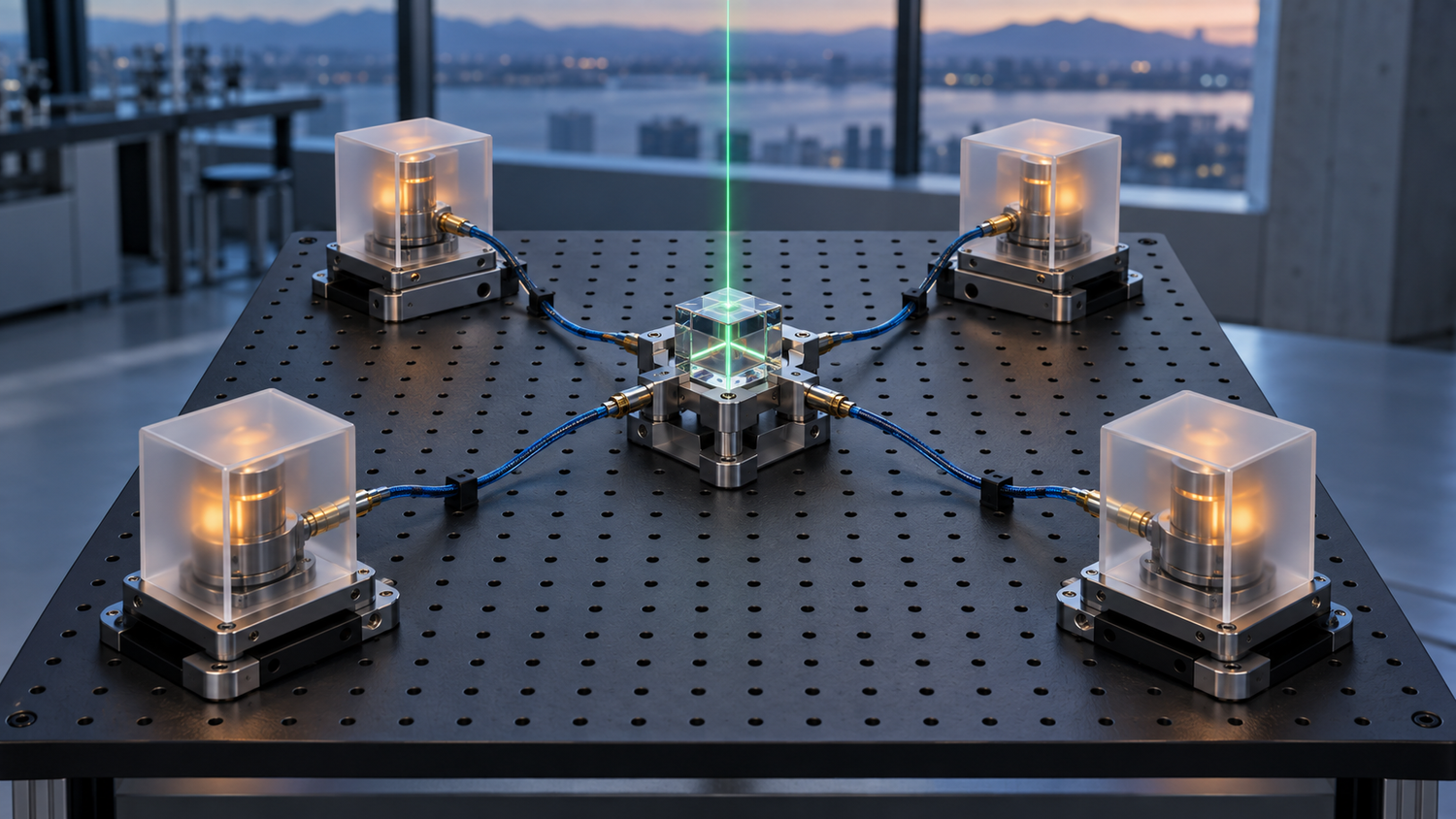
A team from Sorbonne Université's LIP6 laboratory, the Paris quantum-networking company Welinq, Instituto Superior Técnico in Lisbon and Leiden University posted a paper to arXiv on September 15, 2026 that answers a question every shared sensor network eventually raises: how do four parties combine their measurements into one joint result without any of them, or the operator of the network between them, learning what the others measured? Their answer runs on a real four-photon entangled state, and it is the first laboratory demonstration of private quantum networked sensing that both performs the estimation and certifies a privacy bound at the same time.
The paper, "Experimental Private Quantum Networked Sensing" by Nicolas Laurent-Puig, Laura dos Santos Martins, Luis Bugalho, Santiago Scheiner, Majid Hassani, Sean William Moore, Damian Markham and Eleni Diamanti, is available on arXiv. The premise is familiar in distributed quantum sensing: if you entangle distant sensors, you can estimate a global function of their local readings, the average phase across all of them for example, with a precision no set of independent sensors can match. The new problem the Paris group has worked on since 2022 is that the same entanglement carries risk. Whoever supplies the entangled state, and whoever runs the network, sits in a position to learn the individual readings. In a coalition sensor network, that is exactly the information the participants may least want to share.
What the four-photon experiment in Paris actually measured, and how the privacy bound of 0.70 was tested
The apparatus is a table-top photonic source. A titanium-sapphire laser at 775 nanometers, pulsed at 76 megahertz, pumps a periodically poled potassium titanyl phosphate crystal in a layered Sagnac configuration to produce a four-qubit Greenberger-Horne-Zeilinger state in photon polarization. The authors report a fidelity of 96.88 percent to the ideal GHZ state, with a fourfold coincidence rate of about 10 hertz counted on superconducting nanowire single-photon detectors. Each of the four photons stands in for one network node. Each node encodes its local parameter as a phase rotation on its own photon, and the quantity the network agrees to estimate is the sum of the four phases.
The protocol has two stages, and the first is where the privacy comes from. Before any estimation, the parties run a certification round: they draw random stabilizer tests from the GHZ stabilizer group, measure them on a large batch of copies, and accept only if the number of failures stays under a threshold. In the experiment the batch was 10,001 copies with a failure threshold of 300. Passing that test bounds how far the delivered state can be from the ideal GHZ state even when the source and the network are in hostile hands. The estimation stage then runs on the surviving copies: every party rotates its qubit by its local phase, measures in the X basis and announces only the parity of its result. The public statistics reveal the sum. They do not reveal the terms.
The numbers the test establishes are modest and honest. The certification stage sets a fidelity floor of 0.70 at the chosen statistical significance, which translates through the paper's privacy parameter into a privacy floor of 0.70, meaning that at most 30 percent of the quantum Fisher information available to a hostile party could concern anything other than the agreed sum. In the direct comparison the authors run, the measured GHZ state gives a privacy parameter close to 0.999, two Bell pairs give about 0.50, and a fully separable state gives about 0.25. With 30 protocol rounds, the mean relative error on the sum was around 11 percent; with about a thousand rounds it fell to between 6 and 9 percent depending on the estimator. A simulated attacker who injected 20 percent corrupted states was still accepted by the certification test, and the paper shows the attacker's advantage in inferring any local parameter stays negligible below roughly 5 percent injection.
The theory comes from the same laboratory. Nathan Shettell, Majid Hassani and Damian Markham introduced the concept in their 2022 paper on private network parameter estimation with quantum sensors, where they already pointed to secure networks of clocks as the application to watch. A follow-up by Jarn de Jong, Santiago Scheiner and colleagues in Physical Review Applied in November 2025 extended the idea to anonymous participation, letting a subset of network members estimate the average of their private parameters without revealing their values or their identities. The September 2026 paper is the first time the estimation and the tested privacy bound have been run together on hardware with realistic noise. Earlier proposals needed a number of GHZ copies that no source could deliver.
Quantum pillar: networking (distributed sensor arrays). Use posture: defensive. Technology readiness: TRL 3 of 9. The full protocol ran on real photonic hardware, yet all four nodes were photons on one optical bench in Paris rather than separated sensors, so this is an experimental proof of concept, one rung below a laboratory-validated system.
Why a coalition's clock network and sensor array are the defense reading, and why the posture is defensive
The defense value of this work is easiest to see through the problem it solves rather than the physics it uses. A distributed sensor array is a set of sensors, often owned by different organizations, that behaves as one instrument. The most developed example in the defense literature is a network of clocks: several atomic or optical clocks linked so that the whole network delivers a shared time reference better than any single clock. Entangled clock networks were proposed more than a decade ago precisely because a GHZ state across the clocks lets the network estimate the average frequency with a precision that scales with the number of clocks. The same structure appears in multi-station magnetometry, where the array wants the common-mode field across a region, and in distributed apertures for radar and radio-frequency sensing, where the quantity of interest is a phase relationship across sites.
What such a network never wanted to do is publish each member's local reading. A national clock's frequency offset says something about that clock's hardware and operating state. A station's local magnetic reading says something about what is near that station. In a coalition network, or in a network that rents its links from a commercial carrier, the participants want the joint value and nothing else to travel. The Paris protocol gives them that: the network learns the agreed function, and a hostile party who controls the entanglement source and the channels can learn no more than the function, its own inputs, and combinations of the two. That is why the posture is defensive in the sense the Monitor uses the term. The value lies in protecting one's own data and one's own sensor behavior while still taking part in a shared measurement. The paper contains no adversary-facing capability. What a force gains is the ability to pool measurements with partners it does not fully trust, over infrastructure it does not fully control, without exposing the pieces.
That framing connects to a broader theme in quantum networking that Quentir has followed on the medical side, where Stony Brook aimed its quantum network at hospital patient data and ran into the same question of what a network operator is allowed to see. The private-sensing protocol is a cleaner answer than key distribution alone, because it protects the measurement itself rather than the message carrying it. It also belongs to a European program with stated ambitions. The paper acknowledges the Quantum Internet Alliance under Horizon Europe grant 101102140; the Alliance describes its goal as building the world's first full-stack quantum internet prototype network, and it has just signed a memorandum with the research-network operator GÉANT. One of the authors works at Welinq, the Paris company whose quantum memory and quantum-link products are the kind of hardware a spatially separated version of this experiment would need. The path from this bench to a fielded network is being built by the same people who wrote the paper.
What still separates a 10-hertz optical bench from a program office: separation, rate, real sensors and the trusted verifier
The paper's own limitations section is direct, and a defense reader should take it at face value. The four nodes are not distant. They are four photons emitted from one crystal and routed across one optical table, so the demonstration proves the protocol logic and the noise robustness, and it does not yet prove that the entanglement survives distribution over real fiber to real sites. The authors list distribution over spatially separated nodes as the next step. The fourfold coincidence rate of about 10 hertz limits everything downstream: a certification batch of 10,001 copies takes on the order of a quarter of an hour per round at that rate, and the authors observed that drift in the source over long acquisitions degraded the accuracy of the tomographic estimator when fewer rounds were collected. Faster polarization components could raise the rate at some cost in fidelity, which the certification threshold would then have to absorb.
Two further gaps matter more for a program. First, the local parameters here are phases applied to photons with wave plates. No clock, no magnetometer and no radio-frequency sensor was in the loop. The authors name nitrogen-vacancy centers and atomic clocks as the sensors to integrate, and that step is the difference between a network protocol and a networked sensor. Second, the protocol as run relies on an external verifier party to coordinate the certification tests. The paper notes this role can be removed by symmetrizing the protocol across participants, and that removal will have to be demonstrated before a coalition could adopt the scheme, since a trusted third party is the thing the whole design set out to avoid. Readers who followed the Farseer program's attempt to put quantum sensors on a fielding clock will recognize the shape of the gap: the physics is sound, and the engineering of rate, ruggedness and integration is where the years go.
For a buyer, the honest summary is this. The entangled sensor network concept now has a working privacy layer, demonstrated on hardware with a tested bound rather than an assumed one, and the advantage of a genuine GHZ state over Bell pairs and unentangled sensors is measured rather than argued. The privacy floor in this run, at 0.70, leaves room that a program office would want closed, and closing it means better sources and larger certification batches. A program that expects to share timing or field measurements with partners over infrastructure it does not own should put this line of work on its watch list, with the expectation that the next results to look for are a separated-node demonstration over deployed fiber, an integration with a real clock or magnetometer, and a verifier-free version of the protocol. None of those is a physics obstacle, and all of them are engineering work with a schedule a program office can hold a vendor to.
Sources
Primary source: Nicolas Laurent-Puig, Laura dos Santos Martins, Luis Bugalho, Santiago Scheiner, Majid Hassani, Sean William Moore, Damian Markham and Eleni Diamanti, "Experimental Private Quantum Networked Sensing," arXiv 2609.16743, September 15, 2026. Other material: the 2022 protocol paper by Nathan Shettell, Majid Hassani and Damian Markham hosted by the LIP6 Quantum Information team; the November 2025 Physical Review Applied paper by Jarn de Jong, Santiago Scheiner, Naomi R. Solomons, Ziad Chaoui, Damian Markham and Anna Pappa; the Quantum Internet Alliance's program pages; and Welinq's product pages.