Thales Alenia Space and ESA Sign Two TeQuantS Contract Amendments on 16 November 2026 for a CNES Quantum Laboratory to Test an Entangled Photon Source and Satellite-Ground Timing Before QINSAT: TRL 4
Quentir Defense Monitor
Evidence-based insights for quantum defense and security. Published by Quentir Systems LLC · November 21, 2026.
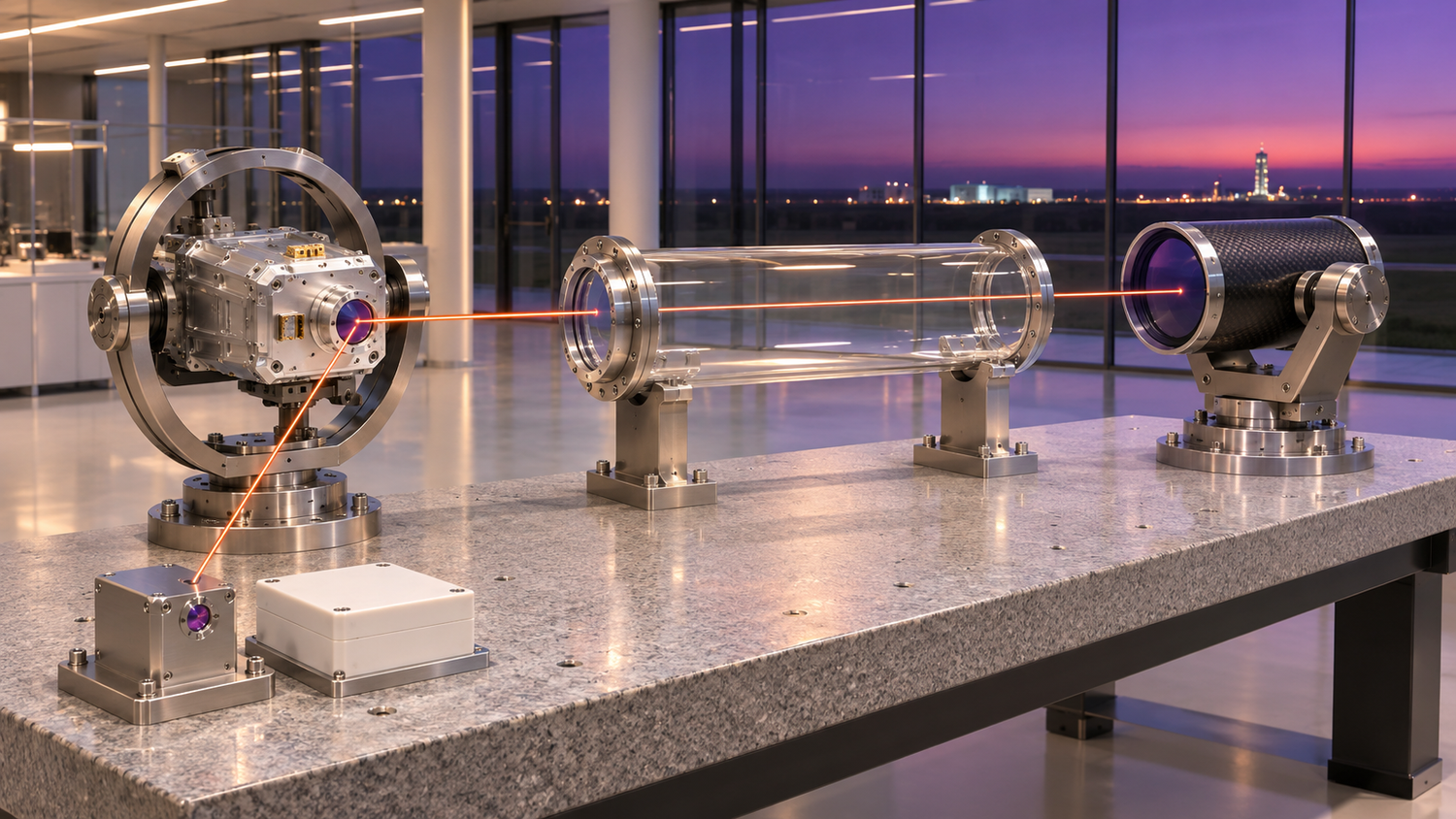
On 16 November 2026 Thales Alenia Space and the European Space Agency announced two amendments to the contract for TeQuantS, a project started in 2023 to develop the technologies for quantum communication links between satellites and the ground, and the amendments open a new phase built around a quantum laboratory at the French space agency CNES. In that laboratory the consortium led by Thales Alenia Space will test an entangled photon source, time synchronization systems between a satellite and its ground stations, and the photon analysis and detection systems that sit on the ground, with the aim of establishing a space-to-Earth quantum link under simulated operating conditions. The Thales Alenia Space press release states that the first phases produced a compact ground station prototype and a first engineering model of the quantum communications system, and that the laboratory results will feed QINSAT, the satellite meant to demonstrate the transmission of entangled photons between space and Earth. ESA's own announcement places the project in the Industrial Competitiveness line of its ARTES 4.0 program.
This post reads TeQuantS as Europe's entanglement-based route to the space segment of satellite quantum key distribution and to the wider quantum information network that Thales Alenia Space and ESA describe. It places the hardware at the laboratory rung of the readiness ladder and reads its posture as dual-use, because the same entangled-photon link that would give a government operator a sovereign key supply would also connect quantum sensors and quantum computers for civil users. The amendments carry no published value and no dates, so the readiness placement rests on the hardware the two releases describe.
What the TeQuantS consortium built between 2023 and 2026 and what the CNES laboratory will test: an engineering model, a compact ground station and three link subsystems
A satellite that distributes entanglement sends one photon of each pair down to a ground station, or one photon to each of two ground stations, and the value of the link depends on whether the receivers can tell which detection events belong to the same pair. The three subsystems the laboratory will test map onto that problem. The entangled photon source comes from AUREA Technology, which the release credits with a space-qualified source; the quantum channel time synchronization comes from SIGMAWORKS; the optical ground stations come from OGS Technologies, with BERTIN ALPAO supplying the adaptive optics and the optical test bench and BERTIN TECHNOLOGIES the optomechanical focal-plane assemblies. Airbus Defence and Space shares the quantum systems role with Thales Alenia Space, and LIP6 at Sorbonne Université and INPHYNI at Université Côte d'Azur and CNRS advise on protocols and on the system as a whole.
A laboratory stage sits between the engineering model and a satellite because the three subsystems only work as one instrument. The two photons of a pair leave the source within a window far shorter than the spacing between successive pairs, and a ground receiver whose clock is not aligned with the satellite's to within that window loses the correlation that makes the photons useful, since accidental coincidences with background light then outnumber the true pairs. Adaptive optics do the same job at the other end of the chain: atmospheric turbulence spreads and wanders the incoming beam, and a telescope that cannot correct for it couples fewer photons into its detector, which lowers the pair rate and raises the share of background. Testing the three together under simulated link conditions, before any of it flies, is the step the amendments pay for. The releases call the ground station prototype compact and give neither its aperture nor the pair rate the engineering model achieves.
Thales Alenia Space also gives the reason Europe wants satellites in the chain at all: terrestrial optical fiber can carry quantum information directly over only about 150 kilometers, because the photons that encode it cannot be amplified without destroying the quantum state, and loss grows exponentially with fiber length. A free-space link from orbit loses photons to beam spreading and to the atmosphere, and over a thousand kilometers it loses far fewer of them than the same length of glass would take. The Defense Monitor covered the detector end of this chain when Creotech Quantum took superconducting nanowire detectors for satellite QKD ground stations under a separate ESA contract in September 2026; TeQuantS is the French-led line that works from the source and the synchronization downward.
Quantum pillar: networking (satellite QKD). Use posture: dual-use. Technology readiness: Quentir's unconfirmed assessment is TRL 4 of 9. The releases report development of a first engineering model of the TeQuantS quantum communications system and a compact ground station prototype, and the CNES laboratory campaign announced on 16 November 2026 will test equipment under simulated link conditions. No TeQuantS photon has yet been sent from orbit.
Where TeQuantS sits in Europe's space segment: EuroQCI, the Eagle-1 prototype due in late 2027 and the QINSAT, QKD-GEO and SAGA missions Thales Alenia Space leads
The European Commission's EuroQCI initiative, launched with a declaration in 2019 that all 27 Member States have since joined, is building a quantum communication infrastructure with a terrestrial segment of fiber networks linking strategic sites and a space segment based on satellites, and the Commission describes it as an integral part of IRIS², the EU's secure connectivity system. The Commission's EuroQCI page says the space segment will build on Eagle-1, the first prototype satellite developed by ESA and an industrial consortium, due to launch in late 2027, with a first-generation constellation to follow under IRIS². ESA's Eagle-1 page adds that SES Techcom leads that consortium, that Tesat Spacecom of Germany builds the quantum key payload on a SITAEL platform, and that three years of in-orbit validation are to follow the launch.
TeQuantS is a different line within the same ESA program. Eagle-1 distributes keys from low Earth orbit with a payload that sends encoded photons to an optical ground terminal; TeQuantS develops the equipment for a link built on entangled pairs, which can serve entanglement-based key distribution and, beyond keys, the exchange of photonic qubits between quantum computers and the linking of quantum sensors that the ESA release lists as future uses. Thales Alenia Space lists three missions it leads: QINSAT, to demonstrate quantum information networks in orbit; QKD-GEO, which the company describes as the first quantum key distribution system from geostationary orbit, intended for intercontinental links; and SAGA, Europe's first orbital system for generating cryptographic keys whose security rests on quantum physics. Quentir's daily blog followed the other ScyLight satellite line in September, when DAS Photonics' faint pulse source passed space qualification for ESA's QKDSat, and the policy caveat raised there applies here too.
What a European entangled-photon satellite link would let a force do, who gains from it, and why the posture reads dual-use
The defensive value the releases describe is a key supply for institutional users that does not depend on fiber routes through third countries or on a constellation another power operates. ESA's announcement promises sovereign end-to-end secure information exchange for institutional users, and Alcino De Sousa, Senior Vice President Telecommunications at Thales Alenia Space, speaks of links "with a clear operational objective" that contribute to European sovereignty. For a ministry, an embassy network or a deployed headquarters the practical meaning is a channel for fresh key material over intercontinental distance whose interception would in principle be detectable, against an adversary who collects encrypted traffic now and expects to decrypt it with a future quantum computer. The EU's overseas territories, which the Commission's page includes in the coverage, are the clearest case where no European fiber route exists.
The limit on that value comes from the United Kingdom's National Cyber Security Centre, whose paper on quantum networking technologies of 5 August 2025 states that the NCSC will not support the use of QKD for government or military applications and recommends post-quantum cryptography as the primary mitigation of the quantum threat. The paper's reasons travel directly to TeQuantS: QKD does not provide authentication, so the participating parties and protocol exchanges require authentication through post-quantum cryptography or symmetric cryptography using pre-shared keys, and the integration of specialized quantum hardware with existing networks adds complexity and attack surface that the NCSC does not want in a government system. Quentir recommends that a program office considering a future TeQuantS key service use it as a second layer beside lattice-based key establishment, the way NEC and IBM Japan combined a QKD key with ML-KEM-768 in one TLS handshake in the demonstration this Monitor covered on 18 November 2026, and never as a substitute for the post-quantum migration already under way.
The dual-use reading comes from the other two user groups in the releases. ESA and Thales Alenia Space both say the network will connect interoperable quantum sensors to enhance the sensitivity of detection systems, and a network that synchronizes and entangles separated sensors is the same tool whether those sensors map the Earth's gravity field for geodesy or watch for the magnetic and gravitational anomaly a concealed platform makes; neither release says which. The third user group, quantum computers exchanging photonic qubits for distributed computation, is civil in every example given. A capability that serves a government key supply, a distributed sensing instrument and a research computing network at once is dual-use in the sense this Monitor uses the word.
What stands between the amendments of 16 November 2026 and a program office relying on a TeQuantS link: missing numbers, the QINSAT date and the authentication layer
The two releases establish the structure of the program and the state of its hardware, and they leave out every number a buyer would need: the value of the amendments, a schedule for the CNES laboratory, a launch date or an orbit for QINSAT, the pair rate of the engineering model, a link budget, the residual timing error of the synchronization system, the aperture of the compact ground station, the efficiency of its detectors and any key rate. The laboratory campaign is described as testing under simulated real-world operating conditions, which is the next rung of the readiness ladder if it succeeds, and QINSAT would be the first flight of TeQuantS equipment. Nothing in either release describes a photon received from orbit by this consortium's hardware.
The questions that follow for a program office are concrete. The laboratory's pass criteria, including the pair rate at the receiver, the ratio of true coincidences to accidental ones, the synchronization residual and the coupling gain the adaptive optics deliver, would show whether the three subsystems work as one instrument. The planned QINSAT orbit, the number and location of ground stations, and the availability of the optical link under cloud cover and in daylight would show how much key material a user could expect per day and from where. The authentication scheme and the interface through which a key leaves the ground station would show whether the service can implement Quentir's recommendation to combine QKD with post-quantum key establishment, and the governance of the service, as a EuroQCI and IRIS² institutional asset or as a national French capability, would decide which users may rely on it at all. The amendments of 16 November 2026 let the consortium answer the first set of questions in a laboratory at CNES; the rest wait for QINSAT.
Sources
Primary source: Thales Alenia Space, press release of 16 November 2026 on the TeQuantS contract amendments and the CNES quantum laboratory. Other material: ESA RNC news of 16 November 2026; the European Commission's EuroQCI policy page, updated 5 November 2026; ESA, "Eagle-1," 12 October 2022; the NCSC, "Quantum networking technologies," 5 August 2025. The capability reading, the posture argument, the readiness placement and the buyer questions are Quentir analysis.