Zhejiang University's Fang, Chen and Zhao Extend a Rydberg Atomic Receiver's Linear Dynamic Range by 14.44 dB in Simulation Only, arXiv 2611.18181, 13 November 2026: TRL 3
Quentir Defense Monitor
Evidence-based insights for quantum defense and security. Published by Quentir Systems LLC · November 16, 2026.
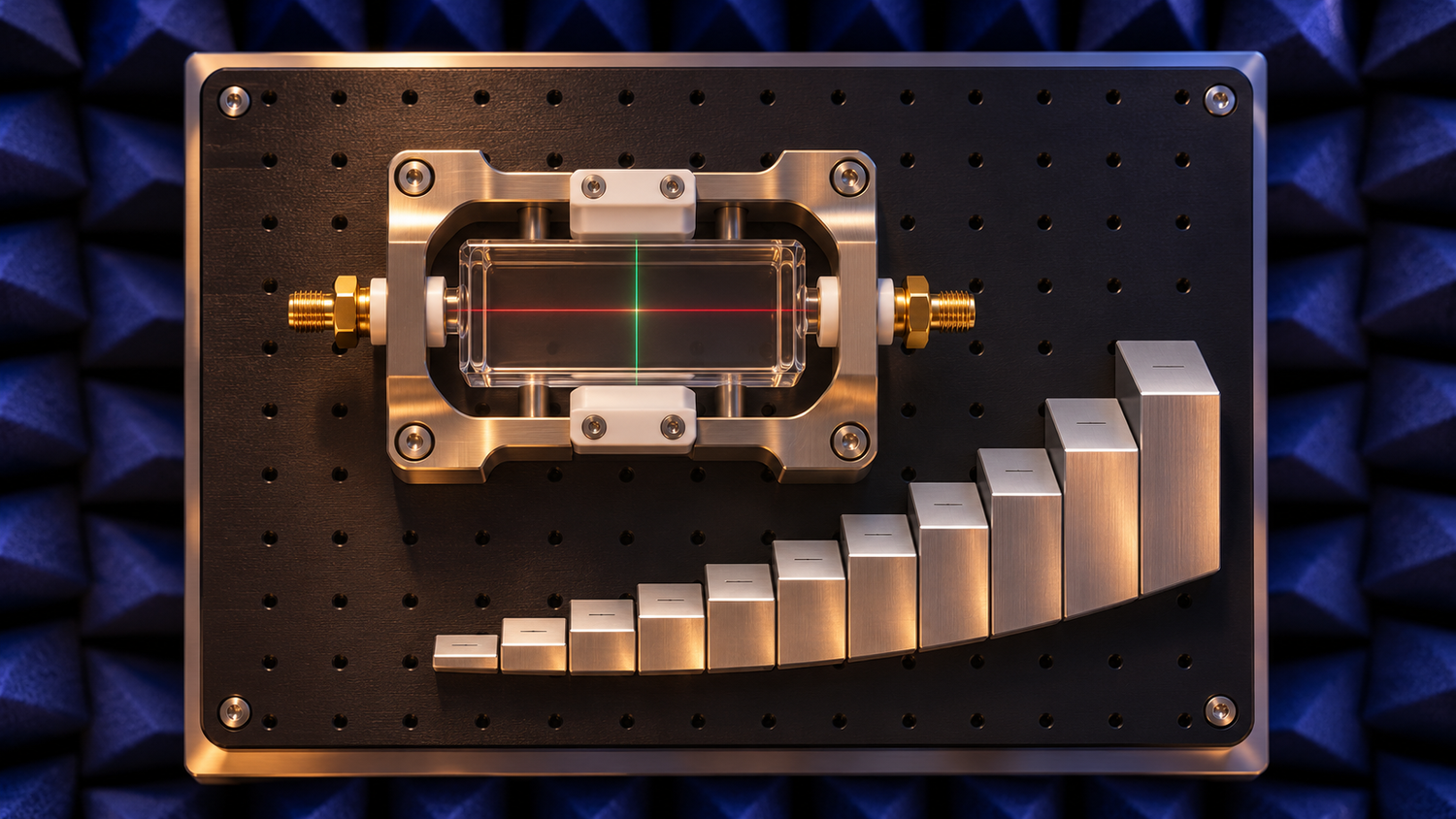
A Rydberg atomic receiver turns a radio-frequency field into a change in how much laser light passes through a small glass cell of cesium vapor. That mechanism gives the receiver sensitivity across an unusually wide span of carrier frequencies. The same mechanism carries a weakness that trade press seldom mentions: the atoms respond linearly only over a narrow band of field strengths, and a strong signal pushes the receiver into distortion long before a conventional radio would complain. A preprint submitted to arXiv on 13 November 2026 by Meng Fang, Lebin Chen and Ming-Min Zhao of Zhejiang University in Hangzhou, Jun-Rong Chen of the Harbin Institute of Technology and Bin-Bin Wei of the Institute of System Engineering in Tianjin addresses that weakness with software alone. Their method, physics-informed band-limited iterative reconstruction, which they abbreviate PI-BLIR, extends the receiver's linear dynamic range by 14.44 dB in simulation and lowers the bit error rate of a 16-QAM link at field strengths where the uncorrected receiver fails.
The result sits at an early stage, and the paper says so in its own terms. No vapor cell was driven. The receiver exists as a model of a room-temperature cesium ladder scheme, and the algorithm was tested on synthetic waveforms with additive white Gaussian noise. The paper still deserves a defense reader's attention because dynamic range, more than sensitivity, decides whether an atomic receiver can operate anywhere near friendly transmitters, a radar or a jammer.
Why a cesium vapor cell distorts strong signals: envelope magnitude and the curve of the atomic response
The receiver in the paper is a two-color, four-level ladder scheme. A probe laser at 852 nm and a coupling laser at 510 nm excite cesium atoms into a Rydberg state, and an incoming radio-frequency field alters the transmission of the probe light through the cell. NIST demonstrated the measurement principle in 2014, with a probe that read fields as weak as 0.8 millivolts per meter between 1 and 500 GHz. To receive a modulated signal, the Zhejiang model adds a local-oscillator field offset in frequency from the signal carrier by the intermediate frequency, so the atoms see the sum of the two fields and the photodetector output follows the envelope of that sum through the atomic response function, which the authors write as S(E).
That arrangement produces two nonlinearities, and the paper separates them cleanly. The first is envelope-magnitude formation: the atoms respond to the magnitude of the combined field, so the complex amplitude of the signal is folded into a real envelope before it reaches the detector. The second is the curvature of S(E) itself. The transmission feature is steepest at one field strength, which the authors compute as 5.18 millivolts per centimeter for a 5 cm cell at 290 K with a coupling Rabi frequency of 40.284 MHz. Operating the local oscillator there gives the largest linear response, and the response curls over on either side. When the field grows large enough, the probe transmission drops to zero and the output carries no information at all. Short of saturation, the receiver has a 1 dB compression point beyond which distortion grows.
Two remedies existed before this paper. One tunes the physical parameters, the laser powers, the cell and the local-oscillator strength, at a cost in bandwidth or sensitivity. The other inverts the known response function in software. The paper cites earlier work that extended a Rydberg homodyne receiver's linear dynamic range by more than 7 dB with such an inverse-function method, and it identifies the cost: near saturation the inverse becomes ill-conditioned and amplifies noise, and it neglects the envelope-magnitude nonlinearity entirely. The Army Research Laboratory's waveguide-coupled receiver of 2021, published in Physical Review Applied, reached a linear dynamic range above 80 dB with 4 MHz of instantaneous bandwidth from DC to 20 GHz and a sensitivity better than −145 dBm/Hz with a preamplifier. The Zhejiang method addresses the ceiling that remains once the hardware is fixed.
What PI-BLIR does: a maximum-likelihood reconstruction that takes the signal bandwidth as prior knowledge
The method treats the distorted detector output as a measurement of an unknown intermediate-frequency waveform passed through a known nonlinearity, and it recovers the waveform by maximum likelihood. The first step calibrates S(E) by scanning the photodetector output over known field strengths and fitting a Lorentzian. The second sets the local oscillator at the point of steepest slope. The third gives the method its name: the authors assume the signal occupies a known frequency band and parameterize the waveform by its frequency-domain coefficients inside that band, so the bandwidth constraint is built into the unknowns and the constrained problem becomes an unconstrained one. A linearized estimate initializes the search and gradient descent with backtracking refines it. The method runs entirely as digital post-processing and changes nothing about the local-oscillator field, the optics or the atomic operating conditions.
The simulation measures two things. For the linear dynamic range, a single tone at a 100 kHz intermediate frequency is swept in amplitude and the 1 dB compression point is located for three processing chains: the raw local linear approximation, an inverse-response baseline the authors call Atomic S⁻¹, and PI-BLIR. PI-BLIR moves the compression point by 14.44 dB relative to the raw chain. For link performance, two 16-QAM cases run at 40 kilosymbols per second with peak envelope amplitudes of 4 and 7 millivolts per centimeter and a signal-to-noise ratio swept from 10 to 20 dB. PI-BLIR gives the lowest bit error rate in both cases, and the paper is candid that a gap to the ideal additive-noise reference remains, which it attributes to residual nonlinear distortion. The paper gives a channel bandwidth of 48 kHz and an intermediate-frequency band of 81 to 129 kHz.
Quantum pillar: sensing (RF spectrum sensing). Use posture: dual-use. Technology readiness: TRL 3 of 9. The reconstruction algorithm runs as working software on synthetic waveforms from a modeled cesium receiver, with no vapor cell driven and no field test, so a buyer should read the 14.44 dB figure as a simulation result that still awaits a bench measurement.
What a 14 dB wider linear range would let a force do: spectrum sensing beside its own transmitters
The defense interest in Rydberg receivers has always rested on coverage. The Army Research Laboratory said in February 2021 that its sensor operated continuously from zero frequency to 20 GHz for the first time, and it listed soldier communications, spectrum awareness and electronic warfare as the applications in view. DARPA's Quantum Apertures program, now complete, sought receivers with greater sensitivity, bandwidth and dynamic range than any classical receiver, according to the agency's program page. Dynamic range has advanced more slowly than sensitivity and bandwidth, and in the field it is the quantity that bites first, because the signal a receiver is sent to find is weak and distant while the nearest emitters, a unit's own radios, a ship's radar or a jammer a few hundred meters away, are strong and close.
A 14.44 dB extension of the 1 dB compression point corresponds to roughly five times the field amplitude, or about twenty-eight times the power, that the receiver can accept before distortion reaches 1 dB. For spectrum sensing beside friendly transmitters, coexistence testing would need to establish whether PI-BLIR can recover weak signals during simultaneous strong interference. The architecture the Zhejiang group models shares its local-oscillator heterodyne principle with the single-oscillator receiver that Surrey, Queen Mary and Southeast University analyzed for 10 MHz OFDM at 16 GHz, which this Monitor read earlier this month, and investigating PI-BLIR for that design would require adaptation and testing against its auxiliary-assisted five-level, frequency-dependent dynamic response. The posture is dual-use: the same post-processing serves a telecom receiver, a spectrum-monitoring station and an intercept receiver, and the paper itself speaks only of wireless communication and radar sensing.
What stands between the simulation and a program office: a bench run, a latency figure and a calibration that holds
The first gap is the absence of hardware. The receiver model assumes a Doppler-averaged susceptibility under the rotating-wave and weak-probe approximations, and it neglects collisional dephasing and ground-state decay. A real cell adds laser noise, temperature drift and movement of the operating point, each of which changes S(E). Because the method depends on a calibrated S(E), the first question a buyer should put is how often the calibration must be repeated and whether it can be refreshed while the receiver is listening.
The second gap is latency. The implementation operates on a complete frame of samples and iterates, and the authors defer a low-latency variant to a separate study. An electronic-warfare receiver that must hand a detection to an operator or a countermeasure within milliseconds cannot wait for a frame to fill and an optimizer to converge, so the frame length, iteration count and processor load need numbers before the method leaves the bench. The third gap is bandwidth: the simulated channel is 48 kHz wide, two orders of magnitude below the 4 MHz instantaneous bandwidth of the Army's 2021 receiver. The fourth is the saturation ceiling, which no post-processing can lift; a very strong co-site emitter would still have to be handled by attenuation or by moving the local-oscillator point.
Against those gaps the paper offers a method that is cheap to try. The evidence a program office should ask for is correspondingly modest: a two-tone intermodulation measurement on a physical cesium cell with and without PI-BLIR, a measured 1 dB compression point for each chain, a latency figure for one frame on a candidate processor, and a repeat of the measurement after the cell has warmed for an hour. If those four numbers hold up, the 14.44 dB of the simulation becomes a measured property of a receiver, and the readiness reading moves from 3 toward 4. Until then the paper is an analysis of why Rydberg receivers distort and a software route around part of that distortion, shown on synthetic data.
Sources
Primary source: Meng Fang, Lebin Chen and Ming-Min Zhao (Zhejiang University, Hangzhou), Jun-Rong Chen (Harbin Institute of Technology) and Bin-Bin Wei (Institute of System Engineering, Tianjin), "Linear Dynamic Range Extension for Rydberg Atomic Receiver via Band-Limited Reconstruction," arXiv 2611.18181, submitted 13 November 2026. Other material: Meyer, Kunz and Cox (CCDC US Army Research Laboratory), "Waveguide-Coupled Rydberg Spectrum Analyzer from 0 to 20 GHz," Physical Review Applied 15, 014053, 27 January 2021; US Army DEVCOM Army Research Laboratory, "Army researchers detect broadest frequencies ever with quantum receiver," 4 February 2021; DARPA, Quantum Apertures program page, read 16 November 2026; NIST, "NIST Quantum Probe Enhances Electric Field Measurements," 7 October 2014. The capability reading, the posture argument, the readiness placement and the buyer items are Quentir analysis.