Cells That Grow Their Own Quantum Sensors
Quentir Medicine Monitor
Evidence-based insights for quantum medicine. Published by Quentir Systems LLC · August 26, 2026.
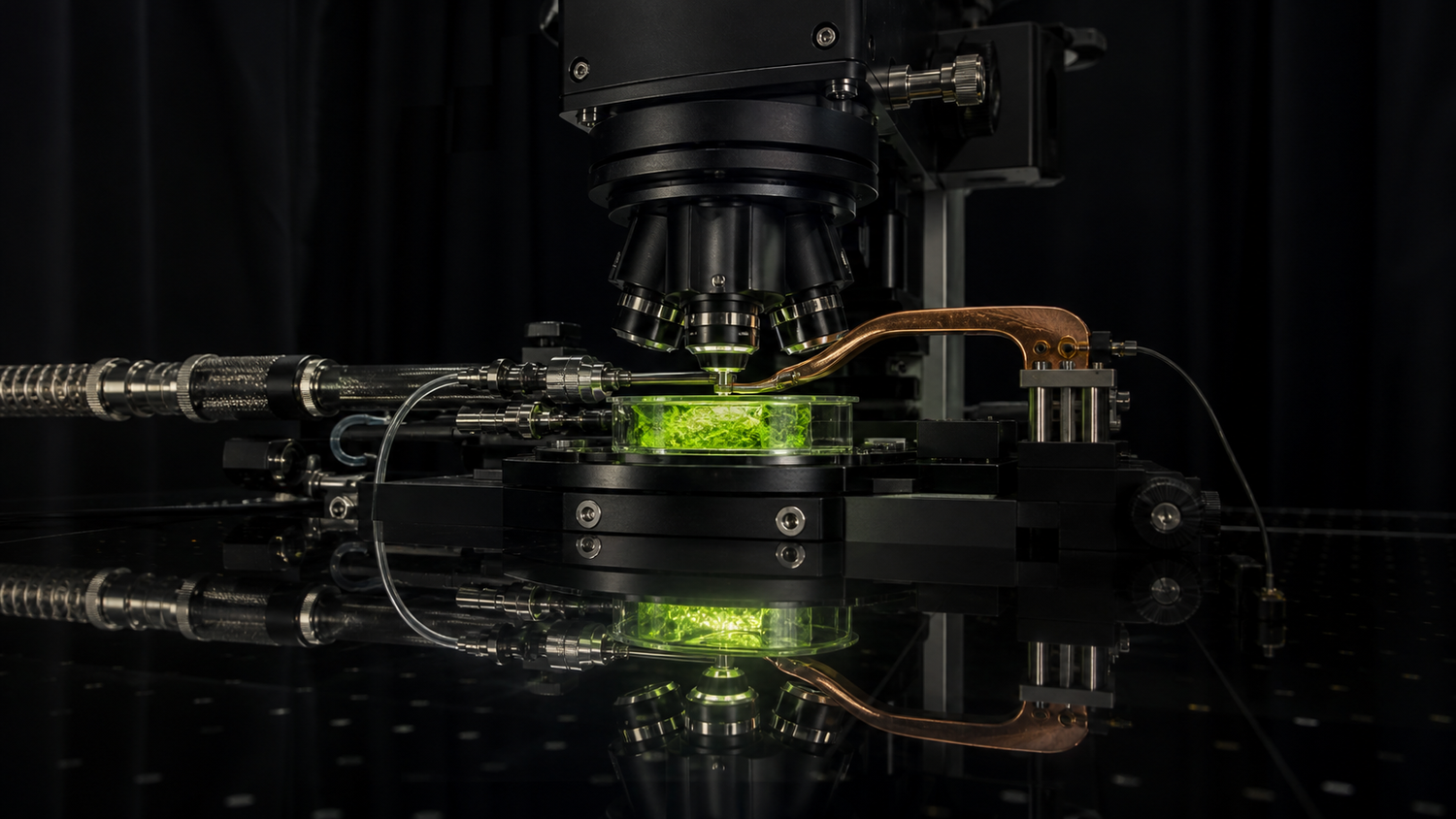
A diamond quantum sensor has to be got into the cell. Someone injects it, or the cell is coaxed into swallowing it, and from that moment the experiment is partly about the biology and partly about the freight.
On August 25, 2026 the United States National Science Foundation renewed the Chicago institute that has spent five years trying to remove the freight. The Quantum Leap Challenge Institute for Quantum Sensing for Biophysics and Bioengineering, known as QuBBE, received a five-year, 37.5 million dollar cooperative agreement running from September 1, 2026 to August 31, 2031. It is led by the University of Chicago's Pritzker School of Molecular Engineering, with Chicago State University, the University of Illinois Chicago and Harvard University as partners, and Greg Engel, chair of chemistry at Chicago, as director.
Practical takeaway. The renewal's load-bearing bet is that a genetically encoded quantum sensor can be written into a cell's DNA and built by the cell itself, instead of manufactured in a fab and delivered. That physics was published a year ago and it works. It was demonstrated at three separate temperatures, and none of them demonstrates coherent control at human physiological temperature.
The problem the field has been carrying around
Nanoscale quantum sensing in biology has, until recently, meant one thing: the nitrogen-vacancy center, an atomic defect in diamond that can be initialized with light, nudged with microwaves and read out optically. It is an exquisite magnetometer and thermometer. It is also embedded in a lump of diamond, and that lump is the delivery problem. A nanodiamond has to be introduced into the cell from outside, it settles roughly where the cell's own machinery leaves it, and steering one to a chosen protein on a chosen membrane is difficult work in its own right.
Biology solved the equivalent labeling problem thirty years ago, and not with hardware. Fluorescent proteins became the standard of in vivo microscopy because they are genetically encodable: fuse the gene for the label to the gene for the protein you want to watch, and the cell manufactures the two joined together, in the right compartment, at the right time, in every daughter cell thereafter. No injection, no uptake, no targeting chemistry.
QuBBE's first five years produced the observation that closes the gap between those two worlds. Fluorescent proteins have a metastable triplet state that nobody had interrogated as a quantum system, and it turns out to behave like one. Work led by Peter Maurer and David Awschalom at Chicago showed that a fluorescent protein can be operated as an optically addressable spin qubit. Maurer describes the motivation in the institute's own words: the first phase used diamond and molecular sensors to probe biological processes, and the difficulty was placing them exactly where they were needed in a living system. The protein qubits that answer it are, in his description, genetically encodable sensors roughly ten times smaller than diamond ones that can potentially be targeted with precision inside cells. Potentially is his word, and the post keeps it.
Quantum pillar: sensing. Technology readiness: TRL 3 of 9. The protein qubit has been demonstrated in a laboratory, inside cultured human and bacterial cells, as proof that the physics is real; it has not yet been used to measure anything a doctor needs to know, and no animal study or human study exists.
Three temperatures, and no coherent control at body temperature
The underlying result appeared in Nature on August 20, 2025, and it repays a careful reading because the headline and the fine print point in slightly different directions. Feder, Soloway and colleagues realized an optically addressable spin qubit in enhanced yellow fluorescent protein. A near-infrared laser pulse triggers readout of the triplet state with up to twenty percent spin contrast. The physics was characterized at liquid-nitrogen temperatures near eighty kelvin, where coherent microwave control gave a coherence time of sixteen microseconds under a standard decoupling sequence.
The demonstration then steps through two further conditions, and the three are worth keeping apart. Coherent control of the qubit inside mammalian cells, human embryonic kidney cells, was shown at one hundred and seventy-five kelvin. Optically detected magnetic resonance in bacterial cells was shown at room temperature, with contrast up to eight percent. So the coldest condition carries the full qubit characterization, the middle one carries control inside a mammalian cell, and only the warmest reaches ordinary laboratory air, where what survives is magnetic resonance detection rather than arbitrary control sequences.
One hundred and seventy-five kelvin is roughly ninety-eight degrees below zero on the Celsius scale. Room temperature is a milder distance, some twelve to seventeen degrees below the thirty-seven of a human body, but the precise statement is about what was shown rather than about degrees. Coherent control inside mammalian cells was demonstrated at one hundred and seventy-five kelvin. The room-temperature evidence was optically detected magnetic resonance in living bacteria. No coherent control was shown at human physiological temperature, and neither the paper nor the institute claims it was.
Temperature is one unresolved constraint among several, and it would be careless to present it as the only one. The paper's own discussion also names sensitivity below that of bulk-diamond sensors, photobleaching, readout efficiency and initialization conditions as things that have to improve, and it did not investigate targeted fusion-protein sensing in this study. A reader should hold all of those together rather than picture a finished sensor waiting on a warmer cryostat.
It is also worth separating this result from an adjacent one the Monitor covered in July. MagLOV, the directed-evolution magnetic sensor from an Oxford-led team, is likewise a genetically encodable fluorescent protein that produced optically detected magnetic resonance in living bacteria at room temperature. The mechanisms differ, and the difference matters. MagLOV works through a radical pair involving a bound flavin cofactor, which makes it sensitive to a magnetic field. The Chicago work operates the protein's own metastable triplet state as a spin qubit that can be initialized, coherently driven and read out. One is a magnetically responsive reporter; the other is a two-level system under coherent control, and only the second brings the sensing techniques that depend on holding and manipulating phase.
The authors are candid about the rest of it. The sensitivity, they write, falls short of nitrogen-vacancy centers in bulk diamond. Photobleaching is named as the biggest limitation, which for a sensor you intend to leave running inside a living cell is a serious one. Their proposed routes forward are concrete rather than rhetorical: substituting deuterium for protons to push coherence toward a hundred microseconds, better readout efficiency, better initialization. This is the shape of an honest early result, and it is why the readiness rung above is three rather than five.
What thirty-seven and a half million dollars is buying
The renewal names four directions, and the institute states them plainly: novel quantum nanoprobes for biological sensing, entanglement and squeezed sensing, in vivo measurement with quantum sensors, and accelerating adoption across biology and medicine. Read against the Nature paper, the first three are the gap-closing program. Nanoprobe work and entanglement-enhanced readout both attack the sensitivity deficit against diamond, and in vivo measurement is where the temperature and photostability problems have to be solved or conceded.
The fourth direction is different in kind, and it is the one a clinical reader should watch. Adoption is not a physics problem. Fluorescent proteins conquered biology because a cell biologist with no optics training could order a plasmid and use one by Friday. A protein qubit that requires a microwave delivery line, a photon-counting detector and a cryostat is a physics instrument that happens to contain biology. Whether the technique reaches the people who have the biological questions depends on how much of that apparatus can be made to disappear.
Engel's own framing of the renewal is measured. Quantum sensing, he says in the announcement, has reached a point where it can begin to address real biological questions, and the next challenge is to make the tools reliable and useful in the complex environments where biology actually happens. Begin is doing the work in that sentence, and it is the correct verb. The institute is one of eight in a round the agency itself puts at more than 290 million dollars, and within that round the biological application is a minority of the money, with the larger share going to quantum computing hardware, materials and error correction. That is a statement about this round and not about national quantum funding as a whole, which the announcement does not describe. Within this NSF institute round, the biology-focused institute is a minority allocation, and that is worth holding in mind whenever a roadmap presents quantum medicine as an inevitability.
How Quentir Reads It
Two kinds of item sit near the bottom of the readiness ladder, and they arrive there from opposite directions. One is the funded plan: a named disease, a named validation method, a budget, and no hardware result yet. The other is what this renewal rests on, a working laboratory result with real numbers attached and no clinical question yet fastened to it. Reading this field well is mostly the work of telling the two apart, because they fail differently. A plan fails when the physics does not cooperate; a result like this one fails when nobody finds the biological question it was the right instrument for.
The structural point is that a bottleneck has moved rather than vanished. For a decade the binding constraint on quantum sensing in living systems was delivery and targeting, and the answer was always some variation on better nanoparticle chemistry. Genetic encoding offers a route around that constraint, and in principle a route to placing a sensor deterministically by fusing it to a chosen protein. That second half is a prospect and not a result. The Chicago team investigated the physics of the protein itself; targeted fusion-protein sensing, where the qubit is carried to a particular structure by the cell's own expression machinery, was not investigated in this study. What the work does buy is the promotion of two other problems, temperature and photostability, from footnotes to headline status, which is progress because both are measurable. Coherence time, spin contrast and bleaching lifetime are all numbers a skeptical reader can be shown.
Nothing here changes what a hospital buys this year or next. What it changes is the vocabulary. The phrase genetically encoded quantum sensor will begin appearing in grant applications, startup decks and eventually in claims made to clinicians, and most of what it is attached to will be nowhere near the Nature result. Four questions separate them: at what temperature was the coherent control performed, in what organism and cell type, what spin contrast and coherence time were measured, and how long before the signal bleached. A team with real work behind it will answer all four in a sentence.
Sources
Primary source: the University of Chicago Pritzker School of Molecular Engineering announcement of August 25, 2026 that the National Science Foundation renewed the NSF QuBBE Quantum Leap Challenge Institute with a 37.5 million dollar five-year cooperative agreement, from which the award figure, the September 1, 2026 to August 31, 2031 term, the partner institutions, the directorship of Greg Engel, the four phase-two research directions and the description of protein qubits as genetically encodable sensors roughly ten times smaller than diamond sensors are taken. The underlying physics, from enhanced yellow fluorescent protein as an optically addressable spin qubit, twenty percent spin contrast on near-infrared triggered readout, sixteen microsecond coherence under Carr-Purcell-Meiboom-Gill decoupling at liquid-nitrogen temperature, coherent control in human embryonic kidney cells at one hundred and seventy-five kelvin, optically detected magnetic resonance in bacterial cells at room temperature with contrast up to eight percent, the sensitivity deficit against bulk-diamond nitrogen-vacancy centers and photobleaching as the principal limitation, is read from the paper by Jacob S. Feder, Benjamin S. Soloway and colleagues with Peter C. Maurer and David D. Awschalom, published in Nature on August 20, 2025; the three demonstration temperatures are kept distinct in the text because the paper reports them separately. The size and count of the wider NSF institute round are taken from the National Science Foundation's own announcement of August 25, 2026, and the quotations from Greg Engel and Peter Maurer are read from the University of Chicago announcement itself rather than from any secondary report of it. The comparison with MagLOV draws on this Monitor's post of July 19, 2026 and the Oxford-led work it reported.