NEO, the First Approved Implantable BCI, and the NSCEB's Gap List of 2 September 2026: What China Has in Place, What the US Lacks, and a 1,951-Character Mandarin Claim With No Located Paper
Quentir Medicine Monitor
Evidence-based insights for quantum medicine. Published by Quentir Systems LLC · September 4, 2026.
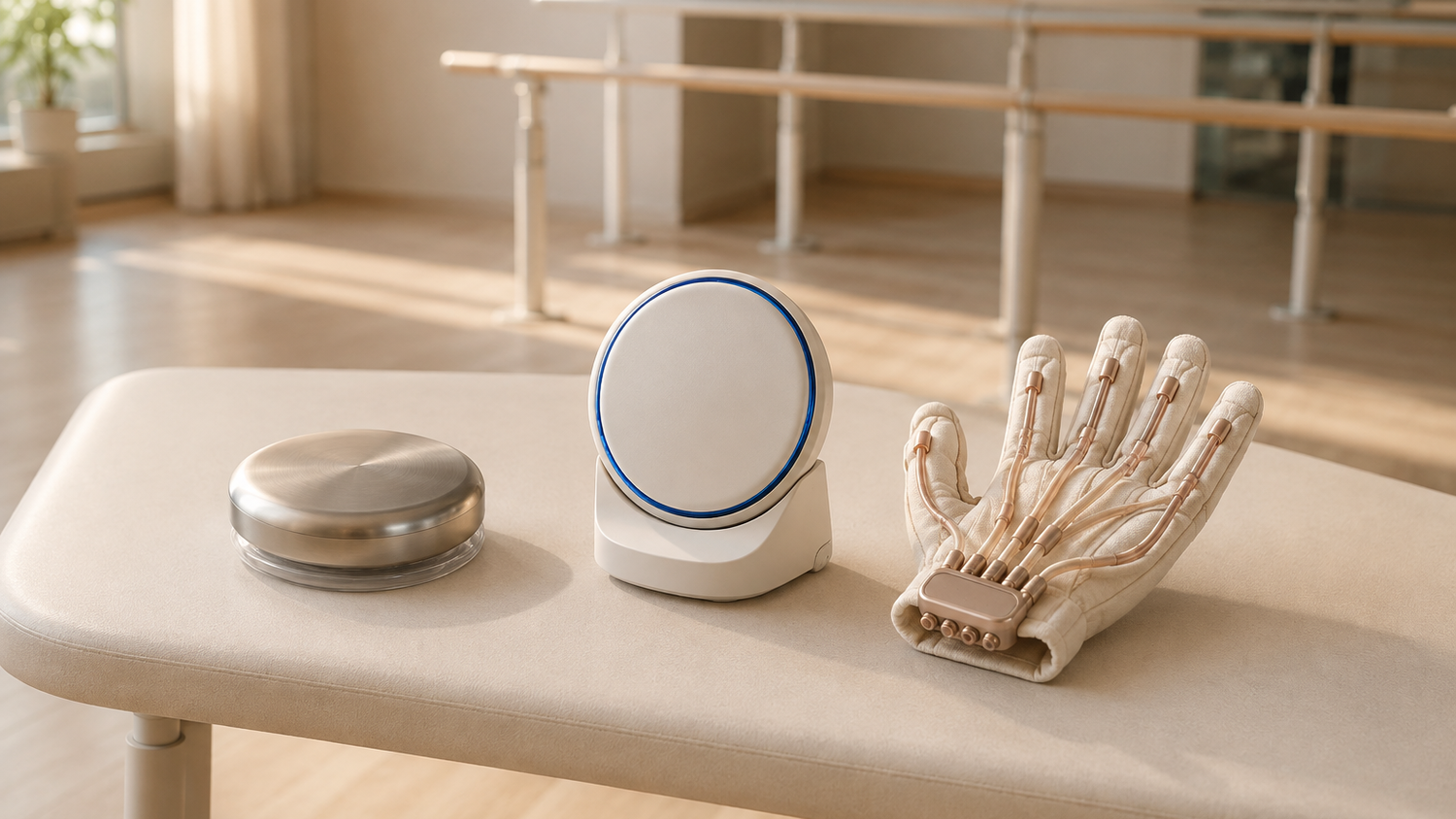
A person with a cervical spinal cord injury can imagine closing a hand for years without the hand moving. The brain still issues the command; the spinal cord no longer carries it. A brain-computer interface reads the command above the break and sends it to a machine that does the closing. Regulatory approval, manufacturing capacity and reimbursement all decide whether such a device reaches routine care, and this week the two largest medical markets showed how differently they handle the three.
On 13 March 2026 China's National Medical Products Administration granted market approval to NEO, an implantable brain-computer interface for hand motor function developed by Neuracle, known in Chinese as Boruikang, with Tsinghua University. On 2 September 2026 the US National Security Commission on Emerging Biotechnology published an analysis that called it the world's first commercial approval of an implanted BCI and listed four missing US mechanisms. The same week brought a Chinese magazine profile claiming 1,951 Chinese characters decoded from an implant, and a Taiwanese report on a US company that wants to read the brain through the nose. This Monitor reads the cluster for what each item can support.
What the NMPA Approved on 13 March 2026, in the Regulator's Own Words
Quentir's daily blog read the approval and its insurance sequel in July, when a brain implant entered the insurance system, so the recap here is short and taken from the regulator. The Shanghai drug administration's account of the NMPA approval, dated 13 March 2026, names the product as an implantable brain-computer interface hand motor function compensation system from Brainrec Medical Technology, Shanghai, the company known in English as Neuracle. It lists the components: the implant, an implantable electrode array, an EEG signal transceiver, a pneumatic glove, disposable surgical tools, and decoding, clinical management and testing software. It describes the implantation as minimally invasive and extradural, outside the membrane over the brain, with wireless power and communication, and the approved population as adults of 18 to 60 with C2 to C6 cervical spinal cord injury of grades A to C, diagnosed more than a year earlier and stable for six months, who cannot grasp and retain partial upper-arm function. The device went through the innovative medical device pathway, and the account reports significantly improved grasping in the trial without giving the numbers. The Korean news agency Newsis, reporting on 4 September 2026, states plainly that NEO does not treat the paralyzed hand; it compensates for it.
What happened next is the part that distinguishes an approval from a market. The trade newsletter Neurotech Reports wrote on 20 August 2026 that within 48 hours of the NMPA decision China's National Healthcare Security Administration assigned the device a reimbursement billing code, and described NEO as the first invasive motor brain-computer interface cleared for routine clinical use outside a trial. The price side had been prepared earlier: the administration's own notice of 23 April 2026 records separate price items for invasive and non-invasive BCI procedures, with invasive implantation fees clustered at 6,000 to 6,600 yuan per procedure across provinces. Newsis records that China has designated BCI a national future industry alongside quantum technology, biomanufacturing and 6G. A billing code two days after an approval, on price items set in advance, is what that policy looks like from the outside; how many patients have been implanted under it is not in any cited report.
The Four Gaps the NSCEB Named on 2 September 2026, and the Pathway Announced in April
The National Security Commission on Emerging Biotechnology is a bipartisan advisory body created by Congress, chaired by Senator Todd Young. On 2 September 2026 it released an analysis titled "Securing U.S. Leadership in Brain-Computer Interfaces", which records that China became the first country to approve an implantable BCI for commercial use in March 2026 and moved from approval to deployment faster than the United States. The commission's release lists the gaps on the US side: no unified federal strategy across the agencies that fund or regulate BCIs, no clear approval pathway through the FDA process, no Medicare coverage for implantable BCIs and so no payment structure after approval, no infrastructure to bring neural, biological and clinical data together across institutions, and technical barriers in signal degradation and implant design. Its recommendations include a National Biotechnology Coordination Office, a Web of Biological Data, streamlined FDA pathways, faster clinical trials at the same safety standard, and explicit inclusion of BCIs in the FDA and CMS RAPID programs. Commissioner Paul Arcangeli is quoted in the release saying a comprehensive national strategy that prioritizes safe, effective technologies will get US BCIs from the laboratory to commercial product faster. The Newsis report of 4 September 2026, a Korean news account relaying Axios of 3 September, adds that the FDA issued guidance for implanted BCI trials in 2021 and quotes Senator Young saying China is developing strategic technologies like BCI faster than the United States.
Part of the answer already exists on paper. Neurotech Reports records that in April 2026 CMS and FDA jointly announced a coverage pathway called RAPID, intended to synchronize FDA authorization with Medicare coverage decisions, and describes it as a reaction to China's advance. The same report puts the shortest US timeline for a breakthrough-designated device at just over 300 days against roughly 180 for China's fast-track review. This Monitor read the same regulatory shape three days ago, when OpenAI connected ChatGPT to Epic charts under a decision support criterion written for a different product: the US pattern is a general instrument stretched over a new device class, and the commission's request is for a device-specific one.
Quantum pillar: not applicable. Technology readiness: TRL 8 of 9. Rung eight means a system has been qualified through a regulator's approval, and that is this Monitor's editorial assessment of NEO on the reported approval and system qualification: market approval on 13 March 2026 and a reimbursement code within two days, with the post-approval implantation counts and long-term performance data that would earn the ninth rung not yet in the cited record. The cluster contains no quantum technology; the Shanghai investment session discussed below pitched quantum biosensing alongside neural interfaces, and that is the only point where the two fields touch in today's pool.
Two Mandarin Decoding Results: One in Science Advances With Numbers, One in a Magazine Profile Without a Paper
Decoding speech is harder than decoding a grasp, and Mandarin is harder than English because tone carries meaning. The checkable result is peer reviewed. On 5 November 2025 Science Advances published "Real-time decoding of full-spectrum Chinese using brain-computer interface" from Huashan Hospital of Fudan University, ShanghaiTech University and the Shanghai Institute of Microsystem and Information Technology. A 256-channel flexible electrocorticography array with 1.3-millimeter contacts recorded one participant, a 43-year-old woman, for about nine hours over eleven days. The system decoded all 394 Mandarin syllables at a median syllable accuracy of 71.2 percent, and in real-time sentence decoding with a language model reached 73.1 percent character accuracy at 49.7 characters per minute. One participant, stated methods, stated error rates.
The second result reached the pool through a cover profile in the magazine Science Chinese, republished by The Paper on 2 September 2026, of Li Meng, a researcher at the same Shanghai microsystems institute. The profile states that his team, with Huashan Hospital and Zhejiang University, achieved implanted Chinese language decoding across 1,951 common characters, with 83 percent accuracy on initial consonants and 84 percent on finals, under half a second per sentence, and that 54 characters and 100 minutes of training generalized to the full set, a ratio the profile gives as 1 to 36. It attributes the generalization to an intracranial EEG foundation model the team released in 2025, trained on data from the iBRAIN consortium of Chinese neurosurgical hospitals. The profile cites no paper, journal, participant count or comparator for these figures, and no publication carrying them was located for this post. The two sets of numbers also measure different things: 73.1 percent is whole-character accuracy in sentences, while 83 and 84 percent are accuracies on the two halves of a syllable, so no ranking between them is possible until the second result appears with comparable whole-character figures and its methods. Until then, the Science Advances paper is the peer-reviewed real-time Mandarin result the public record supports.
A Nasal Spray Instead of a Craniotomy: What Subsense Has Funded and What It Has Shown
Subsense, a US company founded by Tetiana Aleksandrova and Artem Sokolov, is pursuing a design that needs no surgery. Its NanoBCI concept delivers nanoparticles through the nose, where a report in the Taiwanese outlet Life.tw of 4 September, a news item relaying company statements, describes two kinds, plasmonic and magnetoelectric, that work with a wearable headset to read neural signals and to stimulate. The trade site Longevity.Technology reported on 11 December 2025 that the company had closed a further USD 10 million from Golden Falcon Capital on top of a USD 17 million seed earlier in 2025, bringing the total to USD 27 million, and that the company projected pilot human trials for 2027. The Life.tw report states that mouse proof-of-concept studies began in late 2025 and that the company's stated target is to show by the end of 2026 that its particles can read neural activity and relieve symptoms of Parkinson's disease and epilepsy. All of those dates are company-reported targets. The public evidence is a funded concept and a mouse study in progress, with no published data.
Where Quantum Enters: Nine Pitches in Shanghai on 3 September 2026
The Shanghai municipal government's account of an investment matchmaking session for life and health projects held in Jing'an district lists nine companies that pitched to roughly fifty investment institutions, including a neural interface and rehabilitation company that received multiple expressions of investment interest, a wearable transcranial ultrasound BCI, and a Beijing company presenting quantum biosensing. The account names no figures and no technology beyond the field labels. It appears here because it is the one place this week where quantum sensing and neural interfaces sat in the same room, and the conclusion it supports is co-occurrence at one investment session and nothing more. Quantum sensors for medicine have their own evidence trail on this site, most recently when Quentir's daily blog read the instrument that Korea's health ministry funded as a quantum nanosensor for cancer-drug heart damage; nothing in the Shanghai account connects the Beijing company to that work or to neural recording.
What Would Move Each Item Up the Ladder
For NEO, the next evidence is post-market: how many patients have been implanted under the reimbursement code, and the long-term signal-degradation data the US commission says nobody yet has. For the 1,951-character claim, a paper with participant count, electrode type, session hours, whole-character accuracy and a comparator, which would let it be placed beside the 73.1 percent result. For Subsense, the mouse data promised by the end of 2026. For the United States, whether RAPID, which CMS described as able to bring coverage as soon as two months after authorization once its final notice takes effect, produces a Medicare coverage decision for an implanted BCI, which would answer one of the commission's gaps in practice. Each of those is an event with a date attached, and this Monitor will read them when they land.
Sources
Primary source: the US National Security Commission on Emerging Biotechnology, press release "NSCEB Releases Analysis for Securing U.S. Leadership in Brain-Computer Interfaces," 2 September 2026, for the analysis title, the March 2026 China approval as the first commercial implantable BCI, the US gaps in strategy, FDA pathway, Medicare coverage, data integration and technical barriers, the recommendations, and Commissioner Paul Arcangeli's statement; the full analysis document behind the release was not retrieved. Regulator and payer accounts: the Shanghai Municipal Drug Administration's notice of 13 March 2026 on the NMPA approval, for the product name, the developer, the components, the extradural implantation with wireless power and communication, the approved population and the innovative-device pathway; and the National Healthcare Security Administration's notice of 23 April 2026, for the separate invasive and non-invasive BCI price items and the 6,000 to 6,600 yuan implantation fee range. Secondary reports: Park Young-hwan, Newsis, "사지마비 환자가 장갑 움직였다…中 '뇌에 심는 칩' 세계 첫 시판 승인," 4 September 2026, a Korean news account relaying Axios of 3 September, for the compensation framing, the 2021 FDA trial guidance, China's future-industry designation, and Senator Todd Young's statement. Neurotech Reports, a trade newsletter, 20 August 2026, for the reimbursement code within 48 hours, the RAPID pathway announced by CMS and FDA in April 2026, and the 300-day and 180-day timelines. Peer-reviewed: Youkun Qian, Changjiang Liu, Peixi Yu and colleagues, Science Advances, 5 November 2025, for the 256-channel array, the single participant, the 394 syllables, the 71.2 percent syllable and 73.1 percent character accuracies and the 49.7 characters per minute. Magazine profile: Science Chinese, cover profile of Li Meng, republished by The Paper on 2 September 2026, for the 1,951-character, 83 and 84 percent, half-second and 1-to-36 figures and the iBRAIN and foundation-model context, which carry no cited publication. Company-reported: Life.tw, 4 September 2026, and Longevity.Technology, 11 December 2025, for Subsense's founders, particle types, funding and stated study targets. Government account: the Shanghai Municipal People's Government, 3 September 2026, for the Jing'an session. The judgments are this Monitor's own: the TRL 8 placement of NEO as an editorial assessment, the reading that the two Mandarin figures measure different quantities and cannot be ranked, and the observation that the Shanghai session shows co-occurrence only.
- Shanghai drug administration's account of the NMPA approval
- Neurotech Reports wrote on 20 August 2026
- released an analysis titled "Securing U.S. Leadership in Brain-Computer Interfaces"
- Science Advances published "Real-time decoding of full-spectrum Chinese using brain-computer interface"
- The Paper on 2 September 2026