What Quantum-Inspired Buys a Federated ECG Classifier
Quentir Medicine Monitor
Evidence-based insights for quantum medicine. Published by Quentir Systems LLC · August 17, 2026.
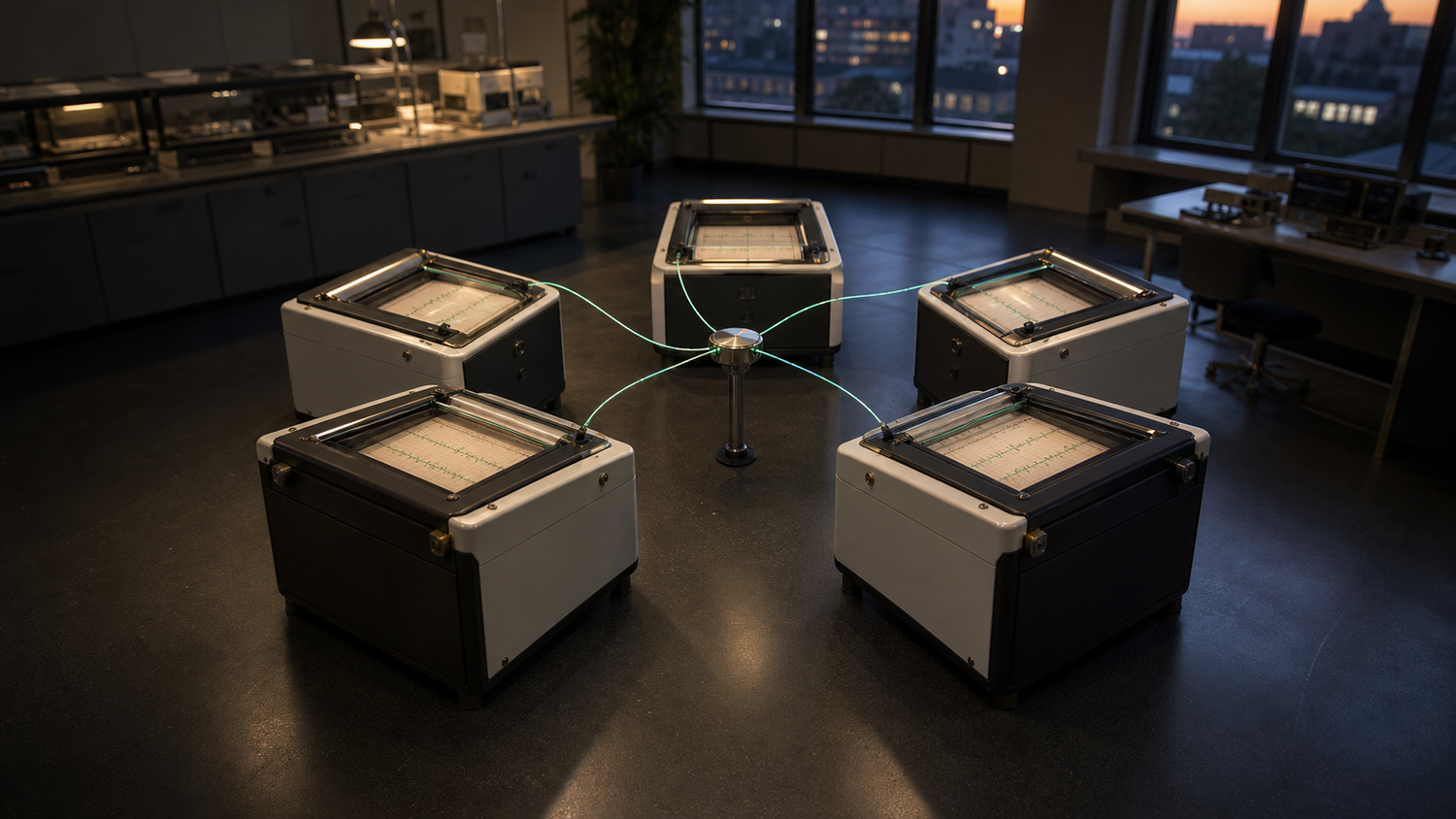
A new study asks whether a compact network borrowed from quantum machine learning can classify heart rhythms across hospitals that never share their raw recordings. The measured answer is a smaller model and a lighter communication bill, with every calculation still running on ordinary computers.
The preprint, posted August 14 by Chun-Hua Lin, Samuel Yen-Chi Chen and colleagues, evaluates a hybrid quantum-inspired Kolmogorov-Arnold network for arrhythmia classification under federated learning. On two public ECG datasets, the model matched or improved most of the metrics of a standard neural-network baseline while carrying between 37 and 45 percent fewer trainable parameters and reporting between 25 and 36 percent lower communication cost.
Those numbers deserve a careful reading, because the phrase quantum-inspired does a specific and limited job here. The architecture takes its mathematical form from quantum machine learning. The computation runs entirely on classical hardware. What the study actually tests is whether that borrowed structure earns its place in a privacy-constrained clinical setting where model size directly prices the collaboration.
Practical takeaway. A quantum-inspired ECG classifier reduced parameters and communication costs in a federated benchmark on public arrhythmia data. No quantum computer took part, and the comparison covers one baseline on retrospective datasets, so the result marks a design direction rather than a clinical capability.
Why federated ECG training is a real clinical constraint
An electrocardiogram is privacy-sensitive health data. Hospitals, clinics and wearable-device makers each hold recordings they cannot simply pool into one training set, which limits how well any single institution can train an arrhythmia classification model, especially for rhythm types that appear rarely in any one location.
Federated learning answers that constraint by moving the model instead of the data. Each participating site trains locally on its own recordings and shares only model updates, which a central server averages into a common model. The study uses federated averaging, the standard version of this procedure, and its authors name the three difficulties that make the setting harsh: each client holds few samples, arrhythmia labels are heavily imbalanced, and the data across clients is not identically distributed.
Communication is the quiet cost in this arrangement. Every training round requires each site to transmit its model update, so a model with fewer parameters makes every round cheaper for every participant. For wearable devices and smaller clinics, that recurring cost weighs directly on how practical joining a training federation is. This is the specific lever the new architecture pulls.
What the quantum lineage contributes
Kolmogorov-Arnold networks replace the fixed activation functions of a conventional neural network with small learnable functions on each connection. In the quantum-inspired variant, those learnable functions take the mathematical form of trainable single-qubit circuits with data re-uploading, a construction developed in quantum machine learning research. The authors state the position plainly: quantum-inspired models exploit the structural features of quantum machine learning without requiring noisy intermediate-scale quantum devices.
That form is compact by design. The quantum machine learning literature developed single-qubit data re-uploading circuits as parameter-efficient function approximators, and evaluating one classically is computationally cheap. What this paper adds is the measurement: a network built from that form shrank substantially while matching or improving most benchmark metrics, which is exactly the property a communication-priced federated system rewards.
Quantum pillar: not applicable. Technology readiness: TRL 3 of 9. The work is functioning classification software whose architecture borrows quantum-circuit mathematics, evaluated on recorded public datasets rather than in any live clinical workflow, and no quantum processor participates at any stage.
The measured results, and their edges
The benchmark covers five-class arrhythmia classification on the MIT-BIH Arrhythmia Database and three-class classification on the St. Petersburg INCART database, both public reference collections hosted on PhysioNet. On MIT-BIH, the quantum-inspired network used 37.35 percent fewer trainable parameters and cut communication cost by 24.89 percent. On INCART, the reductions were 44.81 percent and 36.41 percent. Across multiple client configurations, the authors report improvements on most aggregate metrics and on most metrics for the minority rhythm classes, the rare beat types that matter clinically and suffer most when data is fragmented.
The study also stresses the model under simulated client heterogeneity, skewing the label distributions across sites, and reports that the quantum-inspired network degraded more gracefully than the baseline on minority-class measures. For federated learning in medicine, robustness to that kind of skew is a load-bearing property, since real hospitals differ systematically in the patients they see.
The edges of the evidence are equally clear. The comparison runs against a multilayer perceptron, a deliberately plain baseline, and does not test the stronger convolutional and residual architectures that lead centralized ECG benchmarks. Both datasets are retrospective research collections; MIT-BIH consists of 48 half-hour recordings from 47 subjects digitized decades ago. Improvements on most metrics leave some metrics unimproved. And the federation itself is simulated, with partitions of public data standing in for institutions. None of this diminishes the parameter arithmetic, which is the paper's firmest contribution. It does bound what the arithmetic proves.
Naming discipline is part of the evidence
Quantum medicine now includes a growing family of results labeled quantum-inspired, and the label needs the same discipline this Monitor applies to hardware claims. A quantum-inspired algorithm is a classical algorithm whose design descends from quantum research. It inherits no speedup from quantum physics, requires no cryogenics and waits on no device roadmap. Its virtues, when they appear, are conventional software virtues: fewer parameters, cheaper communication, better behavior on skewed data.
Read that way, this study is good news of a modest and useful kind. The quantum machine learning literature produced a functional form that turns out to fit a genuine clinical infrastructure problem, the pricing of collaborative training over private ECG data. The value transferred through mathematics, arriving years before fault-tolerant machines. Institutions evaluating quantum medicine claims should keep the two categories separate, and should notice when a quantum-inspired result quietly borrows the prestige of quantum hardware it does not use.
How Quentir Reads It
Quentir reads this preprint as a well-bounded negative-space result for quantum medicine: it shows what the field's mathematics can deliver today with no quantum computer in the loop. The Evidence Register tracks such work as classical algorithms with quantum lineage, a category whose claims are checkable now, on public datasets, with ordinary reproduction effort.
The next meaningful tests are concrete. A comparison against the stronger architectures that dominate ECG classification would establish whether the compactness advantage survives serious competition. A deployment across genuinely separate institutions, with their real distribution differences and governance constraints, would test the federated story outside simulation. A demonstration on a prospective stream of recordings would begin the climb toward clinical relevance.
Until those arrive, the honest summary is that a quantum-derived functional form made a federated arrhythmia classifier smaller and cheaper to train collaboratively, on public benchmarks, against a plain baseline. That is a real, dated, measurable step, and it belongs in the evidence record under exactly that description.
Sources
Primary source: Chun-Hua Lin, Samuel Yen-Chi Chen, Yu-Chao Hsu, Kuo-Chung Peng, Jiun-Cheng Jiang, Chi-Sheng Chen and colleagues, "Hybrid Quantum-inspired Kolmogorov-Arnold Networks for Privacy-Aware Federated Biosignal Learning," arXiv preprint, August 14, 2026. Dataset records: MIT-BIH Arrhythmia Database and St. Petersburg INCART database, PhysioNet.