Forescout's October 2026 Healthcare Report Finds 6% of Medical IoT Devices on Post-Quantum-Capable SSH and 31% of Exposed Hospital Systems on TLS 1.3
Quentir Medicine Monitor
Evidence-based insights for quantum medicine. Published by Quentir Systems LLC · October 22, 2026.
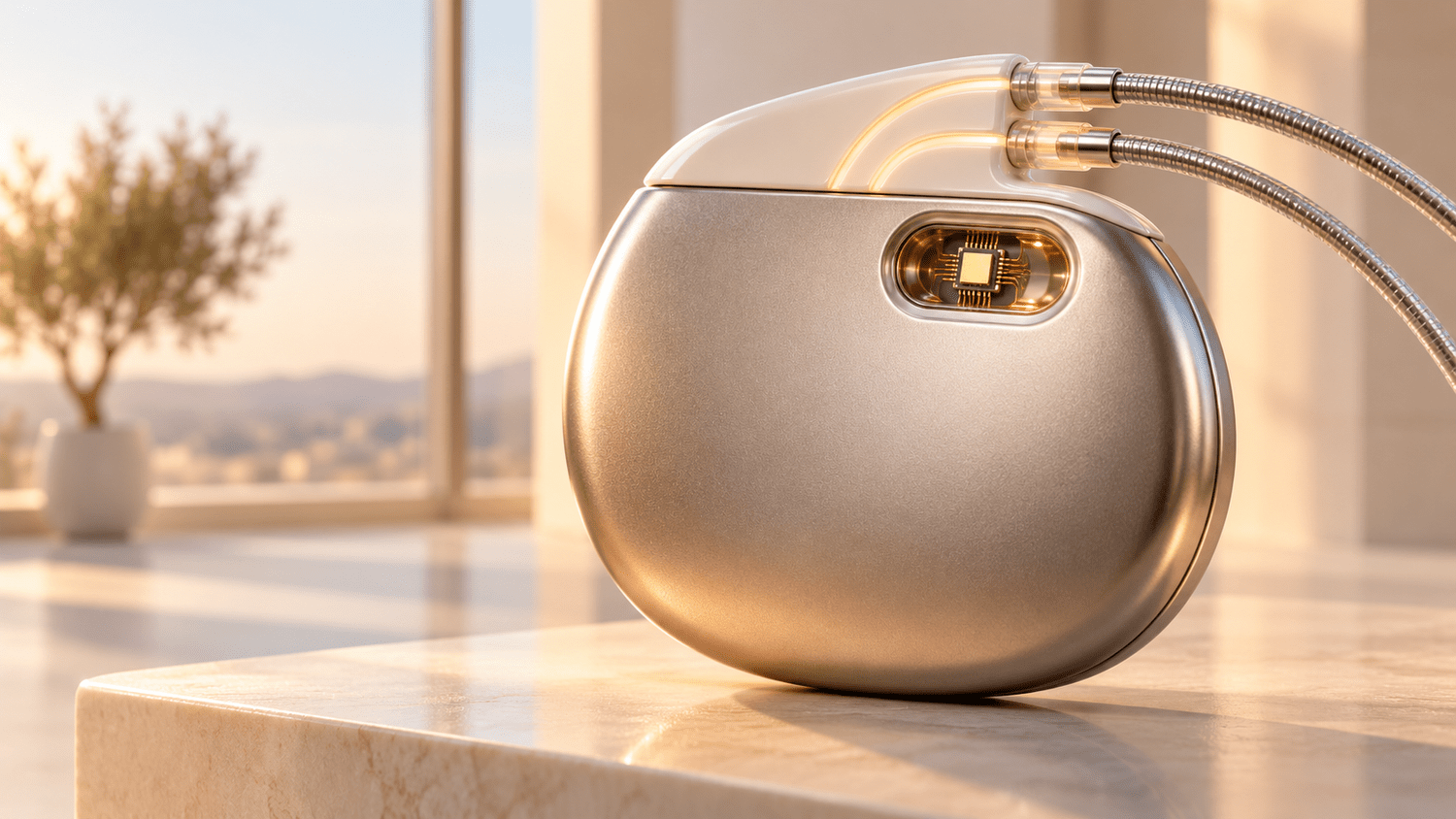
A CT scan taken in a hospital this week will still describe the same patient in 2040. The encryption that carries that image from the scanner to the archive, and from the archive to an outside radiologist, was mostly designed for a world without large quantum computers.
The security firm Forescout has now put numbers on that gap. Its research report PQC in Healthcare: From Data Risk to Migration Readiness, released in early October 2026, looks at how far hospital networks have moved toward post-quantum cryptography, the new public-key algorithms meant to resist a future quantum computer. The answer is uneven. In the enterprise networks Forescout tracks, half of ordinary IT devices run OpenSSH versions that support the new algorithms. Among the devices of the Internet of Medical Things, such as infusion pumps, patient monitors and imaging equipment, the share is 6%.
The report also searched the open internet for hospital systems that anyone can reach. It found more than 5,500 of them, mostly electronic medical record platforms and image archives, and only 31% of those systems support TLS 1.3, the only version of the web's standard encryption protocol that can carry the standardized post-quantum key exchange.
For a hospital board or a chief medical information officer, the figures separate the devices a hospital can upgrade on its own from the devices whose encryption changes only when a manufacturer ships new firmware. They come from one vendor's customer data and from public internet scans, so they describe the networks Forescout can see, not a random sample of all hospitals.
What Forescout measured across 2.5 million devices in more than 50 hospital networks
The dataset comes from Forescout's own device cloud: more than 2.5 million connected devices across more than 50 healthcare delivery organizations, an average of around 50,000 devices per organization. About two-thirds are IT assets, such as workstations and servers. The rest are network equipment, building and facility systems, and medical devices, which make up about 5% of the total.
The headline comparison concerns SSH, the protocol used to manage devices remotely, and it draws on Forescout's wider tracking of enterprise networks. There, 50% of IT devices run OpenSSH versions that support post-quantum key exchange. For general connected devices the figure is 28%, for operational technology such as building and facility controls it is 16%, and for medical devices it is 6%. On TLS the picture is thinner still: by the report's count, 8% of IT devices support post-quantum TLS, 5.6% of connected and medical devices, and 0.8% of operational technology.
The internet scan used the Shodan search engine. Of the more than 5,500 exposed instances of 50 medical information systems, 46% were electronic medical record platforms and 40% were picture archiving and communication systems (PACS), the archives that store medical images. Among PACS that use encryption at all, 36% run TLS 1.3. For electronic medical records the share is 33%, and for laboratory information systems 13%. Forescout adds that 15% of the exposed systems still accept TLS 1.0 or 1.1, versions the internet's standards body deprecated in 2021. Support for TLS 1.3 also does not prove that a given connection uses post-quantum key exchange, because the two ends can still agree on a classical algorithm.
The report sets this against the general threat level. Between 1 January and 31 August 2026, Forescout counted 461 public ransomware claims against healthcare providers worldwide, a 47% rise on the 313 claims of the same period in 2025.
Why PACS images and EMR records sent today could be read once a capable quantum computer exists
No one can break today's hospital encryption with a quantum computer yet, and Forescout says so plainly. The concern is a slower attack known as harvest now, decrypt later. An adversary copies encrypted traffic today and stores it until a capable quantum machine can recover the keys. Daniel Trivellato, Forescout's vice president of operational technology, healthcare and cyber risk solutions, told Healthcare Dive on 8 October 2026 that the primary threat is not that hackers will use quantum computers against hospitals tomorrow, and that medical records and diagnostic images stay sensitive for decades.
That long shelf life is what sets medicine apart from most sectors. A stolen card number can be cancelled. A diagnosis, a genetic result or a psychiatric note cannot. Forescout ranks five kinds of data as most exposed: electronic medical records, medical images, laboratory results, medication and prescription data, and payment data. All five regularly leave the hospital, through patient portals, partner links, cloud services and external reading services.
The defense is already standardized. In August 2024 the US National Institute of Standards and Technology published FIPS 203, which defines ML-KEM, a lattice-based key-encapsulation mechanism, alongside two signature standards. TLS 1.3 and OpenSSH can already use ML-KEM. The Monitor described the same harvest-now risk from the policing side when it covered Europol's 7 October 2026 report placing health records in the ten-year risk window. Forescout's contribution is to show where, device by device, the hospital side of that problem actually sits.
Quantum pillar: post-quantum cryptography. Technology readiness: not applicable. The Forescout report is a survey of devices and exposed systems in hospital networks, so it measures the spread of existing post-quantum software and places no new technology of its own on the ladder.
Why an infusion pump's encryption depends on its manufacturer: FDA's February 2026 cybersecurity guidance
On a hospital server, moving to post-quantum key exchange can be a library update and a configuration change. On an embedded medical device it depends on the manufacturer. Forescout sorts hospital assets by what it calls crypto-agility. IT systems under direct administrative control can move quickly. Partner-managed endpoints and vendor appliances move at shared speed. Legacy proprietary systems and regulated medical devices move only when the vendor releases new software, when the device passes regulatory review again, or when the hardware is replaced.
Regulation explains part of that delay. The US Food and Drug Administration's nonbinding guidance Cybersecurity in Medical Devices, issued on 3 February 2026, says that changes that may require a new premarket submission could include changes to authentication or encryption algorithms; whether a submission is needed depends on the specific modification. The same document asks manufacturers to choose cryptography expected to remain strong throughout the service life of the device. A pump or a monitor bought today may stay on the ward for ten years or more, so in the Monitor's reading that second sentence points toward post-quantum algorithms for new designs.
For a hospital buyer, the practical consequence sits in procurement. Earlier Quentir analysis argued that quantum deadlines are now a supply-chain question, and the Forescout figures show why medicine feels that most sharply: the hospital owns the risk to the data, while the vendor controls the code that would remove it.
What Forescout tells hospitals to do in the next 6 to 12 months, the next 24, and after that
The report closes with a phased plan. In the first six to twelve months, hospitals should map their own devices, data types and internet exposure, give priority to patient portals, external APIs, VPN gateways and data exchanges with partners, enforce TLS 1.3 wherever possible, and define simple measures such as the share of assets that can use post-quantum algorithms.
Over the following period up to 24 months, the plan is to update cryptographic libraries and device firmware where possible, segment legacy systems that cannot be updated, place post-quantum gateways in front of them, ask vendors for their roadmaps, and write post-quantum requirements into purchasing and contract renewals. After 24 months, Forescout suggests considering replacement for assets that still have no clear migration roadmap, and further safeguards for those that cannot be replaced.
None of these steps needs a quantum computer to exist first. The gateway approach is the one most likely to matter on the ward. A hospital can protect the link from its image archive to an outside radiology service today, even when the scanner behind it will wait years for new firmware. The measurement Forescout proposes, the share of sensitive data flows already protected by post-quantum encryption, is also one a hospital board can ask for at its next risk review.
Sources
Primary source: Forescout Research (Vedere Labs), PQC in Healthcare: From Data Risk to Migration Readiness, October 2026. Also drawn on: Jill Hughes's Healthcare Dive report of 8 October 2026 with Daniel Trivellato's comments, the FDA guidance Cybersecurity in Medical Devices of 3 February 2026, NIST's FIPS 203, and earlier Quentir coverage.