SEALSQ's 9 September 2026 Interview on Fifteen-to-Twenty-Year Medical Device Lives, and the QS7001 Page That Still Lists Kyber and Dilithium 2
Quentir Medicine Monitor
Evidence-based insights for quantum medicine.
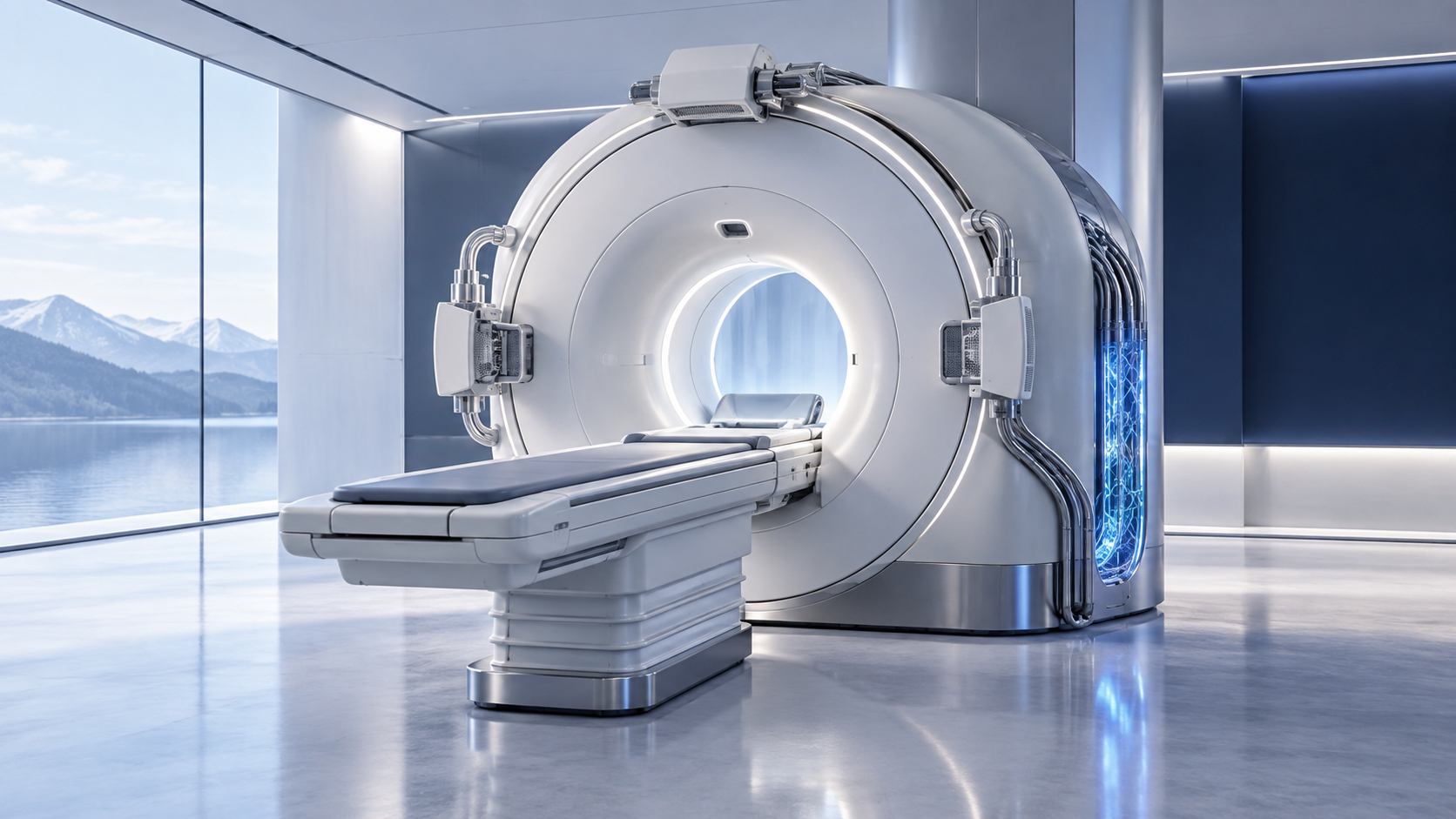
On 9 September 2026 Carlos Moreira, founder and chief executive of the Nasdaq-listed semiconductor company SEALSQ, described in a published interview a post-quantum exposure specific to connected physical systems, among them medical devices, which he sets alongside the familiar risk of stored data waiting to be decrypted later. His reason rests on an arithmetic any hospital finance office already runs: equipment bought today could remain in service well beyond the transition date NIST has proposed.
Many connected devices stay fifteen or twenty years in service and cannot be swapped out quickly. A draft NIST report proposes that the public-key algorithms those devices ship with become disallowed after 2035, with the weaker parameter sizes deprecated five years earlier. The company's answer is a secure microcontroller called the QS7001, whose product page names medical and healthcare devices as a target market, and whose specification sheet still lists Kyber and Dilithium 2, the names those algorithms carried before NIST standardized them.
A 90-Degree Antenna for a Difficult Organ
The eye makes 7-tesla MRI work hard
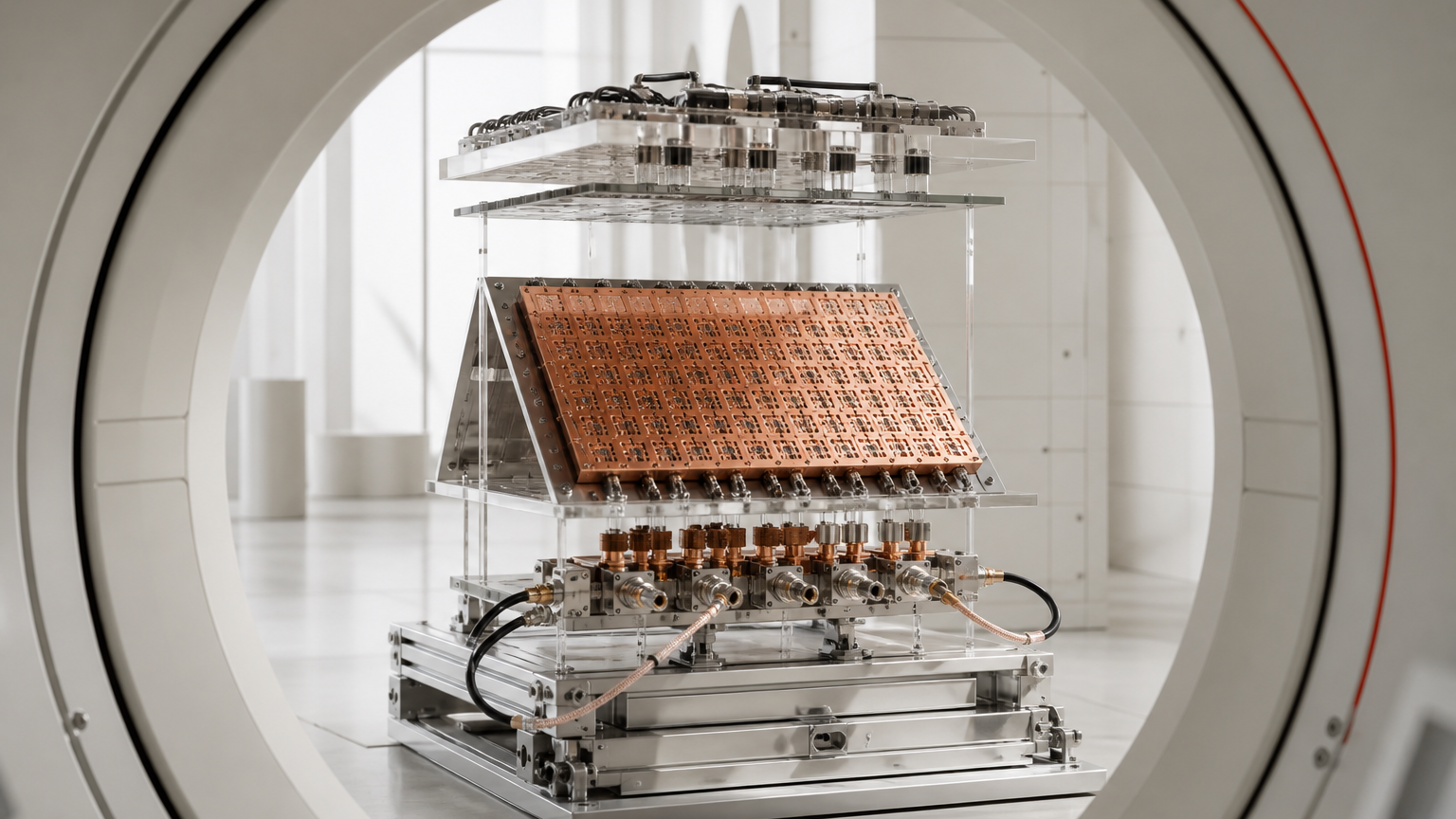
The human eye is small, moves easily, and sits among tissues that respond differently to a strong radiofrequency field. Higher magnetic fields can reveal finer anatomy, but they can also create shading, signal voids, and local heating. A team in Berlin and Rostock built a metamaterial antenna around that problem. The printed circuit board bends through 90 degrees over the eyes. Forty subwavelength copper cells are integrated with a two-channel transmit-and-receive loop to reshape the field at the operating frequency of a 7-tesla scanner.
The prototype reached human imaging
The antenna was tested in phantoms, five healthy adults, and one person with treated retinal disease. Three healthy volunteers received direct comparisons with a matched conventional loop. The new design increased transmit efficiency and received signal across the reported eye measurements. A flat version also extended coverage across the occipital region in two healthy volunteers. Safety work combined electromagnetic simulation, human voxel models, magnetic-resonance thermometry, and fiber-optic temperature probes. These results make the device a serious ocular MRI prototype, while the small cohort and technical endpoints stop well short of diagnostic superiority or routine care.
The quantum boundary matters
MRI reads signals produced by nuclear spin and magnetic resonance, placing this work in the quantum-sensing pillar. The metamaterial itself is an engineered radiofrequency structure rather than a quantum computer or algorithm. A contemporary UC San Diego account describes a separate line of quantum metamaterials built from nanoscale quantum elements and notes the broader use of metamaterials to shape MRI fields. The two research lines meet at materials control, but they should not be treated as the same mechanism. For hospitals, the relevant questions remain attached to the actual device: field uniformity, heating, scan performance, reproducibility, patient comfort, qualification, and whether better signal changes a clinical decision.
The Quiet Defect Inside a Noisy Diamond
A diamond defect can have a cleaner optical voice
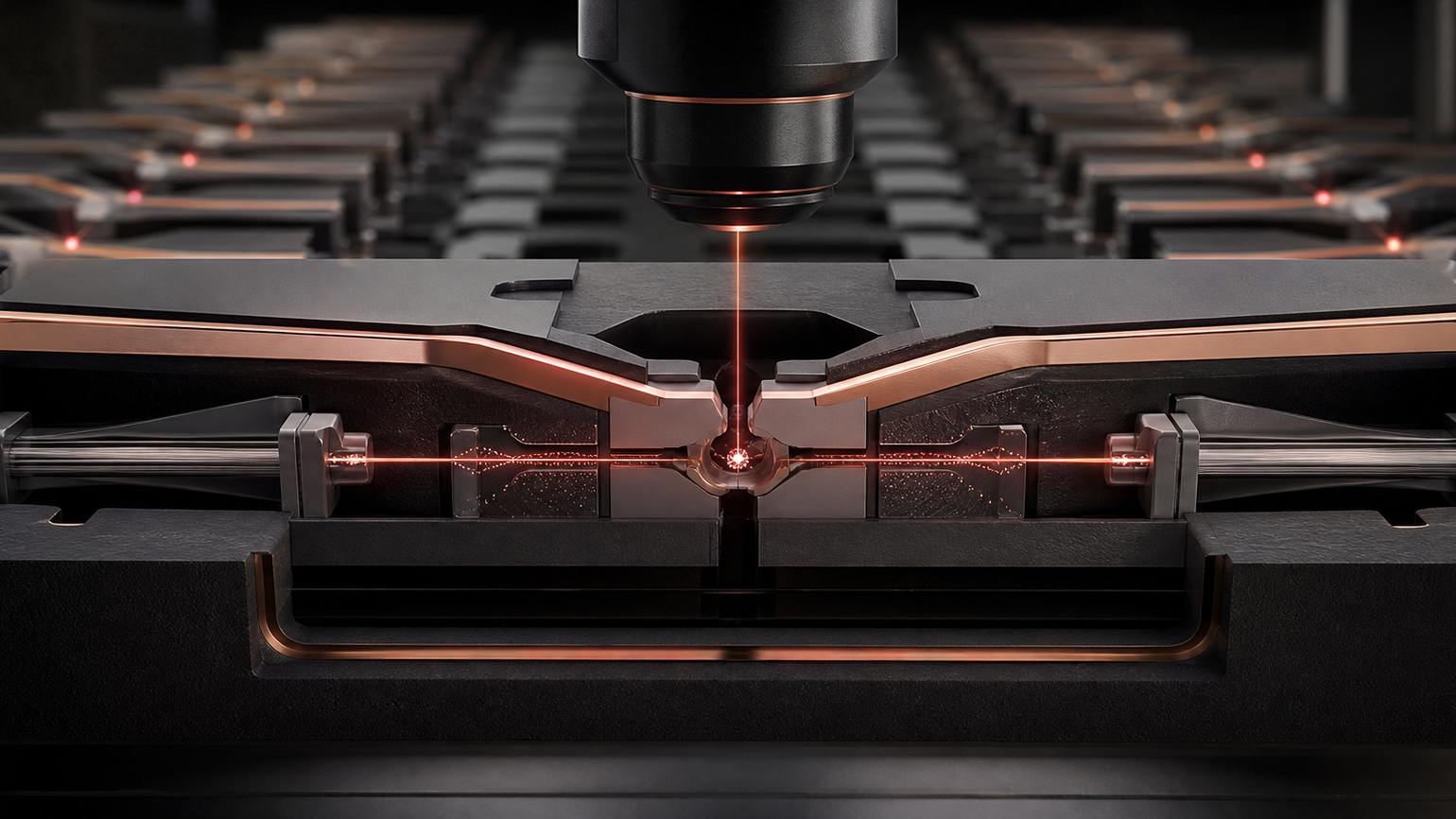
At room temperature, vibrations in a diamond lattice usually disturb the light emitted by an atom-sized defect. A research team led from the University of Illinois has reported a newly identified IL1 color center in nanodiamonds that behaves differently. The peer-reviewed paper describes single-photon emission with linewidths down to 0.3 nanometers at room temperature and brightness above 10 million counts per second at saturation. The usual broad phonon sideband was almost entirely suppressed. Instead, the emitter coupled mainly to one localized vibrational mode outside the diamond phonon band.
The result changes one engineering constraint
That combination matters because many solid-state quantum emitters pay a heavy thermal price for optical coherence. The IL1 result shows room-temperature emission from a real material under laboratory measurement. It does not yet show a complete sensor. The paper reports no controlled spin state, stable charge protocol, integrated readout package, biological sample, analyte, patient cohort, or clinical task. The authors themselves identify spin and charge control, quantum memory, and engineered versions of the defect as future questions.
Medicine enters through the temperature budget
Medical sensing often has to meet living tissue, routine laboratory workflows, or compact instruments at ordinary temperatures. A quantum component that preserves a narrow optical signal without deep cooling could eventually reduce one obstacle between materials physics and a usable device. Sensitivity, selectivity, calibration, biocompatibility, fabrication yield, and reproducibility remain separate problems.
Quentir reads IL1 as an experimental materials result with a credible sensing path and a still-open medical case. Its value today is precise: the team found an unusual way for an emitter to remain optically clean while the surrounding crystal vibrates. The next useful milestones are an integrated sensor, a defined target, comparison with existing diamond defects, and testing in the kind of sample the intended medical job actually involves.
A Surgical Simulator Enters the Real-Time Loop
The loop is now fast enough for interaction
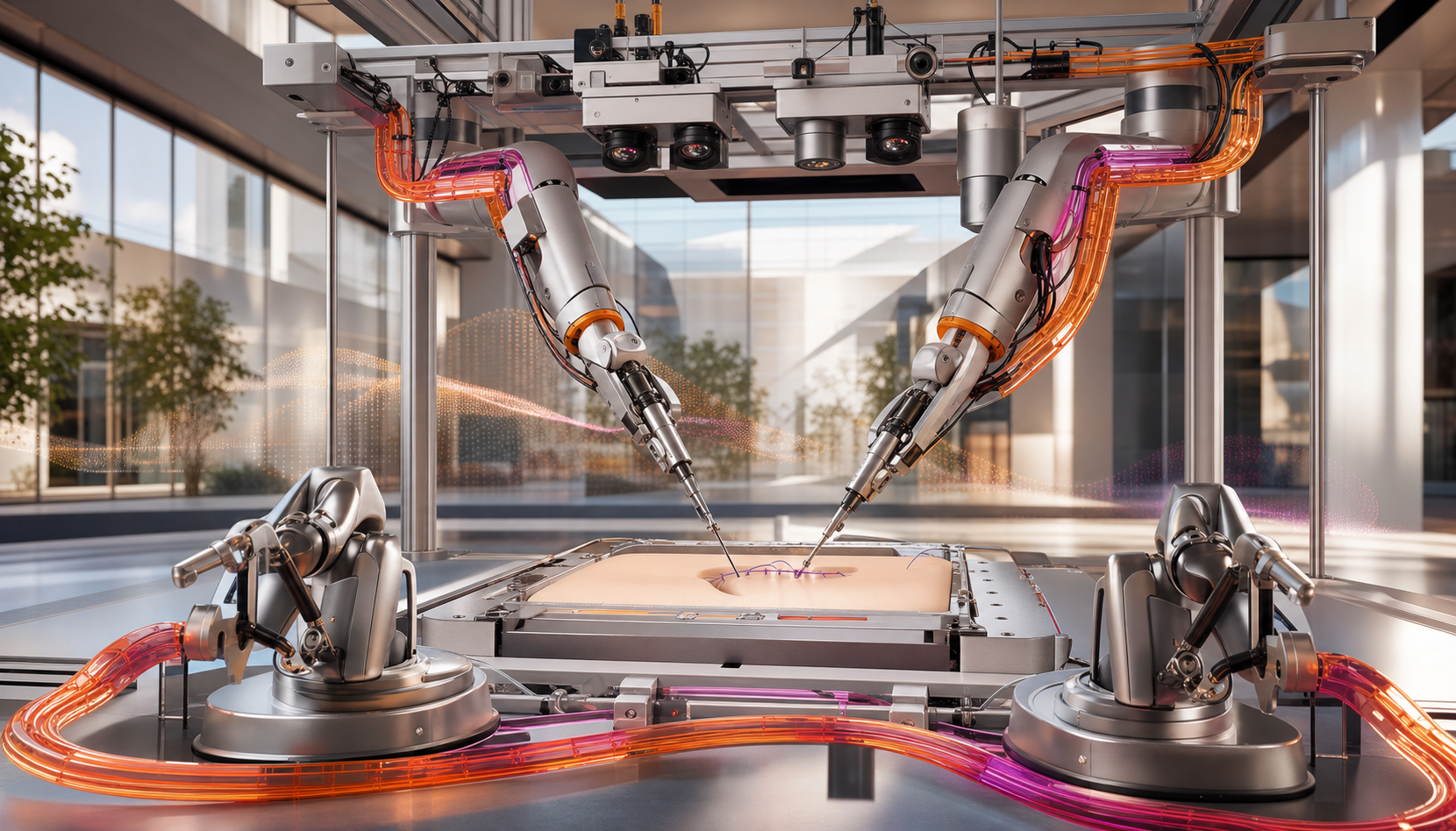
NVIDIA's Cosmos-H-Dreams takes an initial surgical video frame and a live stream of robotic actions, then generates the next scene in 12-frame blocks. The developers report roughly 160 frames per second on one RTX PRO 6000 GPU, up from about 10 frames per second for standard Cosmos-H-Surgical-Simulator inference. That throughput moves the system into real-time surgical simulation: a keyboard, Meta Quest controller, or learned robotic policy can act against the scene while the model keeps generating. The release specializes in tabletop suturing with the da Vinci Research Kit. It uses a 44-dimensional action format, causal attention, a streaming key-value cache, and a student model distilled from a bidirectional surgical-video teacher. This changes the experiment from a completed clip inspected later into a responsive environment that can be interrupted while a rollout is still unfolding.
Fidelity now becomes the demanding test
Interactivity supports closed-loop evaluation, but speed alone cannot show that the simulated robot behaves like the physical robot. The training material includes successful demonstrations along with needle drops, missed throws, unsuccessful knots, and out-of-distribution episodes. That is valuable because a simulator used for policy development must reproduce the consequences of poor actions as well as clean demonstrations. The developers themselves call for benchmarks covering tool-tip reach, pose accuracy, gripper cycles, idle stability, counterfactual actions, long-horizon drift, and agreement between simulated and physical policy outcomes.
The current release is a research and development platform for rehearsal, interactive demonstration, synthetic data, and robotic-policy testing. It does not report clinical performance, diagnostic value, prospective procedure studies, or validated transfer to patient care. Quentir reads it as an infrastructure advance whose medical value will depend on a precise simulation contract: the starting scene, action stream, generated response, time horizon, and physical comparator. The loop is fast enough to challenge in real time. Its fidelity remains open to independent testing.