KRIBB and Quandela Signed a Memorandum in Paris During Meetings on 7 and 8 September 2026 to Apply Photonic Quantum Computing to Drug-Candidate Discovery
Quentir Medicine Monitor
Evidence-based insights for quantum medicine. Published by Quentir Systems LLC · September 12, 2026.
During meetings in Paris on 7 and 8 September 2026, the Korea Research Institute of Bioscience and Biotechnology signed three memoranda of understanding, one of them with Quandela, the photonic quantum computing company founded in 2017 on research from CNRS and Université Paris-Saclay. KRIBB announced the agreements on 10 September, and the Korean daily Herald Economy carried the institute's account the same day. The signing took place during President Lee Jae-myung's state visit to France; on 8 September, Korea's science ministry and France's economy ministry exchanged a government-level memorandum on artificial intelligence, semiconductors and quantum technology at the Élysée.
The KRIBB and Quandela agreement has one stated purpose: to combine artificial intelligence and quantum computing with biological research so that finding a drug candidate takes less time and money than it does today. KRIBB puts the usual time to discover a candidate at more than ten years. The public announcement does not disclose a molecule, a disease target, a budget or a delivery date, and Quandela's own product pages describe the two machines it documents in use, Lucy at the French national computing center TGCC and Belenos in its cloud, as 12-qubit photonic machines. Read together, those two facts set the honest expectation for this partnership: a research collaboration at the stage of a signed memorandum, with no demonstrated pipeline benefit yet and no published plan for producing one.
What KRIBB signed in Paris during the meetings of 7 and 8 September 2026, and with whom
According to KRIBB's account as published by Herald Economy on 10 September 2026, the institute signed separate memoranda with the Institute of Plant Sciences Paris-Saclay (IPS2), with INSA Toulouse, and with Quandela. The three agreements are described as one plan: connect a research institute, a university and a deep-tech company so that Korea and France run joint research across plant science, biotechnology and what KRIBB calls bio-quantum technology.
Two of the three are conventional life-science partnerships. With IPS2, KRIBB extends cooperation on AI-based functional genomics; the institute already runs a Korea-France project with Seoul National University on the function of non-coding RNA in drought- and heat-tolerant plants, and the IPS2 relationship began at KRIBB's first International Scientific Advisory Committee meeting in May 2026. With INSA Toulouse, whose Toulouse Biotechnology Institute has more than forty years of enzyme engineering and synthetic biology behind it and worked with Carbios on a PET-degrading enzyme, KRIBB plans joint research and researcher and student exchange.
The third memorandum is the one that belongs in this Monitor. KRIBB president Kwon Suk-yoon signed it with Quandela chief executive Niccolo Somaschi. The stated goal is a technology that reduces the time and cost of discovering drug candidates by applying AI and quantum computing to biological research. Kwon's quoted line frames the whole package: plant science, biotechnology and quantum technology are different fields, and all three are core axes of the future bio industry; the institute hopes the agreements become a turning point toward concrete joint research results. Yonhap's report of 9 September 2026 on the science ministry's announcement lists the same KRIBB agreements and places them inside the wider state-visit package: regular Korea-France meetings on AI and quantum, joint research and innovative-company projects, and investment for market entry in both directions, all built on the letter of intent signed during President Macron's visit to Korea in April 2026.
What Quandela's photonic machines can do in 2026: 12 qubits on Lucy and BELENOS
Quandela's technology is photonic. Its qubits are single photons emitted by semiconductor quantum-dot sources, the component the company has manufactured since before it built computers, routed through optical circuits. Two machines are documented on the company's own product pages. Lucy, deployed in October 2025 and announced by Quandela as delivered to EuroHPC and GENCI at the CEA's TGCC, is a universal photonic quantum computer with at least 12 qubits, owned by the EuroHPC Joint Undertaking, co-acquired by GENCI, hosted and operated by the CEA at its TGCC center and coupled to the Joliot-Curie supercomputer for open research. Belenos is the company's second-generation machine with 12 qubits, available in its cloud, with a fully integrated version described as due in a supercomputer at the end of 2025; the same pages list Ascella as the first machine deployed out of the lab and a newer Canopus due to premium customers through the cloud in 2026, without a public qubit count on its page. The programming side is public too: Perceval, the company's open-source framework, documents the linear-optical components, single-photon sources and simulations a user can compose, and MerLin, the quantum machine-learning layer Quandela announced with OVHcloud, is built for hybrid AI and quantum workflows. What is absent is anything KRIBB-specific: neither partner has described a workload, an architecture or a result for the drug-candidate program.
The photonic route has a real strength that this Monitor's Defense sister lane has covered from another angle: the delivery by CSIRO of two entangled-photon light sources to DSTG, Australia's military science agency shows how mature photon sources have become as engineered components. A photon source that ships is a different thing from a photonic processor that solves a chemistry problem, and Quandela's public figures describe the second at twelve qubits.
Quantum pillar: computing. Technology readiness: TRL 2 of 9. This is Quentir's provisional assessment from the public announcements. The KRIBB and Quandela drug-candidate program exists as a signed memorandum of understanding and a stated concept: apply AI and photonic quantum computing to shorten candidate discovery. No molecule, target, algorithm, benchmark or hardware run has been published for it, so the program sits at the concept stage, before a proof-of-concept run on hardware (rung three), before laboratory validation against a classical baseline (rung four), and far before any preclinical or clinical use of a candidate the method produced.
Why "more than ten years" is the wrong benchmark for a 12-qubit processor
KRIBB's Korean wording attaches the ten-year figure to the discovery of drug-candidate substances (신약 후보물질 발굴), the stage before clinical development, and the memorandum's aim is that stage. Even within it, the parts a quantum computer could touch are narrow. Candidate discovery includes target validation, hit finding, lead optimization, toxicity and metabolism work and animal studies; the molecular computation where a quantum processor could in principle contribute sits inside some of those steps, in estimating how a small molecule sits in a protein pocket, in scoring binding energies, where accuracy beyond the classical approximations is the research objective and remains to be demonstrated, and in some property predictions. A vendor's qubit count, the operations its platform supports and a demonstrated chemistry result are three different things. For Quandela the first two are published, through the product pages and Perceval; the third, a drug-relevant computation on Lucy or Belenos with figures a chemist can check, is what neither partner has yet put in public for this program. What a 12-qubit machine can plausibly run is a small hybrid step, a sampling or kernel routine inside a classical machine-learning model, which is the kind of experiment MerLin exists for.
This Monitor has watched Korean drug-discovery programs make exactly this move before. For 13 August 2026 the Korea Pharmaceutical and Bio-Pharma Manufacturers Association scheduled a webinar at which SDT was to present a hybrid stack of CPUs, GPUs, simulators and quantum processors for molecular simulation, candidate search and ADMET prediction, with KRIBB among the announced participants; that announcement named the workload before anyone could judge whether a processor helps. The Paris memorandum takes the next institutional step, a foreign hardware partner, without yet naming the workload at all. For a reader inside a hospital pharmacy committee or a pharmaceutical partnering team, the practical reading is that this agreement carries no demonstrated benefit for any candidate now moving toward a clinic, and that it is still worth following because KRIBB, as a national institute, publishes what it does.
What a hospital or pharma buyer should watch for from KRIBB and Quandela next
Three items would move this program up the ladder. The first is a defined task: one protein target, one set of ligands, one question, with the classical method it is compared against. The second is a run on a Quandela processor, whether Lucy at TGCC or Belenos in the cloud, with the qubit count, circuit depth and error figures published, and with the classical baseline run on the same inputs. The third is a result a medicinal chemist could act on: a binding-energy ranking or property prediction on a molecule KRIBB cares about, compared against the relevant classical method, checked against experimental measurements where they exist, and reported with the total computational cost of the quantum and classical parts together. Until the first of those appears, the correct filing for this partnership is an agreement to try, with capable partners on both sides, and no evidence yet about whether the trying works.
How Quentir Reads It
This Monitor reads the Paris memorandum as an institutional signal and no technical one. KRIBB is a government-funded national institute that publishes its research program, and Quandela has machines installed at a national computing center and on a commercial cloud, so both sides have something concrete to bring and a habit of publishing what they do. The claim of a shorter discovery timeline will be judged on what the two partners publish. A defined task, the first item on the list above, would make the program assessable; only the second, a proof-of-concept run on Lucy or Belenos with its figures, would justify moving Quentir's provisional TRL 2 placement to rung three.
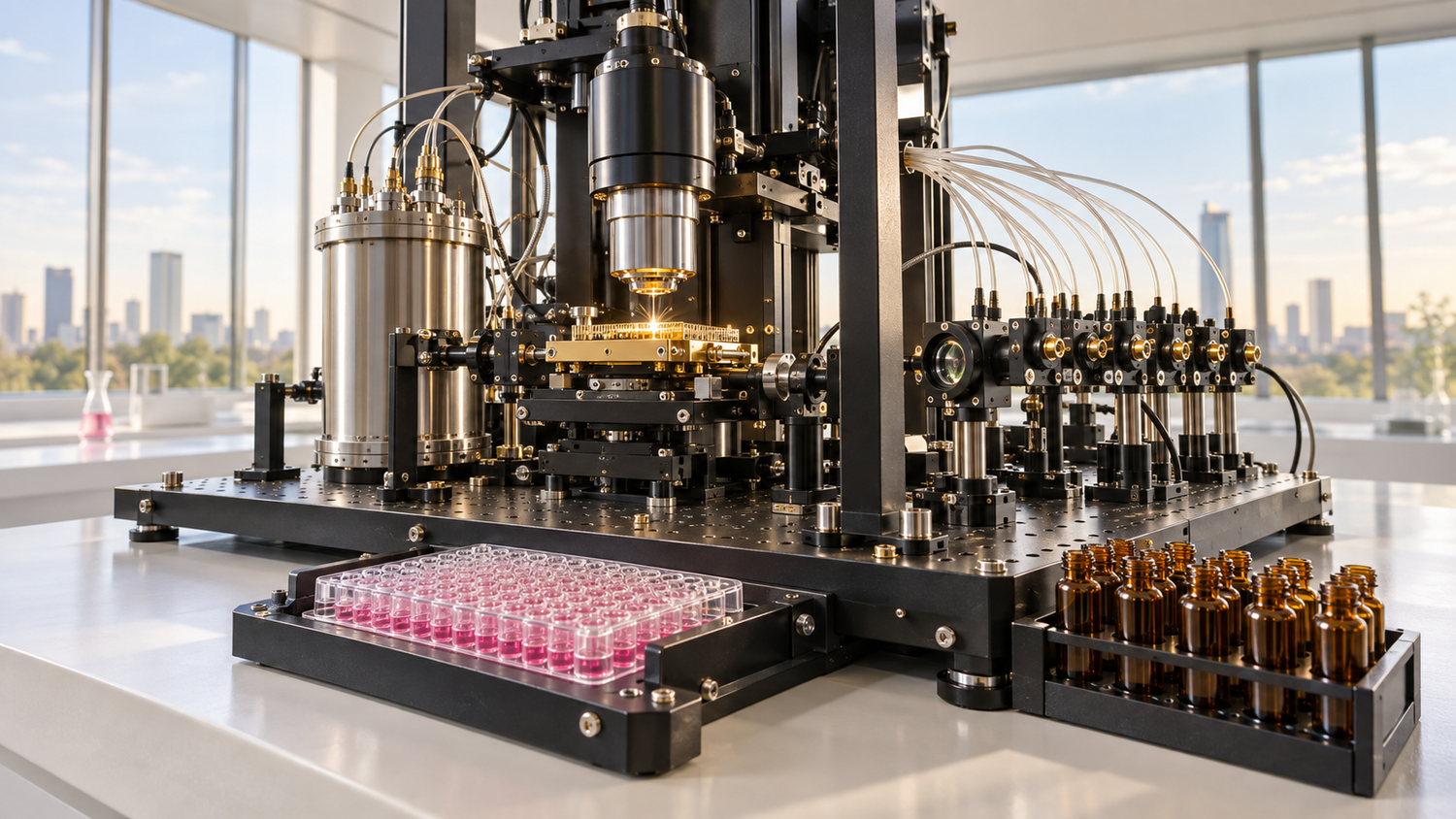
Image: an AI-generated conceptual illustration of a benchtop photonic instrument with a microplate and vials on its tray. It depicts no equipment of KRIBB or Quandela and no real laboratory.
Sources
Primary source: the Korea Research Institute of Bioscience and Biotechnology's announcement of 10 September 2026, known to this Monitor through Herald Economy's report of that day (reporter Koo Bon-hyuk, from KRIBB-supplied material; a capture of the page is kept with this post), for the three memoranda signed during the Paris meetings of 7 and 8 September 2026 with IPS2, INSA Toulouse and Quandela, the drug-candidate discovery aim, the more-than-ten-years baseline, the IPS2 and INSA Toulouse cooperation details, the Quandela company description and the quoted statement by KRIBB president Kwon Suk-yoon. Yonhap News Agency, 9 September 2026, supplies the science ministry's announcement of the government-level AI, semiconductor and quantum memorandum exchanged in Paris on 8 September, its April 2026 letter-of-intent basis, and the institutional agreements including the KRIBB and Quandela joint research on next-generation drug development. Quandela's product pages for Lucy and Belenos supply the October 2025 deployment of Lucy with at least 12 qubits under EuroHPC, GENCI and the CEA at TGCC, the 12-qubit second-generation Belenos in the cloud, and the Ascella and Canopus listings; the Perceval site supplies the open-source programming framework. The 2017 founding on CNRS and Université Paris-Saclay research is as stated in the KRIBB announcement. The judgments are this Monitor's own: the TRL 2 placement, the reading of the ten-year figure against the narrow part of the pipeline a quantum processor can touch, and the three items that would move the program up the ladder.