Quentir Medicine Monitor
Evidence-based insights for quantum medicine. Published by Quentir Systems LLC · November 21, 2026.
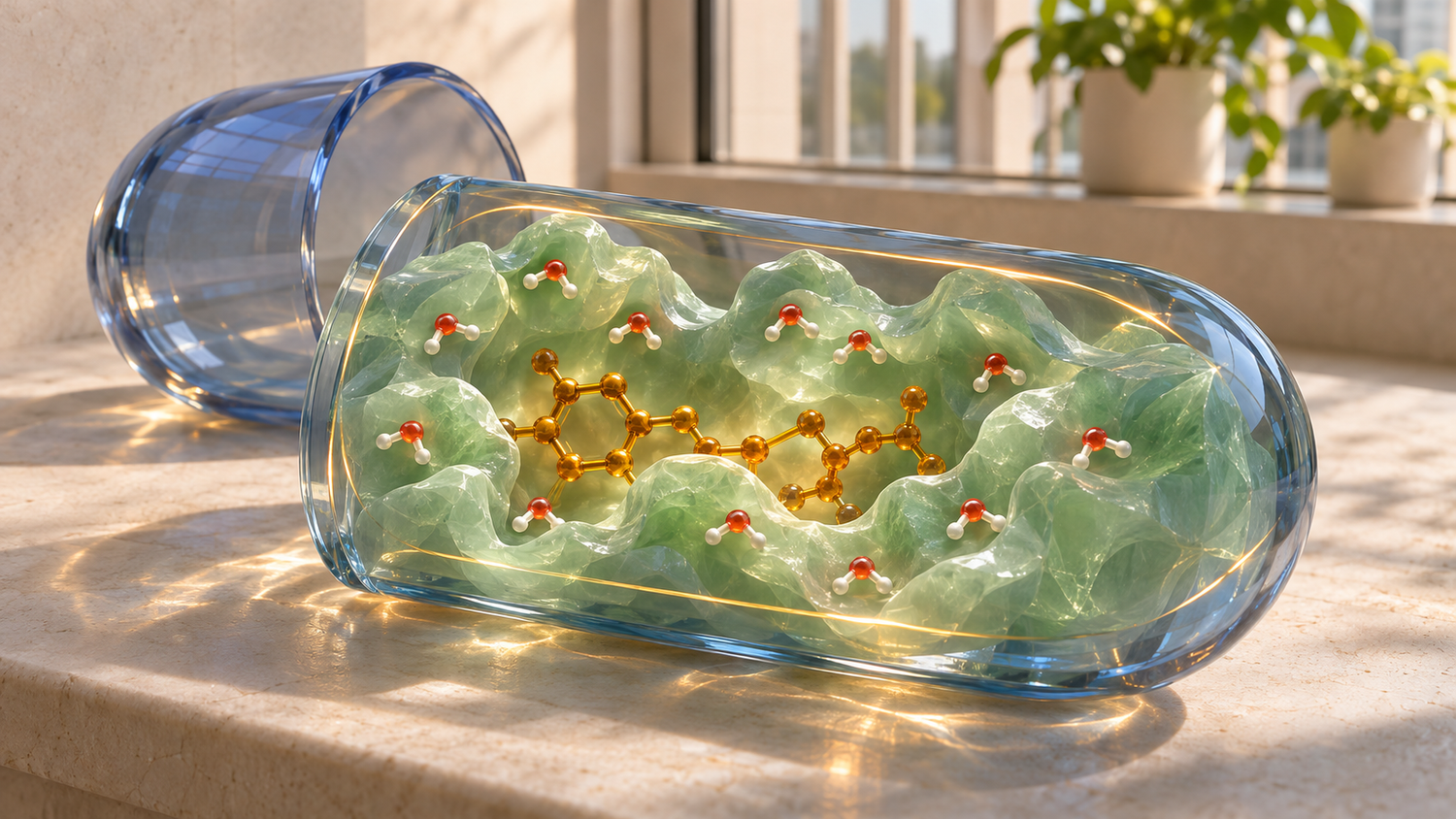
Researchers from the Paris drug-discovery company Qubit Pharmaceuticals, Sorbonne Université and the quantum software company Q-CTRL have used IBM quantum computers to predict where water molecules settle inside the binding protein pockets of drug targets. Daniele Loco, Kisa Barkemeyer, Andre Carvalho and Jean-Philip Piquemal cast hydration-site prediction as an optimization problem and solved instances of up to 123 binary variables on 156-qubit IBM Heron processors, using protein structures linked to diseases for which the U.S. Food and Drug Administration has approved a drug. Their paper appeared in Physical Review Research in September 2026, and Quantum Computing Report summarized it on 21 November 2026.
The study answers a practical question for medicinal chemists. A candidate drug binds to its target inside a cavity that is already filled with water, and some of those water molecules help the drug hold on while others must be pushed out before it can bind. Computer-aided drug design programs therefore need a map of the stable water positions before they can estimate binding or set up a docking calculation. The authors show that a quantum optimizer can produce that map at small scale, and they estimate how large a quantum computer must become before the method could be useful in routine drug design.
The work extends an earlier study by part of the same group that placed water in two-dimensional slices of a protein pocket on an analog quantum device built from Rydberg atoms. The new paper handles the full three-dimensional pocket on digital hardware, which brings the problem closer to the structures that pharmaceutical modelers use every day.
Why drug designers need to know where water sits in a protein pocket
Water shapes the structural stability of proteins and the way proteins interact with small drug molecules, which chemists call ligands, as the authors explain at the start of their paper. Interfacial water molecules can sit between a protein and a ligand and take part in the binding itself. Predicting their arrangement is expensive because each water molecule can form shifting networks of hydrogen bonds, exchange quickly with the surrounding solvent, or become fixed in place inside a binding site. Molecular dynamics and Monte Carlo simulations can capture these effects, but they can require substantial computational resources and rely heavily on parallel GPU computing, and the authors judge that machine-learning methods do not yet reach the accuracy that drug design requires.
The team's workflow begins with a classical calculation called the three-dimensional reference interaction site model, or 3D-RISM, which estimates how densely water is distributed around every point of the protein. The authors approximate that density with a sum of Gaussian distributions, each centered on a likely water position. Choosing the set of centers that fits the density most closely then becomes a yes-or-no decision for each candidate position, which they write as a quadratic unconstrained binary optimization model, or QUBO. The lowest-cost solution of the QUBO gives the three-dimensional coordinates of the most probable water sites.
How the team turned water placement into a QUBO problem for IBM Kingston and IBM Pittsburgh
The test set contains five protein-ligand structures from the Protein Data Bank, selected from 108 complexes that Samways and colleagues had analyzed in earlier work, plus one structure of a protein without its ligand bound. The authors explain that the hydration pattern of an empty pocket can guide chemists who design new binders. A full-resolution map of each pocket would produce a QUBO with roughly one million binary variables, far beyond any quantum computer and also beyond exact classical solvers. The team therefore resampled each map on a coarser grid and discarded low-density points, which reduced the instances to sizes that fit on a 156-qubit chip. The authors state openly that this coarsening lowers the accuracy of the predictions.
The quantum step ran through Q-CTRL's optimization solver, which includes the company's Fire Opal software for automated error suppression on IBM hardware. Most experiments used IBM Kingston, a Heron r2 processor. During the study IBM released its newer Heron r3 processor, IBM Pittsburgh, and the authors moved their hardest instance onto it. They compared every result with CPLEX, an exact classical solver, and with simulated annealing, a classical heuristic widely used for this kind of problem.
Quantum pillar: computing. Technology readiness: TRL 3 of 9. The method has worked as a proof of concept on real quantum processors with real drug-target structures, but only on coarsened pockets, and the study does not report using the method to choose or improve a compound.
What the 116-qubit and 123-qubit runs showed against simulated annealing and CPLEX
On the largest instance of the main test set, 116 variables run on 116 qubits of IBM Kingston, the Q-CTRL solver returned the exact optimal water arrangement in about 9 percent of its samples, according to the open preprint version of the paper, arXiv 2512.08390. Simulated annealing found the same optimum in about 2 percent of its samples, and a greedy local solver did not find it at all. At this size CPLEX could still prove which arrangement was optimal, which allowed the authors to check the quantum output against a certain answer.
The 123-variable instance was harder. The authors built it from structure 3b7e with its ligand included, on a grid spacing of 1.9 ångström. CPLEX ran for three hours, the cut-off the authors had set, and stopped with a best solution of cost minus 319.90 that it could not prove optimal. The Q-CTRL solver on IBM Pittsburgh found a lower-cost solution, minus 321.32, after a total runtime of 25 minutes. The result shows that an exact classical solver already struggles at about 120 variables. The authors add that it falls short of a quantum advantage, because simulated annealing and other fast heuristics remain strong at this size.
How accurate the predictions were against crystal structures and four classical tools
The authors judged accuracy by comparing predicted water sites with the water molecules that X-ray crystallography had located in each pocket. At the 123-variable size that fits on current hardware, the method placed roughly 60 percent of the crystal waters. To see what larger quantum computers might deliver, the team solved bigger instances classically with simulated annealing, up to 6,824 variables. Precision rose markedly from about 900 variables, and the fraction of crystal waters identified levelled off near 90 percent from 1,450 variables onward. Against four established classical programs, Hydraprot, Watgen, Placevent and Dowser++, the QUBO approach performed on par with Hydraprot, the strongest of the four, in the authors' comparison on structure 3b7e.
The large-instance results come from classical simulation with simulated annealing. They show that the QUBO formulation reaches competitive accuracy once instances grow large enough; whether a quantum computer will solve such instances better than a classical heuristic remains untested. The same situation appears in other recent drug-discovery tests on the same IBM hardware, including an A*STAR study that placed an 18-variable drug-docking problem on six qubits of ibm_kingston. In each case the quantum run demonstrated a working pipeline on a problem far smaller than those drug designers already solve classically.
When the authors expect the method to need about 900 qubits, and what that means for pharmaceutical groups
The paper ends with a resource estimate. The authors treat about 900 variables as the point at which the method becomes competitive with classical hydration tools for structure 3b7e. They compiled instances of up to 156 variables for a Heron processor and found that the number of two-qubit gates grows roughly with the square of the problem size, which puts a 900-variable instance at about 100,000 two-qubit gates. Comparing that figure with IBM's published hardware roadmap, they expect machines of around 1,000 qubits by 2027, while the gate count will probably require early error correction, which IBM projects for 2029. In the authors' forecast, the square qubit connectivity of IBM's next-generation hardware, together with better compilation, could cut the circuit to roughly 15,000 two-qubit gates and bring the target within reach as early as 2028. They anticipate that a fair test against leading classical heuristics may become feasible in that year.
For pharmaceutical research groups, the near-term value of this work lies in the pipeline. The 3D-RISM calculation, the Gaussian mixture and the QUBO all run classically today, and the authors' own large-scale results suggest that the formulation already matches leading fast hydration tools when solved with simulated annealing. A team interested in the quantum step can follow the published method and benchmarks, while the claim that quantum hardware will eventually solve these problems better awaits the experiments that the authors place around 2028.
Sources
Primary source: Daniele Loco, Kisa Barkemeyer, Andre R. R. Carvalho and Jean-Philip Piquemal (Qubit Pharmaceuticals, Q-CTRL and Sorbonne Université), Physical Review Research, September 2026, with the open preprint on arXiv. Also drawn on: Quantum Computing Report's summary of 21 November 2026, Q-CTRL's Fire Opal product page, IBM's quantum hardware and roadmap page and earlier Quentir coverage.