Japanese Patent 7,908,389, Registered 10 August 2026: What Toshiba and AOI Biosciences Claim for Allosteric Site Prediction, and What Quantum-Inspired SQBM+ Actually Runs On
Quentir Medicine Monitor
Evidence-based insights for quantum medicine. Published by Quentir Systems LLC · September 6, 2026.
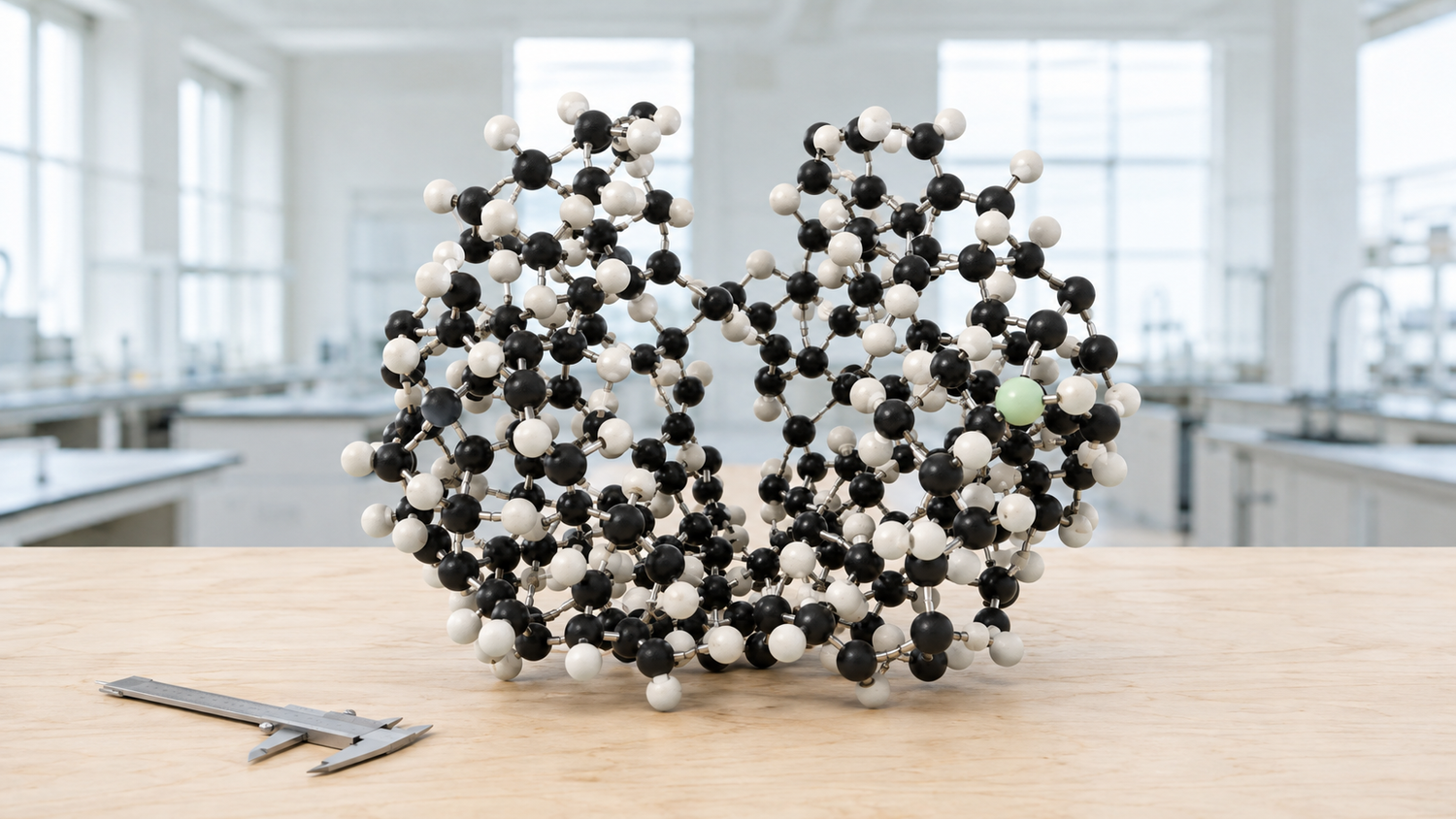
On 3 September 2026 Toshiba Corporation and AOI Biosciences announced that a patent the two companies had filed together was registered in Japan on 10 August 2026. It covers an allosteric pathway prediction device: software that reads a protein's three-dimensional structure and predicts the internal routes leading to pockets that sit away from the site where the protein does its work.
Three parts of that announcement carry different weights. Japanese Patent 7,908,389 is a legal instrument whose protection runs to its granted claims in Japan, which is a separate question from whether the method finds sites nobody had found before. The supporting evidence offered in the release is one figure, accuracy of 80 percent or higher on already-known sites, reported without a definition of accuracy, a benchmark set or a paper behind it. And the optimization engine at the center of the work, Toshiba's SQBM+, is described as quantum-inspired, a term that here means the solver runs on ordinary classical computers and uses no qubits.
What Toshiba and AOI Biosciences Announced on 3 September 2026, and What Patent 7,908,389 Covers
The joint news release of 3 September 2026 gives the patent's particulars in a short table. The invention is titled "allosteric pathway prediction device" (アロステリック経路予測装置), the patent number is 7,908,389, the registration date is 10 August 2026, and the applicants are AOI Biosciences Inc. and Toshiba Corporation. AOI Biosciences, formerly Revorf Inc., is based in Ibaraki City in Osaka Prefecture and led by Shinichi Sueda; it works in infectious disease and autoimmune disease across testing, drug discovery and drug-discovery support. Toshiba is based in Kawasaki, Kanagawa, under president and chief executive Taro Shimada. The same release was carried the same day by Nikkei Biotech ONLINE.
The scientific problem is a familiar one in small-molecule drug discovery. Most small-molecule programs aim at the active site, the pocket where a target protein does its chemistry. Many proteins either have no pocket a small molecule can bind well, or have one whose blocking causes side effects, which is why the set of proteins a small molecule can address has stayed narrow. An allosteric site is a different pocket, elsewhere on the same protein, where a regulator binds and changes the behavior of the active site at a distance. Targeting it can widen the set of addressable proteins and can yield compounds with higher specificity. The release states the practical obstacle plainly: identifying allosteric sites costs a great deal of labor and money, and that cost is what has kept the approach from spreading.
The patented method attacks that cost. From a protein's three-dimensional structure, SQBM+ is used to predict and analyze the allosteric pathways running through the protein's interior, and promising allosteric sites are then predicted from the result of that analysis. Toshiba Digital Solutions Corporation and Revorf, the company that is now AOI Biosciences, reported verification results on 27 June 2022, building on work carried out in a Toshiba open-innovation program between July and September 2021. That earlier verification covered several proteins including the oncogene KRAS, comparing predicted allosteric regulatory sites against sites already described. The 2026 release reports two further results, in its own words. Checked against allosteric sites that were already known, the method is said to have predicted them with accuracy of 80 percent or higher. Separately, compounds were searched for against sites the method predicted, and on evaluation those compounds are reported to have shown activity against the target protein. Three next steps are named: expanding a prediction service that the release says is already being supplied to pharmaceutical companies, joint drug-discovery research with those companies, and AOI Biosciences using the method in its own pipeline.
Quantum pillar: not applicable. Technology readiness: TRL 4 of 9. SQBM+ is quantum-inspired software running on conventional computers, with no quantum hardware of its own, so this work names no pillar. The rung is this Monitor's provisional editorial assessment of one thing only, the allosteric pathway and site prediction method as the two companies have disclosed it, and it reflects the validation they describe rather than any rating they publish. On the shared ladder both Evidence Registers use, rung four covers laboratory validation, which is what the disclosed evidence amounts to: a check against pockets already described in the literature, and a wet-lab activity result given without an assay type, an affinity or a demonstrated allosteric mechanism. The companies separately say the prediction service is already being supplied to pharmaceutical companies, and the rung stays conditional on the disclosure: it moves when an assay protocol, an evaluation set or a published result arrives.
Why SQBM+ Uses No Qubits: the Simulated Bifurcation Algorithm Goto, Tatsumura and Dixon Published in Science Advances in April 2019
Toshiba's own footnote to the release is the clearest statement of what SQBM+ is, and it is worth quoting in substance. The solver was invented in the course of quantum computer research at Toshiba's Corporate Research and Development Center, it implements the simulated bifurcation algorithm, and it obtains high-quality approximate solutions to large combinatorial optimization problems in a short time using existing computers. That last clause is the whole point. The mathematics was derived from the behavior of a quantum system, specifically the adiabatic bifurcation of nonlinear oscillators, and the machine that runs it is a conventional processor.
The underlying algorithm was published by Hayato Goto, Kosuke Tatsumura and Alexander R. Dixon of Toshiba in Science Advances in April 2019, under the title "Combinatorial optimization by simulating adiabatic bifurcations in nonlinear Hamiltonian systems". Its practical appeal is that, unlike a quantum annealer or a gate-model processor, it parallelizes cleanly onto hardware that already exists in every data center. Toshiba's own product page for the Simulated Bifurcation Machine sells it on that basis, and the release lists the prior deployments: verification work on high-frequency trading in equity markets, picking-route and shelf-placement optimization inside factory warehouses, plus separate exercises in energy management and in materials development.
For a clinical or hospital reader the consequence is simple. Nothing in this patent depends on the availability of a quantum computer, on qubit counts, on error rates or on any of the timelines that govern quantum hardware. A pharmaceutical company buying this prediction service is buying classical software with an unusual pedigree. The word quantum in the headline describes where the equations came from, and the procurement question underneath it is the ordinary one asked of any computational chemistry tool: does it find things, and how would you know?
What the 80 Percent Figure Measures, and What It Leaves Open
The single quantitative claim in the release is that the companies report accuracy of at least 80 percent in validation against known allosteric sites, and the release does not define the metric or the evaluation protocol. Whatever the metric turns out to be, the shape of the exercise is retrodiction: sites already described in the structural biology literature were held up and the method was scored against them. Such a test is the right first step. What it cannot establish is the thing a buyer is paying for, which is the discovery of a site nobody has published yet on a protein that has resisted the usual approaches.
Three properties of the test are missing from the release and would change how the figure reads. The first is the metric itself. Accuracy is not defined in the release, and the same word can mean the fraction of known sites recovered, the fraction of predicted sites that are real, or a rank-based score, which are different quantities with different consequences. The second is the composition of the evaluation set, since the number of proteins and sites in it, and how those proteins were chosen, determine how far the figure generalizes. The third is the error rate in the other direction. A predicted pocket can be a real feature of the surface and still not be allosteric, so an accuracy figure quoted without the false-positive rate leaves open how often the method labels a site as allosteric when it is not. The number a buyer works with is precision, meaning the share of labeled sites that hold up on testing, and beneath that the confirmed hits per tested candidate, because that is what decides whether the method saves money or spends it.
The compound result has the same shape. The release states that compounds were searched against predicted sites and showed activity on the target protein, which if borne out is a wet-lab step beyond pure computation. It names no protein, no compound class, no binding affinity and no assay type, and it does not report that the activity was shown to work through the predicted allosteric site rather than some other mechanism. Activity against a target protein in an assay is a long way from a molecule that regulates that protein usefully inside a cell, and further still from one that survives a whole-animal study.
What the 3 September 2026 Release Does Not Contain: No Benchmark Set, No False-Positive Rate, No Peer-Reviewed Paper
A granted patent is a strong document about novelty and a weak one about performance. Under the Japan Patent Office examination guidelines, examination assesses patentability: whether the claimed invention is new, whether it involves an inventive step, and whether the specification describes it well enough to be worked by a person skilled in the field. Prior art and experimental evidence can bear on that assessment. What a grant is not is independent benchmark validation of predictive performance. Registration on 10 August 2026 is therefore an accurate fact about intellectual property, and it does not independently validate predictive accuracy.
The September release also says nothing about which proteins were involved. The 2022 release did, naming KRAS among several proteins in that earlier verification work, and the announcements do not establish whether their evaluation datasets overlap. Nothing in the 2026 announcement says KRAS underlies either the 80 percent figure or the compound-activity result.
The gap that matters is in the disclosure. The release supplies no peer-reviewed validation paper for this application, and what this Monitor could review is the companies' own registration announcement together with the release of 27 June 2022, four years apart. The granted claims themselves, which are what a licensee would be buying and what fixes the scope of the protection, have not been read here. Computational chemistry has established venues and established benchmark sets for exactly this task, and a method that outperforms the incumbents on one of them would be publishable. The prediction service is meanwhile being supplied to customers. Reading the sequence in that order is what an evidence register is for: the commercial claim is running ahead of the published evidence, and this Monitor places the work at the rung its disclosed evidence supports.
What a Pharmaceutical Buyer Should Ask Before Commissioning an Allosteric Prediction Run
Six questions turn this release into a procurement decision. How is accuracy defined, and which evaluation set produced the figure of 80 percent or higher? How many proteins and sites does that set contain, and how were they chosen? What is the false-positive rate on the same set, what precision does the method reach, and how many confirmed hits follow per tested candidate? How does the method compare against the public allosteric-site prediction tools a computational chemistry group could run for free? Which protein, compound and assay produced the activity result, what affinity was measured, and was the mechanism shown to run through the predicted site? And what do the granted claims of patent 7,908,389 actually cover, since the claims and not the press release define the scope a licensee would be buying?
One further question is the one most easily skipped. Framing the engine as quantum-inspired invites a buyer to treat the compute layer as the innovation. On the companies' own account the prediction quality depends on how the allosteric-pathway problem was formulated as a combinatorial optimization in the first place, and a buyer who benchmarks the solver rather than the formulation will measure the wrong thing.
How Quentir Reads It
This lane has been following a pattern in quantum-adjacent drug discovery where the compute story is announced well before the chemistry result. When BC World Pharm was selected with Qunova Computing to work on pan-beta-lactamase inhibitors on 1 September 2026, the announcement's checkable content was a funding decision and a target class, with the validation ladder still ahead of it. The Toshiba and AOI Biosciences work sits one step further along, because the companies report a compound-activity result, and that report arrives without an assay protocol, so it stops at much the same place: the deliverable that would settle the question is a molecule with a number attached to it.
There is a second reason this item belongs in a quantum medicine monitor even though it uses no quantum hardware. The field's honest near-term output includes algorithms that began as quantum ideas and now run on classical machines, which is a different proposition from the fault-tolerance timelines that govern actual quantum processors, where five preprints of 2 and 3 September 2026 were still testing the assumptions behind low-qubit resource estimates. Simulated bifurcation is available now, on hardware a company already owns. Keeping the two categories apart is what lets a hospital or pharmaceutical buyer read either claim without discounting both.
Sources
Primary source: AOI Biosciences Inc. and Toshiba Corporation, joint news release "Patent acquired for allosteric site prediction technology targeting proteins that are difficult to drug," published 3 September 2026, for the patent title, the patent number 7,908,389, the registration date of 10 August 2026, the two applicants and their locations and chief executives, the description of the method as predicting allosteric pathways from three-dimensional structure using SQBM+, the reported accuracy of 80 percent or higher against known allosteric sites, the reported compound activity against the target protein, the three stated next steps including a prediction service the release says is already being supplied to pharmaceutical companies, and the footnote describing SQBM+ as a simulated bifurcation solver invented during quantum computer research at Toshiba's Corporate Research and Development Center that runs on existing computers, together with its prior applications in high-frequency trading, warehouse picking and shelf placement, energy management and materials development. Nikkei Biotech ONLINE carried the release on 3 September 2026. Hayato Goto, Kosuke Tatsumura and Alexander R. Dixon, "Combinatorial optimization by simulating adiabatic bifurcations in nonlinear Hamiltonian systems," Science Advances, volume 5, issue 4, article eaav2372, April 2019, DOI 10.1126/sciadv.aav2372, supplies the published algorithm behind SQBM+, and Toshiba's Simulated Bifurcation Machine product page supplies its commercial framing. The earlier joint release of 27 June 2022, issued by Toshiba Digital Solutions Corporation and Revorf, supplies the start date of the collaboration and the fact that the earlier verification work covered several proteins including KRAS. The Japan Patent Office examination guidelines supply what patent examination does and does not assess. The judgments are this Monitor's own: the TRL 4 placement, the reading of the 80 percent figure as a retrodiction test, the observation that neither the metric definition, the evaluation set nor the false-positive rate is given, and the six procurement questions.