
Daiichi Sankyo Uses QSimulate's QUELO Quantum Chemistry Software in Several Drug Discovery Programs to Predict Binding Affinity: What the June 2026 AWS Account Shows
How Daiichi Sankyo uses QSimulate's quantum chemistry to predict drug binding
Quentir Medicine Monitor
Evidence-based insights for quantum medicine.
Daiichi Sankyo is using software from the Boston start-up QSimulate to bring quantum chemistry into one of the most routine and most expensive judgments in drug discovery: how tightly a candidate molecule will bind to its protein target. The main public account is a Japanese-language blog on the Amazon Web Services site, published on 11 June 2026.
That blog was written jointly by scientists from Daiichi Sankyo's Smart Research Institute II, by QSimulate, and by an AWS solutions architect, and it describes how the company evaluated and then adopted QSimulate's QM-FEP method, a version of free energy perturbation that uses quantum mechanics for the energy of the interaction between drug and protein.
Predicting binding affinity well matters because it decides which molecules a medicinal chemistry team actually makes. Each round of the design, make, test and analyze cycle costs weeks of synthesis and assay work. A computer model that ranks candidates more reliably lets chemists spend that time on the compounds most likely to work, and lets them drop weak ideas before anyone orders reagents.
No quantum computer is involved here. QSimulate's software runs quantum mechanical calculations on ordinary graphics processors in the cloud. The interest for medicine lies in a large pharmaceutical company putting physics-level chemistry into its everyday design work today, years before quantum hardware is expected to take on the same problem.
The Daiichi Sankyo authors explain the problem in practical terms. Their teams already use structure-based drug design and conventional free energy perturbation, which estimates binding by simulating the gradual transformation of one molecule into another inside the protein. That method depends on a classical force field, a fixed set of rules for how atoms push and pull on each other. The authors write that more accurate energy functions are needed, especially for the chemical modalities they expect to grow more complex, where conventional FEP has struggled with non-classical interactions and with covalent drugs that form a chemical bond with their target.
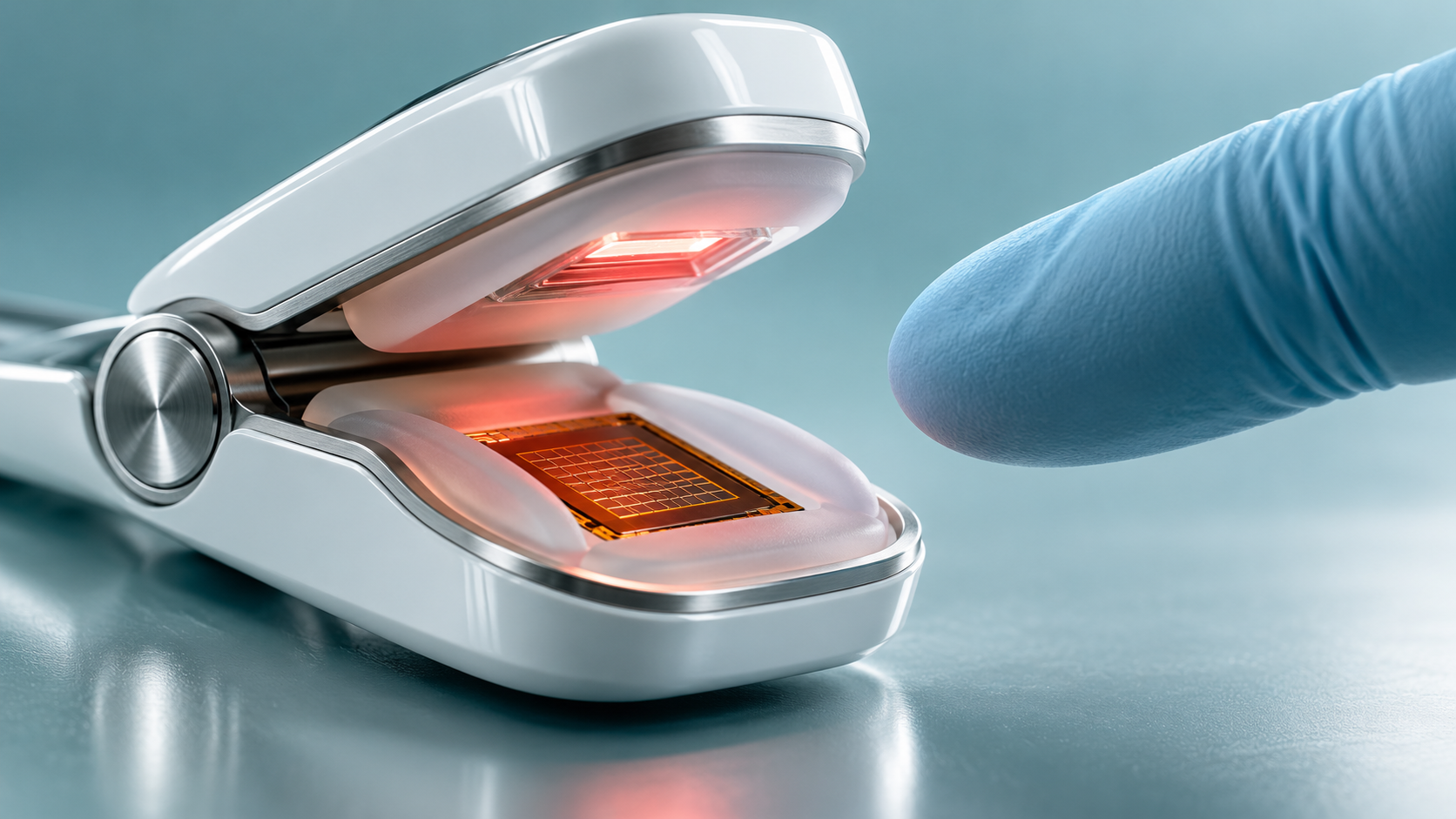
Tanaka Precious Metal Technologies and Nagoya University Develop Lead-Free Silver Quantum Dots for Shortwave Infrared Sensing, With Samples From January 2027
What Tanaka and Nagoya University developed for shortwave infrared sensing
Quentir Medicine Monitor
Evidence-based insights for quantum medicine.
Tanaka Precious Metal Technologies and the Torimoto Laboratory at Nagoya University have developed lead-free quantum dots made of silver, sulfur and tellurium that respond to near-infrared and shortwave infrared light. The company says it will begin supplying samples of the material in January 2027 and expects uses in consumer electronics and in the medical field.
The announcement went out on 20 October 2026. In Tanaka's own test, a simple light sensor that used the silver, sulfur and tellurium dots as its light-absorbing layer reached a maximum external quantum efficiency of 18.4 percent for light between 1,200 and 1,700 nanometers, according to Dellows News' Japanese-language article based on the company's release. The trade journal Compound Semiconductor reported the same figures on 20 October, along with the two conferences where the material will be shown: Okinawa Colloids from 1 to 6 November and nano tech 2026 in Tokyo from 16 to 18 December.
The work addresses a materials problem that has slowed infrared sensing for years. The standard detector material for this band, indium gallium arsenide, detects light out to about 1,700 nanometers with high sensitivity. It is made with vacuum processes, which makes yield and cost hard to control in volume, and Tanaka notes that indium supply is under pressure from demand in other advanced industries. Quantum dots of lead sulfide can be printed over large areas instead, and the release says sensors made that way cost about one tenth as much as indium gallium arsenide sensors.
Lead is the catch. The European Union's RoHS Directive restricts ten substances in electrical and electronic equipment, with lead and cadmium among them, and it applies to every product with an electrical or electronic component unless that product is specifically excluded. Tanaka says the lead content of lead sulfide dots has limited their use in consumer electronics. The new dots contain neither lead nor cadmium and still cover a similar range of wavelengths.
For readers in medicine, the interest lies in the wavelengths. The release states that light between 1,200 and 1,700 nanometers passes readily into materials and into the inside of the body, is less affected by sunlight and bad weather, and is safer for the human eye. It lists biological sensing among the applications, alongside smartphone face recognition, 3D sensing, wearable devices and automotive lidar. Those are the company's general statements about the band. How deep the light reaches and what exposure is safe depend on wavelength, tissue and light intensity, and the announcement offers no medical-device safety data.

QST's Heat-Etched Nanodiamond Quantum Sensors Cut Particle-to-Particle Variation to a Quarter and Raise the Signal 55 Percent: ACS Nanoscience Au, 7 October 2026
Uniform nanodiamond quantum sensors for blood diagnostics
Quentir Medicine Monitor
Evidence-based insights for quantum medicine.
A diagnostic test is only useful when it gives the same answer for the same sample, whichever batch of reagent the laboratory happens to open that morning. Tiny diamond particles that act as quantum sensors have shown remarkable sensitivity in research settings, yet each particle has behaved slightly differently, and that spread has stood between the laboratory result and a test a hospital could rely on.
On 7 October 2026 Japan's National Institutes for Quantum Science and Technology (QST), with Chiba University, Institute of Science Tokyo, Kyoto University and the Chiba start-up Type-I Technologies, reported a new way to make nanodiamond quantum sensors that behave far more alike. According to the QST press release of 7 October 2026, the new process reduces particle-to-particle variation to about a quarter of that of conventional particles and raises the quantum signal by 55 percent. The groups see the work as groundwork for quantum liquid biopsy, the detection of very small amounts of disease-related molecules in blood, and for batch production of uniform sensors rather than hand-picking a few outstanding particles.
The paper, "Spin-Uniform Nanodiamond Quantum Sensors for Reproducible Intracellular Thermometry," by Chihiro Suzuki, Ryuji Igarashi and nine co-authors, appeared online in ACS Nanoscience Au (DOI 10.1021/acsnanoscienceau.6c00068) on the same day. For a laboratory director, a diagnostics buyer or a clinician following early cancer detection, it addresses the question that comes before any claim of sensitivity: whether two sensors given the same sample report the same value.
A nanodiamond sensor depends on a defect called the nitrogen-vacancy center, a spot in the diamond lattice where a nitrogen atom sits next to a missing carbon atom. When green laser light falls on the particle, the defect glows red, and microwave measurements of that glow, a method called optically detected magnetic resonance (ODMR), reveal small changes in temperature and in the chemical surroundings. Particles a few tens to a few hundred nanometers across can enter living cells.
The conventional route crushes larger diamond into nanoparticles first and creates the sensing defects afterward. QST explains that mechanical crushing leaves scratches and strain that differ from particle to particle, so every particle carries its own quirks into the measurement. The new process reverses the order. The team first builds nitrogen-vacancy centers into relatively large diamond particles of good crystal quality, then heats them gently in air so that the surface oxidizes away a little at a time. Diamond faces oxidize at different rates, and the researchers tuned the conditions so that disordered outer material goes first. What remains is the most orderly central tenth of the original particle, still small enough for work inside cells.

AOI Biosciences' Roughly 500 Million Yen Financing and Share Transaction of 14 September 2026 Lists Its Neo-Self Antibody Test Ahead of the Toshiba SQBM+ Quantum-Inspired Drug Platform
Quentir Medicine Monitor
Evidence-based insights for quantum medicine.
On 14 September 2026 AOI Biosciences, a diagnostics and drug-discovery company in Ibaraki, Osaka Prefecture, announced a financing and secondary-share transaction of roughly 500 million yen with existing and new investors; the company says the new-share portion takes its cumulative funding to about 1 billion yen, and it does not state how much of the 500 million is new money. The release describes two core businesses. One is a blood test for a "neo-self" autoantibody that is already sold to more than 300 Japanese medical institutions. The other is an allosteric drug-discovery method built with Toshiba on the quantum-inspired SQBM+ solver, the method whose patent Toshiba announced on 3 September and this Monitor examined on 6 September.
The release lists three planned uses for the proceeds, and that list is the useful fact for a hospital buyer or a pharma partner, with one caution: the order says nothing about how much money goes where or which business the company values more. The neo-self antibody test fills the first two entries, with domestic roll-out, Asian expansion and new autoimmune indications, and further research investment in the quantum-inspired drug discovery platform is the third. No amounts are attached to any entry. The clinical figures the release cites for the test, a pregnancy rate more than doubled and a live-birth rate 1.7 times higher, come from two Frontiers in Immunology cohort studies whose treated and untreated groups can be counted, and this note counts them.

Japanese Patent 7,908,389, Registered 10 August 2026: What Toshiba and AOI Biosciences Claim for Allosteric Site Prediction, and What Quantum-Inspired SQBM+ Actually Runs On
Quentir Medicine Monitor
Evidence-based insights for quantum medicine.
On 3 September 2026 Toshiba Corporation and AOI Biosciences announced that a patent the two companies had filed together was registered in Japan on 10 August 2026. It covers an allosteric pathway prediction device: software that reads a protein's three-dimensional structure and predicts the internal routes leading to pockets that sit away from the site where the protein does its work.
Three parts of that announcement carry different weights. Japanese Patent 7,908,389 is a legal instrument whose protection runs to its granted claims in Japan, which is a separate question from whether the method finds sites nobody had found before. The supporting evidence offered in the release is one figure, accuracy of 80 percent or higher on already-known sites, reported without a definition of accuracy, a benchmark set or a paper behind it. And the optimization engine at the center of the work, Toshiba's SQBM+, is described as quantum-inspired, a term that here means the solver runs on ordinary classical computers and uses no qubits.