When the Error Check Happens Decides What It Buys
Quentir Medicine Monitor
Evidence-based insights for quantum medicine. Published by Quentir Systems LLC · August 23, 2026.
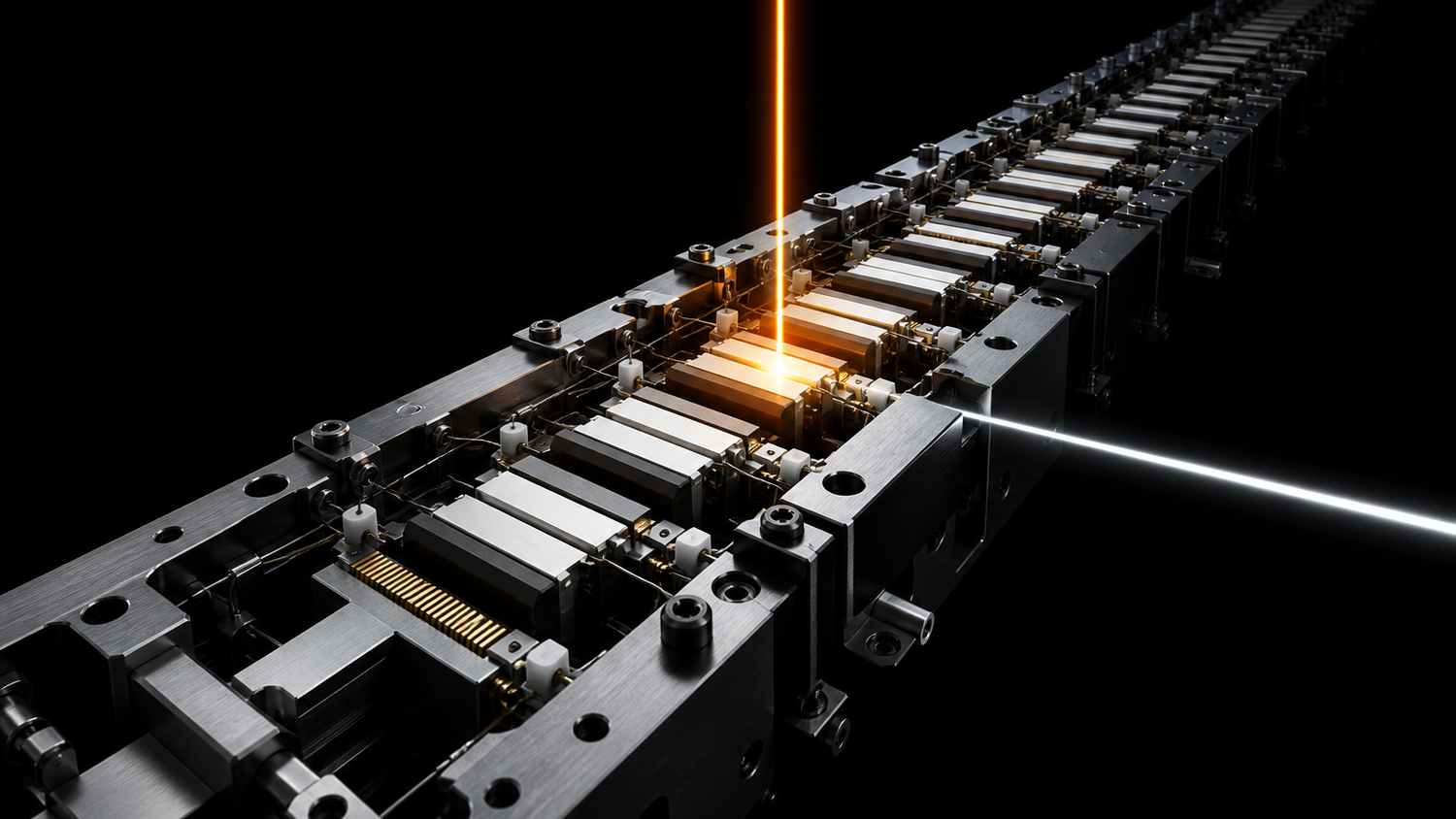
A chemistry simulation on a quantum computer degrades the way a photocopy of a photocopy degrades. Every step is very nearly right, and the small faults from each one pile up until the picture at the end carries almost nothing about the molecule you started with.
That pile-up has a name in the field. Simulating how a molecule evolves in time means chopping the evolution into many short slices, a technique called Trotterization, and the answer gets more accurate as the slices get finer. Finer slices make a deeper circuit, a deeper circuit runs more gates, and on today's hardware every gate is another opportunity for a physical fault. Depth is what the chemistry asks for, and depth is what the machine punishes.
A paper from IonQ, qBraid and NVIDIA takes a narrow, well-instrumented run at that trap. In a preprint first posted on May 7, 2026, James Brown, Jason Iaconis, Yuri Alexeev, Linta Joseph, Spencer Churchill, Kenny Heitritter, William Aguilar-Calvo, Martin Roetteler and Martin Suchara report that a particular combination of encoding and mid-flight checking lowered the logical error rate by up to 54 percent on a trapped-ion machine. IonQ's own account of the work, published on the company blog, presents the same figure alongside the prospect of lower research costs and shorter time to market for enterprises running these workloads.
Practical takeaway. The 54 percent came from a 26-qubit test circuit that contains no molecule and produces no chemistry answer. The more transferable result sits in the paper's control arm: moving the same error checks to the end of the run still helped, and it stopped being good enough to beat the unprotected baseline by a statistically significant margin.
Where the difficulty actually sits
Public conversation about quantum computing tends to fix on qubit counts, and the count is a poor guide to what quantum chemistry needs. A molecular simulation of any pharmaceutical interest requires circuits of enormous depth, and depth is governed by error rates, connectivity and the cost of the encoding that maps electrons onto qubits. Adding qubits without lowering the per-gate fault rate buys a longer photocopy chain.
Two of the paper's ingredients attack that cost directly. The Generalized Superfast Encoding replaces the older Jordan-Wigner mapping, which strings long chains of operators across many qubits and forces circuits to grow. The newer encoding keeps the interactions local, shortening the circuit, and it carries loop stabilizers that make certain faults detectable by construction. Clifford Noise Reduction then prepares a verification state off to the side, measures a small set of its stabilizers, discards any preparation that fails the check, and teleports only the accepted operation onto the working register. Faults get caught on scratch hardware before they touch the data.
The verification can be arranged in more than one way, and that is where mid-circuit measurement enters: the ability to read some qubits partway through a computation, learn something from them, and keep going with the rest. The encoding itself carries no such requirement, and Clifford Noise Reduction can be implemented with its stabilizer readout deferred to the end of the run. What this paper establishes is narrower and more interesting: the advantage over the unprotected baseline depended on reading those stabilizers in flight. Trapped-ion systems are comparatively good at this, because ions can be measured and reset individually while their neighbors hold their states, and because any ion in the chain can interact with any other in a single operation. This Monitor's general-blog companion has argued before that the ability to act on a machine while a computation is still running is a better progress signal than the headline qubit number, and this paper is a direct instance of that argument.
What the circuits actually ran
Here the record deserves a careful reading, because the widths matter. The unprotected baseline, which the paper calls the physical Trotter circuit, is a six-qubit encoded Clifford Trotter step running 16 two-qubit gates within 173 gates in total. The protected version is substantially wider: the Clifford Noise Reduction implementation uses 26 qubits and 580 gates, and the graph-state variants sit at 25 or 26 qubits. The extra width is the verification machinery, and it is the price the scheme pays for catching faults. Both were run on a Barium development system similar to IonQ's forthcoming Tempo line, and benchmarked against each other using hardware runs and a calibrated device-level noise model.
The word Clifford is doing quiet work in that sentence. Clifford circuits are the well-behaved subset of quantum operations that an ordinary laptop can simulate exactly and efficiently, which is precisely why they make good test articles: the correct answer is known in advance, so any deviation the hardware produces is measurable error and nothing else. A Clifford Trotter step is a clean instrument for measuring a noise-reduction method. It is a test article and not a chemistry calculation, and no molecule, binding energy or reaction barrier appears anywhere in the result.
Quantum pillar: simulation. Technology readiness: TRL 3 of 9. The method was tried for real at small scale on existing hardware, twenty-six qubits running a test circuit with no molecule in it, several rungs below any working chemistry prototype and far below anything a laboratory or a pharmaceutical program would use.
The timing of the check is the finding
The most instructive part of the paper is its control arm. The authors kept the verification structure and moved the stabilizer readout from mid-circuit to the end of the run, then compared three cases: no stabilizers at all, stabilizers read at the end, and stabilizers read mid-circuit.
End-of-circuit readout did help. It beat the case with no error detection, which confirms that the verification itself is doing real work. What it did not do was beat the unprotected physical Trotter circuit by a statistically significant margin for a single stabilizer round. Only the mid-circuit version cleared that bar. The two arrangements are also not quite equal in cost, since the delayed variant drops the leakage check, so this is a comparison of two useful configurations and not a clean presence-or-absence test.
The reason is mechanical. A fault that appears early in a deep circuit and goes unnoticed propagates, and by the end it has contaminated work that was performed correctly. Detecting it while the computation is still running limits how far it spreads. For anyone reading hardware roadmaps, the practical implication is that dynamic circuit capability, meaning measure-decide-act inside a single run, earns its place well before full quantum error correction arrives. For anyone reading vendor claims, it means the timing of a scheme's error checks is a variable worth asking about separately from its overhead.
The authors add a proof-of-concept observation that machine-learning-guided selection of which stabilizers to check outperformed random selection. They label it as a proof of concept, and that label is the right weight to give it.
The distance to a molecule that matters
Consider what a genuinely useful target costs. Cytochrome P450 is the enzyme family responsible for clearing most medicines from the body, and one member, CYP3A4, metabolizes roughly half of all marketed drugs. If its electronic structure could one day be computed reliably at the scales that matter, that capability could in turn support work on metabolic behavior, on the early triage of compounds likely to fail for metabolic reasons, and on how two drugs behave when taken together. Each of those steps is conditional on the one before it, and none of them is established by the computational work described here.
In 2022, Joshua Goings, Alec White, Joonho Lee, Christofer Tautermann, Matthias Degroote, Craig Gidney, Toru Shiozaki, Ryan Babbush and Nicholas Rubin published resource estimates for exactly that calculation in the Proceedings of the National Academy of Sciences, available as arXiv preprint 2202.01244. What they cost out is specific: computing spin gaps in models of the CYP catalytic cycle, the property that signals multireference electronic character and defeats routine classical methods. That is a methodology benchmark for what the authors frame as a candidate quantum-advantage problem. It is not a dosing model, an interaction predictor, or any validated clinical instrument. Their largest cytochrome P450 active space needs on the order of 1,434 logical qubits, which compiles at a 0.1 percent physical error rate to roughly 4.6 million physical qubits running for 73 hours. Those compiled figures are assumption-dependent upper bounds, resting on four Toffoli factories, a one-microsecond surface-code cycle, a ten-microsecond control reaction time and a 90 percent target success probability for the computation. Change the assumptions and the number moves.
Set that beside 26 physical qubits running a Clifford circuit with no chemistry in it. The gap is not a matter of a few hardware generations, and error mitigation of the kind demonstrated here does not close it, because mitigation lowers error rates by factors while the resource estimates above already assume a full error-correction layer underneath. The honest description is that this work improves one component of a stack whose other components remain missing.
How Quentir Reads It
Two things can be true at once, and holding both is the whole discipline of reading this field. The paper is careful, well controlled and genuinely informative about what makes error mitigation work. The commercial framing that reaches a pharmaceutical executive, in which a 54 percent error reduction becomes lower research costs and faster time to market, travels a very long way past what 26 qubits and a Clifford circuit can support.
The distance shows up in a specific translation. The paper says logical error rate on an encoded test step. The company blog says improved chemistry simulations. Between those two statements sit the encoded chemistry Hamiltonian, the non-Clifford gates that real time evolution requires, the qubit count, the error-correction layer, and the validation that any computed binding affinity actually predicts what happens in a cell. None of those is addressed here, and a reader who has seen only the second statement would not know that the first is what was measured.
For a hospital pharmacy, a formulary committee or a clinical pharmacologist, this changes nothing in current practice, and the route to clinical utility remains remote. That is worth saying plainly, because quantum chemistry is the pillar where the promotional gap is widest and where procurement conversations are most likely to arrive early. When a vendor or a research partner raises quantum simulation for drug discovery, the useful questions are narrow: which molecule, which property, how many qubits, what was the classical baseline, and was the correct answer known in advance.
The humane stake in the cytochrome P450 example is real, and it is worth stating at the right strength. Adverse drug interactions harm people every year, and metabolic prediction accurate enough to be trusted could help identify some of that risk earlier, alongside the pharmacokinetic studies and post-market surveillance that carry the work today. Whether a quantum route ever contributes to that is an open question, and the resource-estimate paper cited here establishes the computational cost rather than any clinical benefit. What the record shows on August 23, 2026 is a well-run 26-qubit experiment establishing that fault detection should happen mid-flight, which is a genuine contribution to a machine that does not yet exist. Recording it accurately, at TRL 3, with the enzyme's spin gaps still 1,434 logical qubits away, is how this field eventually earns the trust it will need on the day it does have something to offer a patient.
Sources
Primary source: James Brown, Jason Iaconis, Yuri Alexeev, Linta Joseph, Spencer Churchill, Kenny Heitritter, William Aguilar-Calvo, Martin Roetteler and Martin Suchara, "Mid-Circuit Measurements for Clifford Noise Reduction in Hamiltonian Simulations," arXiv preprint, submitted May 7, 2026, from IonQ, qBraid and NVIDIA; circuit widths and the control comparison read from its Table I and Sections III-C and V-A. Company account of the same work: IonQ blog, August 2026. Resource estimates for cytochrome P450: Joshua Goings and colleagues in the Proceedings of the National Academy of Sciences, 2022.