Why a 12,635-Atom Protein Simulation Still Needs Supercomputers
Quentir Medicine Monitor
Evidence-based insights for quantum medicine. Published by Quentir Systems LLC · July 18, 2026.
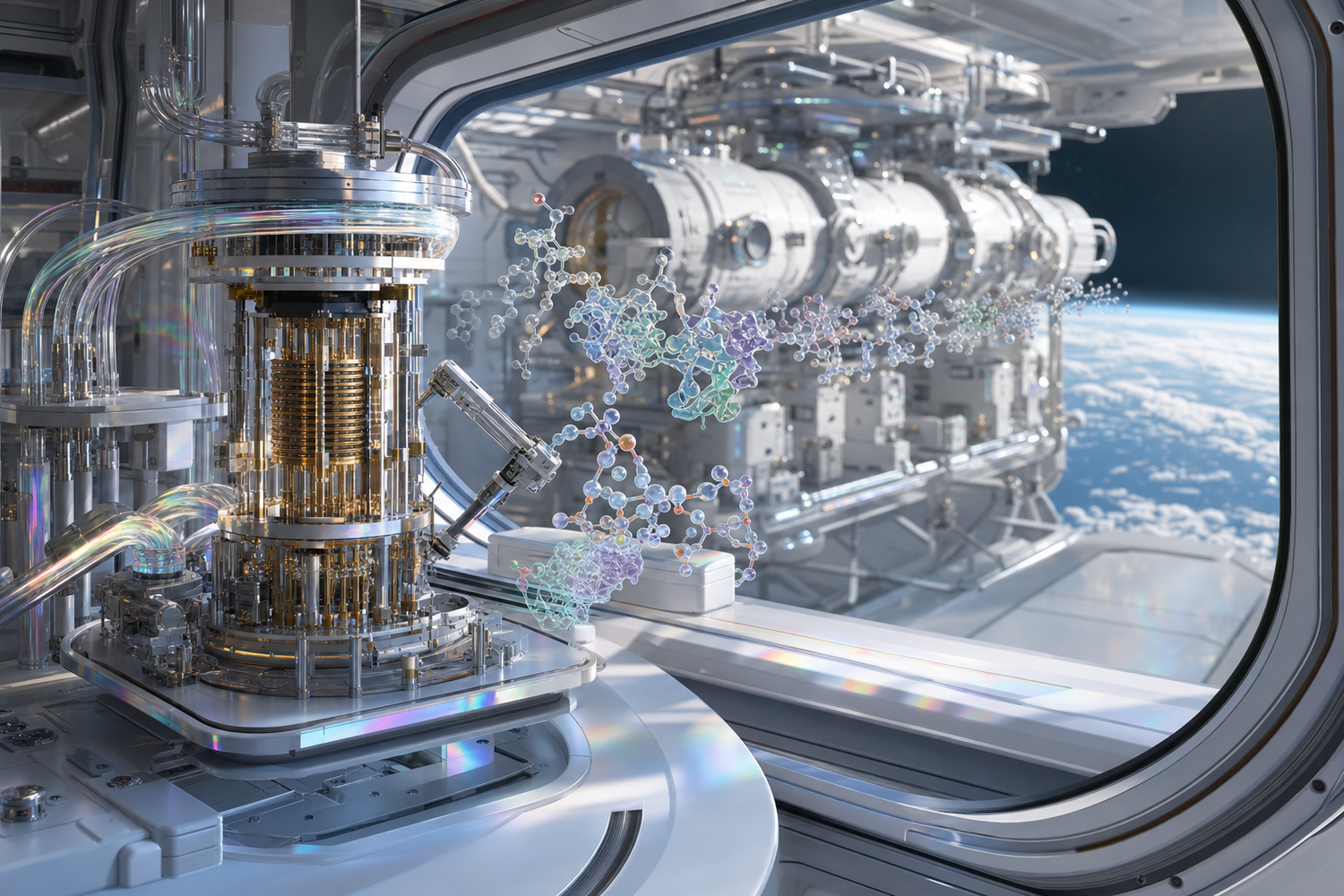
The oldest molecular models turned atoms into colored balls joined by sticks. A 2026 protein simulation replaces that tabletop object with a heterogeneous quantum-classical workflow spread across quantum processors and two classical supercomputers.
The team simulated a 12,635-atom protein-ligand complex in water, using up to 94 qubits for selected electronic-structure calculations. It is an unusually large test of quantum computing inside biomolecular science. It is also a clear view of how much classical machinery surrounds the quantum step.
The atom count describes the whole biological scene
The arXiv preprint by Kenneth M. Merz Jr. and 23 coauthors, submitted on May 1, 2026, studies two familiar proteins: T4 lysozyme and trypsin. Each protein was modeled with a binding molecule and surrounding water. That fuller scene matters because proteins do their work in an environment. Water, charge, and the shape of a binding pocket affect how a molecule fits and how strongly it interacts.
The larger trypsin system contained 12,635 atoms. The T4 lysozyme system contained 11,608. Those totals describe the protein and ligand together with the solvent model. They do not mean that every atom entered one giant quantum circuit. The researchers used embedding to divide each system into smaller electronic fragments. Classical calculations handled much of the decomposition. Quantum processors sampled selected fragments whose electron correlations were harder to capture.
That distinction keeps the result legible. A protein-scale atom count signals a larger scientific object than earlier demonstrations. The quantum processor still receives a carefully chosen portion of the problem. Scale here comes from coordinating different forms of computation, with each assigned the work it can perform.
Ninety-four qubits carried a bounded part of the chemistry
The researchers ran their quantum sampling on two IBM Heron r2 processors, each with 156 qubits. Individual calculations used up to 94 qubits. Across the project, the team executed 9,200 circuits over more than 100 hours and collected 1.3 billion measurement outcomes. Fugaku in Japan and Miyabi-G at the University of Tokyo then processed the sampled data and solved the large classical linear-algebra tasks around it.
The architecture resembles a scientific relay. A classical embedding method identifies fragments and their surrounding electronic environment. Quantum hardware samples electronic configurations for selected fragments. Supercomputers perform optimized subspace diagonalization and assemble the numerical result. The final calculation belongs to the complete relay, including the choices made at each handoff.
This division also explains why a qubit count alone says little about medical usefulness. Qubits are one scarce resource. Circuit volume, sampling time, supercomputer allocation, algorithm design, and the accuracy of the fragment model all shape the result. The paper is valuable because it reports those resources instead of hiding them behind the atom total.
The accuracy claim has a narrow and useful meaning
The authors report more than a 40-fold increase in system size over an earlier 303-atom Trp-cage calculation. They also report up to a 210-fold accuracy improvement over the previous quantum-centric approach in a particular workflow step. For selected fragment calculations, the hybrid method matched coupled-cluster singles and doubles accuracy, a respected classical reference method in quantum chemistry.
The phrase "up to" deserves attention. The 210-fold figure belongs to a comparison against a previous version of the same broad approach. It is not a 210-fold improvement in drug-candidate prediction, laboratory yield, clinical success, or patient outcome. The reported gain concerns an electronic-structure calculation inside the workflow.
IBM's public account of the project, published May 5, makes an important concession: the method still trails leading classical approaches. That sentence sets the right boundary around the accomplishment. The work shows that current quantum hardware can contribute to a large biomolecular calculation at substantial scale. Classical leadership on the complete chemistry problem remains intact.
Drug discovery needs reliable deltas, not impressive totals
A medicinal chemist rarely needs a beautiful picture of one static protein. The practical questions concern differences. How does binding energy change when one functional group is replaced? Which protonation state matters in water? Does a candidate remain selective when a related protein is considered? Can a computational ranking reduce the number of compounds that must be synthesized and tested?
A method earns its place in drug discovery when it improves answers to such questions with acceptable cost and repeatability. The current study establishes a route for large protein-ligand systems and reports strong agreement for selected fragment energies. It does not report a prospective compound-selection campaign, blinded prediction, wet-lab validation, or a drug advanced because of the quantum calculation.
That gap is ordinary in computational science. Enabling methods often mature before a useful decision benchmark appears. The humane stake is still real. Better molecular prediction could reduce failed experiments, spare scarce biological samples, and focus laboratory effort on more plausible candidates. Patients benefit only after those computational gains survive chemistry and toxicology before clinical testing. The atom count begins that chain; it does not complete it.
The hidden advance is coordination
The result is easy to frame as a contest between quantum and classical computers. Its more interesting contribution is the engineered cooperation between them. Quantum hardware is assigned a limited electronic problem. Classical supercomputers prepare the fragments and carry the heavy numerical assembly. Domain scientists choose a representation that preserves enough chemistry to make the fragments meaningful.
That coordination crosses institutional boundaries too. Cleveland Clinic contributes biomedical and computational-chemistry expertise. IBM supplies quantum hardware and algorithm development. RIKEN and the University of Tokyo bring supercomputing capacity. A credible quantum-medicine result increasingly depends on this kind of combined infrastructure, plus transparent records of where each calculation ran and how the pieces were compared.
The economics follow the architecture. More than 100 hours of quantum execution, two supercomputers, and 1.3 billion measurements are substantial research resources. A future production method will need to justify those resources through accuracy or scientific reach unavailable at lower cost. The paper offers a serious benchmark for that discussion because it names the resources and the comparison method.
How Quentir Reads It
Quentir reads the 12,635-atom result as an infrastructure milestone for biomolecular simulation. The achievement lies in making present-day quantum hardware participate in a protein-scale calculation while preserving a route to systematically improved accuracy. The honest constraint sits in the same record: leading classical methods still perform better overall, and the medical value remains upstream of laboratory or clinical validation.
This combination is more informative than a simple claim of quantum advantage. It tells research leaders where to look next. Independent groups can test the fragment selection, reproduce resource accounting, compare stronger classical baselines, and ask whether the method changes a real molecular decision. Progress may arrive as a better answer for one hard fragment before it arrives as a faster answer for an entire drug program.
The next consequential result will probably carry a smaller headline number. It may show that the method ranks a difficult ligand series more accurately, predicts an experimentally measured energy difference, or handles a chemical interaction that defeats practical classical approximations. That would connect the large computational apparatus to a choice a laboratory can check.
Sources
Primary source: Merz Jr. et al., arXiv preprint submitted May 1, 2026. Also drawn on: IBM Quantum, May 5, 2026.