The five-nanometer film that lets diamond hold a protein
Quentir Medicine Monitor
Evidence-based insights for quantum medicine. Published by Quentir Systems LLC · July 17, 2026.
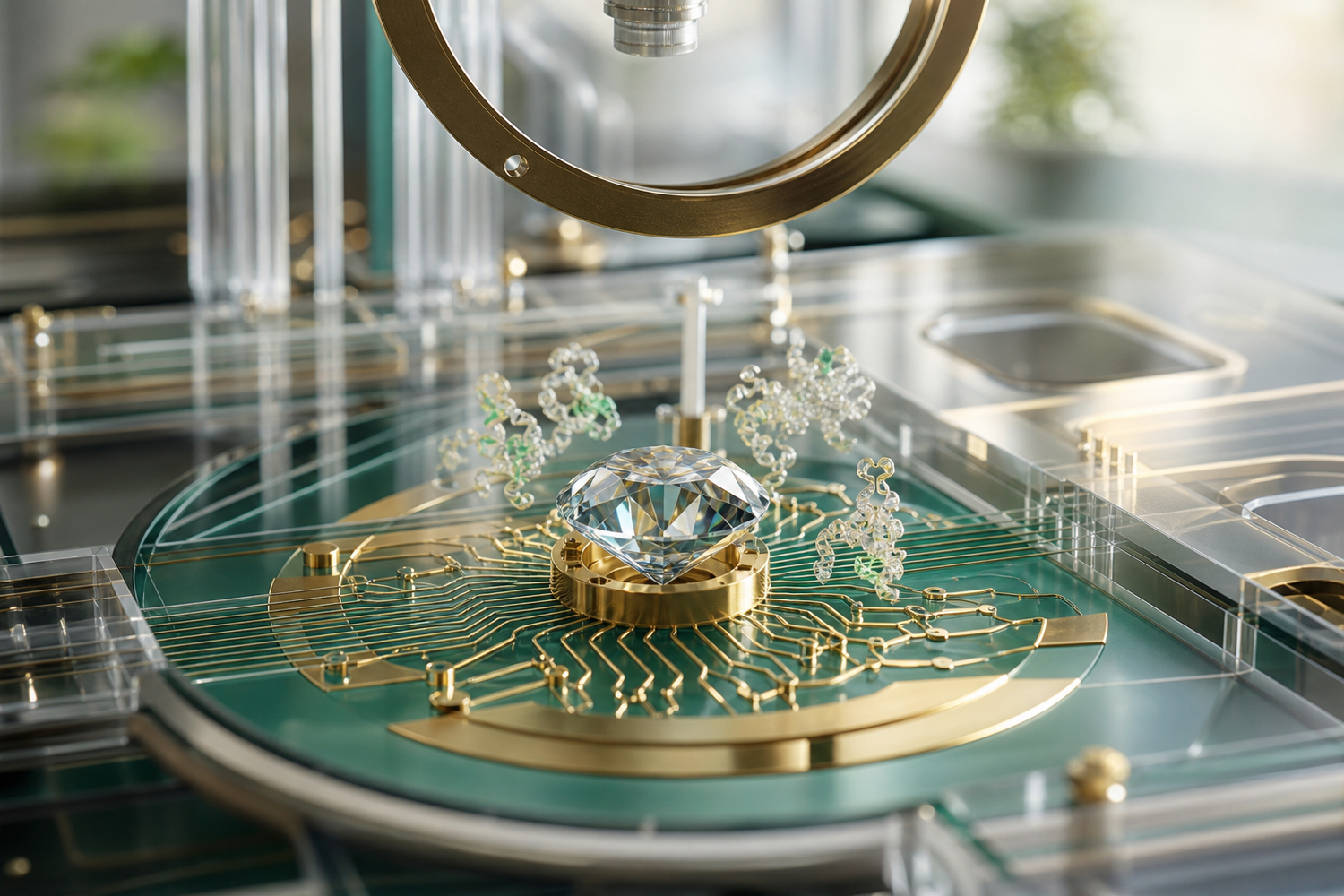
A dry diamond chip and a protein in salt water belong to different laboratory worlds. One protects a fragile quantum state; the other must keep its biological shape and mobility while it is brought close enough to be measured.
A research team built a sub-five-nanometer interface that joins those worlds on one surface. The coating held individual proteins and DNA molecules on diamond while preserving near-surface qubit coherence approaching 100 microseconds. The result is a piece of enabling science for quantum biosensing: the sensor can now meet a biological target without losing the physical qualities that make it useful.
The interface problem is physical
Diamond quantum sensing often uses nitrogen-vacancy centers, tiny defects in the crystal whose quantum states respond to nearby magnetic fields. Those centers can act as nanoscale probes. Their useful range creates a severe design constraint. Every layer placed between the diamond and a biomolecule adds distance, while roughness, chemical treatment, and environmental noise can weaken the quantum signal.
The PNAS study by Mouzhe Xie and colleagues, published in February 2022, treated the interface itself as the research object. The team combined a thin aluminum-oxide adhesion layer with polyethylene glycol, or PEG, chemistry. The resulting architecture could bind selected biological molecules and resist nonspecific adsorption. It also kept the targets near nitrogen-vacancy sensors embedded close to the diamond surface.
This is where surface chemistry becomes part of quantum engineering. A coating that is excellent for attaching proteins can still be too thick for nanoscale sensing. A pristine quantum surface can be chemically useless in a wet biological sample. The experiment sought a narrow middle ground where both systems could continue to function.
What the five nanometers contain
The reported architecture used roughly two nanometers of aluminum oxide deposited on oxygen-terminated diamond. A PEG layer sat above it and carried the chemical groups used for binding. The authors estimated the full hydrated functional layer at about five nanometers, with a path toward a thinner version.
That scale is difficult to picture. A human hair is measured in tens of thousands of nanometers. Here, a few nanometers determine whether a molecule is chemically accessible and whether its magnetic signature remains close enough to a quantum defect to matter. The engineering problem resembles fitting a dock, a filter, and an electrical insulator into a space only a handful of atoms thick.
The team used biotin-streptavidin binding and click chemistry as demonstrations. By changing the mix of PEG molecules, it adjusted protein adsorption density across more than two orders of magnitude. Single-molecule fluorescence images showed individual bound proteins at lower densities, and DNA molecules were immobilized as well. These observations established controllable attachment. They did not establish a clinical assay.
The coating had to protect two kinds of fragility
Biological targets can unfold, detach, or lose function when a surface is chemically hostile. Near-surface quantum states can lose coherence when a surface carries charge noise or structural disorder. The researchers tested both sides of that junction.
The functional architecture remained chemically stable for more than five days under physiological conditions. Nitrogen-vacancy coherence times approached 100 microseconds after functionalization. The paper also reports that the ultrathin aluminum-oxide layer did not reduce the observed attachment density compared with a much thicker control layer. Together, those measurements show that biomolecule handling and quantum performance can coexist on the same prepared diamond.
The numbers still describe a materials and biophysics experiment. The team did not report disease detection, sensitivity and specificity in patient samples, or a comparison with an established diagnostic platform. It predicted that an individual carbon-13 nuclear-spin signal might be detectable with an integration time as short as 100 seconds under the demonstrated distance and coherence conditions. That is a modeled next step, clearly separated from the attachment measurements already completed.
Where medicine enters the story
A Nature Reviews Materials research highlight placed the work in the longer pursuit of nanoscale nuclear magnetic resonance for biology. Conventional NMR can reveal molecular structure, yet it usually needs far more material than a single protein. A diamond sensor operating near an individual molecule could open a different scale of observation.
The potential applications are concrete enough to explain the interest. The authors discuss pulldown assays that collect scarce molecules from solution, proteomic measurements, drug-discovery targets, and cancer-marker detection. They also point toward microfluidic integration. Each possibility depends on later demonstrations with real targets, realistic mixtures, calibrated controls, and a defined medical use.
For patients, the humane promise lies in information from very small samples. A sensor able to study a scarce biomolecule could help researchers see a binding event or structural change that bulk measurements blur. That possibility remains upstream of care. A useful diagnostic device would need to convert nanoscale sensitivity into reproducible answers about a person's health.
How Quentir Reads It
This paper moves quantum medicine through an interface, measured in nanometers, that can easily disappear from broad claims about diagnostic sensing. The decisive object is the surface stack between a qubit and a biological target. Its thickness and chemical stability shape what the sensor can eventually measure. Binding selectivity and any effect on coherence matter too.
The original connection is institutional as well as technical. Medical devices often fail between laboratory performance and routine use because materials, sample preparation, manufacturing, and clinical interpretation have to work together. Quantum biosensors inherit that whole chain. They add a further obligation: the quantum state must survive the same interface that keeps the biology intact.
The paper therefore belongs at an enabling-research stage. It demonstrates controlled biomolecule immobilization and preserved sensor coherence. It offers a prediction for single-spin NMR and names diagnostic directions. Those categories should remain separate as the field develops, since a stable film, a detected molecular signal, an analytical assay, and a clinically useful device answer different questions.
The next claim will come from the sample
The five-nanometer film solves a quiet problem that had kept two mature toolkits apart. Diamond processing could protect a quantum defect, and bioconjugation could place a protein on a surface. The 2022 experiment showed that both could inhabit one carefully built layer.
The next persuasive result will involve the signal from a biological target under conditions that resemble the intended use. From there, analytical validation and clinical study would carry the work toward medicine. That path may be slower than the striking sensitivity of the underlying physics suggests. It is also where a beautiful quantum measurement begins to acquire meaning for the person whose sample is on the chip.
Sources
Primary source: Xie et al., Proceedings of the National Academy of Sciences, February 22, 2022. Also drawn on: Bakhshandeh, Nature Reviews Materials, March 22, 2022.