AOI Biosciences' Roughly 500 Million Yen Financing and Share Transaction of 14 September 2026 Lists Its Neo-Self Antibody Test Ahead of the Toshiba SQBM+ Quantum-Inspired Drug Platform
Quentir Medicine Monitor
Evidence-based insights for quantum medicine. Published by Quentir Systems LLC · September 14, 2026.
On 14 September 2026 AOI Biosciences, a diagnostics and drug-discovery company in Ibaraki, Osaka Prefecture, announced a financing and secondary-share transaction of roughly 500 million yen with existing and new investors; the company says the new-share portion takes its cumulative funding to about 1 billion yen, and it does not state how much of the 500 million is new money. The release describes two core businesses. One is a blood test for a "neo-self" autoantibody that is already sold to more than 300 Japanese medical institutions. The other is an allosteric drug-discovery method built with Toshiba on the quantum-inspired SQBM+ solver, the method whose patent Toshiba announced on 3 September and this Monitor examined on 6 September.
The release lists three planned uses for the proceeds, and that list is the useful fact for a hospital buyer or a pharma partner, with one caution: the order says nothing about how much money goes where or which business the company values more. The neo-self antibody test fills the first two entries, with domestic roll-out, Asian expansion and new autoimmune indications, and further research investment in the quantum-inspired drug discovery platform is the third. No amounts are attached to any entry. The clinical figures the release cites for the test, a pregnancy rate more than doubled and a live-birth rate 1.7 times higher, come from two Frontiers in Immunology cohort studies whose treated and untreated groups can be counted, and this note counts them.
What AOI Biosciences announced on 14 September 2026, and who put in the money
The company release on PR TIMES describes the round as a mix of a third-party share allotment and a secondary share transfer, totaling about 500 million yen in transaction value; the release does not say how much of that is new money into the company, since a secondary transfer moves shares between holders rather than into the company's accounts. Existing investors Nippon Venture Capital, SBI Shinsei Corporate Investment and i-nest capital added money; new investors include GoAhead Ventures, SUMISEI INNOVATION FUND, SBI Okasan Alternative Investment, BIG Impact and two further Japanese venture funds. The company was founded in November 2019, is led by Shinichi Sueta, and sits in the Saito Bio-Innovation Center in northern Osaka.
The release states three uses for the proceeds, in this order: faster domestic adoption and global expansion of the beta-2-glycoprotein I neo-self antibody test, with Malaysia, South Korea, Taiwan and Indonesia already served; new neo-self antibody tests and drug research for other autoimmune diseases; and further research and development investment in allosteric drug discovery using quantum-related technology. The test, the release says, has been offered since 2022, is approved under Japan's Advanced Medical Care category A for recurrent pregnancy loss, and qualifies for municipal subsidies that lower the patient's own payment. Those regulatory and reimbursement statements are the company's own; this Monitor has not inspected the ministry listing.
What the two Frontiers in Immunology studies of 26 September 2024 and 24 November 2025 measured
The release footnotes its two clinical claims to two papers, and both are open. The live-birth claim rests on Tanimura and colleagues, published 26 September 2024: a prospective, multicenter, observational study in which 462 women with recurrent pregnancy loss were screened for anti-beta-2-glycoprotein I/HLA-DR antibodies between August 2019 and December 2021. The analysis covers 47 pregnancies in antibody-positive women. Thirty-nine were treated with low-dose aspirin, unfractionated heparin or both, and eight were treated with neither. The live-birth rate was 87.2 percent in the treated group against 50.0 percent in the untreated group, which is the 1.7-fold figure in the release; the p-value is 0.03, and the untreated group is eight pregnancies.
The pregnancy-rate claim rests on Ono and colleagues, published 24 November 2025, with Hisashi Arase of Osaka University among the authors: a multicenter prospective cohort of 194 women with infertility undergoing embryo transfer, of whom 30 antibody-positive and 123 antibody-negative women were analyzed. Among the positive women, the clinical pregnancy rate per embryo transfer was 42.9 percent with aspirin or heparin against 17.6 percent without, 15 of 35 transfers against 6 of 34 transfers, with a p-value of 0.044 and an adjusted odds ratio of 3.34 whose 95 percent confidence interval runs from 1.02 to 12.3. That is the "more than double" in the release. The unit is the transfer, and the 30 antibody-positive women contributed 69 transfers between them, so the two treatment groups contain repeated transfers by the same women rather than two separate groups of patients. In both studies the attending physician chose the treatment; neither was randomized. The antibody-positive group also showed a higher rate of recurrent implantation failure, 40.0 percent against 20.3 percent, an association that motivates testing without by itself showing that testing improves outcomes.
For a fertility clinic reading the release, the numbers are real and the studies are published, and the untreated comparators are eight pregnancies in one study and 34 embryo transfers in the other, with treatment assigned by the doctor. A randomized trial, which neither paper claims to be, would strengthen the causal reading of the 1.7-fold and twofold figures; until one exists, a clinic should read them as associations from small observational comparators.
Quantum pillar: not applicable. Technology readiness: TRL 4 of 9. SQBM+ is quantum-inspired software that runs on conventional computers, so the drug-discovery work names no quantum pillar, and the antibody test carries no quantum technology at all. The rung is this Monitor's provisional editorial assessment of the allosteric site prediction method alone, unchanged from 6 September: laboratory validation, a check against sites already described in the literature and one activity result given without an assay type, an affinity or a mechanism. The antibody test sits far higher, in routine care at more than 300 institutions, and it would be a mistake to let the mature product lend its rung to the quantum-inspired one.
What "quantum-inspired" means in the Toshiba SQBM+ platform, and what the 80 percent figure covers
The release calls the allosteric method "quantum-related technology". Toshiba's own announcement of 3 September 2026 is more precise: SQBM+ is a quantum-inspired optimization solver built on a simulated-bifurcation algorithm that, in Toshiba's words, uses existing computers. The one disclosed accuracy figure is a prediction rate of 80 percent or more against allosteric sites already known, followed by a statement that compounds aimed at predicted sites showed activity against the target protein. Toshiba also states that the prediction service is already being supplied to pharmaceutical companies, which is a reported commercial use and not an independently demonstrated performance. No assay, no affinity and no evaluation set are given, which is why the readiness rung above does not move with the funding.
The two businesses therefore come with different kinds of evidence. The antibody test has two published cohorts with visible denominators and stated limitations. The allosteric platform has one percentage without a denominator, a headline number of the kind that, as with NVIDIA's 347-fold decoder result and its hardware footnote, means little until the conditions behind it are read; a pharma partner can ask the vendor for those conditions before repeating the figure.
How Quentir Reads It
AOI Biosciences runs a diagnostics business and a drug-discovery program, and its release of 14 September 2026 gives both equal billing: the subtitle names the domestic and overseas roll-out of the beta-2-glycoprotein I neo-self antibody test and the acceleration of allosteric drug discovery with quantum-related technology in one breath, and each business has its own section. The list of planned uses puts the test first and the platform third, without amounts for either, and that ordering establishes neither the allocation of the money nor which business the company or its investors consider more important.
This Monitor's provisional assessment places the Toshiba and AOI allosteric method at rung four and keeps the antibody test outside the quantum ledger, where it belongs. The two evidence tracks move separately. An evaluation set and an assay for the predicted sites would allow the allosteric rung to be reassessed. A randomized trial of aspirin and heparin in antibody-positive women would strengthen the clinical figures the funding release cites, and would say nothing about the quantum-inspired platform. The difference between the two businesses, for a buyer, lies in their evidence: two published cohorts with visible denominators on one side, one undenominated percentage and a reported commercial use on the other.
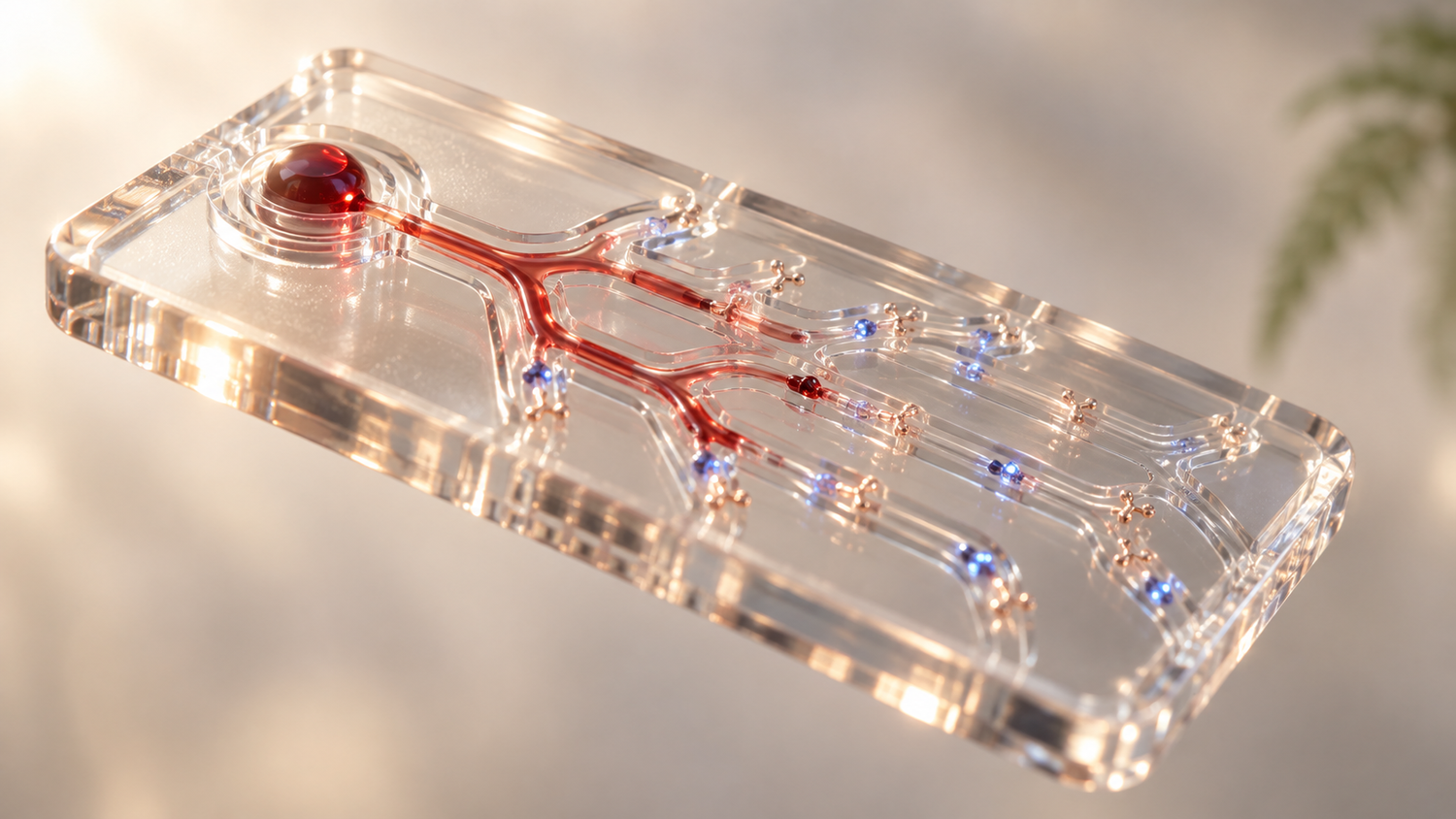
Image: an AI-generated conceptual illustration of a crystalline diagnostic chip in which a single blood droplet spreads through microfluidic channels and points along them light up as a schematic visualization of antibody detection. It depicts no real laboratory, product, company or institution.
Sources
Primary source: the AOI Biosciences funding announcement of 14 September 2026, published on PR TIMES, naming Shinichi Sueta as representative director and listing the round's investors and the planned uses of the proceeds. Also drawn on: Tanimura, Saito, Tsuda, Ono and colleagues in Frontiers in Immunology, 26 September 2024; Ono, Wada, Kobayashi, Tanimura, Arase, Yoshino and colleagues in Frontiers in Immunology, 24 November 2025; and Toshiba's announcement of 3 September 2026 on Japanese Patent 7,908,389. The counting of the comparator arms and the readiness placement are this Monitor's own.