CNR-INO, QTI and the Italian Space Agency Simulate Mid-Infrared Free-Space Quantum Key Distribution in Advanced Quantum Technologies, October 2026: 10 km Through Fog Against 7.5 km at 1,550 nm, TRL 2
Quentir Defense Monitor
Evidence-based insights for quantum defense and security. Published by Quentir Systems LLC · October 15, 2026.
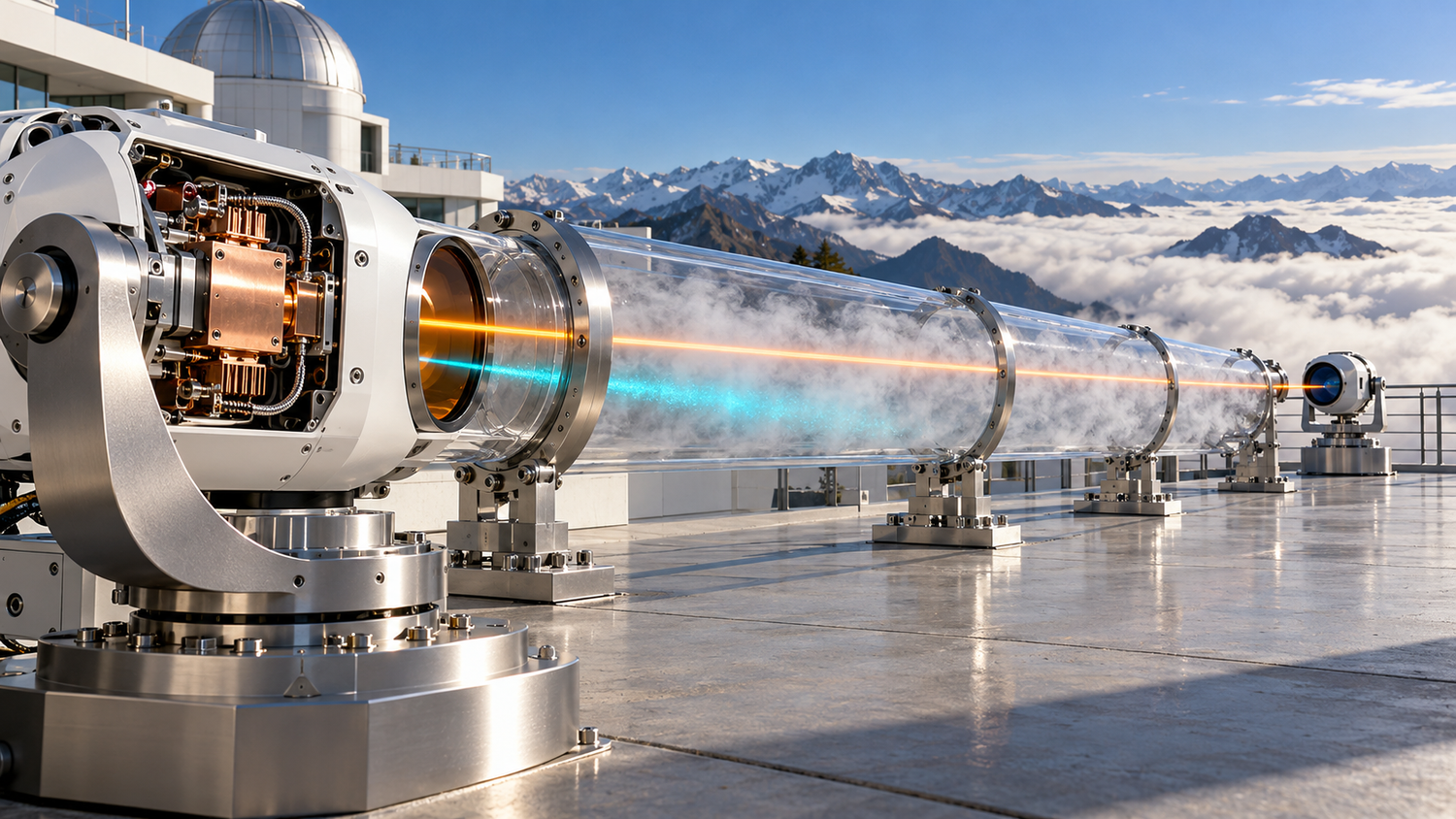
On October 14, 2026, the Italian Space Agency announced a study by the National Institute of Optics of Italy's National Research Council (CNR-INO), the Florence company QTI, the University of Florence and the agency itself, published in Advanced Quantum Technologies, which simulates free-space quantum key distribution at a mid-infrared wavelength of about 4 micrometers and compares it with the near-infrared wavelengths every fielded system uses today. The simulation finds that a mid-infrared link holds a secure key through fog of 1 kilometer visibility out to 10 kilometers, where a telecom-wavelength link stops at 7.5 kilometers, and that it keeps working in daylight because the sun's background light is suppressed above 3 micrometers.
That result matters to a defense reader for a plain reason. Free-space quantum links are the version of the technology that reaches a ship, a forward site, an island garrison or a satellite ground station where no fiber runs, and weather availability is the problem that has limited every free-space optical link, classical or quantum, since the first military laser communication trials. A study that moves the operating wavelength to a window where fog scatters less is therefore a study about link availability, which is what a communications planner buys. The work is a simulation with no hardware, which places it low on the readiness ladder, and the authors say so themselves.
What De Lazzari, Zavatta and their co-authors simulated, and the numbers at 800, 1,557 and 3,998 nanometers
The primary source is the paper by Claudia De Lazzari, Tecla Gabbrielli, Natalia Bruno, Francesco Cappelli, Domenico Ribezzo, Nicola Biagi, Nicola Corrias, Simone Borri, Mario Siciliani de Cumis, Paolo De Natale, Davide Bacco and Alessandro Zavatta, posted to arXiv as 2508.13008 on August 18, 2025, and now carrying the journal identifier 10.1002/qute.202500867 in Advanced Quantum Technologies. The authors sit at QTI, CNR-INO and the European Laboratory for Non-Linear Spectroscopy in Florence, the University of Florence, and the Italian Space Agency's center at Matera.
The protocol is a three-state BB84 scheme with time-bin encoding, one decoy intensity and a finite-key analysis, run on weak coherent pulses from a phase-randomized laser. The authors compare three transmitter wavelengths, 800 nanometers, the telecom wavelength of 1,557.7 nanometers and a mid-infrared wavelength of 3,998.6 nanometers, the last chosen with the HITRAN molecular absorption database as a local minimum of atmospheric absorption. The channel model adds Rayleigh scattering, whose attenuation scales with the fourth power of optical frequency and therefore falls steeply as the wavelength lengthens, Mie scattering for rain and fog, and an optional turbulence term with a refractive index structure parameter of 10 to the minus 14. Three weather cases are run: clear air at 40 kilometers visibility, rain at 2.5 millimeters per hour with 6 kilometers visibility, and fog at 1 kilometer visibility.
The detector assumptions are where the honesty of the study shows. For the near-infrared cases the authors assume a superconducting nanowire single-photon detector at 90 percent efficiency and one dark count per second. For the mid-infrared they run two cases: a realistic detector at 5 percent efficiency and 100 dark counts per second, and an optimized detector at 80 percent efficiency with the same dark count rate, which does not exist today. A fourth option converts the mid-infrared photons up to a near-infrared wavelength and reads them with the mature detector, at a combined efficiency of 12.7 percent.
The results, read from the paper's Figure 3 as secure key rate per pulse against link length, come out as follows. In clear air without turbulence the telecom link reaches 500 kilometers and the mid-infrared link with optimized up-conversion reaches 800 kilometers. With turbulence switched on, both collapse to roughly 100 and 120 kilometers. In rain the two are nearly level at about 25 kilometers, or 20 kilometers with turbulence, with the optimized mid-infrared detector slightly ahead. In fog the mid-infrared link reaches 10 kilometers against 7.5 kilometers for telecom. The authors add that solar and terrestrial black-body background is suppressed between 3 and 5 micrometers, which eases daytime operation.
Why a fog-tolerant daylight quantum link is a defense capability, and who gains from it
The lane's capability map reads this as networking, in the sub-branch of terrestrial fiber and free-space key distribution, because the paper models what the authors call an Earth point-to-point link and never models a satellite pass. The satellite framing comes from the Italian Space Agency's own press release, in which Giancarlo Varacalli, head of the agency's telecommunications and navigation office, says that new regions of the optical spectrum for transmitting quantum keys from satellites open interesting prospects, and Paolo De Natale, director of CNR-INO, says the simulations show the mid-infrared can make single-photon transmission more reliable in fog and smog. The paper supports the ground-link part of those statements.
The defense reading follows from what free-space QKD is for. Free-space QKD protects a link where the owner cannot lay fiber: ship to shore, a harbor to a headquarters across a bay, a deployed command post to a relay mast, an aircraft on the ground to its operations building, or a ground station to a satellite. The recurring objection to all such links is weather. A classical free-space optical terminal loses its link in fog and falls back to radio. A quantum link has no fallback, because the key stops. A wavelength that extends the fog range by a third, from 7.5 to 10 kilometers at 1 kilometer visibility, is the difference between a harbor link that works on most mornings and one that works on clear ones.
Two further properties carry defense weight. Daylight operation removes a constraint that has pushed many free-space QKD demonstrations to night hours. Lower scattering also means less light leaves the beam sideways, which lowers the signature an observer sees from off-axis, a point the paper does not make and this post states as an inference from the same physics. The posture is dual-use. The same channel serves a bank's campus, a hospital's two sites or an army's headquarters, and the reader has to weigh who gains. Nothing in the study acts against an adversary's systems.
Quantum pillar: networking (quantum key distribution links). Use posture: dual-use. Technology readiness: TRL 2 of 9. The study is a numerical simulation of a free-space link whose mid-infrared transmitter and detector do not exist as a working QKD system, with the authors assuming a detector efficiency sixteen times higher than today's realistic mid-infrared devices, so a specific application has been worked out on paper with its numbers and nothing has yet been tried on hardware.
What stands between the simulation and a program office: 5 percent detectors, missing modulators and a link nobody has flown
The authors list the gaps without being asked. Mid-infrared single-photon detection is, in their words, still relatively immature, and adequate high-performance detectors are underdeveloped, which is why the realistic case assumes 5 percent efficiency where the near-infrared nanowire detector gets 90. High-speed mid-infrared modulators for state preparation remain a research topic, so the authors report secure key rate per pulse rather than per second, a figure that is independent of how fast the transmitter can be clocked. The analysis excludes pointing stability, tolerance to turbulence and aberration correction, each of which the authors say must be addressed in a practical system. The up-conversion route borrows the mature near-infrared detector and gives up most of the photons on the way.
That detector gap is the same one Europe is spending money to close at near-infrared wavelengths. Quentir covered Creotech Quantum's 2.33 million euro contract with the European Space Agency of September 21, 2026, to take superconducting nanowire detectors for satellite QKD ground stations to TRL 5 in 24 months. Those detectors are built for telecom wavelengths. A mid-infrared link would need a detector program of its own, or a converter in front of one of these, before any of the simulated curves could be measured.
The institutional path is clearer than the hardware path. The study was funded in part by the QASINO joint laboratory agreement between the Italian Space Agency and the National Research Council on space-oriented quantum technologies, listed with the preprint on the joint laboratory's publications page, by the PRIN project QUAQK and by QUID, the Quantum Italy Deployment project under the European Union's European Quantum Communication Infrastructure initiative, which all 27 member states joined and which has a terrestrial segment of national fiber networks and a space segment developed with the European Space Agency. The space segment's first prototype, Eagle-1, led by SES with a SITAEL platform and a Tesat payload, is due to launch in late 2027 according to the Commission's page and will spend three years in orbit validating satellite key distribution at conventional wavelengths. A mid-infrared satellite link would come after that, if at all, and the paper's horizontal-path model would first need extending to a slant path through the whole atmosphere.
A buyer should also hold the study against the position several governments have taken on the technology as a whole. The Dutch quantum strategy of October 5, 2026, which Quentir read as post-quantum deadlines from 2026 to 2035 with no role for QKD in central government, cites the lack of authentication and the limited end-to-end protection, and the UK's National Cyber Security Centre declines QKD for government and military use on the same grounds. A better atmospheric window does not answer those objections. It answers a different one, availability, which is the objection that applies once an owner has decided to run a free-space quantum link at all.
For a program office the questions are concrete. Is there a mid-infrared source with a modulator fast enough to clock a QKD transmitter, and at what pulse rate. Is there a detector, or a converter, that gets the efficiency above the 5 percent the authors call realistic. Has anyone measured the key rate through real fog over a real kilometer, with a pointing system, rather than through a Mie scattering model. Until those three questions have published answers, today's development is a well-argued reason to fund a bench experiment, which is the right thing to say about a TRL 2 result and all that the sources establish.
Sources
Primary source: Claudia De Lazzari, Tecla Gabbrielli, Natalia Bruno, Francesco Cappelli, Domenico Ribezzo, Nicola Biagi, Nicola Corrias, Simone Borri, Mario Siciliani de Cumis, Paolo De Natale, Davide Bacco and Alessandro Zavatta (QTI S.r.l., CNR-INO and LENS Florence, University of Florence, Agenzia Spaziale Italiana Matera), "Free-space time-bin encoded quantum key distribution from near- to mid-infrared wavelengths," arXiv:2508.13008, posted August 18, 2025, https://arxiv.org/abs/2508.13008, journal version in Advanced Quantum Technologies, DOI 10.1002/qute.202500867. Other material: Agenzia Spaziale Italiana press release of October 14, 2026, https://www.asi.it/2026/10/uno-studio-italiano-esplora-nuove-frontiere-per-le-comunicazioni-sicure/; the ASI-CNR QASINO joint laboratory publications page; the European Commission's EuroQCI policy page; the European Space Agency's Eagle-1 mission page.