Fraunhofer IAF's Diamond Laser Threshold Magnetometer Reaches 100 Percent Contrast Across 280 Microtesla, Nature Communications, 22 October 2026: What It Offers Magnetic Navigation, TRL 4
Quentir Defense Monitor
Evidence-based insights for quantum defense and security. Published by Quentir Systems LLC · October 24, 2026.
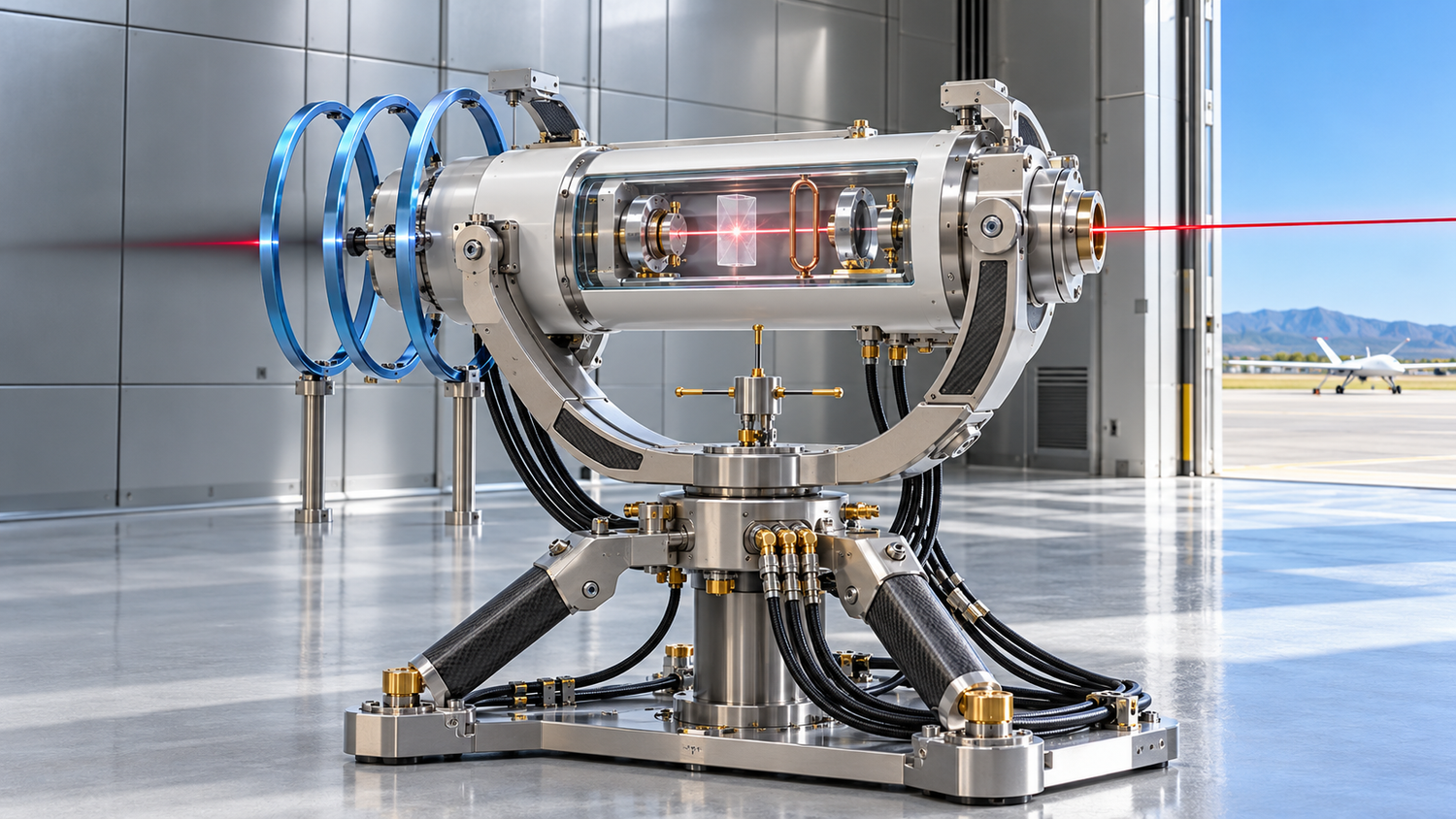
A team at the Fraunhofer Institute for Applied Solid State Physics IAF in Freiburg has placed a magnetically sensitive diamond inside a laser cavity and shown that a magnetic field can switch the laser's output fully on and fully off. The paper, Laser-enhanced quantum sensing boosts sensitivity and dynamic range, appeared in Nature Communications on 22 October 2026 with Florian Schall as first author and Jan Jeske as senior author, and it reports 100 percent optical contrast, up to 50 milliwatts of signal power, and a linear measurement range of plus or minus 280 microtesla in one configuration.
Those three numbers matter to a defense reader for a reason the authors themselves put in the paper. Alongside brain imaging, they list magnetic navigation in environments where satellite signals are denied and magnetic anomaly detection as the uses the sensor could serve. Both are capabilities that forces already pursue with other magnetometers, and both are limited today by the same trade-off this experiment claims to loosen: a sensor that is very sensitive usually works only across a very small range of field, and a sensor that covers the whole Earth field is usually not very sensitive.
This post reads the Freiburg result as a defense capability. It sets out what was built, what the numbers do and do not establish, how they compare with the sensors flying on magnetic navigation testbeds now, and what still stands between a laboratory bench and a program office.
What Schall, Jeske and their co-authors built in Freiburg: a diamond absorber inside a 1042 nanometer laser cavity
Conventional diamond magnetometers work by fluorescence. A green laser excites nitrogen-vacancy centers, atomic-scale defects in the diamond lattice, and a microwave field tunes their spin state. When the microwaves hit a resonance, the red fluorescence dims by a few percent, and the exact frequency of that dip shifts with the magnetic field. The weakness is the size of the dip. A contrast of a few percent means almost all the collected light is background, and the useful signal is a small ripple on top of it.
The Freiburg approach, called laser threshold magnetometry, turns the diamond from the light source into a gatekeeper. A membrane external-cavity surface-emitting laser supplies optical gain at 1042 nanometers, a wavelength that matches an infrared transition of the nitrogen-vacancy center. The diamond sits inside the same cavity and absorbs that light more or less strongly depending on the spin state of its defects. Because a laser only switches on once gain exceeds loss, the magnetic field now decides whether the cavity lases at all. In the experiment, a resonant microwave drive turned the output off completely, and away from resonance it rose to as much as 50 milliwatts in a collimated beam. The difference between those two states is the 100 percent contrast in the title.
The idea is a decade old. Jeske, Jared Cole and Andrew Greentree published the theory in 2016 as Laser threshold magnetometry in the New Journal of Physics, where they predicted that a cubic millimeter of diamond read this way could reach a shot-noise limited sensitivity below 2 femtotesla per root hertz. The 2026 paper is the first experimental confirmation that the field-dependent shift of the laser threshold behaves as that theory said it would, with full contrast. The diamond itself carries roughly 2 parts per million of nitrogen-vacancy centers, grown and treated with partners at the College of Staten Island in New York and the National Institutes for Quantum Science and Technology in Japan, with RMIT University in Melbourne and the German laser maker Twenty-One Semiconductors on the author list. The work ran under the NeuroQ project funded by the German Federal Ministry for Research, Technology and Space, according to the institute's press release of 22 October 2026.
The authors also resolved the four crystal orientations in which nitrogen-vacancy centers sit in diamond, and held full contrast on all of their resonances. That makes the device a vector magnetometer: it reads the direction of the field as well as its strength, which a navigation filter needs and which most high-sensitivity alkali vapor sensors do not provide without added hardware.
Quantum pillar: sensing (gravimetry and magnetometry). Use posture: dual-use. Technology readiness: TRL 4 of 9. The device ran as a bench assembly, its headline sensitivity is a calculated photon-shot-noise limit rather than a measured field result, and nothing has yet been tested against the vibration, temperature swings and platform fields of a vehicle, so the reader should treat this as laboratory validation of a principle rather than a sensor ready for integration.
Why a ±280 microtesla range with a 1160 femtotesla limit, or ±40 microtesla with a sub-400 femtotesla limit, changes the arithmetic for a sensor riding on an aircraft or a hull
The Earth's magnetic field is between about 25 and 65 microtesla depending on latitude. The paper derives an intrinsic linear range from minus 280 to plus 280 microtesla from the resonance linewidth, paired with a calculated photon-shot-noise limit of 1160 femtotesla per root hertz. It presents operation while moving through the Earth's field as a future possibility. That range alone does not establish compatibility with the stray field of a carrying platform; that requires measured platform fields and operating tests. The paper states that it reached this range without flux concentrators or feedback.
In a second configuration using a different diamond sample and tuned for sensitivity rather than range, the authors calculate a photon-shot-noise limit below 400 femtotesla per root hertz on all three vector components, with 127 femtotesla per root hertz on its strongest single resonance, across a range of plus or minus 40 microtesla. Comparing the ratio of range to sensitivity with typical fluorescence-based diamond and vapor-cell magnetometers, they arrive at an advantage of up to a factor of 590. Two cautions belong next to that figure, and the authors give both. The ratio does not mean any single reading is 590 times more precise. And the sensitivity is a limit set by the statistics of the light itself; the paper notes that technical noise in laser systems typically sits orders of magnitude above that limit, and the Freiburg bench has not yet shown a measured noise floor near it.
Crustal magnetic anomalies, the fixed pattern of magnetized rock that a magnetic navigation system matches against a map, vary by tens to hundreds of nanotesla over kilometers. A submarine hull or an armored vehicle perturbs the field by nanotesla to microtesla at ranges of hundreds of meters, falling steeply with distance. Sensors in the tens of picotesla class already resolve both. What they struggle with is the platform: an aircraft rolling through the Earth field changes the field at the sensor by tens of microtesla, and the magnetometer must either follow that swing or be compensated for it. A sensor that follows the swing natively, with vector output and a femtotesla-class noise floor, could remove a layer of engineering from that problem if those properties were demonstrated together under operating conditions. That is the capability claim worth testing, and it is a claim about range as much as about sensitivity.
What the MagNav C-17 flights of May 2023 and the AQNav drone test say about the gap the Freiburg sensor would have to close
The United States Air Force has already flown magnetic navigation on an operational airframe. In May 2023, during exercise Golden Phoenix, the Department of the Air Force and MIT Artificial Intelligence Accelerator flew three C-17A Globemaster III sorties from Travis Air Force Base to Edwards Air Force Base and performed real-time magnetic navigation in flight, with MIT Lincoln Laboratory, the Air Force Research Laboratory Sensors Directorate and the Air Force Institute of Technology taking part; Lincoln Laboratory's account is here. Separating the aircraft's own magnetic signature, which changes with every control surface movement and every current in the wiring, from the faint crustal signal underneath is a central challenge. The cited account does not establish the sensor type or compensation architecture used.
Quentir examined the commercial follow-on to that work when SandboxAQ flew its AQNav system on Northrop Grumman's Lumberjack, the first reported magnetic navigation test on an attritable drone. A diamond laser threshold magnetometer could become a sensor option for such systems, but treating it as a sensor swap would require system-specific evidence and integration tests. Its case rests on vector output, an intrinsic range that points toward possible operation while moving through the Earth's field, and a calculated sensitivity limit that could offer cleaner data if realized in practice. Whether those properties meet a platform's measured field envelope and survive operating conditions is exactly what a flight campaign would have to show.
The anomaly detection side of the posture is less documented in public sources, and this post does not speculate about particular programs. The physics is the same: a towed or hull-mounted vector magnetometer looking for the signature of a steel object under water or under ground wants the widest range it can get, since the platform carrying it is usually itself a large steel object. Both uses draw on one sensor, which is why the posture reading here is dual-use. Navigation protects one's own forces when satellite signals fail; anomaly detection finds platforms an adversary intends to keep hidden. The same instrument serves both, and it serves geophysical survey and medicine as well. The Quentir Medicine Monitor has followed this sensor class toward the clinic in A Diamond Magnetometer Closes the Distance to Biomagnetism, and the Freiburg authors' own clinical goal, magnetoencephalography outside a shielded room, is the next step on that path.
What stands between a shielded-room bench in Freiburg and a program office: noise, shielding, size and power
The first gap is noise. A calculated photon-shot-noise limit is a ceiling on performance, and a laser threshold device is by construction sensitive to everything that changes gain or loss in its cavity: pump power fluctuations, temperature drift of the semiconductor membrane, mechanical motion of the 98.5 millimeter cavity. The authors say plainly that technical noise typically dominates in laser systems. Until the group publishes a measured sensitivity, with a noise spectrum, the sub-400 femtotesla figure is a design target, and a buyer should read it as one.
The second gap is shielding. The accessible paper does not establish whether the experiment ran in a magnetically shielded room; it discusses unshielded applications as a future possibility. For a navigation or detection sensor, operation in the ambient field is a central question. The wide intrinsic linear range motivates that possibility, but compatibility with a platform's measured fields still requires operating tests.
The third gap is engineering. The bench uses a 5 watt green pump laser at 532 nanometers, an 808 nanometer diode pump for the gain membrane, a free-space linear cavity, and a microwave drive near 2.87 gigahertz. The output falls to about 2 milliwatts of baseline when the sensor reads all four orientations for a full vector measurement. None of that is exotic, and Fraunhofer IAF has packaged semiconductor lasers for industry before, but turning it into a sealed head of a few hundred grams with a power budget a drone or a towed body can carry is a multi-year effort that has not started in public.
For a buyer, the practical reading is this. The result is real and the principle now has experimental standing after ten years as a proposal. The reported configurations pair a ±280 microtesla intrinsic range with a calculated limit of 1160 femtotesla per root hertz, and a ±40 microtesla range with a calculated limit below 400 femtotesla per root hertz, using different diamond samples. The dual-use capability they point toward, a vector magnetometer operating while moving through the Earth's field without feedback, would be valuable to navigation and to anomaly detection alike, but remains prospective. The evidence supports laboratory validation and nothing more. The milestones that would move it are specific and checkable: a measured noise floor, operation without a shield, and a packaged head on a moving platform. Each of those, when published, will be a reason to revisit this entry.
Sources
Primary source: Florian Schall, Lukas Lindner, Yves Rottstaedt, Marcel Rattunde, Florentin Reiter, Rüdiger Quay, Roman Bek, Alexander M. Zaitsev, Takeshi Ohshima, Andrew D. Greentree and Jan Jeske (Fraunhofer IAF, Twenty-One Semiconductors, College of Staten Island CUNY, QST Japan, RMIT University), "Laser-enhanced quantum sensing boosts sensitivity and dynamic range," Nature Communications 17, 10825, published 22 October 2026, open access, https://www.nature.com/articles/s41467-026-78386-z. Other material: Fraunhofer IAF press release of 22 October 2026; J. Jeske, J. H. Cole and A. D. Greentree, "Laser threshold magnetometry," New Journal of Physics 18, 013015 (2016); MIT Lincoln Laboratory, "MagNav project successfully demonstrates real-time magnetic navigation," 31 May 2023. The field-range arithmetic, the posture reading and the buyer questions are Quentir analysis.