IIT Bombay and Raman Research Institute Image at 1550 Nanometers With Photons a Camera Never Sees, arXiv 2610.32292, 23 October 2026: What It Offers Low-Light Infrared Sensing, TRL 3
Quentir Defense Monitor
Evidence-based insights for quantum defense and security. Published by Quentir Systems LLC · October 26, 2026.
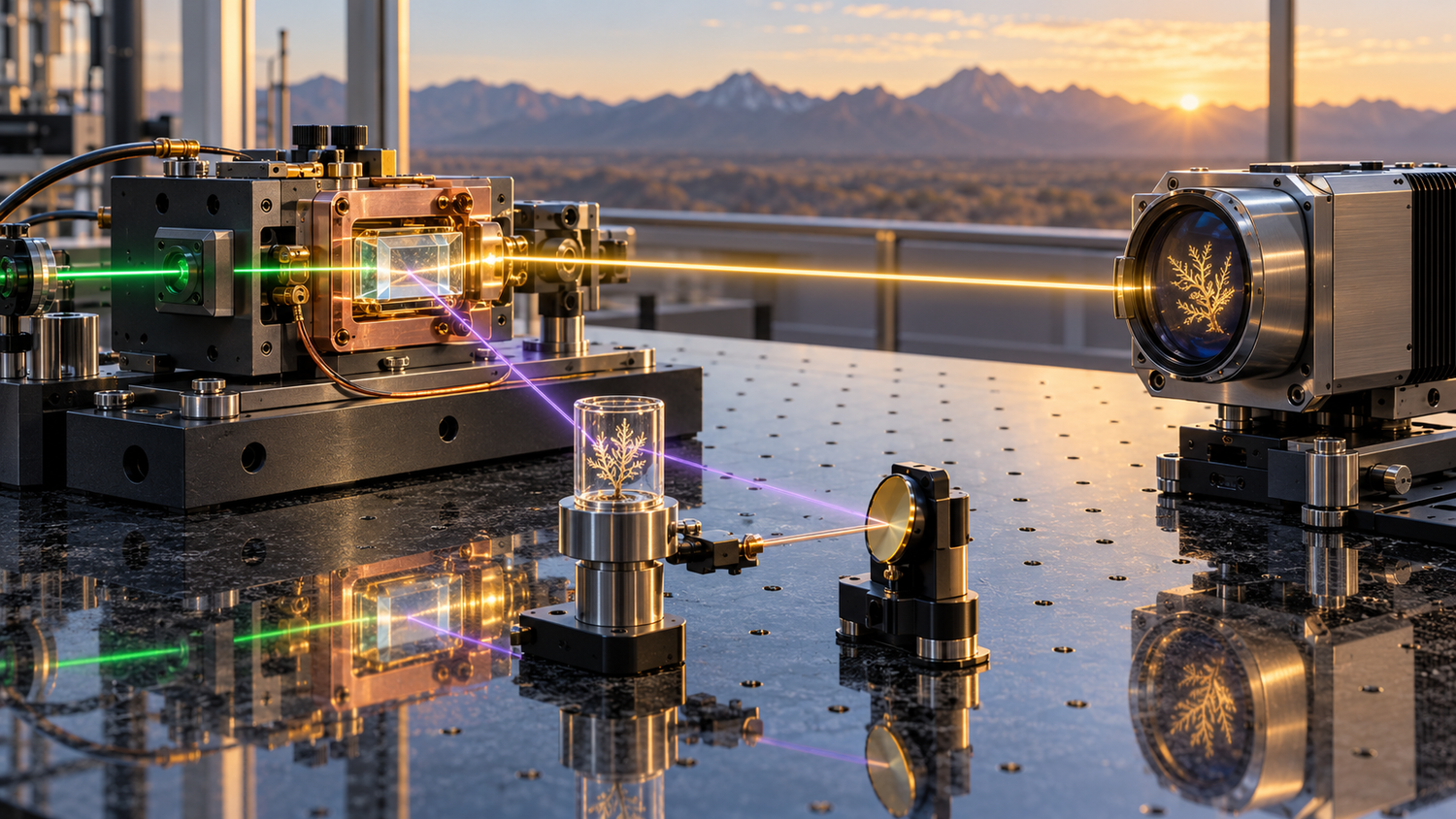
A group at the Indian Institute of Technology Bombay and the Raman Research Institute in Bengaluru has imaged a zebrafish larva at 1550 nanometers, in the short-wave infrared, without any infrared detector in the apparatus. The probe light that passed through the specimen was never measured. A silicon spectrometer at 810 nanometers produced the picture instead. The preprint, High Resolution Hyperspectral Quantum Infrared Imaging with Undetected Photons, appeared on arXiv on 23 October 2026 with Aadi Suketu Bharatia as first author and Anshuman Kumar as senior author, and it reports a spectral resolving power of about 1460 at 1550 nanometers, which the authors describe as the finest yet achieved for imaging with undetected photons.
The result belongs in a defense briefing for one reason. Most of the optical information that tells one material from another sits in the infrared, and the detectors that read the infrared are expensive, few in pixels, and in many jurisdictions subject to export control. Cooling requirements depend on the detector, band and performance target; commercial uncooled InGaAs cameras cover 0.9 to 1.7 micrometers, including 1550 nanometers. A method that moves infrared information onto an ordinary silicon sensor changes who can build an infrared hyperspectral imager and what it costs. The Bombay experiment does this at the single-photon-pair level, with a probe beam at an eye-safe telecom wavelength and a pump of 64 milliwatts.
This post reads the preprint as a defense-specific capability. It sets out what was built, what the numbers establish, where the work stands against the decade of undetected-photon imaging that preceded it, and what still separates an eight-hour bench image of a fish from a sensor a program office could rely on.
What Bharatia, Kumar and their co-authors built: a folded lithium niobate interferometer that images at 1550 nanometers on an 810 nanometer detector
The physics was first demonstrated in Vienna. In August 2014 Gabriela Barreto Lemos, Anton Zeilinger and colleagues published Quantum imaging with undetected photons in Nature. A pump laser drove two nonlinear crystals, each able to emit a photon pair made of an idler and a signal. The idler from the first crystal passed through the object and was overlapped with the idler path of the second, so that nothing could tell which crystal had emitted a given pair. With that information erased, the signal photons from the two crystals interfered, and the fringes carried the image of an object only the idler had touched. The idler was never detected.
The Bombay apparatus folds that scheme into a single crystal. A continuous-wave 532 nanometer laser, held below 1 megahertz linewidth, pumps a 10 millimeter periodically poled lithium niobate crystal held at 110 degrees Celsius. Type-0 spontaneous parametric down-conversion produces signal photons near 810 nanometers and idler photons between 1539 and 1552 nanometers. Mirrors on both arms send the pump, signal and idler back through the same crystal in the opposite direction; the specimen sits in the idler arm, on a scanning mirror, and the returning signal light is routed to a grating spectrometer with a CCD, with an sCMOS camera used for alignment and calibration. Where the specimen absorbs at a particular infrared wavelength, the visibility of the interference fringes at the matching signal wavelength falls. Reading that visibility, wavelength by wavelength, is the hyperspectral measurement.
Baseline fringe visibility peaked at 74.4 percent at 811.22 nanometers after dark-count subtraction. The usable spectral window ran from 809.6 to 813.0 nanometers on the detected side, which maps to an instantaneous window of about 51 reciprocal centimeters in the infrared and roughly 12 independent spectral channels. The spectrometer's point-spread function set a resolution of 4.4 reciprocal centimeters, a resolving power near 1460; the coherence length of the down-converted light gave a more conservative estimate of 8.9 reciprocal centimeters, a resolving power near 730. The authors report both estimates. Narrow-pump energy correlations transfer the spectrometer's resolution to the idler, and phase-stepped readout recovers the instrument response, so the 8.9 reciprocal centimeter source bandwidth is not a physical resolution floor.
Two objects were imaged. A fixed zebrafish larva four days after fertilization was raster-scanned at 250 micrometer steps into a 21 by 21 pixel transmission image over about eight hours, and a laser-printed carbon-ink logo on plastic at 2 millimeter steps into a 52 by 17 pixel image over about twelve hours. Spatial resolution was set by the idler beam waist of about 1 millimeter. The authors list the improvements they intend: temperature tuning of the crystal to cover 1100 to 2700 nanometers, a higher-dispersion spectrometer, a 4f lens relay in the idler arm for microscopic resolution, and a fix for a spatial drift of about 2 millimeters at the longer idler wavelengths. The work ran under India's National Quantum Mission and an Anusandhan National Research Foundation grant.
Quantum pillar: sensing (imaging in low light). Use posture: dual-use. Technology readiness: TRL 3 of 9. The instrument ran as a bench proof of concept on real hardware, producing a 21 by 21 pixel transmission image over eight hours at 1 millimeter resolution, with no reflection geometry, no wide-field readout and no test outside a laboratory, so the reader should treat it as a demonstration that the spectral resolution is reachable, and nothing yet about a sensor.
Why 4.4 reciprocal centimeters on a silicon detector matters for infrared sensing in the field
Infrared spectroscopy identifies materials by absorption lines. A benchtop Fourier-transform infrared instrument in an industrial laboratory typically runs at 4 reciprocal centimeters, and the Bombay authors make exactly that comparison: their 4.4 reciprocal centimeter figure puts undetected-photon imaging, for the first time, at the resolution a chemist already uses. Earlier imaging work with undetected photons, which the preprint tabulates, reached 8 reciprocal centimeters in 2026 and 10 reciprocal centimeters in 2025. Single-point undetected-photon spectroscopy without imaging has gone finer, to 0.5 reciprocal centimeters with pulsed sources. A picture with a spectrum at every pixel tells a sensor operator more than either alone.
For a force, the capability in question is short-wave infrared hyperspectral imaging on hardware that reads the infrared through silicon rather than an indium gallium arsenide or mercury cadmium telluride array. That capability already exists in conventional form and is used to separate painted or netted objects from vegetation, to see through haze that scatters visible light, and to detect gases by their absorption bands. What limits its spread is the detector: infrared focal-plane arrays are costly, carry few pixels compared with silicon, and sit on dual-use control lists. Some also draw power for cooling, depending on the detector, band and performance target, but uncooled InGaAs cameras already cover 1550 nanometers. The undetected-photon route reads the infrared through the visible twin of each photon pair, so the sensor that counts the photons is a silicon spectrometer or a silicon camera. The Bombay paper cites gas absorption spectroscopy of carbon dioxide and water vapor and industrial infrared spectroscopy as the next applications; both have a direct defense counterpart in chemical detection and materials inspection.
The second property that matters is the light level. The idler beam that touches the object is produced by down-conversion of a 64 milliwatt pump, which means the probe reaches the specimen at power levels far below those of a conventional active infrared illuminator, at a telecom wavelength the eye does not register. This is the sense in which the work falls under imaging in low light in the capability vocabulary this lane uses: photon-starved, with a probe that is hard to notice. Quentir read the thermal end of the same idea when Imperial College London put a thermal infrared band onto a silicon camera earlier this year; the Bombay result extends the approach from a single band to a spectrally resolved measurement at every pixel, at the telecom wavelength where fiber components and lasers are cheapest.
The posture is dual-use. The same instrument that would let an analyst classify a camouflage net by its infrared signature would let a port inspector classify a plastic, a clinician read tissue chemistry, or a factory sort polymers. The authors' own test object is a biological feasibility test, and the Quentir Medicine Monitor has followed the Bombay group's broader sensing program in its review of diamond sensors and fluorescent-protein qubits.
Where the result stands against Kviatkovsky 2020 and DARPA's Invisible Headlights: wide field, speed and standoff
Three comparisons give the capability its scale. The first is spectral range. In October 2020 Inna Kviatkovsky, Sven Ramelow and colleagues at Humboldt University of Berlin published Microscopy with undetected photons in the mid-infrared in Science Advances, imaging between 3.4 and 4.3 micrometers on a standard CMOS camera with a spatial resolution of approximately 322 micrometers and a field of view of 9.1 millimeters in the unmagnified configuration, and a spatial resolution of 35 micrometers in the magnified configuration. That work was wide-field and sat in the band where molecular fingerprints are strongest; the Bombay work is scanned, sits at 1.55 micrometers, and resolves spectrum rather than space. Each group has what the other lacks. A sensor a buyer would want needs both: wide-field readout at video rate with a spectrum per pixel.
The second comparison is the defense use case for passive infrared sensing. DARPA's Invisible Headlights program, now complete, set out to quantify the information available in ambient thermal emission so that an autonomous ground vehicle could drive at night without visible headlights or lidar, because switching on an emitter allows adversaries to detect a vehicle's presence. That program measured what is already radiated; the undetected-photon approach still probes the scene with light, so it is active sensing, with a very weak and eye-safe probe. The Bombay instrument sits closer to a laboratory spectrometer or a short-range inspection head than to a vehicle sensor.
The third comparison is standoff, and it is the hard one. A nonlinear interferometer requires mode overlap and control of relative delay and phase; the Bombay experiment placed the specimen in the idler arm of a laboratory interferometer. The Bombay authors needed eight hours partly because every pixel required a phase-stepped scan of the idler mirror in 70 nanometer increments. The experiment did not test targets at hundreds of meters, and the published theory establishes no universal centimeter range ceiling. The capability demonstrated is therefore laboratory hyperspectral inspection, which is valuable for material identification, forensics, chemical screening and component inspection. Performance as a standoff surveillance camera remains untested.
What stands between an eight-hour, 21 by 21 pixel image and a program office
The first gap is speed. Eight hours for 441 pixels is a demonstration rate. The Humboldt group showed in 2020 that wide-field readout on a camera removes the raster scan; combining wide-field imaging with the spectrometer readout that gives the resolution is the engineering step that has not been published.
The second gap is geometry. Transmission imaging requires a thin specimen. A field instrument reads reflection or scattering from a surface, which returns far less light into the interferometer and demands a different optical design. The Berlin and Bombay results are both transmission measurements.
The third gap is spectral coverage. An instantaneous window of 51 reciprocal centimeters is narrow; the full 1100 to 2700 nanometer range the authors cite depends on stepping the crystal temperature, which is slow and which they have not yet shown end to end. The 2 millimeter drift at the longer wavelengths is the kind of alignment sensitivity a packaged head would have to engineer out.
The fourth gap is stability outside a laboratory. The folded single-crystal layout is the most robust configuration available, yet it still depends on a stable path length through the specimen arm, and vibration, temperature and airflow all enter the measurement. No one has yet published an undetected-photon imager running off an optical table.
For a buyer, the practical reading is this. The result is real, the resolution figure is the highest reported for this class of imaging, and the detector economics it points to are the reason the field exists. The capability it supports today is a laboratory spectrometer that reads the short-wave infrared on silicon, and the defense value lies in material and chemical identification at close range. A sensor on a platform remains several published steps away. The milestones that would move it are specific and checkable: a wide-field hyperspectral image at camera frame rates, a reflection-mode measurement, a demonstration across the full temperature-tuned range, and a packaged head run off a bench. Each of those, when published, is a reason to revisit this entry.
Sources
Primary source: Aadi Suketu Bharatia, Vidya Prakash Muppalla, Ananya Asthana, Priyanka Kandankel, Tanmoy Chakraborty, Sreelaja Nair and Anshuman Kumar (Indian Institute of Technology Bombay; Raman Research Institute, Bengaluru), "High Resolution Hyperspectral Quantum Infrared Imaging with Undetected Photons," arXiv:2610.32292, submitted 23 October 2026, https://arxiv.org/abs/2610.32292. Other material: G. B. Lemos et al., "Quantum imaging with undetected photons," Nature 512, 409-412, 27 August 2014; I. Kviatkovsky et al., "Microscopy with undetected photons in the mid-infrared," Science Advances 6, eabd0264, 14 October 2020; DARPA, Invisible Headlights program page. The capability reading, the standoff argument and the buyer milestones are Quentir analysis.