IonQ and Capella Run a 20-Qubit Quantum Circuit Born Machine for SAR Change Detection on Forte Hardware: Filtered F1 0.32 Against 0.24 and 0.16 at MCAS Miramar, arXiv 2609.05313, 4 September 2026
Quentir Defense Monitor
Evidence-based insights for quantum defense and security. Published by Quentir Systems LLC · September 25, 2026.
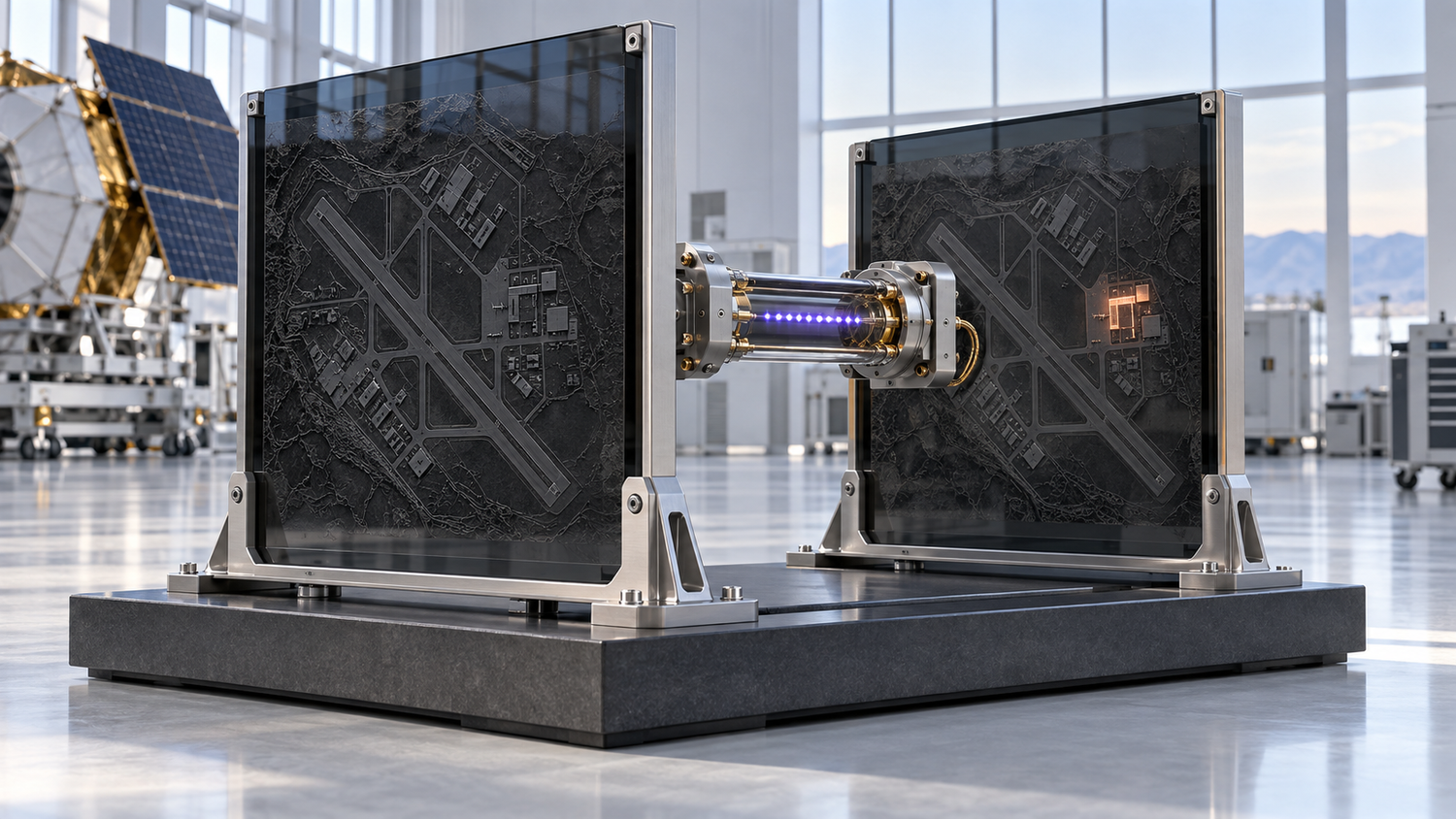
On September 24, 2026, IonQ announced that a quantum generative model had outperformed two classical methods at finding what changed between two radar images of an airfield. The claim rests on a paper by Samwel K. Sekwao, Shaunak De, Alexis Hocken, Scott Staniewicz and six colleagues at IonQ in College Park and at Capella Space in San Francisco, the radar satellite operator IonQ acquired in July 2025, posted to arXiv on September 4 as "SAR and InSAR Change Detection with Quantum Generative Models". The team trained a 20-qubit quantum circuit Born machine to model the joint statistics of a before image and an after image, ran it on IonQ's Forte trapped-ion processors, and reports a filtered F1 score of 0.32 on hardware against 0.24 and 0.16 for the two classical baselines on the same scene.
For a defense reader the interest is the task. Synthetic aperture radar sees through cloud and darkness, and sub-meter commercial radar is now bought by intelligence agencies in bulk. The analytic that turns two passes over the same ground into a map of what moved, appeared or was built is the product those agencies consume, and the paper says that analytic gets harder as the radar gets sharper. What the sources establish is a hardware run on real satellite data with a measured relative gain in one statistical regime. What they do not establish is that the gain survives outside that regime, or that anyone could run this at the pace of a tasking cycle.
What Sekwao, De and colleagues measured: two Capella scenes, a 20-qubit Born machine, and a simulated F1 score of 0.41 that fell to 0.32 on the Forte processor
Change detection in radar does not compare two images pixel by pixel, because speckle makes every pixel noisy. The pipeline estimates what each pixel of the second image should look like if nothing had changed, given the first, and flags the places where the observed value departs from that expectation. That expectation is a conditional mean, and the standard way to get it is a joint histogram of before-and-after pixel values. The paper's first classical baseline, which it calls NLCD, does exactly that with lookup tables. The second does the same in copula space, a transformation that separates how two variables depend on each other from the shape of each one's own distribution.
The quantum method replaces the histogram with a learned sampler. Pixel intensities are mapped through their own cumulative distributions into the unit square, discretized into ten bits per image, and the 20-bit joint distribution is learned by a quantum circuit Born machine, the generative model Marcello Benedetti and colleagues proposed in npj Quantum Information in 2019 for shallow-circuit distribution learning. The circuit is small: 50 single-qubit gates and 28 two-qubit gates on two 10-qubit registers, trained by minimizing the Kullback-Leibler divergence between its samples and the observed pixel pairs. On an ideal simulator the team trained for 1,000 epochs with 100,000 shots per iteration; on the processor they used 300 iterations of 5,000 shots to keep hardware time within reach, and 100,000 shots at inference.
The radar data came from Capella's own fleet. The SAR scene is a pair of X-band stripmap acquisitions at 1.2 meter resolution over Marine Corps Air Station Miramar in San Diego from October 22 and October 29, 2020, with a hand-labeled change mask. The InSAR case uses Capella-13 acquisitions at about one meter over Piton de la Fournaise on La Réunion during the 2025 to 2026 eruption sequence, where lava flows are the change to find. Interferometric SAR, as the US Geological Survey explains, reads the phase difference between passes and can resolve ground displacement on the order of ten millimeters, so it adds a wrapped-phase variable that the copula treatment has to handle differently.
The headline numbers belong to Miramar. On the original data the Born machine scored a filtered F1 of 0.30 against 0.14 for NLCD and 0.20 for the classical copula method. With a small median filter applied, the configuration the press release quotes, the simulated model reached 0.41 against 0.16 and 0.24. Larger median windows narrowed the gap: 0.36 against 0.21 and 0.26, then 0.32 against 0.25 and 0.29. Then the team ran the trained circuit on the processor. With ideal training and hardware inference the score was 0.37; with hardware training and hardware inference it was 0.32. The abstract reports that last figure, and it still sits above both baselines, but a reader who stops at the press release's 0.41 is reading the simulator.
Why the gap closed after a Yeo-Johnson transform, and what the press release leaves out
The paper's most useful result is the one that explains the others. When the team applied a Yeo-Johnson power transform to make the pixel distributions approximately Gaussian before running any method, all three converged: 0.56, 0.55 and 0.56 in one configuration, 0.54, 0.53 and 0.54 in another. The quantum model's advantage lives in the heavy-tailed regime that sub-meter radar produces, where the joint histogram has too few counts in its tails to give a reliable conditional. Where the statistics are adequate, the Born machine matches a lookup table and does no better.
Two things follow. The absolute scores are low: a filtered F1 of 0.41 means that well under half of the flagged pixels are true changes, or that well under half of the true changes are flagged, or both. And the comparison is against two histogram estimators. The paper lists broader classical density-estimator comparisons as future work and does not test a learned classical estimator, such as a small neural density model on the same copula-space data, which is the comparison a program office would ask for first. The volcano result makes the same point from the other side: all three methods peaked near 0.66 on the lava flow, with the quantum model holding that level across a wider range of thresholds, a robustness claim rather than an accuracy one.
The Monitor has followed quantum machine learning applied to radar before, when a hybrid quantum classifier was trained to vouch for radar satellite data, and the pattern in medical imaging has been similar, where adding a quantum layer changed little about what a medical AI saw. This paper is more careful than most in that literature: it shows the regime where it wins and the regime where it does not. The claim holds for sparse statistics on a two-scene evidence base, and that is how a buyer should read it.
Quantum pillar: computing (machine learning for ISR). Use posture: dual-use. Technology readiness: TRL 3 of 9. The trained 20-qubit circuit ran for real on IonQ's Forte processors against two recorded satellite scene pairs, which is an experimental proof of concept, while the per-scene retraining, the single airfield and single volcano, and the untested transfer to other regions keep it short of a validated laboratory pipeline.
Who gains from a change detector for sub-meter radar: the dual-use reading, and NRO's Radar Commercial Augmentation award of 6 August 2026
Change detection over radar imagery is the same computation whether the after image shows a lava flow, a collapsed bridge or a new revetment on an airfield apron, so the posture is dual-use in the plain sense of the capability map. The paper's own list of applications runs from disaster response and infrastructure monitoring to defense and land-use enforcement, and its test scene is a military air station. What a working version would let a force do is monitor more ground at finer resolution with fewer analysts, because the analytic rather than the sensor becomes the bottleneck once revisit rates reach several passes a day. Its defensive value is early warning of what an adversary is building or moving; it stops nothing directly.
The buyer is concrete. On August 6, 2026, Capella, as an IonQ company, was awarded a contract under the National Reconnaissance Office's Radar Commercial Augmentation program to supply commercial SAR imagery and data services for national security missions. The company that flies the satellites, sells the imagery to the NRO and owns the quantum processors is one company, which explains why a radar-analytics paper appears on a quantum vendor's newsroom. The party best placed to benefit is the vendor itself, since an analytic that adds value to its own imagery adds value to a contract it already holds. The paper provides no method for defeating radar change detection, though an adversary could still benefit from the detection research itself.
What stands between a two-scene proof of concept and an analytic a program office would rely on
The distance is set out in the paper's own limitations. The Born machine is trained per image pair: every new before-and-after scene means a fresh optimization before a single change pixel can be scored, and the paper reports no wall-clock time for training or inference. Its suitability for a tasking cycle that returns several passes a day over a site remains unproven pending timing and throughput measurements. Conditioning the model on a given before-pixel is done by rejection sampling, which the authors call inefficient for rare conditioning values, and rare values are precisely the tails where the model earns its advantage. The wrapped phase of InSAR needs a circular copula formulation the team has not yet built. Transfer across regions, a model trained on Miramar applied to another airfield, was barely evaluated.
Hardware noise cost real accuracy. Moving from the simulated score of 0.41 to ideal training with hardware inference at 0.37 produced an inference-associated decrease of 0.04. Hardware training and hardware inference scored 0.32, a further training-associated decrease of 0.05 and a total decrease of 0.09 from simulation. On a 78-gate circuit that is tolerable. A model wide enough to condition on several reference acquisitions, the next step the authors name, would run deeper circuits and pay more.
For a buyer the practical reading is this. A vendor claim that quantum generative modeling improves radar change detection is now backed by one preprint, not yet peer reviewed, with a hardware run on two scenes, a measured gain in the heavy-tailed regime and a measured absence of gain once the data are Gaussianized. The evidence a program office should ask for next is a comparison against a learned classical density estimator on the same data, a transfer test across a handful of sites, and a timing figure for training and inference on hardware. The results to watch for are the multi-reference conditioning experiment, the circular-copula InSAR version, and an independent replication on radar data that Capella did not collect.
Sources
Primary source: Samwel K. Sekwao, Shaunak De, Alexis Hocken, Scott Staniewicz, Evgeny Epifanovsky, Craig Stringham, Gordon Farquharson, Martin Roetteler, Panagiotis Kl. Barkoutsos and Jason Iaconis, "SAR and InSAR Change Detection with Quantum Generative Models," arXiv 2609.05313, submitted September 4, 2026. Other material: IonQ's announcement of September 24, 2026; IonQ's announcement of Capella's NRO Radar Commercial Augmentation award of August 6, 2026; the US Geological Survey's description of interferometric SAR; Benedetti, Garcia-Pintos, Perdomo, Leyton-Ortega, Nam and Perdomo-Ortiz, "A generative modeling approach for benchmarking and training shallow quantum circuits," npj Quantum Information, May 27, 2019.