Japan's Defense Ministry Puts Drone-Mounted Quantum Magnetometers for Submarine Detection in Its Fiscal 2027 Budget Request, With Prototypes Planned for 2027 to 2031
Quentir Defense Monitor
Evidence-based insights for quantum defense and security. Published by Quentir Systems LLC · September 11, 2026.
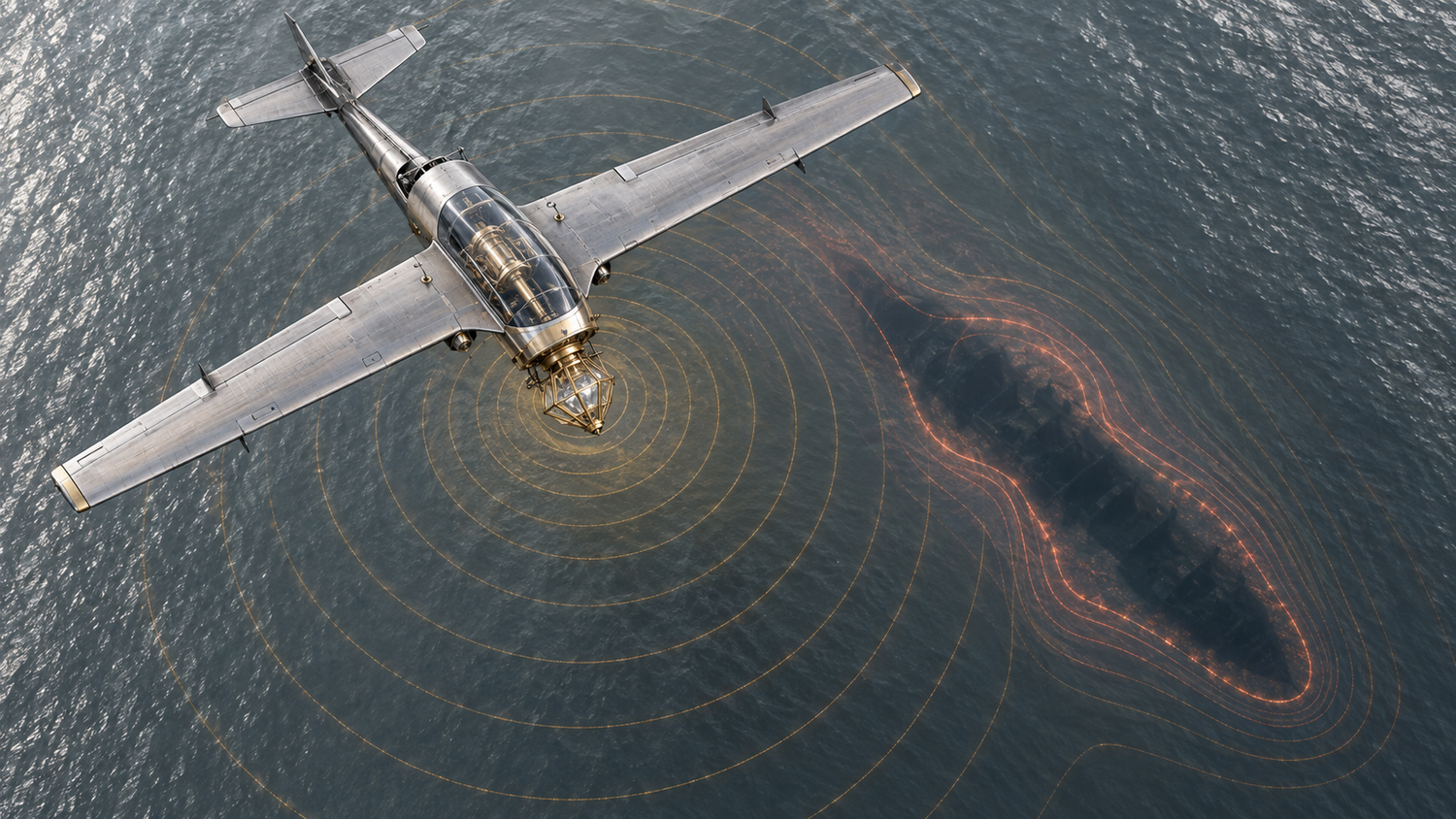
On September 10, 2026, Nikkei reported that Japan's Ministry of Defense will develop a sensor for small aerial drones that detects submerged submarines through quantum magnetic technology, and that the ministry has written the development cost into its fiscal 2027 budget request. The English edition on Nikkei Asia frames the program plainly: a sensor that employs quantum magnetic technology for aerial drones that can detect submarines, requested amid China's increasing operations in nearby waters, with domestic mass production as the goal. The plan is to contract Japanese companies, build prototypes from fiscal 2027 through fiscal 2031, mount them on drones and verify their performance in flight.
The concept of operations matters as much as the sensor. The drones are to be cheap, quick to produce and fielded in quantity, and they do one thing only, which is to find the submarine. Engagement stays with crewed warships, which would launch torpedoes at a contact the drones have fixed. Yonhap's Tokyo correspondent carried the full account of the Nikkei report the same day: the sensors exploit the fact that even a submarine equipped with degaussing systems to erase its magnetic signature still leaves a faint residual field, and a sufficiently sensitive detector flying close to the water can catch that small change. Part of the search mission now flown by the Maritime Self-Defense Force's patrol helicopters could pass to machines, and a drone can fly closer to the surface than a crewed patrol aircraft, which makes a submerged boat easier to find.
This briefing reads the request as a defense capability in the making: what the budget filing establishes and what it leaves open, why magnetic detection from low-flying drones changes the anti-submarine picture, how China's own drone-mounted magnetometer trial in 2025 frames the competition, and what still separates an item in a budget request from a surveillance net a fleet commander can rely on.
What the August 31 filing establishes: an item request without an amount inside an 8,890.8 billion yen budget, and drones that only detect
The instrument behind the story is the ministry's fiscal 2027 budget request, filed on August 31, 2026 and published as an overview document on the ministry's site. The topline is 8,890.8 billion yen, the largest request the ministry has filed, and the submarine-detection sensor enters it as what Japanese budget practice calls an item request, a line that states the program without stating the money. That form is a signal in itself. Item requests are reserved for programs whose scale depends on decisions still pending, and this year the pending decision is the year-end revision of Japan's three security documents, the National Security Strategy among them. The sensor program's final size will be set in that round. A survey of the same filing shows where the program sits in the ministry's larger turn: alongside an AI decision-support system for the Joint Operations Command, long-range attack drones built for mass production from civilian technology, underwater modules for uncrewed submersibles and hypersonic weapons development, the request reads unmanned mass and sensing as the pillars of what the ministry calls a new way of fighting.
The operational logic Nikkei describes is a division of labor. Submarine search today rides on crewed platforms, patrol aircraft and helicopters with magnetic anomaly detectors and sonobuoys, and each airframe carries a crew that a shrinking self-defense force struggles to fill. The ministry's plan spreads the search across many expendable airframes and keeps people out of them, which lowers the cost of persistence and the cost of loss at the same time. Nikkei puts China's submarine fleet at roughly three times the size of Japan's force of about two dozen boats, and names Chinese submarines as the surveillance target the program has in view. The drones' detection-only role also keeps the hard decisions where they already live: a contact found by a drone is prosecuted by a warship and its torpedoes, under the same command chain that runs anti-submarine warfare today.
Why a low-flying magnetometer sees what a degaussed hull cannot hide
A submarine is a steel body moving through the Earth's field, and it bends that field around itself. The distortion is the basis of magnetic anomaly detection, the technique fleets have used since the 1940s, and its central limitation has never changed: the anomaly of a magnetized hull falls off roughly with the cube of distance, so a detector twice as far away sees about an eighth of the signal. That geometry is why patrol aircraft descend to low altitude for magnetic runs and why a small drone that can hold station meters above the swell is an attractive host. Modern boats fight back with degaussing coils and deperming treatments that cancel most of the hull's permanent magnetization, which pushes the surviving signal down toward the detector's noise floor. The ministry's bet is that a quantum magnetometer holds enough sensitivity to catch what degaussing leaves behind, from a platform cheap enough to fly in swarms. The supplied reporting does not identify Japan's sensor architecture or establish a measured advantage over existing airborne atomic magnetometers.
Laboratory sensitivity results motivate further testing but do not establish operational feasibility. This publication examined the levitated-magnet magnetometer from Peking University and Mainz, which reached 32 femtotesla per root hertz at room temperature. Diamond nitrogen-vacancy instruments are crossing comparable thresholds in other fields, as the Medicine Monitor's report on a diamond magnetometer approaching biomagnetic signals shows. Neither result supplies the bandwidth, detection distance, target assumptions or environmental noise conditions needed to establish submarine detection at operational standoff. A drone's motors, servos and power electronics also generate magnetic noise far coarser than the target signal centimeters away from the sensor, and compensating that self-noise in real time, through maneuvers, in weather, is the engineering that must be tested before laboratory sensitivity can support a mission-ready detector.
Quantum pillar: sensing (gravimetry and magnetometry). Use posture: defensive. Technology readiness: provisionally assessed at TRL 2 of 9, pending verification against the governing readiness rubric. Today's development is a budget request rather than a demonstrated system, and the supplied reporting does not establish the program's hardware state or document flight demonstrations; a reader should treat every capability figure in the program as an intention awaiting measurement.
China reported offshore trials in April 2025: CASC's drone-mounted magnetometer off Weihai reached 0.849 nanotesla after correction
Japan is requesting a capability its neighbor has already reported carrying into offshore trials. In April 2025, researchers led by Wang Xuefeng at the Quantum Engineering Research Center of the China Aerospace Science and Technology Corporation published results, reported in detail by The Quantum Insider, from a drone-mounted atomic magnetometer flown off Weihai in Shandong province. The instrument, built on coherent population trapping, surveyed the local field to an accuracy of 2.517 nanotesla raw and 0.849 nanotesla after correction, with repeat surveys agreeing to a root mean square error of 1.149 nanotesla. The team compared its sensitivity to the MAD-XR detector that equips NATO patrol platforms, at a fraction of the cost, while acknowledging the trial ran in controlled conditions and the system is short of operational readiness.
Set side by side, the two programs suggest a conditional possibility in Beijing and Tokyo: airborne submarine detection could become something a force does with many cheap sensors rather than a few expensive aircraft, if target-detection and operational trials demonstrate the necessary performance and economics. The strategic weight of that possibility is hard to overstate calmly. The survivability of every submarine force rests on the ocean staying opaque, and opacity has held because wide-area search was expensive. If magnetometer drones bring the cost of a search hour down by an order of magnitude, chokepoints like the straits threading the first island chain become surveyable on a schedule, in both directions. Japan gains warning of boats approaching its waters. The same physics, matured in Chinese hands, presses on the boats Japan and its partners send out. A capability this symmetric rewards whoever industrializes it first, which is why the ministry's stated goal of domestic mass production is the most consequential phrase in the request.
What stands between an item request and a surveillance net over the East China Sea
A buyer reading this program should hold three open questions. The first is money and schedule: an item request carries no amount, and the figure arrives with the year-end document revision. The reported schedule does not establish an operational deployment date; the supplied reporting does not document flight demonstrations for this program. The second is physics in service conditions: magnetic self-noise on a small airframe, sea-state turbulence at the low altitudes where the signal lives, geomagnetic disturbance during solar events, and the false-alarm behavior of a sensor net over seabeds strewn with wrecks and pipelines are all unpublished for this program. The third is the kill chain around the sensor: detection-only drones are useful exactly in proportion to the data links, fusion and command arrangements that move a contact from a drone to a torpedo-armed ship before the contact fades, and those arrangements sit outside this budget line.
None of these questions diminishes what the request establishes. Japan's defense ministry has looked at its patrol aviation, its personnel pipeline and its neighbor's fleet, and concluded that the answer to a growing submarine fleet next door is quantum sensing distributed across expendable platforms and built at home. The evidence for that conclusion now sits in a public budget document with a program shape and a test calendar attached. Watch for the year-end revision to put a figure on it, and watch which Japanese companies take the prototype contracts, because the industrial base that learns to compensate a magnetometer on a cheap drone will hold expertise every navy in the Pacific wants.
Sources
Primary source: Nikkei's September 10, 2026 report on the Defense Ministry's submarine-detection sensor program, read through the Nikkei Asia English edition and corroborated in full by Yonhap correspondent Lee Do-yeon's same-day dispatch from Tokyo. Other material: the ministry's fiscal 2027 budget request overview (August 31, 2026); SBBIT's analysis of the filing; The Quantum Insider's April 27, 2025 account of the CASC Weihai drone-magnetometer trial.