Quantum Brilliance and Oak Ridge Ran Fragment-Based Quantum Chemistry Across Three Room-Temperature Diamond QPUs, arXiv 6 October 2026: 93.6 Percent Parallel Efficiency on Helium Clusters, TRL 3
Quentir Defense Monitor
Evidence-based insights for quantum defense and security. Published by Quentir Systems LLC · October 7, 2026.
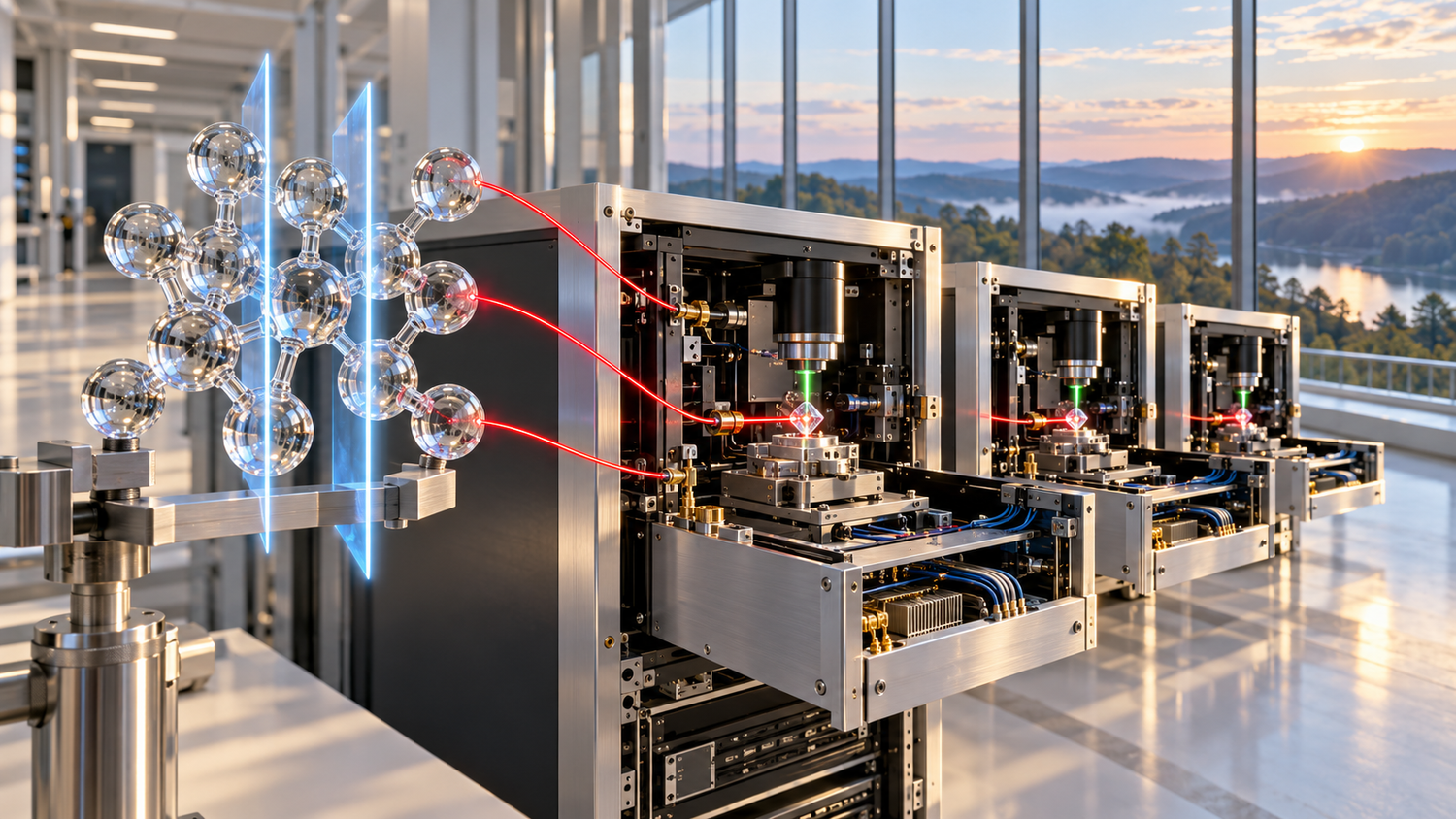
On October 6, 2026 twenty-four authors from Quantum Brilliance in Canberra and Stuttgart and from Oak Ridge National Laboratory posted a paper that splits a molecular energy calculation into fragments and runs those fragments at the same time on three separate quantum processors. The processors are two-qubit diamond devices that work at room temperature, sit together in one standard server rack at the Oak Ridge Leadership Computing Facility, and draw about 400 watts each. The molecules are helium clusters of two to fourteen atoms. The result is a throughput number, and the authors are careful to say so: three processors sampling together reached 93.6 percent of the ideal speedup while the assembled energies stayed within chemical accuracy of the exact classical answer.
This post reads the Quantum Brilliance and Oak Ridge paper as a materials simulation capability. The question a defense buyer should bring to it is simple. Propellant, explosive and armor chemistry eventually needs electronic-structure calculations on molecules far too large for any single quantum processor on any published roadmap. If such a problem can be cut into pieces, does adding more small processors actually shorten the wall-clock time, and does accuracy survive the cut? The paper gives a measured answer to both halves of that question, on hardware that exists, for a toy molecule.
What Nils Herrmann, Daniel Claudino and their co-authors ran on the Quoll cluster, and how the fragment method divides the work
The method is the fragment molecular orbital approach that Kazuo Kitaura and colleagues introduced in 199900874-X) for classical supercomputers. A large molecule is divided into fragments, called monomers, and the total energy is assembled from the energies of each monomer and each pair of monomers, with every fragment feeling the electrostatic field of all the others. The fragment calculations are independent of one another, and that independence is what the team uses to spread work across quantum processors.
Each fragment energy comes from the Quantum Wave Function Sampler, a selected configuration interaction method in which a short parameterized circuit is sampled on the quantum processor, the measured bitstring probabilities become the magnitudes of wavefunction coefficients, and a small classical model supplies the signs. Every circuit was sampled 5,000 times. A fragment counted as converged once its energy sat within one ten-thousandth of a hartree of the exact value in the same restricted space, and the whole run was allowed at most 50 sampling iterations. Chemical accuracy for the assembled total energy was set at 1.4 thousandths of a hartree.
The hardware is the part a program office will want to look at twice. Each of the three Quoll processors is a programmable two-qubit device built on a single nitrogen-vacancy center in diamond. The nuclear spins of a nitrogen-14 atom and a nearby carbon-13 atom are the two qubits; the electron spin of the defect initializes them, reads them out through a 520-nanometer laser and a microscope objective, and mediates the entangling gate. Each unit weighs 98.4 kilograms, measures 339 by 436 by 1,020 millimeters, and runs from ordinary 10-ampere mains outlets, with a CPU and GPU subsystem built in. All three mount in a single 19-inch rack. Oak Ridge announced the installation on September 2, 2025 as the laboratory's first on-site commercial quantum cluster and as Quantum Brilliance's first United States deployment. The devices are not identical. Quoll-2 collects nearly twice the fluorescence of Quoll-1 and therefore samples faster, and Quoll-3 needs extra delays in its gate sequence to keep its microwave antenna from heating the diamond. The paper measures single-processor shot rates of 5.44, 10.01 and 3.08 shots per second for the three units.
Two ways to parallelize: shared shots at 93.6 percent efficiency and independent fragments at 75 percent, rising to 95 percent without idle time
The team tested two execution modes. In the synchronous shot-parallel mode, all processors sample the same circuit, each takes a share of the 5,000 shots proportional to its measured speed, and the error-corrected counts are merged into one probability distribution. The two-processor pairings reached 97.5, 96.7 and 97.7 percent of the ideal combined shot rate. All three together reached 17.34 shots per second, a parallel efficiency of 93.6 percent, and the three-processor configuration produced the smallest total energy errors in the study, with every cluster through fourteen helium atoms inside chemical accuracy.
Quantum pillar: simulation (materials and energetics). Use posture: dual-use. Technology readiness: TRL 3 of 9. The calculation ran on three real diamond processors installed in a working computing facility, but the molecule was a helium cluster chosen as a testbed rather than any material a program would model, which places the result on the third rung of the shared ladder as an experimental proof of concept.
Why heterogeneous noise matters, and what the fragment-parallel mode shows about running many small processors as one resource
The shot-parallel mode exposed a real constraint. Circuit parameters optimized on one processor did not always transfer to a mixed pool of processors with different noise. Two fixes worked: giving each processor its own optimized parameters while still merging the counts, or optimizing one parameter set directly under three-processor sampling. The authors put the lesson plainly. Parallel sampling itself holds up, and processor-dependent noise has to be accounted for when choosing which circuits to sample on today's hardware.
The second mode, asynchronous fragment-parallel execution, hands whole fragments to different processors, each running its own device-specific circuit to the full shot count, and pulls converged fragments out of a queue as they finish. This mode sidesteps the parameter-transfer problem entirely. Every two-processor and three-processor run converged within the 50-iteration budget and every assembled energy stayed within chemical accuracy. The measured efficiency was lower, 75.0 percent for three processors, because the prototype job interface could not interrupt a submitted circuit once the fragment it served had already converged, so processors sat idle while finishing work nobody needed. Removing that idle time gives an inferred efficiency of 95.2 percent. The correction points to a scheduler problem that software can fix, and the 75 percent is what the facility actually got.
The authors claim no computational advantage over classical chemistry. Their words are that the observed gain is a workflow-level advantage in sampling throughput and wall-clock efficiency. A fourteen-atom helium cluster is trivial for a laptop. The contribution is a systems answer: when a molecular problem decomposes into many small quantum subproblems, several physical processors can be used productively in parallel, and the overhead of combining their output is small. Marcus Doherty, Quantum Brilliance's chief technology officer and the paper's senior author, told Quantum Computing Report at the installation that the collaboration was meant to inform the engineering pathway to a future in which hundreds of parallel quantum computers are integrated with classical computers.
What a defense buyer should take from a six-qubit cluster: the deployable form factor, the dual-use reading, and the distance to a propellant molecule
The capability this points toward is materials and energetics simulation: predicting the energy, stability and decomposition chemistry of propellants, explosives and structural materials from first principles, with enough accuracy to shrink the number of samples that have to be synthesized and tested. That is dual-use in the plainest sense. The same calculation that tells a formulator how a new oxidizer decomposes tells a detection chemist what signature to look for, and the same armor-ceramic model serves whoever builds the plate. The paper's funding is civil: the Australian Capital Territory government's Quantum Prototyping Export Program on the company side, and Oak Ridge's Laboratory Directed Research and Development program under a Department of Energy contract on the laboratory side. No defense agency appears in the acknowledgments, and this post does not infer one.
What is specific to defense is the hardware's shape. A processor that runs at room temperature, needs no cryostat, no vacuum pumps and no dedicated cooling plant, fits in a rack unit alongside its own classical controller and runs from a wall socket is a processor that can be placed where the computing has to happen: inside a sovereign facility, a laboratory on a base, or eventually a vehicle. The 98-kilogram, 400-watt figures in this paper are public engineering numbers for a quantum processor installed in a national laboratory's computing environment, and the installation description reads like any other HPC acceptance checklist. A buyer evaluating distributed quantum simulation should notice that the integration problem has been solved before the physics problem has.
The distance to a molecule anyone would pay to simulate remains long, and the paper does not hide it. Two qubits per processor means each fragment circuit is tiny. Realistic energetic molecules need active spaces of tens to hundreds of orbitals per fragment, and the larger single-processor chemistry runs this house has covered, such as the 156-qubit enzyme calculation in the Medicine Monitor, show how much error mitigation that scale demands. Shot rates of three to ten per second mean a single 5,000-shot circuit takes between eight and twenty-seven minutes on one Quoll unit, which is why throughput, rather than qubit count, is the bottleneck the paper chose to attack.
A program office should therefore place this result where the authors do. It is proof on real hardware that fragment-based quantum chemistry parallelizes across physically separate processors with heterogeneous noise, with a measured 93.6 percent efficiency in the shared-shot mode and a known, fixable loss in the independent-fragment mode. On the shared ladder it sits several rungs below a field trial such as the Airbus quantum-secure tactical communications trial in Malta that this Monitor read last week, with one feature that matters to a buyer: the processors in this paper are installed, powered and under a facility's change control today. The questions to put to any vendor proposing distributed quantum simulation for materials work are the ones this paper answers for helium and leaves open for everything else: how many qubits per fragment and at what fidelity, what the shot rate is and who schedules the fragments, and whose parameters run on which machine when the processors differ.
Sources
Primary source: Nils Herrmann, Mariam Akhtar, Luke W. Bertels, Leigh Cameron, Raymond Chan, Lei Cheng, Daniel Claudino, Travis Humble, Stephan Irle, Marcus W. Doherty and co-authors (Quantum Brilliance Pty Ltd, Quantum Brilliance GmbH and Oak Ridge National Laboratory), "Demonstration of Parallel Multi-QPU Execution for Fragment-Based Quantum Chemistry Using On-Premises Hardware," arXiv:2610.07702v1, posted October 6, 2026. Other material: Oak Ridge Leadership Computing Facility interview with Andreas Sawadsky on the Quoll installation, September 2, 2025; Quantum Computing Report on the Quantum Brilliance and ORNL cluster, September 2, 2025; Kitaura, Ikeo, Asada, Nakano and Uebayasi, Chemical Physics Letters 313, 1999.