UNSW Bench Test Posted 29 September 2026: Polarization Post-Selection Extends Entangled-Photon Clock Acquisition 2 to 3 dB Into Channel Loss, 30 to 40 Percent More Range for One Downlink
Quentir Defense Monitor
Evidence-based insights for quantum defense and security. Published by Quentir Systems LLC · September 30, 2026.
On September 29, 2026, Ravi Singh Adhikari, Aman Gupta, Xiaoyu Ai and Robert Malaney of the University of New South Wales in Sydney posted a short paper to arXiv with a plain claim: entangled photon pairs can let two remote clocks acquire synchronization at higher channel loss than the standard method allows, provided the receiver uses the polarization of each photon as well as its arrival time. The paper reports a bench experiment and a Monte Carlo study, and its acknowledgments credit co-funding from Northrop Grumman Australia and the Defence Trailblazer program run by the University of Adelaide and UNSW. That funding line is the reason it belongs in a defense monitor. The problem it addresses, holding a network of quantum-enabled devices to a common time base through a satellite link that delivers very few photons, is the same problem a force faces when it wants quantum clock synchronization to survive the loss budgets of real space channels.
The result is modest in size and specific in meaning. At a background count rate of 70,000 per second, the conventional estimator reached a fitted 90 percent acquisition-success threshold at 49.3 dB of total channel loss and the polarization-assisted one at 51.4 dB. At a quieter 1,500 per second the figures were 55.9 dB and 58.7 dB. These thresholds describe acquisition across independent one-second records, not demonstrated continuous clock lock. The authors translate that 2.1 to 2.8 dB into 30 to 40 percent more propagation distance when the entire gain is allocated to one geometrically limited downlink, which is the headline number. The measured loss combines two downlinks; if both distances increase equally, the gain gives approximately 13 to 17 percent more distance for each, using 10^(\Delta L/40). Everything below explains what was measured, why it works, and what remains before anyone in a program office should rely on it.
What the UNSW team measured on the bench: an 811 nm entangled source, an emulated 45 to 68 dB satellite channel and two background levels
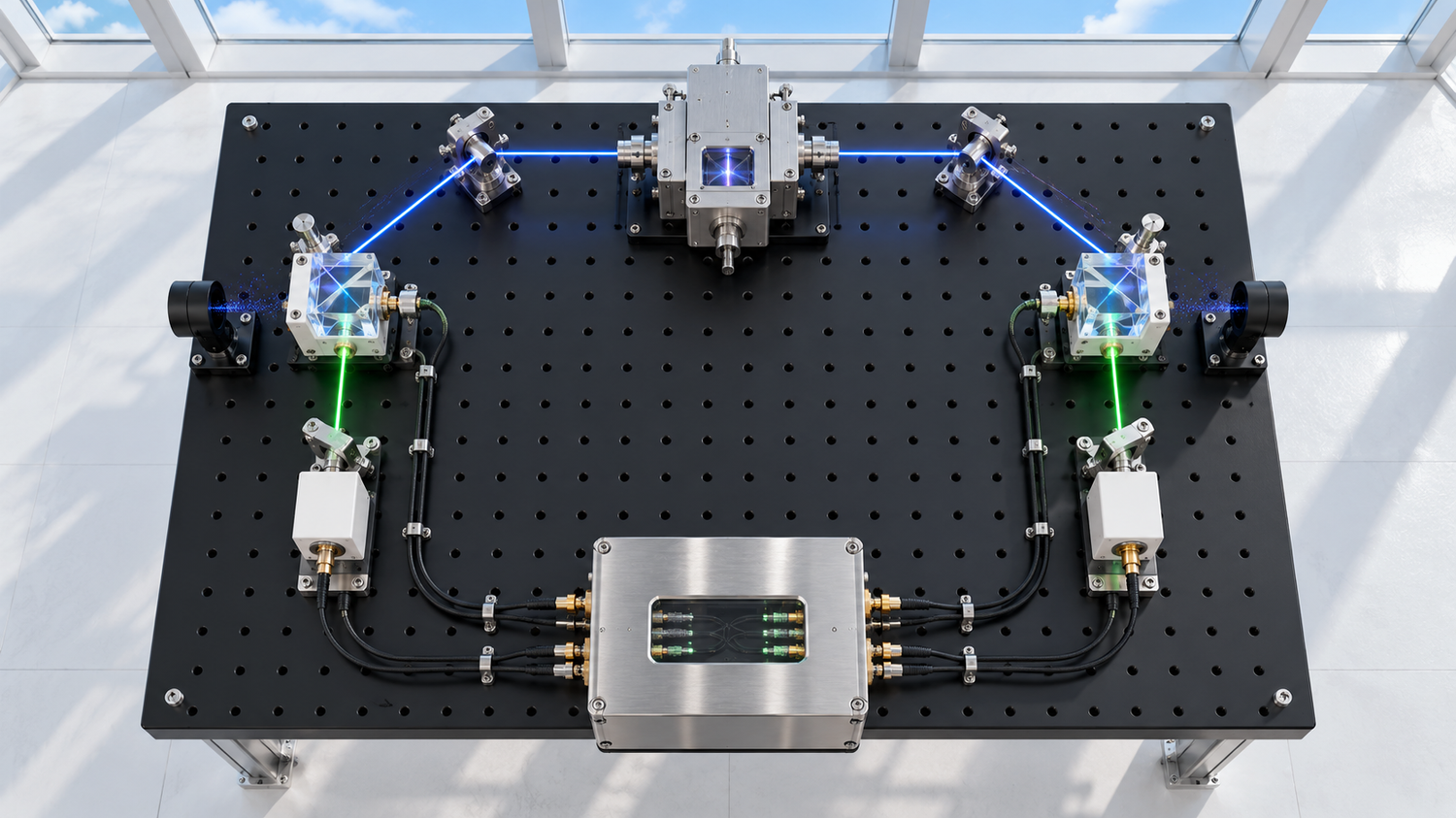
The apparatus is a laboratory one. A polarization-entangled photon source, pumped at 1 milliwatt and centered at 811 nanometers, sends one photon of each pair to a station called Alice and the other to Bob over separate 1.2 meter free-space paths. Each station splits horizontal from vertical polarization with a polarizing beam splitter and counts photons on single-photon modules with about 100 dark counts per second and a 250 picosecond timing error. A Swabian Instruments time tagger with 18 picosecond error stamps every detection together with its polarization outcome. The measured polarization visibility of the source is 0.99 and the intrinsic arrival-time spread of a pair is 1.5 picoseconds, so the system timing error, once both detectors and both tagger channels are added, comes to about 354 picoseconds.
Two things are emulated. A variable attenuator introduces 40 to 70 dB of total loss, chosen to match the combined loss reported for the Micius satellite experiments with a 0.3 meter transmitting and a 1.2 meter receiving telescope at about 1,000 kilometers of separation. And the second clock is synthetic: the team used one time tagger and manufactured Bob's timestamps by adding a minus 5 nanosecond offset and a drift of 10 picoseconds per second to one set of timings, a fractional frequency offset of one part in 10^11 that they describe as consistent with two portable rubidium standards. Laboratory illumination was adjusted to give background rates of 1.5 kilohertz and 70 kilohertz at each detector. At every operating point the team collected 100 independent one-second acquisitions and asked whether the estimated clock offset landed within 0.5 nanoseconds of the true value. The quoted loss thresholds are fitted points at which 90 percent of acquisitions succeed by that criterion; they do not demonstrate continuous tracking or clock lock.
The estimator itself is the two-stage coarse-to-fine correlation search from earlier UNSW work: a coarse pass over plus or minus 1 millisecond in 100 nanosecond bins to find the correlation peak, then a fine pass over plus or minus 100 nanoseconds in 200 picosecond bins. The only difference between the conventional and the new method is one filter applied before that search. The polarization-assisted version keeps a coincidence only when both photons show the same polarization, HH or VV, and discards the rest. For the entangled state the source produces, a true pair matches with probability (1 + V)/2, which at a visibility of 0.99 is almost always, while an accidental coincidence built from unrelated detections matches only half the time. The filter therefore halves the accidental background while leaving the true peak almost untouched, and the coincidence-to-accidental ratio improves by a factor of 1 + V, close to 3 dB.
The precision numbers matter as much as the thresholds. At 45 dB of loss and the high background rate, the conventional estimator's clock-offset standard deviation was 14.4 picoseconds and the polarization-assisted one's 11.2 picoseconds, against a theoretical floor of 9.5 picoseconds. Near 50 dB the assisted estimator still delivered 31.8 picoseconds while the conventional one collapsed to 2.35 microseconds, which means it had lost the peak entirely. Polarization assistance adds little sharpness at low loss. Its value is that a usable clock estimate survives at loss levels where the older method has already failed.
Why the Monte Carlo map over 40 to 70 dB and 0 to 300 kHz matters, and why the authors say entanglement itself is not the source of the gain
A bench test at two background levels is a thin map, so the team ran 1,000 Monte Carlo trials at each point of a grid spanning 40 to 70 dB of loss and 0 to 300 kilohertz of background, with the same source rate of 4 × 10^7 pairs per second, the same one-second acquisition and the same search algorithm. The simulated thresholds land close to the measured ones: 49.1 dB against 51.1 dB at 70 kilohertz, and 54.6 dB against 57.4 dB at 1.5 kilohertz. The difference map shows where the method earns its keep. When the true peak already towers over the background, the filter changes nothing. When the peak's excess approaches the statistical fluctuation of the accidental counts, the filter moves the acquisition boundary outward by 2 to 3 dB. That is a narrow band, and on a satellite pass it is the band that decides how much of the pass is usable.
The authors are candid about the physics. The improvement comes from polarization correlation, and any source with strong enough polarization correlations would deliver the same statistical benefit; quantum nonlocality is not required. What entanglement buys is compatibility: the same photon pairs that synchronize the clocks can also feed entanglement-based quantum key distribution and entanglement verification, so a satellite carrying an entangled source for secure communication gets synchronization from the same downlink without a separate timing signal. That is the architecture Hui Dai and colleagues in Jian-Wei Pan's group demonstrated with Micius in their 2020 Nature Physics paper on satellite-based quantum-secure time transfer, and the UNSW work is best read as an estimator-level improvement inside that architecture.
Quantum pillar: networking (network time synchronization). Use posture: dual-use. Technology readiness: TRL 3 of 9. The estimator ran on real entangled-photon hardware over a 1.2 meter bench path with satellite loss emulated by an attenuator and the second clock emulated in software, so this is a laboratory proof of concept and no field link has yet been synchronized with it.
What the method would let a force do: timing without GNSS, and why NATO's Quantum Technology Roadmap of 29 September 2026 and the Micius time-transfer result frame the use
Timing is the quiet dependency of modern forces. Frequency-hopping radios, netted radars, distributed sensor arrays and encrypted data links all assume a shared time base, and most of them draw it from satellite navigation signals that can be jammed or spoofed. The classical fallback between national laboratories is two-way satellite time and frequency transfer, which NIST describes as exchanging signals through a communications satellite so that most path delays cancel. That works with strong radio signals. A quantum downlink delivers a few photons per second after 50 dB of loss, and the question the UNSW paper asks is how deep into that starved regime a receiver can still find the correlation peak that gives it the clock offset after subtracting differential propagation delay. For GNSS-denied timing over an entangled link, the estimator therefore requires accurately known satellite-to-station distances from independent geometry or ranging information; correlation-peak recovery alone cannot separate clock offset from unknown path delay.
NATO put quantum sensing for GNSS-denied PNT on its calendar this week. The public summary of the Alliance's Quantum Technology Roadmap, adopted by Allies on July 30, 2026 and released on September 29, lists precise positioning, navigation and timing among the areas where quantum technology can give the Alliance an advantage, and it schedules QUESTOR sea trials with the Centre for Maritime Research and Experimentation in 2026 and 2027 to test quantum sensing for PNT in GNSS-denied scenarios. The roadmap does not identify this estimator or entangled-downlink synchronization as a trial requirement. Any suggestion that a polarization-assisted synchronization estimator could be relevant to those trials is editorial speculation.
Who gains is genuinely both sides of the line, which is why the panel reads dual-use. On the defensive side, a force that can transfer time through an entangled downlink could keep its networks coherent when GNSS is denied, provided independent geometry or ranging supplies accurately known satellite-to-station distances for the propagation-delay correction, and it does so on a channel whose photon statistics can be checked for tampering. The same property serves any civil operator of a satellite quantum network, and the authors write their motivation in those terms: the backbone of a quantum internet has to stay synchronized. There is no offensive employment in the paper and none implied by the physics; a better clock estimator degrades nobody else's sensing or communications. The defense interest is visible in the funding, with Northrop Grumman Australia and the Defence Trailblazer program in the acknowledgments, and in the Australian context, where CSIRO has already delivered two entangled-photon sources to the Defence Science and Technology Group for an intended tamper-evident ground-to-satellite link. A receiver-side method that stretches such a link's usable loss budget fits that program directly.
What still stands between a 1.2 meter bench and a program office: the emulated clock, the emulated channel and the missing satellite pass
The gaps are the ones the authors themselves list, plus a few they leave implicit. The channel is an attenuator, so it reproduces the average loss of a satellite link and nothing of its structure: no turbulence-driven fading, no pointing jitter, no rotating polarization reference frame as the satellite moves across the sky. The team notes that frame rotation can be compensated dynamically and estimates the residual would cut visibility by about 1 percent, and that is an estimate; on the bench the source's 0.99 visibility never had to survive a real pass. The background was set with room lighting, and a daytime sky at 811 nanometers is a harsher and more variable source of accidental counts than a dimmer switch.
The second clock is synthetic. One time tagger stamped both channels and the offset and drift were added in software, which lets the team explore the parameter space cleanly and leaves the harder question open: how the estimator behaves when two physical oscillators wander independently over a pass of several minutes, with drift that must be followed across successive one-second acquisitions. The paper's footnote argues that atomic-clock drift has a marginal effect within one acquisition and can be followed by updating the estimate, and that expectation still awaits a measurement.
The third gap is the distance between an estimator and a system. The 2 to 3 dB is a receiver-side software gain on data the detectors already collect, which is its attraction: no new hardware, no separate synchronization beacon. The same 2 to 3 dB is also available from a slightly larger telescope, a lower-dark-count detector or a brighter source, and a program office will weigh a post-processing change against those alternatives on cost and risk. The honest place for this result is rung 3 on the ladder the Register uses: real hardware, a synthetic second clock, an emulated channel. Rung 4 needs a bench with two independent clocks and a channel that includes turbulence; rungs 5 and 6 need a pass over a real satellite, or at least a long free-space link under sky background. The Micius group has already shown that time transfer over a real orbit works with entangled photons; the next public step for the UNSW method is to run this filter on such a pass and report the threshold shift there.
For the reader the takeaway is a small, well-measured improvement in a component that every entanglement-based satellite network will need, published with its assumptions visible and its funders on the page. It is worth logging because timing is where quantum communication and GNSS-denied operations meet, and because the same photon pairs that would carry keys can carry the clock. It is not yet worth a requirement line.
Sources
Primary source: Ravi Singh Adhikari, Aman Gupta, Xiaoyu Ai and Robert Malaney (School of Electrical Engineering and Telecommunications, University of New South Wales, Sydney), "Synchronized Quantum Devices in Lossy Channels," arXiv:2609.36627, posted September 29, 2026. Other material: NATO's public summary of its Quantum Technology Roadmap, released September 29, 2026; Hui Dai and colleagues (Jian-Wei Pan's group), "Towards satellite-based quantum-secure time transfer," Nature Physics, 2020; NIST's description of two-way satellite time and frequency transfer.