Lu Chaoyang Called "Quantum New Drugs" a Packaged Product at the 2026 Bund Summit; Califano Calls Cancer "Quantum" as an Analogy
Quentir Medicine Monitor
Evidence-based insights for quantum medicine. Published by Quentir Systems LLC · September 13, 2026.
In September 2026 the word "quantum" reached medicine from two directions, and the contrast is instructive for anyone who buys for a hospital or a drug company. In Shanghai, the physicist Lu Chaoyang told the 2026 Bund Summit that some Chinese companies sell "quantum new drugs" as finished products while leading research teams still offer prize money for a practical quantum algorithm. In New York, Columbia University published a feature on 26 August in which the cancer biologist Andrea Califano called cancer a "quantum disease", a comparison with electron energy levels and no quantum hardware in it.
Califano's phrase points at two Nature Genetics papers, a pancreatic cancer dataset of hundreds of thousands of single cells, and a testable count of six cell states. The quantum new drugs that Lu Chaoyang objected to are described in a Xinmin Evening News commentary of 11 September as marketing, and the commentary supplies no product-level evidence for a buyer to assess. It also asked why the correction had to come from a scientist and why no industry regulator has set a standard for what a company may call quantum. That is the question a buyer should put to a vendor before any contract is signed.
What Lu Chaoyang said at the 2026 Bund Summit, and what Xinmin Evening News added on 11 September
The remarks reached this Monitor through a commentary by Gao Yang in Xinmin Evening News's "Fengmian" column, published on 11 September 2026 and carried by Sina News, with a second Sina copy crediting Shanghai Observer, the sister outlet in the same Shanghai media group. According to that account, Lu Chaoyang told the Bund Summit audience that leading groups are still posting rewards for quantum algorithms with a real-world use, which he took as proof that the basic research still has a long way to run, and that some domestic firms have nonetheless packaged "quantum new drugs", "quantum finance" and "quantum pig farming" as mature products. The commentary called this technical boasting, and its sharpest line was directed at the state: departments pass the question between them, one calling it a science matter and the other a market matter, and no single body has agreed to own it.
The column reproduced a Xinhua graphic of the claims now circulating in Chinese consumer markets: "quantum energy waves" said to resonate with human bioelectricity and nourish the skin, "quantum entanglement" said to make crops absorb fertilizer and stop pests laying eggs, and wave-particle duality offered as a scientific basis for feng shui. It reported that "quantum bracelets" had already been sold to elderly buyers, that "quantum pig farming" pitches might now be aimed at rural-development industry funds, and that some of the companies involved had received support from local government industry funds. It also recalled that Pan Jianwei, the Chinese Academy of Sciences academician who leads the country's quantum program, had warned in July 2026 that a capital-market frenzy was inflating a quantum bubble, and that the public could come to believe that everyone working on quantum is a fraud.
For a reader in a hospital or a drug company, the health items on that list matter more than the pigs. A skin product, a bracelet and a "new drug" sold under a physics word are marketing claims, and the commentary's complaint is regulatory inaction: departments passing the question between them rather than one of them owning it. The United States offers a point of comparison rather than a parallel rule: on 1 July 2026 the Federal Trade Commission issued a proposed policy statement on the suppression of accuracy in AI systems, which Quentir read at the time as treating an accuracy claim as part of the product itself. That statement is a proposal, and the FTC's existing authority over deceptive claims under Section 5 of the FTC Act is the older and separate instrument; a "quantum" label on a health product would be tested against the latter, and against the medicines or devices regulator only where the product's classification and claims bring it within that regulator's remit.
What Califano's lab published in Nature Genetics on 26 August 2026, and why its "quantum" is an analogy
The Columbia work is a different animal. In a paper published in Nature Genetics on 26 August 2026, Pasquale Laise, Mikko Turunen, Alvaro Curiel-Garcia and colleagues from Andrea Califano's laboratory at Columbia University Vagelos College of Physicians and Surgeons applied single-cell master-regulator analysis to several published pancreatic ductal adenocarcinoma cohorts and found malignant cells in three co-existing developmental lineage states, one poorly differentiated and two well differentiated, each split into a low-MAPK and a high-MAPK substate: six malignant cell states in the cohorts analyzed, governed by developmental and MAPK-responsive transcription factors, with lineage tracing showing cells moving between states both spontaneously and under treatment. In the Columbia feature Califano reads the difference between patients as the share of cells in each state, and calls that the main effect of mutations. A companion paper from the laboratory, by Ester Calvo Fernandez and colleagues in Nature Genetics on 22 April 2026, found seven states in diffuse midline glioma and identified three existing drugs, avapritinib, ruxolitinib and larotrectinib, which the laboratory proposes combining to cover all seven; the paper reports laboratory results for the drugs and the combination remains a proposal, with no clinical test yet.
Califano, who trained as a physicist, explained the "quantum disease" phrase in the Columbia University Irving Medical Center feature of 26 August 2026, republished by SciTechDaily on 11 September: just as electrons in an atom are restricted to a limited set of energy levels, cancer cells in a given tumor type appear to occupy one of a small set of stable states or to be in transit between them. His earlier analysis of more than 10,000 samples across more than 20 cancer cohorts found 112 such states in total, and no cancer studied so far has shown more than seven. The clinical consequence he draws is a hypothesis awaiting clinical validation: a combination of drugs collectively targeting the states could in principle work for most patients with that cancer, and in pancreatic cancer a single drug is unlikely to be enough because the paper shows cells moving from one state into another.
On Quentir's reading, nothing in that argument runs on a quantum processor, a quantum sensor or a quantum simulation. The word is doing the work of an analogy, SciTechDaily's version says so in as many words, and the claims that matter are ordinary and checkable: a count of states, a set of master-regulator proteins, and a prediction about drug combinations that a trial can confirm or refute. That is the honest way to borrow the word.
Quantum pillar: not applicable. Technology readiness: not applicable. This item is a scientist's public correction and a newspaper commentary on one side, and a cancer genetics paper that uses "quantum" as an analogy on the other; the readiness ladder needs a quantum device, algorithm or measurement to place, and this pair of items offers only a product label on one side and an analogy on the other.
Four questions a hospital or pharma buyer puts to any vendor whose product says "quantum"
The Shanghai cases and the Columbia paper give a buyer a short list, and the evidence asked for changes with the sense of the word and the function claimed.
- Which sense of the word. Does "quantum" describe hardware, a computational or measurement method, or an analogy? Califano's use is the third, and it is legitimate because it is declared. A vendor who cannot say which of the three applies, as with the "quantum energy wave" skin claim, has given the buyer nothing to evaluate.
- Which pillar and which evidence, when the answer is hardware or method. Computing, simulation, sensing, networking or post-quantum cryptography, and the evidence that fits: for a processor or simulator, the machine, the qubit count, the date of the run and a published result; for a sensor, the quantity measured, its sensitivity and the validation setting, from phantom to patient; for a quantum link or post-quantum cryptography, the protocol, the implementation and any conformity test it has taken, or the plan for one. When Quentir read the July 2026 paid quantum drug-discovery engagement in Shenzhen, the public account left the hardware configuration and reproducibility undisclosed, which is exactly the gap this question is meant to close.
- Which comparison. What the same task cost and produced on a classical computer or with the existing clinical method, since the Bund Summit remark was precisely that practical quantum algorithms are still being sought.
- Which authority, and which kind. Peer review in a journal, conformity to a published standard, and authorization by a medicines or devices regulator are three different things, and none substitutes for the others; which of them applies depends on how the product is classified and what it claims. A vendor should say which the claim has passed, if any, and which it will seek.
Califano's paper answers the first question cleanly, "analogy", and is the better for saying so; its medical claims about states and drug combinations still face the remaining questions like any other, and the paper supplies the material to ask them. The same discipline that Quentir asked of quantum hardware vendors, an error budget attached to every headline number, applies to a drug label: a number, and a method that lets a reader check it.
How Quentir Reads It
The two events describe the ends of one scale. At one end, a cancer biologist borrows the word for a specific, published idea and states the limits of the borrowing. At the other, in the commentary's account, a company prints the word on a product without showing a processor, a study or an approval, and the correction comes from a physicist at a conference because, the column says, no office in the state has claimed the job. Every real quantum medicine program, from photonic drug-candidate screens in Paris to magnetometers over the heart, is priced by a buyer who has to sort one from the other, and every "quantum new drug" sold without evidence, of the kind the commentary describes, raises the cost of that sorting for the honest ones. Pan Jianwei's warning about reputational damage to the whole field is the point that a hospital buyer should take most seriously: the more often the word is abused, the more evidence a genuine vendor will have to bring to the same table.
The Quantum Medicine Evidence Register keeps an overclaim column for exactly this reason, and the Xinmin Evening News commentary of 11 September 2026 enters that column as a scientist's on-the-record correction with a regulator's answer still to come. The next thing to watch is whether any Chinese ministry, the market regulator or the medical products administration, answers Lu Chaoyang's challenge with a written rule on the use of the word.
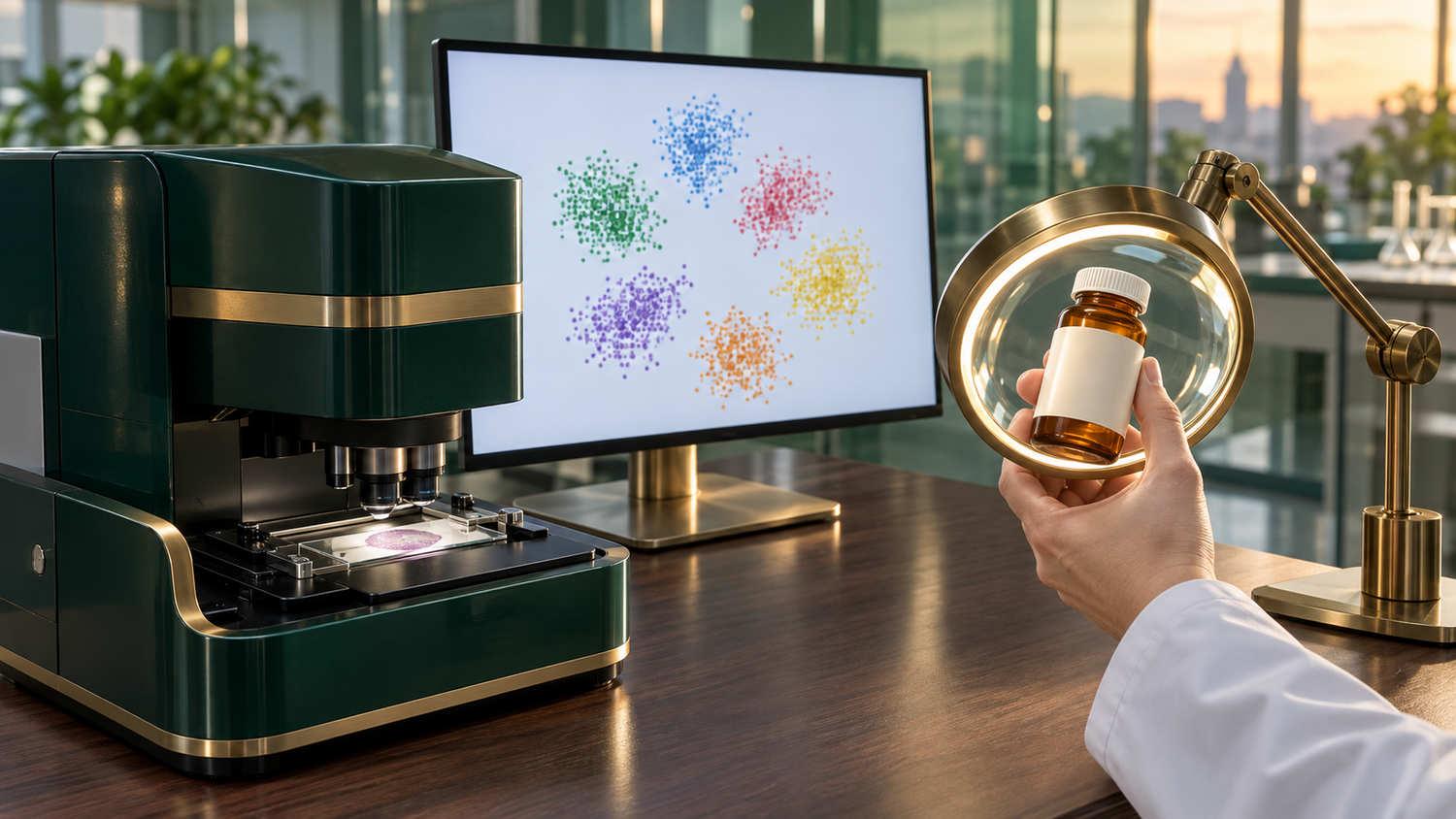
Image: an AI-generated conceptual illustration of a slide scanner, a six-cluster cell map and a blank-label medicine bottle under an inspection lamp. It depicts no real laboratory, product, company or institution.
Sources
Primary source: the Xinmin Evening News "Fengmian" commentary by Gao Yang of 11 September 2026, carried by Sina News (a second Sina copy credits Shanghai Observer), reporting Lu Chaoyang's remarks at the 2026 Bund Summit in Shanghai and Pan Jianwei's July 2026 warning. Also drawn on: Laise, Turunen, Curiel-Garcia and colleagues in Nature Genetics, published 26 August 2026; Calvo Fernandez and colleagues in Nature Genetics, 22 April 2026; the Columbia University Irving Medical Center feature of 26 August 2026 quoting Andrea Califano, republished by SciTechDaily on 11 September; and the FTC's proposed policy statement of 1 July 2026. The reading of the two cases against each other, the four buyer questions and the "not applicable" readiness placement are this Monitor's own.