The Hellenic Physicists' Union Called "Quantum Medicine" an Unfounded Term on 12 September 2026: What the Word Still Covers, From Wearable MEG to Korea's Quantum Nanosensor
Quentir Medicine Monitor
Evidence-based insights for quantum medicine. Published by Quentir Systems LLC · September 15, 2026.
On 12 September 2026 the board of the Hellenic Physicists' Union adopted a press release titled "On the abuse of the term quantum" and posted it on its website the next evening. The one-page text lists what a quantum phenomenon is, credits the second quantum revolution with applications in biology and medicine, and then calls "quantum medicine", "quantum therapy" and "quantum consciousness" unfounded terms. It traces them to Deepak Chopra in 1989, cites Chopra's own 2007 statement that the phrase was a literary metaphor, recalls the 1998 Ig Nobel prize in physics, and adds that the degrees issued by a self-styled "Quantum University" in Hawaii are unrecognized, quoting McGill University's science office. Greece's health minister Adonis Georgiadis said the same on television on 15 September in plainer words: quantum medicine recognized by science does not exist.
This Monitor publishes under the phrase the physicists reject, so the release deserves a careful reading, and a defensive one would miss what it concedes. The physicists are right about the word's history, and their release names no case, no clinic and no practitioner; Greek outlets reported it on 13 September alongside an Athens investigation, a connection the press drew and the release does not. The release also credits, in general terms, applications of quantum physics in biology and medicine. The Hellenic Physicists' Union statement separates a metaphor from measurable physics, and this Monitor applies that separation to two examples of its own choosing, which the union neither names nor endorses; that qualification is stated here once and holds for the whole piece. A wearable magnetoencephalography system built on optically pumped magnetometers, published in Nature in 2018, uses quantum sensing to measure brain magnetic fields and was demonstrated on healthy volunteers, with clinical use as the stated aim. A quantum nanosensor for cardiotoxicity funded by Korea's health ministry on 31 August 2026 is a funded research program with a named measurement still to be made, and no result yet. A practitioner's CV that lists a "quantum medicine" degree from an unaccredited online school is neither, and the difference is checkable by anyone who asks what was measured.
What the union's board decided on 12 September 2026, and why it named Deepak Chopra and a Honolulu "university"
The release on the union's website is dated 12 September 2026 as a decision of its board and was posted on 13 September at 20:53 Athens time. It defines a quantum phenomenon as one observed and interpreted within the mathematical framework of quantum physics, and lists thermal radiation, atomic and molecular radiation, the wave behavior of matter, tunneling and entanglement as the founding examples. It then credits the late twentieth century with encoding information in single atoms and with quantum computers, quantum communication and a quantum internet, and says these achievements gave the world the term "second quantum revolution", with, in the union's own words, significant applications in biology, medicine and knowledge processing. The sentence that follows is the hinge of the document: vision and creative imagination are necessary, and they do not replace laborious systematic research.
The unfounded terms, the release says, were introduced by Deepak Chopra in the United States in 1989, drew public interest, and were shown to lack adequate support; Chopra himself said in 2007 that "quantum" in his usage was a literary metaphor unrelated to quantum physics. The release attributes the 1998 Ig Nobel to an American physicists' association. The Improbable Research list of past winners is the primary record here: the 1998 Ig Nobel prize in physics went to Deepak Chopra of the Chopra Center for Well Being in La Jolla "for his unique interpretation of quantum physics as it applies to life, liberty, and the pursuit of economic happiness", and the prize is run by the magazine Annals of Improbable Research, a satirical publication, with no professional society behind it. The union's final example is the "Quantum University" in Hawaii, whose degrees, it says, are unrecognized. That claim rests on a McGill Office for Science and Society piece, a 3 January 2025 article by Jonathan Jarry of McGill University's Office for Science and Society, which quotes the institution's own catalog: it is an online "institution of higher learning" that is "not accredited by an accrediting agency recognized by the United States Secretary of Education", founded in 2002 by Paul Drouin, a Quebec physician who had earlier been suspended by his provincial college over unscientific diagnostic methods.
What health minister Adonis Georgiadis said on 15 September 2026, and where the Athens case stands
The release was reported in Greece in the context of a criminal investigation. The singer Giorgos Mazonakis, 54, died after collapsing during a plasmapheresis session at a private consulting room in Kolonaki, Athens, and on 15 September the two doctors involved were due before the investigating magistrate, the charge having been raised from fatal exposure to homicide with possible intent, according to Star.gr. Those are charges under investigation; no court has ruled on them. One of the two, who according to the Athens Medical Association is registered as a physician without a specialty, listed a master's degree in "quantum medicine" from the Honolulu institution on her public CV, as In.gr reported on 14 September, which is the context in which Greek outlets carried the union's release. Plasmapheresis itself is an established hospital procedure; the criticism from the union and the minister concerns the claims made for the treatment and the circumstances in which it was given, on the accounts published so far.
Georgiadis, interviewed on Mega's morning program on Tuesday 15 September and quoted by Protagon, said there is state responsibility in the sense that the inspection system failed to identify the people involved: the Athens Medical Association inspected the premises three times without result, and its inspectors are practicing doctors without auditor training. He said medical advertising is already prohibited in Greece, on pain of license withdrawal and fines, and that the statutory exception allowing "information of the public on scientific matters" is being used as a cover for advertising. He said he would not oppose re-establishing the Health Services Inspectors Body, abolished in 2019 and absorbed into the National Transparency Authority, and promised an app within a day that lets a patient scan a consulting room's license at the door. On the term itself he was categorical, in this Monitor's translation of the Protagon transcript: "There is no quantum medicine. Recognized by science, quantum medicine does not exist," and if you hear the word in a clinic, leave.
Quantum pillar: not applicable. Technology readiness: not applicable. The item is a professional society's press release and a minister's public statement about the use of a word; neither describes a quantum technology, and a policy statement has no rung on the readiness ladder. The two research examples in the next section carry their own placements: the wearable magnetoencephalography system was demonstrated on healthy volunteers in a laboratory in 2018, and the Korean nanosensor program began in August 2026 at the design stage, with no measurement published yet.
One demonstrated sensor and one funded research program: the wearable MEG of Boto and colleagues, Nature, March 2018, and Korea's 31 August 2026 award
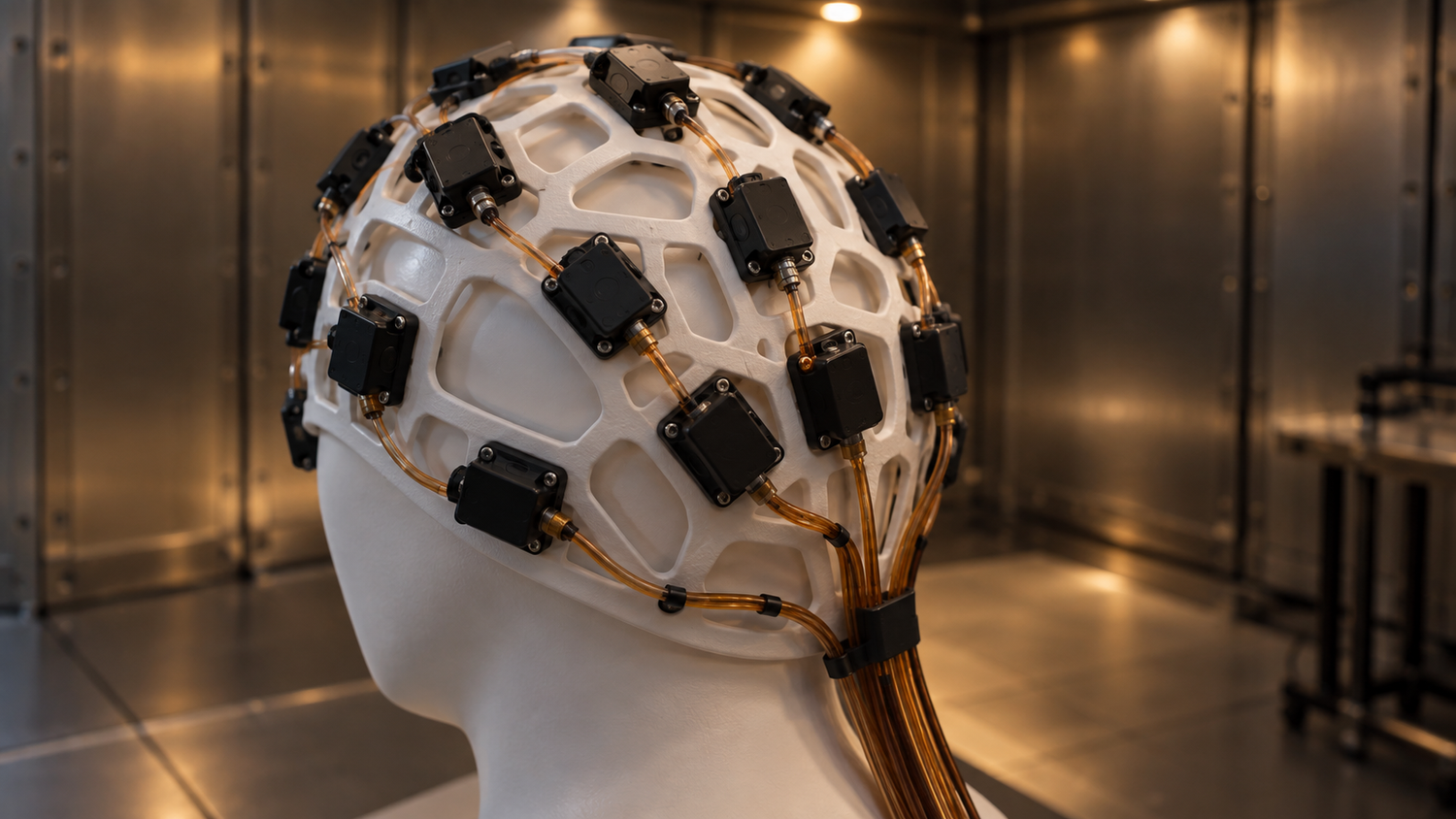
The union's release names biology and medicine among the fields the second quantum revolution serves without giving examples. The two below, one with a published measurement and one with a measurement still to be made, are this Monitor's selection. The demonstrated one is magnetoencephalography with optically pumped magnetometers. In Boto, Holmes, Leggett, Roberts and colleagues, Nature volume 555, pages 657 to 661, March 2018, a University of Nottingham and University College London team mounted vapor-cell magnetometers, which read the spin state of rubidium atoms, on a 3D-printed helmet and recorded brain magnetic fields while the wearer moved, drank and played a ball game, something a conventional helium-cooled MEG scanner cannot do because the head has to stay still inside it. The quantum phenomenon is the atomic spin precession the sensor measures; the result is a recorded neuromagnetic signal in a moving subject; the evidence is a peer-reviewed measurement on healthy volunteers, a research demonstration whose clinical use in patients is the stated aim, with no patient study in the paper. That is a quantum sensor in a medical research use, and nothing in the physicists' release touches it.
The second example is earlier on the ladder. On 31 August 2026 Korea's Ministry of Health and Welfare selected a six-institution consortium led by Kyung Hee University physicist Son Seok-kyun for a KRW 8 billion, four-and-a-half-year award to build a molecular quantum nanosensor read out through a cardiac organoid chip, with heart damage from anticancer drugs as its first measurement, as Quentir reported on the day of the award from the Korean education daily Veritas Alpha and the ministry's project announcement. The award summary as Quentir reported it gives the budget, the duration, the consortium and the endpoint; it does not state the sensor material or a results date, and this Monitor does not add them. There is no patient data yet and there may never be; the program is a design-stage bet with a named instrument and a named endpoint. It appears here as a funded intention with a stated endpoint, and nothing more until a result is published.
The word is also loosened on the scientific side, and this Monitor has said so. On 13 September it reported that Lu Chaoyang called "quantum new drugs" a packaged product and that a Nature Genetics author used "quantum" for cancer as an analogy. The Greek clinic sign and the summit slide are different in degree and in consequence; they share the habit of borrowing a physics word for a claim that no measurement backs.
How Quentir Reads It
A professional society of physicists has said in writing that the phrase on this Monitor's masthead is unfounded, and the Greek health minister has told patients to walk out when they hear it. The minister was describing a consulting room whose practitioner listed a "quantum medicine" degree from an unaccredited online institution, on the accounts published so far; the union's criticism is broader, aimed at a word used loosely in public life since 1989, and it reaches a summit slide as easily as a clinic sign. The usable line is the one the union draws in its first paragraph: a quantum phenomenon is one that has been observed and interpreted within the mathematical framework of quantum physics. A quantum-medicine claim, on this Monitor's reading, is one where that phenomenon is the thing being measured, and where a reader can ask what was measured, in whom, and with what result.
For a hospital buyer or a clinician the practical consequence is one question, and it works in Athens and in a vendor meeting alike: which quantum phenomenon is being measured or computed, and where is the measurement published. The wearable MEG paper answers it in its methods section. The Korean award names the measurement in its scope and has not yet made it. A practitioner who cannot answer it is the case the minister described on 15 September, and the app he promised, once it exists, will tell a patient about the license at the door; the question covers the word, and it is the union's definition put to work.
Image: an AI-generated conceptual illustration of a wearable magnetoencephalography helmet with optically pumped magnetometer sensor modules on a featureless head-form inside a shielded room. It is a concept rendering of the device class described in the Nature 2018 paper, depicting no real product, laboratory, company or institution.
Sources
Primary source: the board of the Hellenic Physicists' Union (Ένωση Ελλήνων Φυσικών), press release "On the abuse of the term quantum", dated 12 September 2026 and posted on eef.gr on 13 September 2026. Also drawn on: Jonathan Jarry, McGill University Office for Science and Society, 3 January 2025; the Improbable Research list of Ig Nobel winners for 1998; Boto, Holmes, Leggett, Roberts and colleagues in Nature, March 2018; the Protagon account of Adonis Georgiadis' Mega interview of 15 September 2026; and the Star.gr report of 15 September 2026 on the Athens investigation. The translations from Greek and the readiness placement are this Monitor's own.