
HAWK Left the Standards Track Before NIST Spoke
A candidate disappeared between meetings
HAWK began the week as a live candidate in the third round of NIST’s Additional Digital Signatures process. It ended the week withdrawn by its own developers after an AI-assisted cryptanalysis project identified a structural weakness in the scheme. NIST later acknowledged the exit and updated its Round 3 record, without announcing a rule for assessing model-generated mathematical work or issuing an independent technical judgment on the finding. The outcome arrived through researchers, expert checking and voluntary withdrawal.
The process worked without a written rule
The disclosed technique concerns HAWK and its particular lattice structure. It does not establish a transfer to NIST’s finalized FIPS 203, 204 and 205 standards. The episode still changes standards governance. It shows machine-assisted cryptanalysis entering a live selection process, where a research result can alter vendor roadmaps and comparative engineering choices before an agency publishes its own reasoning.
Crypto-agility has a nearer deadline
HAWK also gives crypto-agility a practical meaning. An algorithm may leave a standards track during the life of a contract because analysis advances faster than certification, procurement and product refresh. Institutions need separate technical, procedural and commercial records: what was affected, how the finding was checked, and which dependencies must change. A compact public disclosure receipt would make the next case easier to govern. The central control is public reason-giving: a precise claim, reproducible artifacts, a response from the scheme’s developers and a dated status note once disclosure risks permit.
The Quantum Laboratory Has an Overnight Shift
An agent is taking the overnight shift
Four preprints posted within two days put AI agents inside quantum sensing, neutral-atom experiments, error-correcting-code discovery and hardware design. In one diamond-sensing run, software selected a nitrogen-vacancy center, calibrated its resonant frequency, measured coherence and added a pulse sequence to investigate a weak feature. A separate workflow moved from a paper or patent to an overnight campaign on two cloud-accessible neutral-atom processors. These are early research reports, yet they show autonomous quantum experiments becoming concrete enough to govern.
The failures are part of the finding
The neutral-atom authors also describe an inadequate observable and a plausible but wrong hardware diagnosis, both caught by domain experts. Another paper, ContractHIL-HLS, translates natural-language requirements into interfaces, constraints, validation checks and rollback rules, then feeds hardware results back into revision. The emerging issue is the chain of delegated judgment: who set the goal, which actions software selected, what the instrument measured and which person accepted the interpretation.
The handoff becomes an institutional object
Quentir reads the cluster as a move toward instrument delegation. Scientific credit, product assurance, intellectual property and procurement meet at the handoff between machine-selected action and an accepted result. Laboratories may gain speed and preserve more failed branches than ordinary notebooks capture. Trust will depend on visible permission, independent validation and named human acceptance, especially when these methods later shape sensors, chips, diagnostics or security systems.
Post-Quantum Security Has to Survive the Radio
The handshake has a physical footprint
A remote sensor can carry strong cryptography and still fail before useful data moves. A new University of Colorado Boulder preprint models that problem on narrow radio links, where post-quantum certificates, signatures and keys arrive as long packet trains. The authors estimate bandwidth, memory, compute time and battery draw for certificate-based authentication on an NB-IoT connection. Under their stated assumptions, a security Category 1 ML-DSA-44 and ML-KEM-512 exchange produces 334 real-world packets and consumes 10,688 millijoules for transmission and reception. The proposed shared-secret route with ephemeral ML-KEM reduces those figures to 112 packets and 3,584 millijoules.
Loss changes the result
The satellite case makes packet count more than an efficiency metric. With 10 percent independent packet loss, the paper models a 0.8 percent single-attempt success rate for a 46-packet certificate-based exchange and 23 percent for a 14-packet shared-secret exchange. Those are first-order calculations, not field measurements, and the authors spell out assumptions about packet size, throughput, retransmission and device hardware. Even so, the comparison exposes a practical post-quantum authentication problem: a secure algorithm may still miss the contact window in which the device can use it.
Key management moves to the center
The proposed design uses an existing 5G or 6G shared-secret ecosystem, a Kerberos-style key distribution center and a DTLS pre-shared-key handshake with ephemeral ML-KEM. It preserves a post-quantum key-establishment step while avoiding digital-signature certificates at the endpoint. That can ease the radio and battery load, while placing more weight on enrollment, secret storage, lifecycle controls and the trusted key-distribution service. Constrained-network PQC therefore reaches beyond algorithm selection. It changes who holds trust, which infrastructure must remain available and whether a medical sensor, asset tracker or satellite terminal can authenticate reliably at all.
A Public Quantum Claim Built on a Private Attack Circuit
A claim with a missing circuit
Google Quantum AI researchers published lower resource estimates for using Shor’s algorithm against ECDLP-256, a cryptographic problem that protects many cryptocurrency systems. Their March 30 preprint describes two compiled circuits: one below 1,200 logical qubits and 90 million Toffoli gates, another below 1,450 logical qubits and 70 million Toffoli gates. Under stated assumptions, the authors estimate execution in minutes on fewer than 500,000 physical superconducting qubits. They did not publish the underlying attack circuits. That makes this a distinctive case of quantum vulnerability disclosure: the public receives a serious technical claim and a migration warning while a potentially useful attack roadmap stays private.
Zero knowledge changes the bargain
The proof makes a narrower statement than the headline resource estimate. It attests that the authors possess size-bounded reversible circuits that correctly compute secp256k1 point addition across 9,024 pseudorandom inputs derived from each circuit’s hash. Additional reasoning connects that subroutine to the overall Shor resource estimate. Google’s March 31 account says the team engaged with the U.S. government before publication. Zero-knowledge verification can expose a bounded proposition to checking while preserving sensitive implementation detail. It does not validate every hardware assumption, predict the arrival of a cryptographically relevant machine or supply a universal “Q-Day.”
The revision carries its own warning
The April 15 revision acknowledges that Keegan Ryan of Trail of Bits found a software flaw that allowed an attack on the soundness of the earlier proof. Version 2 corrects the proof layer and credits the finding. That repair belongs at the center of the story: cryptographic attestation can narrow a disclosure problem, while its software and statement still require hostile review. The case links cryptography, scientific reproducibility, market confidence and public oversight without treating the current proof as wider than it is.
Who Pays for AI’s Electricity?
A household bill enters the AI debate
The next AI policy dispute may arrive through an electricity charge. Data centers need generation, substations and transmission capacity, and the cost of that infrastructure can reach households far from the servers. A July 23 White House release expanded a ratepayer pledge under which large data-center operators are expected to fund the power assets their projects require. The administration says the initiative now includes more than 200 additional utilities, developers, cooperatives and states. Those are government claims about a voluntary initiative, but they place AI energy governance squarely inside utility agreements and public cost allocation.
AI enters physical science
On July 22, the Department of Energy selected 278 Genesis Mission projects across national laboratories, universities, companies and nonprofit organizations. The selections remain subject to award negotiations and do not commit DOE to issue awards or funding. The portfolio covers nuclear energy, critical minerals, chip design and commercial fusion. Its largest selection is described as a three-year, $60 million nuclear-energy investment. Fermilab is selected to lead an AI and machine-learning project for resonance control in superconducting radio-frequency cavities and collaborate on eight others. These systems operate machines whose tolerances, maintenance and safety have physical consequences.
Who pays is now a governance question
The two announcements expose one dependency. AI ambitions rely on shared power systems and public research infrastructure. Families care about affordable, reliable electricity; laboratories need stable facilities; investors need contracts that assign upgrade costs. Electricity cost allocation now carries part of AI’s public legitimacy. Quentir reads the week as a venue shift from model policy into rate design, facility operations and the older institutions that govern essential networks.
A Green Check Mark Can Hide a Classical Trust Decision
Two credentials can yield one old decision
A new preprint tests whether hybrid X.509 certificates produce genuinely hybrid authentication. Taesung Kim, Boheung Chung, Keonwoo Kim and Yousung Kang examined eight path-validation stacks, nine validation modes and six certificate schemes. Under a policy requiring hybrid authentication, nearly every tested stack that could parse a separable hybrid certificate accepted through the classical path without making the post-quantum credential decisive. A system can therefore show a successful result while the newer credential never carried the trust decision.
Revocation exposes the practical gap
The paper's lifecycle experiment makes the issue concrete. When a bound post-quantum credential was revoked while the classical certificate remained valid, default validation could still accept because the newer credential sat outside the decision's scope. This matters for certificate authorities, trust stores, hardware security modules and applications whose owners may renew or revoke credentials on different schedules. It also matters for autonomous agents that consume authentication responses at machine speed and preserve whatever meaning the verifier supplies.
Migration claims need a visible scope
NIST's ML-DSA standard establishes a post-quantum signature primitive. It does not decide how every relying party should interpret a hybrid certificate. The defensible unit of assurance is one verifier decision under one explicit policy. Quentir reads the paper as a move from counting deployed certificate objects to understanding which credential actually determined access, with direct consequences for migration warranties, audit trails and trusted digital services.
Bitcoin’s Quantum Upgrade Now Has a Patron
A private fund enters a public protocol
Galaxy has committed up to $5 million to Bitcoin post-quantum research and development. Its July 21 initiative names developer grants, a research program and an advisory council. Grants are to be evaluated individually and paid against milestones, with priorities that include transaction proposals, post-quantum signatures, wallet and custodian migration tools, and formal security audits. The announcement gives a neglected maintenance problem money, deadlines and institutional attention. It does not give Galaxy authority to change Bitcoin’s consensus rules.
The protocol record is still plural
BIP 360 remains a draft soft-fork proposal. It would create Pay-to-Merkle-Root, removing the quantum-vulnerable key-path spend from a new output type, while its authors explicitly limit the design to long-exposure attacks. Faster attacks during transaction confirmation may require post-quantum signatures and a different set of tradeoffs. NIST’s ML-DSA standard supplies a standardized post-quantum signature primitive, yet standardization alone does not settle Bitcoin integration, transaction weight, wallet support or consent across the network. The initiative’s first return may be better public disagreement before any code becomes difficult to reverse. Quentir reads the grant program as a new institutional layer in decentralized infrastructure: useful capital, real agenda-setting power and no substitute for open technical review.
The Learning Machine Has No Final Version
A chip that carries its past
Neuromorphic computing is moving from research hardware toward ordinary engineering workflows. UT San Antonio’s Genesis accelerator borrows the brain’s metaplasticity principle so that frequently used connections resist overwriting while flexible ones absorb new learning. The university says the chip remains in testing, runs at milliwatt scale and is intended for devices that may learn for years at the edge. A separate BrainChip announcement says its AKD1500 processor will enter the CELUS electronics-design platform in August, giving hardware teams a guided path from component choice to architecture and bill of materials.
Why continuous learning changes governance
A July 21 Communications Chemistry paper adds a measured workload: a 152-core SpiNNaker2 chip screened 19 billion virtual molecules with higher throughput and much lower energy use than the authors’ Jetson Orin Nano comparison. Together, the three records show brain-inspired hardware spreading across semiconductor design, drug discovery and potential medical-device use. A machine that keeps learning also keeps changing the state on which trust was based. Local processing may reduce data transfers and energy demand, yet it can make updates harder to observe from outside the device. Quentir reads version history, change limits and post-deployment monitoring as part of the product itself, especially where patients or public systems will depend on a device for years.

A Texas Radiation Registration Draws a Boundary Around One Fusion Test
A Texas radiation registration has put a public compliance boundary around one fusion venture. American Fusion Inc. says the Texas Department of State Health Services issued X-Ray Registration R54726 to the company for research involving its Texatron systems at an approved Texas facility. The company’s release supplies the certificate number, dates and twelve named research systems; Texas’s public guidance explains the registration and inspection system. The state’s license database presents a CAPTCHA, so Quentir records the certificate particulars as company-supplied rather than independently verified.
Why it matters
The registration is narrower than a verdict on Texatron’s reactor claims. It authorizes the radiation-machine activity described in the filing and starts an operating discipline around installation, surveys, records, inspections and changes. That is still commercially significant. Advanced hardware becomes investable when engineering milestones acquire auditable administrative counterparts.
The federal layer
The state filing sits inside a wider fusion rulebook that is still being written. In February 2026, the U.S. Nuclear Regulatory Commission published a proposed technology-neutral framework for fusion machines and draft materials-licensing guidance. Texas and other Agreement States therefore matter as practical implementation venues, while the NRC process supplies the national architecture. Quentir reads the Texas registration as one local boundary around one test programme—and as a useful preview of the evidence trail future partners, insurers and regulators will expect.

Quantum First: One Race, Five Fronts, One 2030 Goal
Quentir Founder Mauritz Kop publishes Quantum First essay in War on the Rocks
War on the Rocks published Before Q-Day: The Race to Quantum First on July 20, 2026 — an essay by Mauritz Kop, founder of the Stanford Center for Responsible Quantum Technology, and Joseph Federici, Senior Policy Analyst at the U.S.-China Economic and Security Review Commission and author of its report Vying for Quantum Supremacy. The essay argues that the United States should field strategically significant quantum capabilities before China does — Quantum First, the Commission's target for 2030 — and that cryptography, quantum-AI, networks, sensing, and the supply chain should run as one race under one accountable office at the National Security Council.
In this brief we walk the essay's five fronts and translate them into the enterprise agenda: the June 22, 2026 executive order's deadlines for covered federal high-value and high-impact systems, the post-quantum migration arithmetic that rewards an inventory started in 2026, harvest-now-decrypt-later exposure for long-retention data, supplier files for quantum-critical components, and the standards contest for the quantum network layer. We place the essay in its research lineage — the 2025 Bletchley Park essay, the Stanford scholarship archived at the Stanford Law Library, the Hewlett Foundation's new $100 million initiative — and set out, as our analysis, the readiness signals decision-makers with federal, regulated, or long-retention data exposure should track through 2030.
Peptide Space Has a Population Problem
The blind spot begins in immune genetics
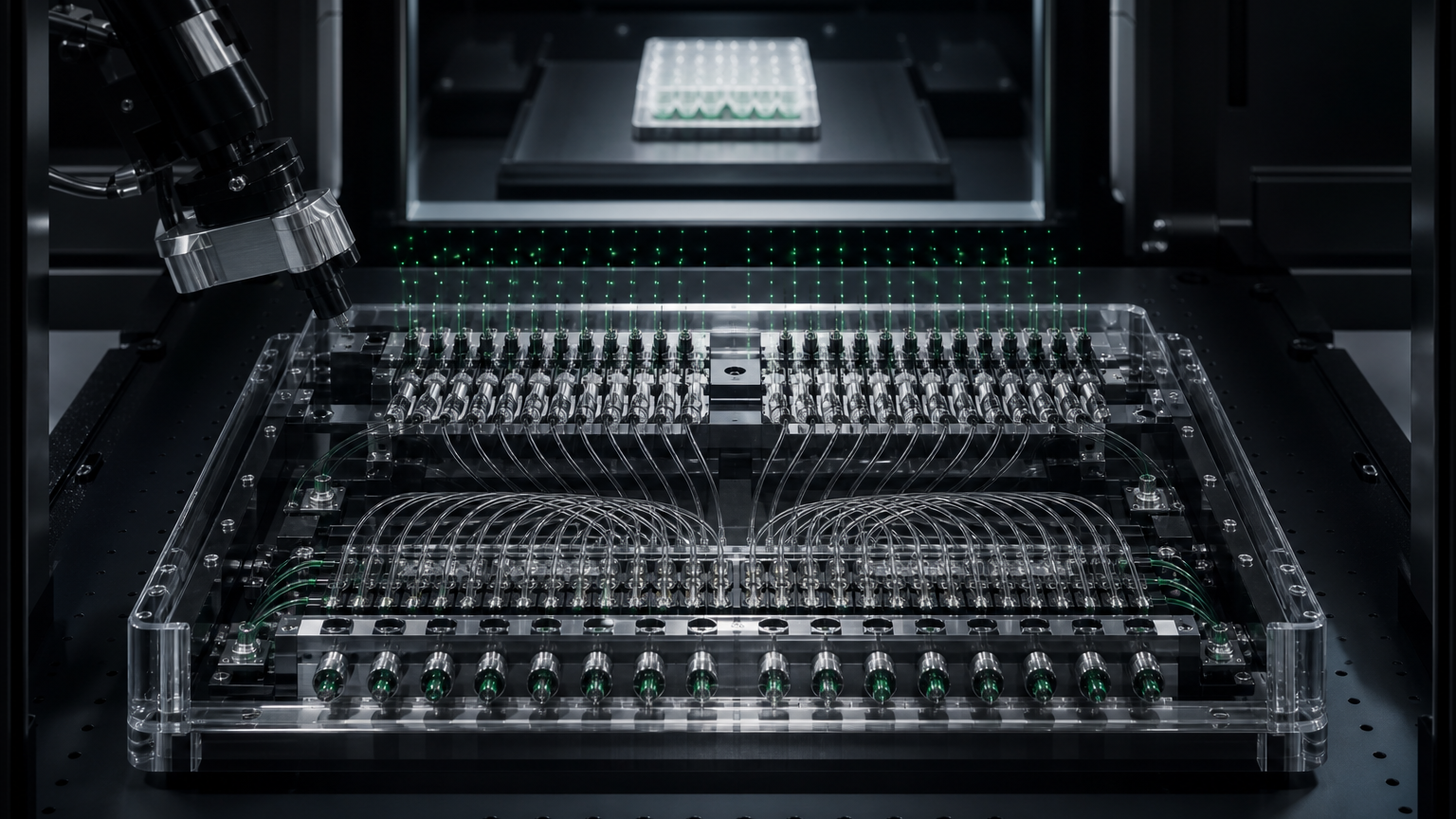
Human leukocyte antigen genes vary sharply across populations, while the datasets used to train peptide-design models are much richer for some HLA alleles than for others. A July 2026 bioRxiv preprint from a DTU-led team asks whether a different source of randomness can help a generative model search the sparse parts of peptide space. The group trained on 105,970 peptide-HLA pairs and compared conventional priors with samples from a 32-mode photonic processor.
Quantum sampling changes the search
The model using a quantum-derived prior produced modestly more predicted strong binders overall, with its clearest gains among alleles where the classical baseline performed poorly. The researchers then synthesized candidates for three understudied alleles and tested whether the peptides stabilized MHC class I complexes in the laboratory. Many did, although one difficult allele also produced failures. The result is biologically interesting because it reaches beyond a simulation while remaining far from a therapeutic claim.
The claim stays narrower than quantum advantage
The authors state that their system remains classically simulable and does not demonstrate quantum advantage. Peptide-MHC binding also does not prove immune activation. The governance significance lies elsewhere: a hardware choice may influence which populations a biomedical model serves well. That connects biomedical AI governance with procurement, data representativeness and the terms under which a supplier’s technical claim enters a future product file.
Six Qubits Meet a Planet’s Worth of Data
A small machine enters a planetary data system
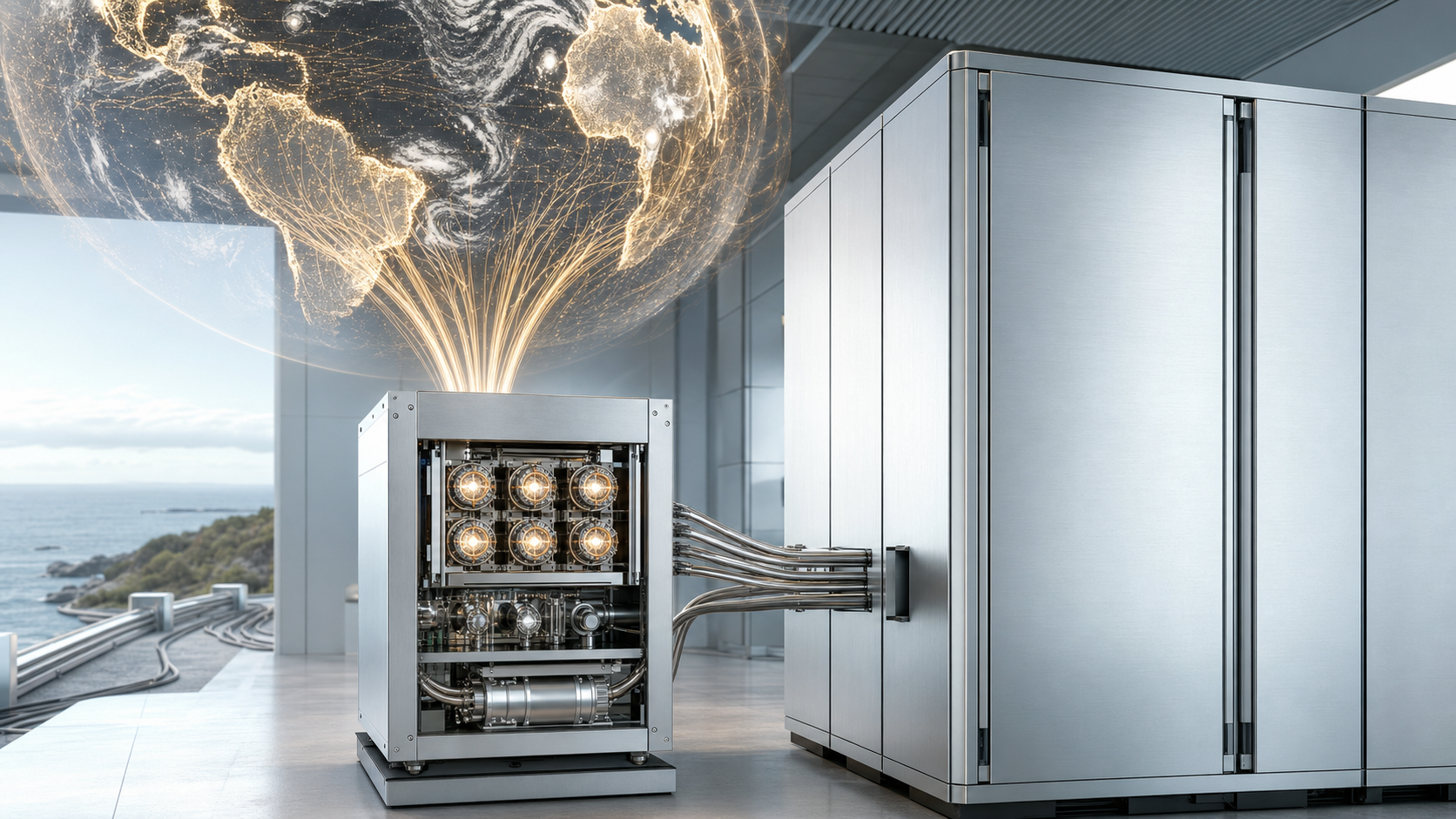
ESA has begun installing Equal1’s Bell-1 at its Earth-observation center in Frascati. The machine has six silicon spin qubits, operates at about 0.3 kelvin and draws 1.6 kW, close to the power demand of one high-end enterprise server. Its scale is modest beside ESA’s data holdings. That mismatch is the point. The agency is testing whether a compact, on-premises quantum computer can become a useful part of a hybrid stack built around classical high-performance computing.
The work begins with bounded use cases
The one-year internal research period is expected to include hybrid quantum neural networks for land-use and land-cover classification and work on satellite mission planning. ESA plans a pilot demonstration by the end of 2026, followed by a workshop with Equal1 after the pilot. The program creates a public test of hybrid quantum computing under real institutional conditions: noisy geospatial data, existing infrastructure, small hardware and applications that matter to climate science and disaster response.
The outcome depends on comparison
Installation alone says little about advantage. Useful results will separate quantum contribution from classical preprocessing, compare the same task against strong classical baselines and disclose error, runtime, energy use and data-movement costs. That is how a six-qubit experiment can improve Earth observation governance even if no dramatic speedup appears. A carefully bounded negative result may save public institutions from scaling the wrong architecture, while a reproducible gain could show where compact quantum hardware belongs inside ordinary data centers.

Which Part of a Network Is Actually Quantum-Resilient?
The label covers several systems
AT&T and Palo Alto Networks announced a Quantum-Resilient SASE Fabric on July 16, 2026. Their account reaches across management traffic, data tunnels, telemetry, branch hardware, multiple underlays and automated policy distribution. That breadth is useful because a network does not become quantum-safe in one place. It also makes the phrase quantum-resilient network harder to interpret. A product name can describe an architecture while leaving deployment state, algorithm choice, fallback behavior and covered traffic to the customer’s configuration.
The cited protocols have defined jobs
The announcement points to IETF RFC 9370, RFC 9242 and RFC 8784. These standards describe mechanisms within IKEv2: multiple key exchanges, an intermediate exchange before IKE authentication that can carry larger payloads, and the mixing of preshared keys for post-quantum security. The intermediate exchange permits IKE-level fragmentation, which can avoid problematic IP fragmentation. These mechanisms support important migration designs. They do not, by themselves, show which algorithms were negotiated on a particular circuit or prove that every control, data and telemetry path received the same protection. TLS 1.3 is also a protocol framework; calling traffic TLS 1.3 does not identify a post-quantum key exchange.
Operations decide what the label means
The useful unit is a live path from endpoint to endpoint, including the branch device, tunnel negotiation, classical fallback, management plane, software version and supplier handoff. Post-quantum network migration therefore connects engineering, procurement, regulated outsourcing and public trust. Hospitals, payment systems and public services depend on networks whose security claims must survive failover, upgrades and mixed infrastructure. The strongest reading of the launch is architectural: major connectivity vendors are preparing PQC controls for ordinary network operations. The unresolved part is observational: what each deployed path negotiates under normal and degraded conditions.
FINMA Writes Mid-2027 Into the Quantum-Safe Finance Calendar
A supervisory date appears
FINMA Guidance 05/2026 recommends that supervised Swiss financial institutions draw up a post-quantum cryptography roadmap by mid-2027. The guidance follows a survey of 60 banks, insurers, asset managers and financial-market infrastructures conducted between November 2025 and January 2026. Only 8 percent reported having a specific roadmap, while 72 percent said they had not planned or implemented measures. The date gives quantum-safe finance a concrete planning horizon without pretending that a cryptographically relevant quantum computer already exists.
The roadmap reaches beyond cryptography teams
FINMA connects the transition to board-approved strategy, institution-specific risk analysis and a continuously updated cryptographic inventory. That inventory reaches encryption in transit and at rest, digital signatures, key management and authentication across internal systems, outsourced functions and services. Long-lived data receives priority because information stolen today may remain sensitive when stronger quantum machines arrive. Hybrid cryptography may help during migration, although the regulator also notes its added implementation complexity.
Outsourcing terms enter the calendar
The guidance makes crypto-agility in outsourcing a commercial issue. FINMA recommends it as a requirement for new software and data arrangements and asks institutions to incorporate it into existing requirements at the earliest opportunity. Responsibility for an outsourced function remains with the supervised institution. The mid-2027 date therefore measures more than the existence of a document: it exposes whether architecture, supplier dependencies and accountability have entered one credible timetable.
A Brain Implant Entered the Insurance System
Four institutions crossed the line
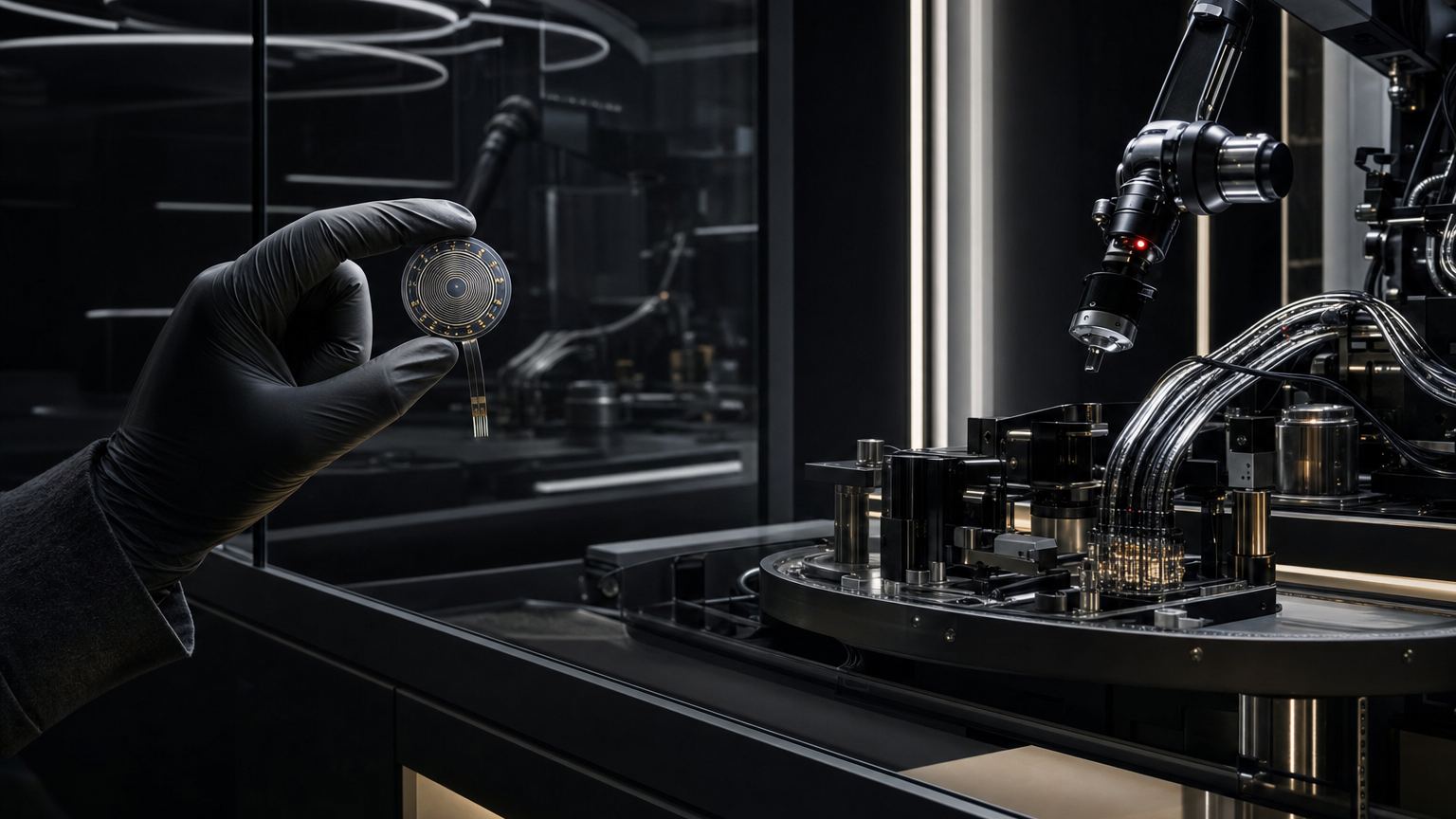
On July 13, 2026, surgeons at Huashan Hospital in Shanghai implanted Neuracle Medical Technology’s NEO device in the patient who underwent the first reported commercial procedure, according to reporting based on a statement from Shanghai’s science and technology commission. China’s National Medical Products Administration had approved the epidural brain-computer interface on March 13. Within four months, the device moved through production, hospital introduction, patient screening and reported inclusion in local commercial health insurance. That sequence makes brain-computer interface governance visible as a chain of institutional decisions, not a single laboratory milestone.
Reimbursement changes the stakes
Once an implant can be prescribed and financed, questions about safety, eligibility, clinical benefit, neural-data control and long-term support become part of ordinary administration. The patient’s ability to reach, grasp and drink independently is the humane stake. The system around the implant decides who can receive that opportunity, which outcomes count, and who remains responsible when hardware, software or clinical circumstances change.
The next competition is institutional
China has linked clearance, surgery and reported insurance access faster than its best-known foreign competitors. That does not settle comparative safety or effectiveness. It does show that the contest now concerns neurotechnology reimbursement, hospital capability, post-market learning and public trust alongside electrode design. UNESCO’s 2025 Recommendation on the Ethics of Neurotechnology adds a global rights framework, while Shanghai supplies a concrete case of technology entering care.
NVIDIA’s 347-Fold Quantum Decoder Result Has a Hardware Footnote
The multiplier has coordinates
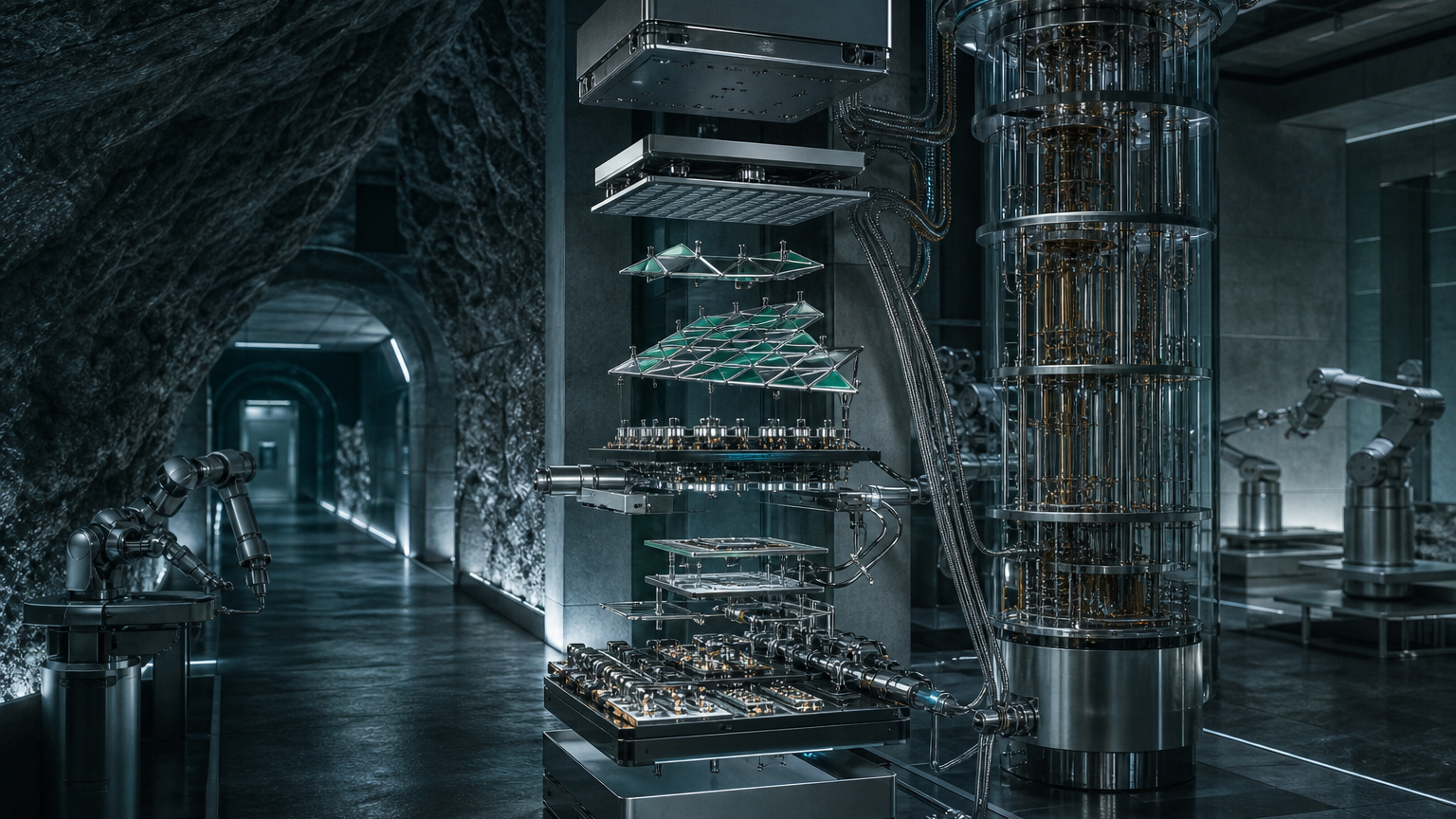
NVIDIA reports that its Ising Decoder ColorCode 1 Fast produced a 347.7-fold improvement in logical error rate and a 7.3-fold runtime improvement over raw Chromobius decoding in one stated benchmark: a distance-31 triangular color code at a physical error rate of 0.3%. The speed comparison also has a hardware split. The pre-decoder ran at FP8 precision on one NVIDIA GB300 GPU, while Chromobius ran on one Grace Neoverse-V2 CPU, using single-shot X-basis measurements. The result gives quantum error correction a striking new performance number with unusually visible conditions.
AI is proposed for the correction loop
The system uses a small three-dimensional convolutional neural network as a pre-decoder. In simulation, it handles many local error syndromes, then passes the remaining problem to Chromobius. NVIDIA presents that architecture as a path toward real-time decoding; the cited work does not report integration with a quantum processor or a live feedback system. Model depth, synthetic training data and hardware-specific noise assumptions shape the reported result.
Governance moves down the stack
NVIDIA has released the model, training recipes and supporting tools as open resources. That helps scrutiny and adaptation, while leaving independent validation and hardware transfer open. For procurement, security and capability forecasting, the proposed AI pre-decoder belongs inside the assessed configuration. A headline multiplier cannot stand alone; its benchmark coordinates and operating conditions determine what the claim can support.

How One Export-Control Table Opened a New AI Compute Route
A legal table changed the route
On July 10, 2026, the U.S. Bureau of Industry and Security moved the United Arab Emirates out of Export Administration Regulations Country Groups D:3 and D:4 and into A:5. The final rule, published July 14, expands access to License Exception Strategic Trade Authorization for the UAE government and approved commercial entities. It also creates license-free access to specified advanced computing items for named government, commercial and U.S.-headquartered AI entities. The change makes AI compute access depend on a country classification and an approved-entity list, not on geography alone.
The entity list carries the control
A:5 status does not create an open channel for every buyer. For STA and the rule's specified license-free advanced-computing treatment, the ultimate consignee and all end users must appear in Supplement No. 8, and the ordinary conditions and restrictions of the EAR still apply. That structure matters commercially. A cloud operator, chip supplier, data-center investor or customer can face a different licensing path when the destination, end user or approved status changes, even if the hardware and service contract stay in place.
Compute now sits beside physical infrastructure
The same rule addresses military items, commercial satellites and spacecraft, and dual-use systems used in oil and gas, desalination and civil nuclear power. Export-control country groups are becoming part of the industrial architecture for AI. They influence who can build capacity, which counterparties can receive controlled technology and how quickly a bilateral political framework becomes a commercial route.

The Certificate Arrives Before the AI Rulebook
Identity is becoming infrastructure
At a border checkpoint, identity and permission are separate decisions. A passport identifies the traveler; another authority decides whether that person may enter. AI agents are approaching the same institutional split. HID Global’s 2026 survey of 300 IT and security leaders in the United States and Europe found that 16% of respondents already use certificates for AI agents, while 34% ranked agent certificates among the three leading PKI trends. That makes AI agent identity an operational layer while legal systems are still working out how existing attribution rules apply to autonomous action and what machine credentials prove.
The weak point is revocation
A certificate can bind a cryptographic key to an identity. It does not define which payment, database, model or patient record the holder may touch. NIST’s zero-trust architecture treats authentication and authorization as distinct controls, and the distinction matters most when an agent changes role, is compromised or exceeds its mandate. HID’s survey found that certificate renewal is much more automated than discovery or revocation. The practical kill switch therefore depends on the least mature part of many certificate estates.
Two migrations meet in one control plane
Public certificate lifetimes are shrinking as major infrastructure providers also accelerate post-quantum migration. The same systems will have to issue short-lived credentials at machine speed and replace the cryptography beneath them. Post-quantum identity governance now connects cybersecurity, AI accountability, procurement and contract attribution. The certificate is becoming part of the answer to who acted, under whose authority, and with which technical protection.
When a Quantum Computer Misses the Temperature
A thermometer for simulation
Gibbs states describe how a physical system distributes itself across energy levels at a given temperature. They sit beneath work in chemistry, materials science, thermodynamics and some forms of machine learning. A newly published experiment on IonQ trapped-ion hardware prepared these states with a hybrid quantum-classical method and then measured how closely the machine matched the target. The result gives quantum simulation fidelity an unusually intuitive test: did the computer reproduce the temperature it was asked to model?
The machine returned a warmer answer
The researchers found that fidelity fell as the target became colder and as the simulated system grew. More strikingly, a state prepared for one inverse temperature often resembled a warmer state more closely. Hardware noise had a thermodynamic signature. That matters because a small temperature mismatch can change which molecular configurations or material phases appear probable, even when the circuit ran as designed.
Why the mismatch travels
The paper is a compact study, not a claim of scientific advantage. Its institutional importance lies in how clearly it connects physics to assurance. A useful quantum model validation regime will need to report the distance between requested and realized conditions, the architecture used, and how error grows with scale. The same discipline belongs in scientific procurement, pharmaceutical research governance and public claims about useful quantum machines.
The Quantum Contest Moves Upstream
The contest before the computer
Two July funding calls reveal where the quantum race is moving. Google Research is asking universities for algorithms that can work within the severe limits of early fault-tolerant machines. Germany’s Fraunhofer INQUBATOR is asking companies to bring real problems in medicine, cybersecurity, insurance and automotive logistics into a ten-month testing program. Together, the calls turn early fault-tolerant quantum computing into a contest over which questions deserve scarce research time.
Why use-case selection matters
A grant call looks administrative, yet its categories can shape laboratories, patents, skills and public investment. The winning proposals will help define what counts as a plausible quantum application before the hardware is mature enough to settle the argument. That gives program design an unusual form of market power: it can direct scientists toward particular social needs while giving firms an early view of technical limits.
The public bargain inside the funding
The strongest proposals will connect resource estimates to human consequences. A medical optimization claim carries different duties from a materials or logistics claim because errors, access and accountability fall on different people. Quentir reads the two calls as a test of quantum industrial policy: whether public and corporate sponsors can reward intellectual ambition without allowing speculative use cases to harden into procurement assumptions.