The Battle Plan That Rewrites Itself in Sixty Seconds

The Imported Key Travels in a Quantum-Resistant Envelope
Google Cloud has opened a preview of quantum-resistant key import in Cloud KMS, wrapping customer key material in ML-KEM and X-Wing envelopes designed to resist known classical and quantum attacks on a recorded transfer. We read what the release means for harvest now, decrypt later exposure, why the wrapped key is the densest target that attack pattern has, and what still separates a preview label from a bring your own key mandate a program office can rely on.
A Silicon Camera Reads an Infrared Band It Cannot See
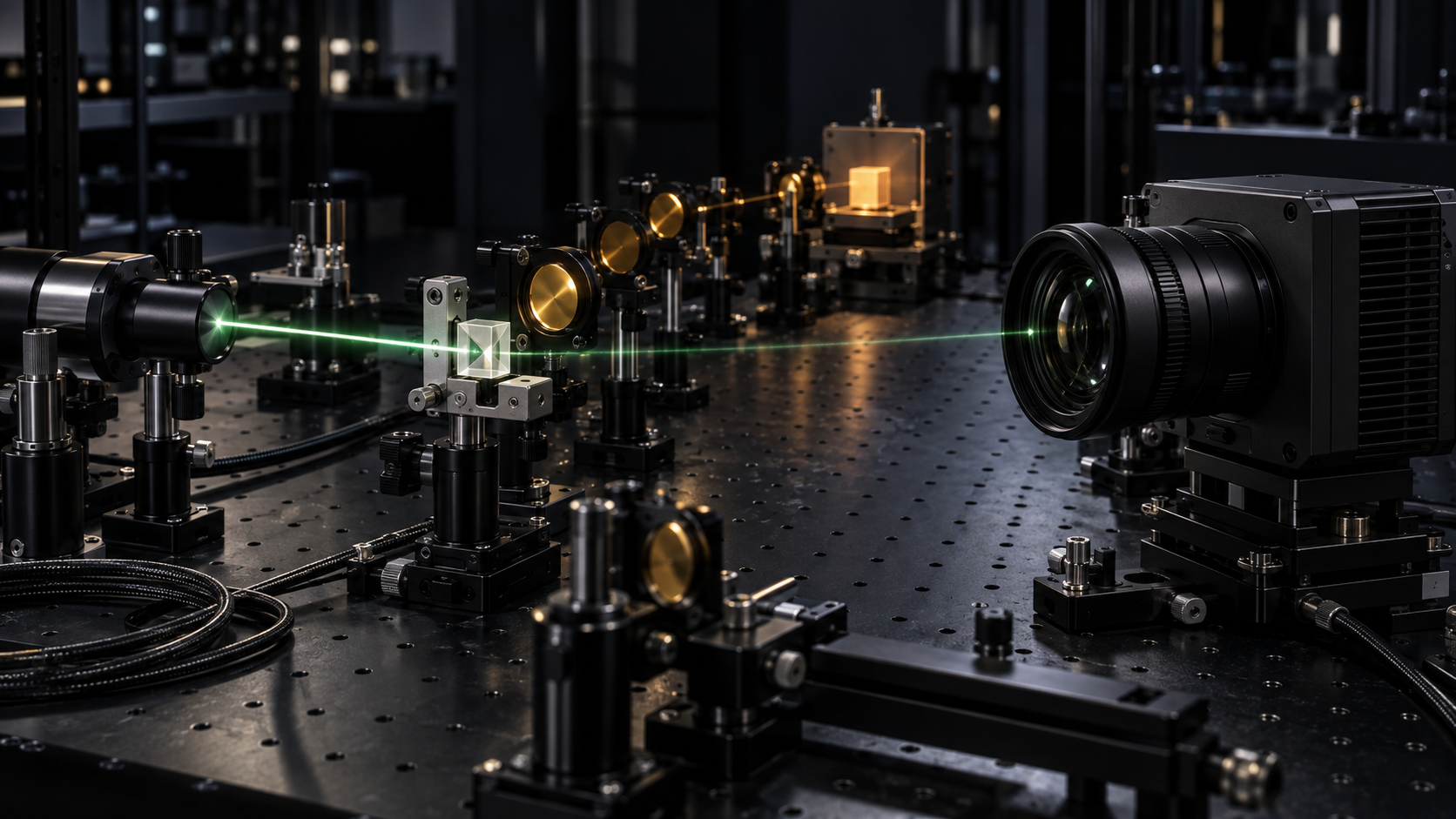
Imperial College London physicists demonstrate wide-field thermal infrared imaging with a specialized Peltier-cooled silicon scientific camera, using quantum imaging with undetected photons to reach 100 times past the background limit at room temperature, and putting a published exception under the assumption that serious infrared performance requires a cryogenically cooled infrared focal-plane detector.
A Hybrid Quantum Classifier Learns to Vouch for Radar Satellites
Researchers at KAUST and the University of Pisa report QUASAR, a hybrid quantum-classical neural network that performs physical-layer authentication of X-band radar-satellite illumination pulses: an eight-qubit variational circuit coupled to a convolutional encoder, evaluated on a representative 10 percent subset of a 3.76-terabyte corpus of real ICEYE emissions, reaching 96.9 percent aggregate accuracy and rejecting most spoofed signals. A close look at radio-frequency fingerprinting as a defensive electronic warfare capability, what the simulated quantum circuit does and does not prove, and the distance between a strong paper and a satellite receiver system a program office could rely on.
The Raw Material of Quantum Radar Arrives at Room Temperature
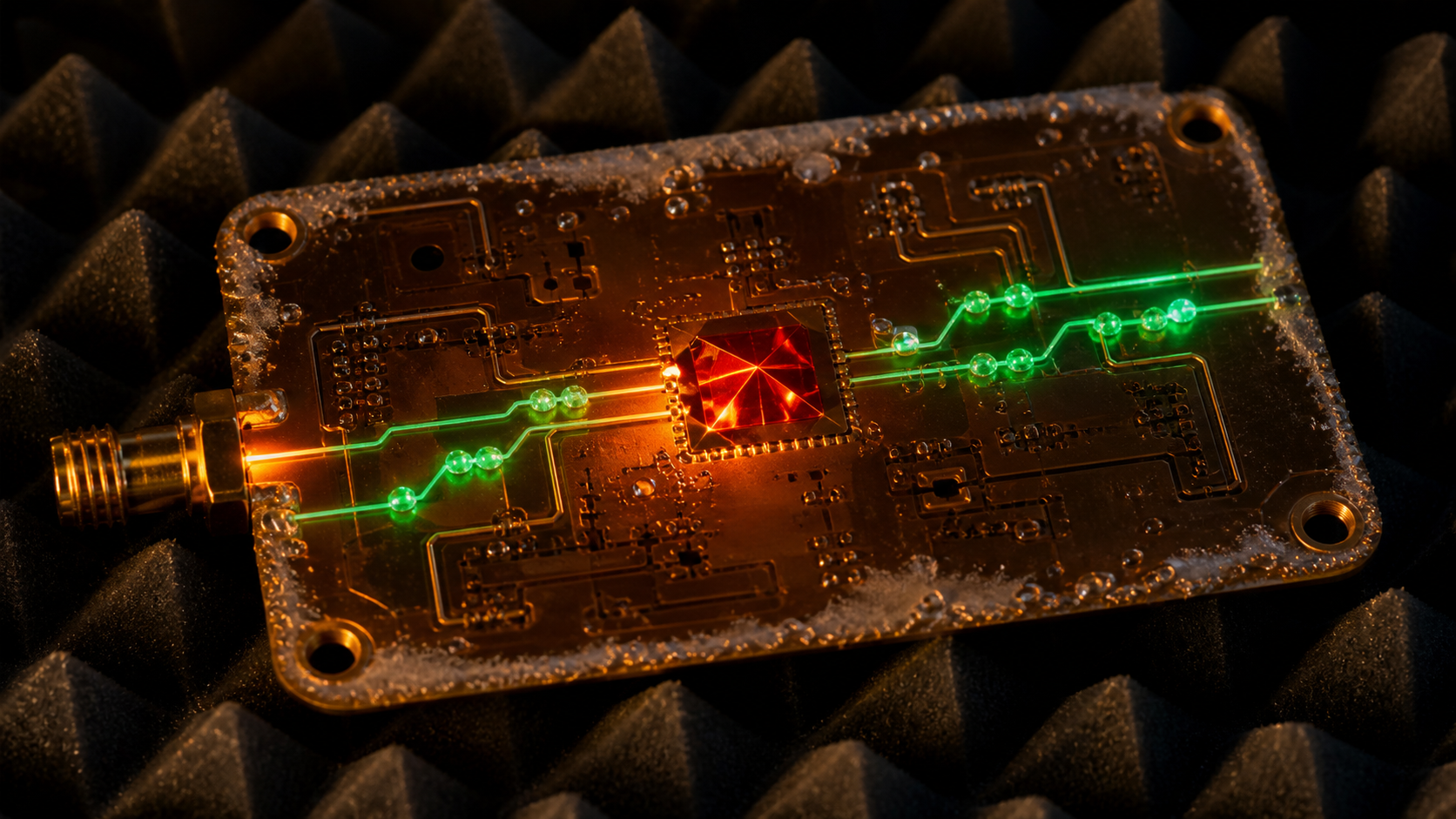
MIT researchers report in Nature Electronics a cavity-magnonic device that generates paired correlated microwave signals at room temperature: a yttrium iron garnet film on a printed circuit board splits one pump photon into two outputs at distinct frequencies with a strongly correlated phase relationship. A close look at why the dilution refrigerator has kept quantum illumination radar and correlation-assisted links confined to laboratories, what a warm pair source changes for whom, and the honest distance between strong correlations on a bench and the entangled, target-ranging quantum radar a program office could rely on.
A Quantum Key Crosses From Fiber to Open Air Without a Trusted Node
A Tel Aviv University team, with the Hebrew University and HEQA Security, demonstrated end-to-end quantum key distribution across a hybrid channel: telecom fiber joined to outdoor free-space links of 90 and 750 meters, with the encoding converted all-optically so the junction never reads the key. A close look at what removing the trusted node means for military and critical-infrastructure networks, who gains on each side of the seam, and the engineering and doctrinal distance still separating a rooftop demonstration from a quantum-secure communications procurement.

Quantum Sampling Reaches a Nucleus Beyond a 768-GB Node's Memory
An IIT Roorkee team produced an unconverged approximate ground-state energy for the exotic nucleus magnesium-32 by sampling configurations from IBM quantum processors after their 768-gigabyte supercomputer node ran out of memory, the first use of sample-based quantum diagonalization on the nuclear shell model. A close look at why nuclear structure is a defense workload, how it feeds stockpile stewardship simulation and evaluated nuclear data, and the accuracy gap still separating a rented quantum sampler from a production weapons code.
A Cold-Atom Comagnetometer Reaches a Fitted 60-Second Spin-Coherence Time
A new experiment traps the nuclear spins of two ytterbium isotopes in one optical lattice and reports a fitted 60-second spin-coherence time, posting a magnetic noise suppression factor above thirty thousand. Comagnetometry broadly sits at the root of nuclear-spin gyroscopes, the inertial instruments behind navigation without GPS, although this cold-atom comagnetometer demonstration does not measure rotation. Quentir places the demonstration at TRL 4 of 9: a validated laboratory instrument with minute-long spin coherence, several rungs below anything a program office could field; an eventual rotation measurement would provide important readiness evidence but would not by itself validate field deployment.
The Post-Quantum Migration Reaches the Silicon Layer
In one August week, a Wuhan university team released a 28-nanometer post-quantum cryptography chip with a naval research institute in the room, and a Canada-Taiwan consortium validated a compute-in-memory rival for the same NIST algorithms. A close look at what a hardware root of trust means for forces whose platforms outlive their ciphers, and at the evaluation gates still standing between both chips and a program office.

A Quantum Lidar Reads Multiple Directions at Once
A POSTECH team funded by South Korea's Agency for Defense Development demonstrated a quantum lidar that resolves multiple targets across a finite fan of directions in one measurement—not omnidirectional coverage—through background light a thousand times stronger than the signal. An early-stage low-light sensing result that establishes no field or fog performance.
Lazarus Fits Its Zero-Day With a Post-Quantum Key Exchange
Check Point Research found the North Korea-linked Lazarus Group using a Kyber-based key-encapsulation step to protect delivery of a privilege-escalation payload inside a Windows zero-day chain aimed at aerospace and defense targets. The post-quantum scheme from which the ML-KEM standard was derived has now surfaced as an offensive tool.

Quantum Optimization Reports for Mission Planning Duty in Huntsville
At the 2026 Space and Missile Defense Symposium, defense engineering firm Davidson and computing company Strangeworks announced a proof of concept that will benchmark quantum optimization against the classical solvers that carry military mission planning today. The commitment to honest classical baselines is the part a program office should watch.
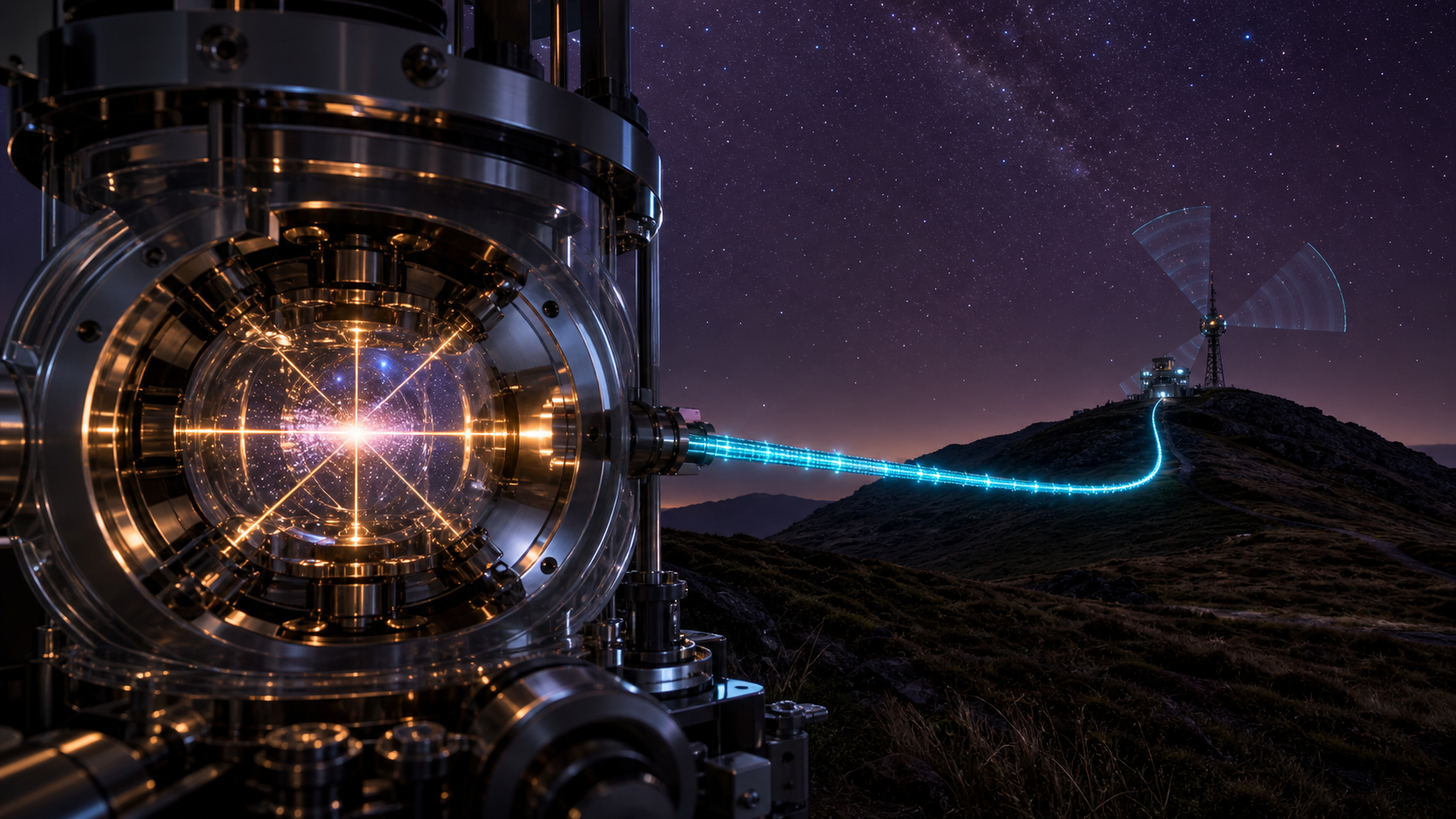
Two Cold-Atom Clocks Hold a Radar Network Together Without Satellites
In a June 2026 UK trial, two prototype cold-atom clocks kept two networked Saab Giraffe 1X radars fused into one coherent air picture with no satellite timing at all, degrading predictably under disruption and recovering fast. It is the first known demonstration of network time synchronization holding a military radar network together in GNSS-denied conditions.
China Is Willing a Quantum Industry Into Existence
Two ChinaTalk essays by Elias X. Huber, written eighteen months apart, bracket the sharpest question in quantum geopolitics: what happens when outbound investment controls wall off a sector that never needed American money. In H1 2026 China's quantum sector logged 44 financing rounds against 8 a year earlier, and the industrial machinery now spinning up is aimed at future cryptanalytically relevant quantum computers.
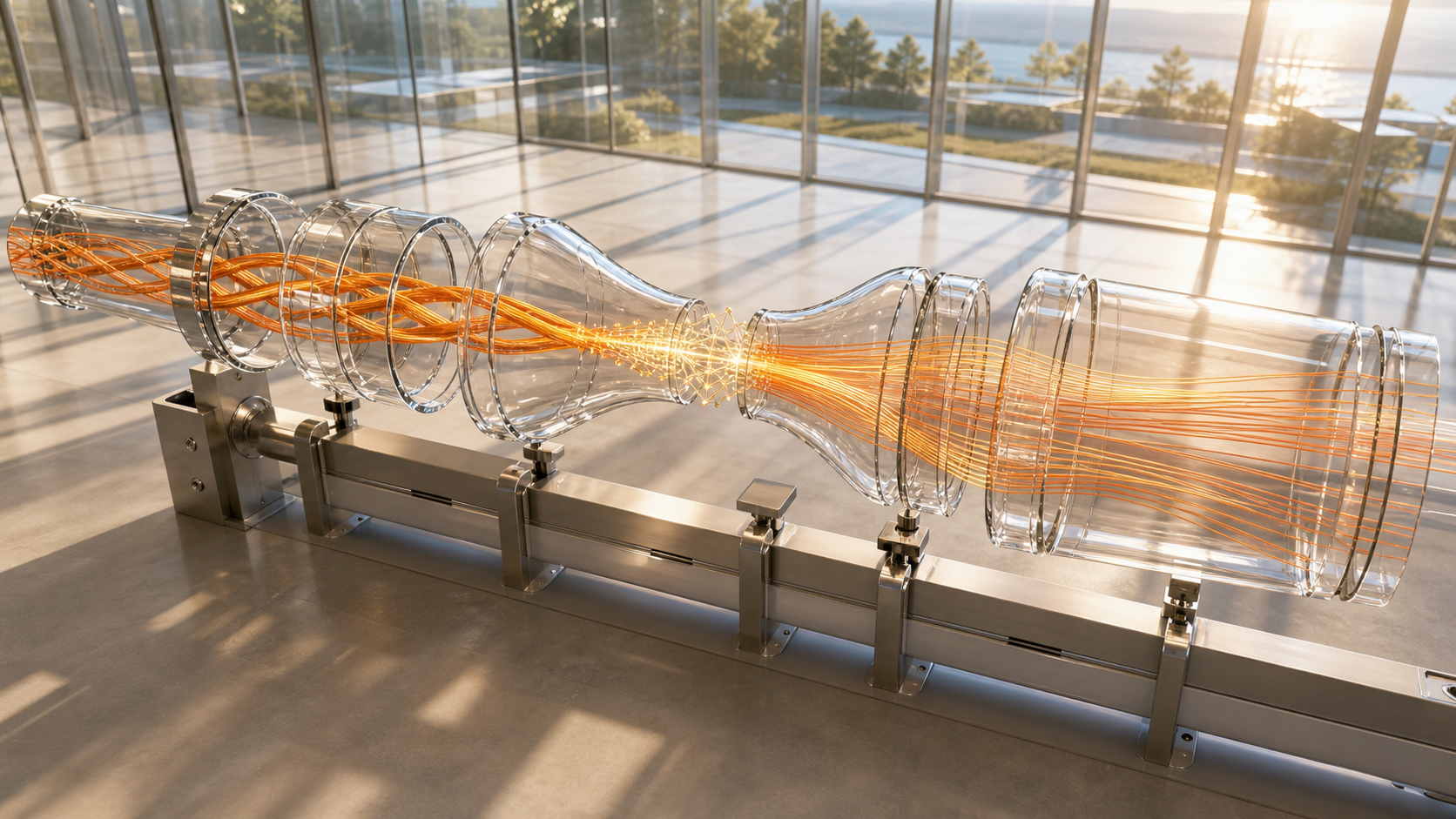
A Quantum Fluid Solver Gets an Exascale Reality Check
An Oak Ridge team ran a variational quantum linear solver for fluid dynamics end to end on the Frontier exascale machine and published the honest bill: memory costs cut over a thousandfold, circuit design rules that fail to predict convergence, and every qubit still emulated. For the discipline behind hypersonic flow simulation, it is the first production-scale accounting of what a quantum CFD pipeline actually costs.

Farseer Puts Quantum Sensors on a Fielding Clock
The Defense Innovation Unit's Farseer program offers up to 200 million dollars to move quantum magnetometers, gravimeters and portable atomic clocks onto operational ISR platforms, with prototypes due at government test facilities within nine months of award. Behind it stands an executive order requiring fielded quantum sensors by September 2028, the firmest schedule quantum sensing has ever been given.
Sixty Hours of AI Cryptanalysis Retired the Hawk Signature Scheme
An Anthropic frontier model found a hidden lattice symmetry that roughly halves the lattice dimension needed to attack Hawk, and the team withdrew the scheme from NIST's process a day later. AI-assisted cryptanalysis is now a working method, with direct consequences for post-quantum cryptography buyers and the case for crypto-agility.
Entanglement Survives 62 Kilometers of Ordinary Aerial Fiber
A NIST, Joint Quantum Institute and Qunnect team sustained entanglement distribution across a 24-hour trial, at 92.8 percent uptime, over 62 kilometers of noisy aerial telecom fiber, moving quantum key distribution links from bespoke builds toward existing infrastructure.

A Diamond Payload Begins Australia's Quantum Space Climb
A November balloon flight will carry a diamond photonic core toward near space, an early rung for sovereign quantum communications as Australia starts the climb toward satellite quantum communications and interception-resistant key links.
A 25-Qubit Test Puts Quantum Routing on the Logistics Map
A real-hardware test puts quantum routing inside an edge-assisted fleet architecture, revealing an early path toward contested logistics while scale, realism, and assurance remain open.