
Korea Funded a Quantum Drug Program That Plans to Make the Molecule
A program that publishes its verification loop
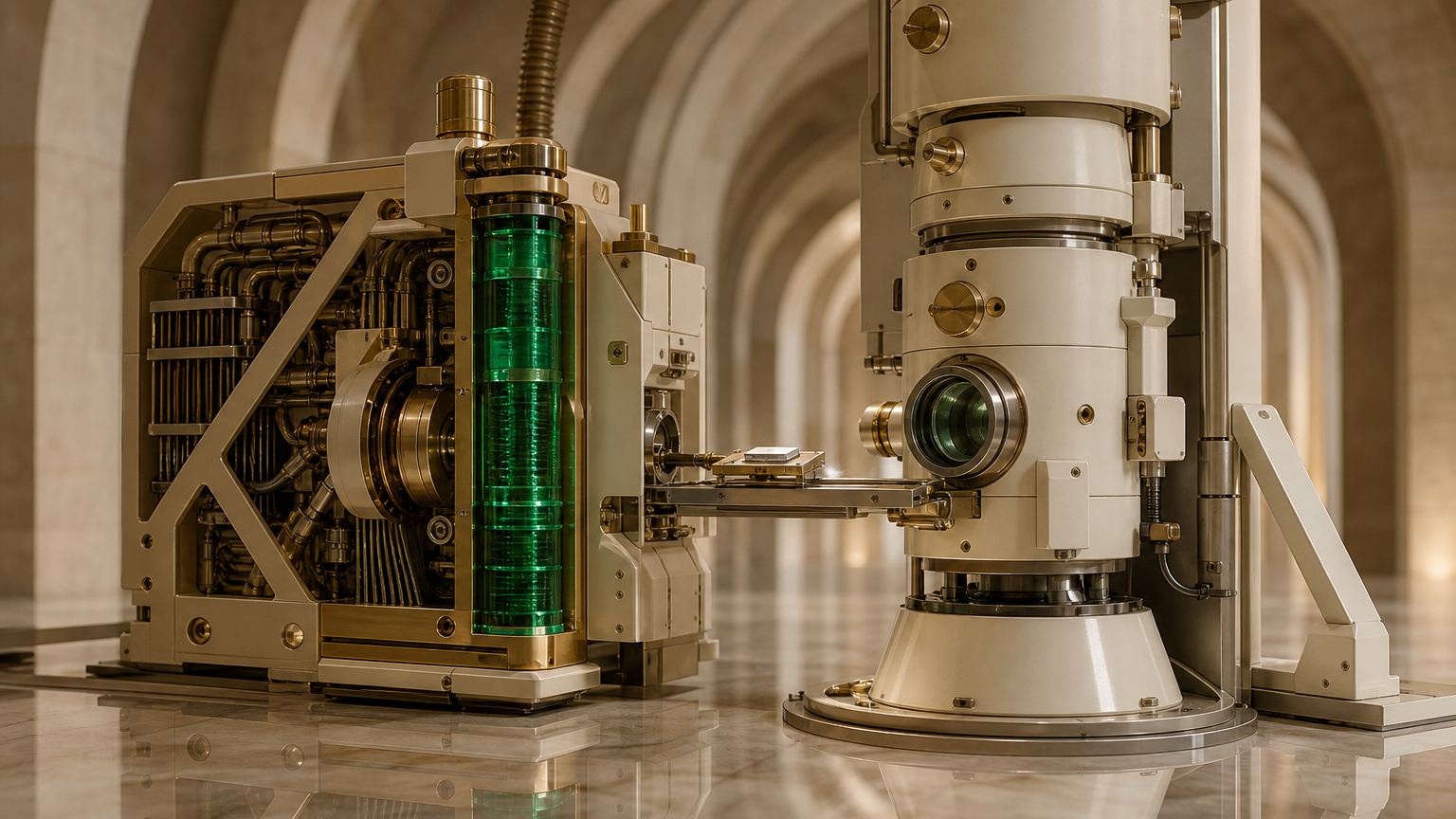
On 19 August 2026 Korean industry press reported that Baobab AiBIO had been named lead research institution of a Ministry of Science and ICT / National Research Foundation program applying quantum computing to targeted protein degradation, with LigaChem Biosciences, Yonsei University and the Institute of Molecular Design as co-institutions. The part worth reading twice is the workflow the program describes: design, then synthesis and evaluation, then Cryo-EM structural work, then redesign. Quantum-assisted molecular design is being pointed at a wet lab instead of at a benchmark table.
What that does and does not settle
Taking predictions into synthesis is not the same as demonstrating quantum advantage. That claim would additionally need a declared classical comparator, a stated endpoint and a resource comparison, and none of those is public yet. Nor is wet-lab work unprecedented here: a 2025 Nature Biotechnology paper reported fifteen molecules designed with a quantum-classical generative model, synthesized and assayed, two of them promising against KRAS. The Korean program adds public money on the testing half of the loop and a named synthesis partner.
The infrastructure running alongside
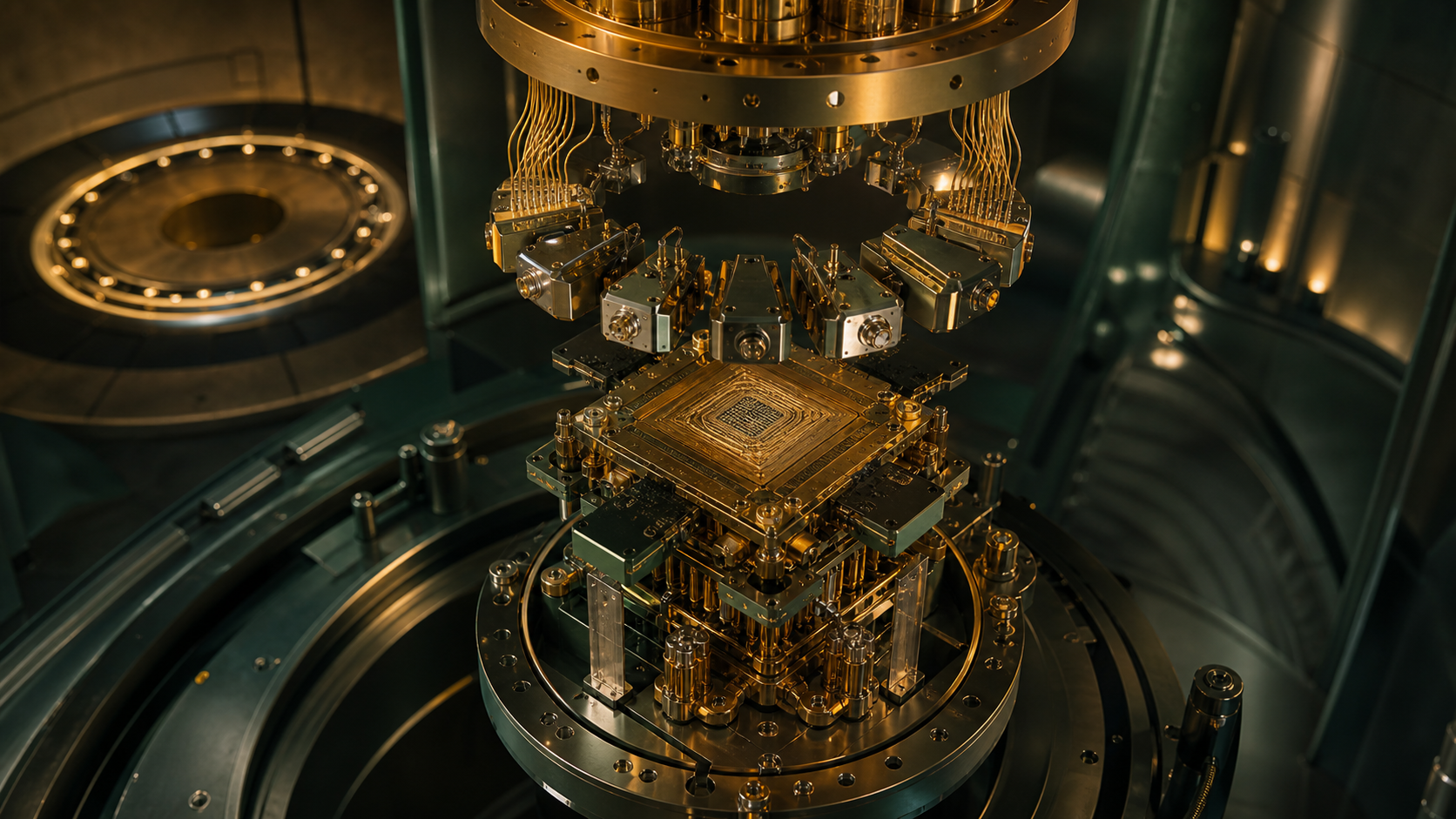
IBM joined and cooled its first two modular cryogenic units below 15 millikelvin the same week, on a roadmap to at least a thousand programmable qubits in 2027. That is parallel context and not a dependency: the Korean work names Yonsei's existing IBM QPU environment. For any reader judging a quantum-medicine claim, the useful test is whether a check has been scheduled.
Two Auditors Found the Reversed Step Inside an AI-Generated Proof
A correction, published with its own author list
On 3 August 2026 two auditors posted a note on Chapter 6 of OpenAI's Ten Advances in Mathematics and Theoretical Computer Science. The chapter claims an exponential parallel-repetition theorem for all finite two-player, one-round entangled games. Its quantitative greedy conditioning lemma is correctly stated and, as printed, incorrectly proved: the continuation test is written in terms of average success where the next step needs a large conditional failure probability. The note supplies a counterexample and a complete repair — and declines to call that repair an independent verification of the theorem.
Machine-checked file, human-read chapter
The same result ships with a Lean 4 formalization whose manifest records zero unfinished steps. Both facts hold at once, because a machine-checked formalization certifies the Lean file and not the prose a reader actually reads. A second audit, published 17 August, rigorized three of the four lemmas in the Dihedral Coset Problem preprint that connects, through a chain of reductions, to the lattice problems behind post-quantum cryptography. It corrected several of them and isolated a surviving hypothesis the algorithm's own rule does not supply, while leaving the parameter gap to ML-KEM exactly where it was.
And in code, a dispute about what was read
In the same week a disclosed GitHub Actions injection in Snowflake's connector repository left Wiz and GitHub publicly at odds over whether an automated review had examined the vulnerable code at all. Authorship of the line is on the record and belongs to a named engineer. What the squash-merge co-author field cannot establish is which lines any machine review actually read. Three cases, one pattern: production of plausible argument is scaling and the reading is not.
Sunlight Replaced the Pump Laser in an Outdoor Entanglement Source
A four-year objection, answered outdoors
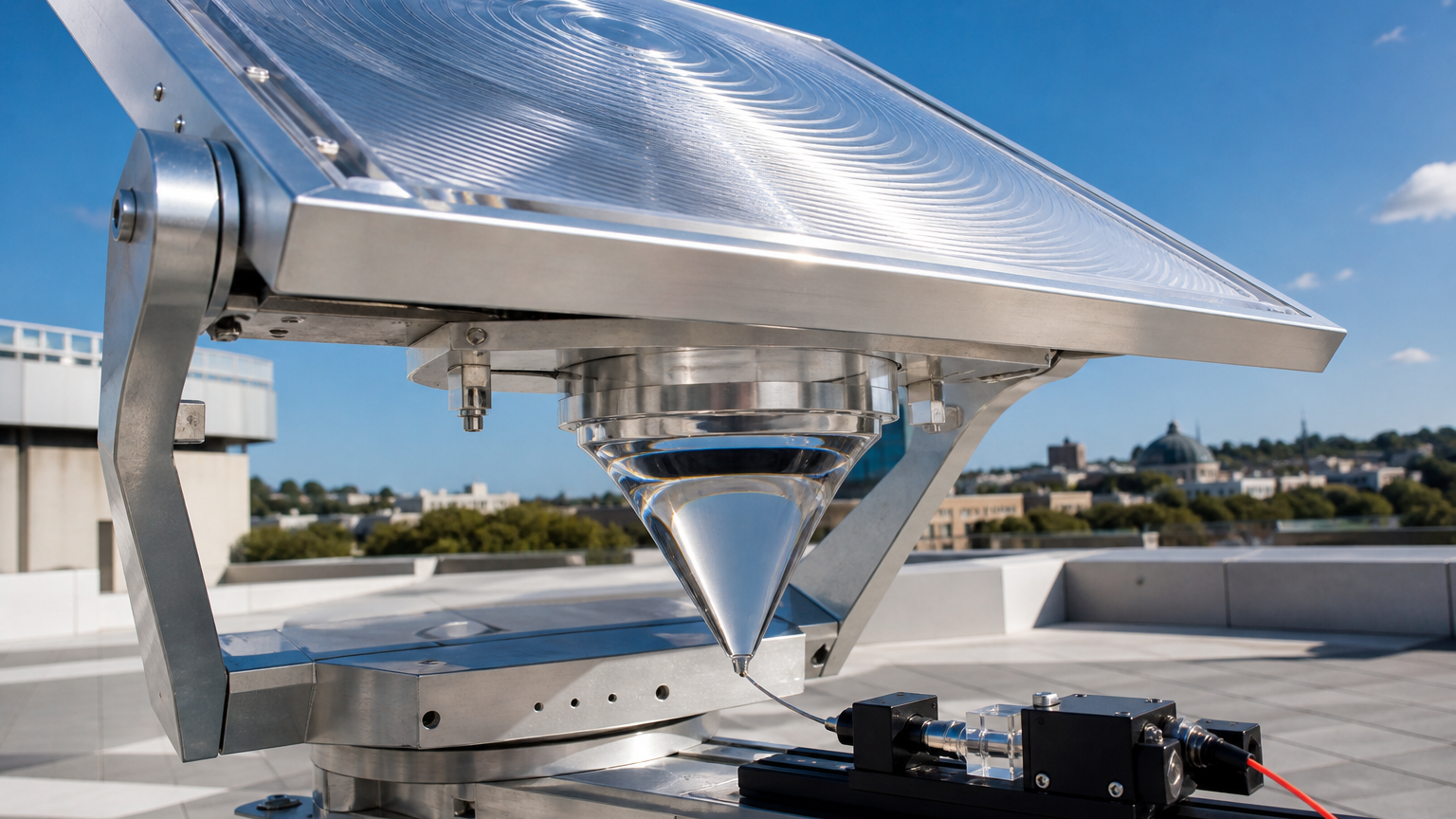
On 6 August 2026 Optica published a result whose lead author, Cheng Li, says has “met with repeated doubt and pushback” since the project began: polarization-entangled photon pairs generated with natural sunlight as the pump, measured outdoors, at a Bell-state fidelity of 0.939 and a CHSH value of 2.5408 against the classical bound of 2. The apparatus is a Fresnel collector about the size of a household window, a custom all-glass concentrator cone, a fiber about as wide as a human hair, and a ppKTP crystal at the end of it. The same lead author had shown in 2022 that an incoherent LED could pump weak entanglement; a Xiamen group showed in 2025 that sunlight could drive down-conversion at all. This joins those two records.
A substitution, not yet a subtraction
The energy overhead of the pump laser is the motivation the authors name, and running a source on light that is already falling on the instrument is attractive for exactly that reason. What the experiment swaps in, though, is a collector, a tracking mount, spectral filtering, a custom concentrator and crystal temperature control, and no published comparison yet shows that trade winning on total mass, power, thermal load or reliability.
What is not yet on the record
The preprint reports roughly 1,600 pairs per second per milliwatt, comparable to laser-pumped setups once normalized for effective phase-matching bandwidth. What is missing is mission-level throughput, a secure key rate, a sustained duty cycle across sky conditions, and an independent replication. Those are the numbers to watch before anyone writes a passive entanglement source into a space-segment work package.
The A-Share Market's First Quantum Measurement Stock Is a Scientific-Instruments Business
A listing that does not match its label
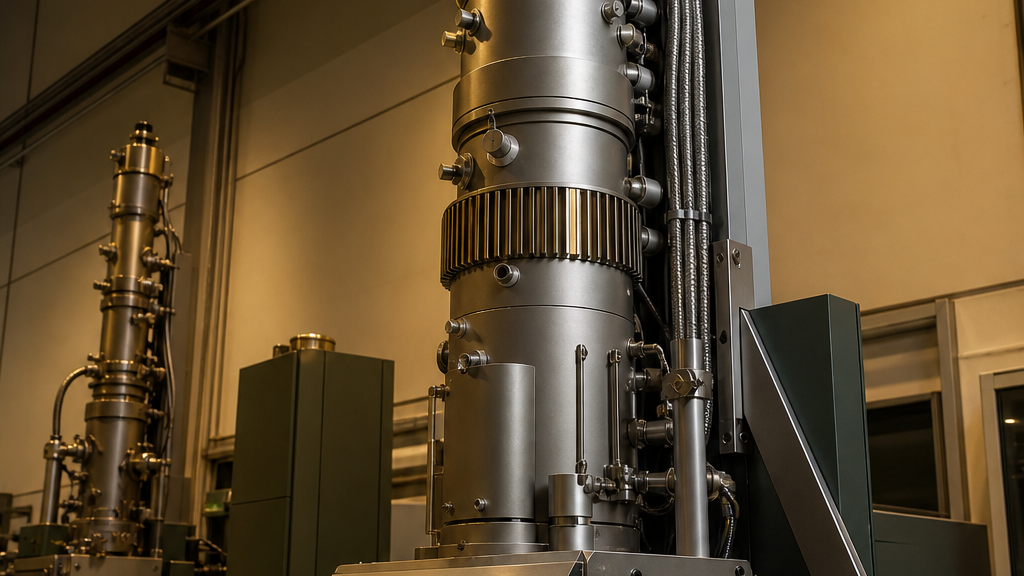
On 11 August 2026 CIQTEK closed its first session on Shanghai's STAR Market at RMB 110.23 against an offer price of RMB 21.22, a gain of 419.46 percent and a market capitalization near RMB 44.1 billion. Chinese financial coverage called it the A-share market's first quantum precision measurement stock. The catalog underneath that label is electron microscopes, nuclear magnetic resonance and electron paramagnetic resonance spectrometers, scanning nitrogen-vacancy microscopes and gas adsorption analyzers, sold to universities, national academies and manufacturers.
Why measurement ships before computation
Part of the catalog is not quantum technology at all — electron microscopes and gas adsorption analyzers are conventional laboratory instruments. The spin-resonance line is where the physics matters. A quantum computer has to protect coherence across an entire algorithm, which is why error correction dominates its cost. Many present-day spin sensors hold a state only for a single short interrogation, read out a field-induced phase or resonance shift, and recover precision by repeating and averaging, which is why the products shipping today carry no fault-tolerance layer.
Where the public instruments reach, and where they thin out
Most of what governments issued this year points at computation or at defence timing: the US Commerce letters of intent in May, DARPA's optical clock award in August, the Royal Navy's cold-atom timing trial. Brussels and London have funded quantum sensing and metrology tooling too. What stays thin is the ordinary laboratory instrument park — the spectrometers, microscopes and adsorption analyzers that qualify materials for every industry, still classified under scientific-equipment rules that predate the quantum label. This post reads the listing closely and asks what concentration in that supply would mean for anyone who has to verify a battery, a wafer or a drug.
Copy-Based Resilience Is the One Habit This Signature Scheme Cannot Allow
One key, one place, one number
Stateful hash-based signatures are the one post-quantum family that behaves like a book of numbered receipts: every leaf may be used exactly once, and the count of what has already been spent is part of the secret. NIST's 2020 recommendation for those schemes holds the line with two plain conformance clauses. The cryptographic module may not export private keying material, even in encrypted form, and it may not use a one-time key more than once. Sign twice at the same index and, in NIST's words, it becomes computationally feasible for an attacker holding both signatures to forge further ones.
Where it meets the recovery plan
Ordinary resilience engineering runs on the opposite reflex. Many conventional copy-based designs duplicate the signing environment or roll it back in time, and where they do, both faults land in the same place: an index issued twice. Safer state-aware mechanisms exist and have been catalogued at the IETF; they are simply not what most recovery machinery does by default. The problem is well enough known to have its own engineering literature at the IETF, and it reached the banking press this week through a Swiss custody bank explaining why Ethereum's post-quantum roadmap is already an operational question. Switzerland's supervisor had reached an adjacent finding in July, reporting that in most cases among the sixty institutions it surveyed there was "a lack of a clear roadmap and sufficiently forward-looking planning" for the migration.
What the standard proposed instead
The interesting part sits in the recommendation itself. NIST anticipated module failure in 2020, refused the copy, and gave over a whole section to two architectures in its place — several independent keys across several modules, or one multi-tree key whose subtrees are generated on separate hardware. That is redundancy without duplication, and it has to be chosen at the key-generation ceremony, years before anyone reaches the migration deadline written in the plan.
Washington Would Take Equity in Nine Quantum Firms. One Prospectus Shows What That Means.
Nine non-binding letters, not nine closed deals
On 21 May 2026 the US Department of Commerce announced nine letters of intent worth $2.013 billion in CHIPS incentives across the American quantum computing industry — $1 billion to IBM for a 300-millimetre quantum wafer foundry in Albany, $375 million to GlobalFoundries, and $100 million each to Atom Computing, D-Wave, Infleqtion, PsiQuantum, Quantinuum and Rigetti, with up to $38 million to Diraq. Attached to each is a condition that changes the instrument: in exchange for the award, each recipient would issue equity securities to the Department. The letters are non-binding, and the definitive documents are still unsigned.
What one filing answers
Commerce described every stake as minority and non-controlling, and said little more. Several recipients have since added something of their own — D-Wave that it would issue $100 million in common stock, GlobalFoundries that the Department's position is about one per cent. Quantinuum's prospectus goes furthest by a distance, describing securities that would be non-voting so far as the law permits and freely transferable, carrying anti-dilution, registration, redemption, exchange, conversion, participation, tag-along and information rights, with funding released against named milestones across a five-year performance period. For that one company the control question is largely designed out. The custody question is not, and no recipient has answered it.
Own, screen, or buy
Three governments reached for three different instruments this season. Washington moved toward ownership. Brussels chose control over ownership: Regulation (EU) 2026/1386 puts quantum technologies into the mandatory screening scope of all 27 Member States for the first time. Israel chose procurement, tendering a sovereign quantum computer in August. Ownership is the instrument whose internal governance is least visible, and it is the one the United States picked in a field whose cost assumptions moved again in July.
The Post-Quantum Handshake That Delivered a Windows Zero-Day
What the report describes
On August 11, 2026, Check Point Research published an account of an Operation Dream Job intrusion chain aimed at defense and aerospace staff in France, Germany, India and Brazil. The lure was a recruiter approach. The payload was a use-after-free race in the Windows socket driver AFD.sys, tracked as CVE-2026-68820, giving local escalation to SYSTEM. Microsoft received the report on July 28, assigned the identifier on August 5, and patched on August 11. CISA added the flaw to its Known Exploited Vulnerabilities catalog the same day, with a federal remediation date of August 25.
The detail that matters
Before the exploit moved, the privilege-escalation loader carried out post-quantum key establishment with its server: it took server public keys, generated fresh key material with Kyber/ML-KEM, returned the encapsulated result, and only then requested the zero-day. The report places this inside that loader's exchange, not across the campaign's wider command infrastructure. A second cipher layer sat on top of the existing AES transport, using a randomly generated 16-byte session key prepended to each packet. The rootkit that followed blinded 94 event-tracing providers and tampered with Smart App Control.
Why it reads as an organizational story
As a general matter, a classical ephemeral exchange offers comparable protection against later decryption, so a post-quantum primitive is not by itself a new offensive capability. What the case shows is speed. NIST finalized ML-KEM in August 2024; it appeared here in an ordinary tooling update, integrated by a team with no inventory to survey and no supplier to wait for. Enterprises measure the same transition in years because their constraint was never the mathematics. That asymmetry, not the handshake, is what inspection-based defense now has to plan around.
The Vulnerability Database Is Being Rebuilt Without a Word About Cryptography
A consultation with one word missing
On August 12, 2026, NIST opened a public consultation on rebuilding the National Vulnerability Database for an era of AI-assisted attack and machine-readable security data. The notice runs to seven groups of questions, from automation of the vulnerability lifecycle through to the standards that govern vulnerability data and a five-year vision for the database itself. Comments close on October 13, 2026. The word cryptography does not appear anywhere in it.
Why the omission matters
Two years after the first post-quantum standards were finalized, European rules now require entities in scope to hold policies on the use of cryptography, and the Dutch implementing statute takes effect three days after this notice published. No instrument orders anyone to keep a cryptographic inventory — but a policy that cannot be checked against deployed systems is not one an auditor can test. The database ingests vulnerability records within about an hour of publication, so speed was never the binding constraint. The constraint is structural: a register answers only the questions its schema anticipated, and a flaw record was never built to describe a key exchange or a signing algorithm.
Who this decides for
Cryptographic discovery is already procurable by anyone with a budget, and no central record could replace it: what a given operator has configured is local knowledge that has to be found locally. What a public record could supply is the reference layer underneath — what a product version implements — so that local discovery resolves against something instead of being re-derived by everyone independently. Whether that layer acquires a cryptographic dimension will shape the real pace of migration among smaller operators more than any further deadline, and it is being settled on an open docket rather than in an instrument.
DARPA Is Buying the Copies, Not the Discovery
A program bought units, not a demonstration
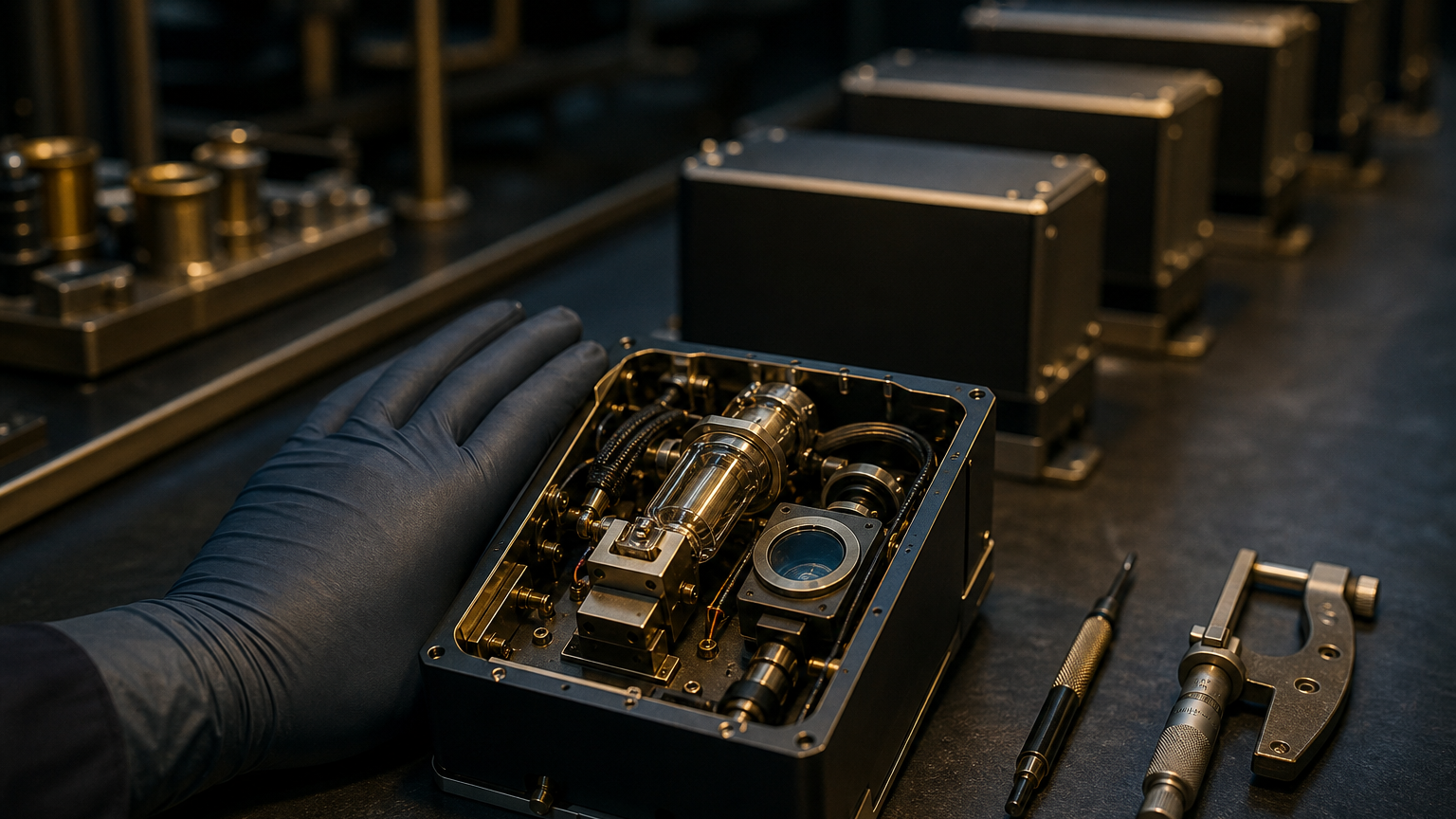
On August 6, 2026 the Defense Advanced Research Projects Agency announced It's About Time, a program whose stated aim is a pilot manufacturing pipeline for tactical-grade optical clocks. On the same day IonQ said it had received a $28 million contract extension covering manufacturing development and 25 Evergreen-05 optical atomic clocks, with an unexercised $30 million option for a further 100 units, and that it would add $15 million of its own capital for production space, equipment and staff. A facility is expected to open by mid-2027.
Timing is the capability arriving first
The Evergreen-05 sits in a five-liter enclosure, roughly one seventy-fifth the volume of an active hydrogen maser, and is specified at 50 femtoseconds of stability at one second with nanosecond-level holdover across ten days. Holdover is the number that matters operationally: it describes how long a platform keeps defensible time after the satellite signal stops. Against a documented rise in GNSS jamming and spoofing across the Baltic, the Black Sea, the eastern Mediterranean and the Middle East, that is a civil infrastructure question as much as a military one.
The qualification route is unnamed
DARPA's companion OASIC effort is building fee-based, certification-style testbeds open to outside users, and its atomic-clock testbed team is Vector Atomic — the company IonQ acquired in October 2025 — with the University of Colorado. Yet neither the DARPA announcement nor the IonQ release says whether the delivered clocks will be qualified there, or anywhere else: no national metrology institute, no international comparison, no cited military standard is named for the units. Meanwhile the same physics is being assessed on a separate civilian calendar, where the international committee responsible for the second is working toward a possible redefinition around 2030. A quantum instrument is entering pilot manufacturing while the reference frame it will be judged against is itself under revision.
What Would Have to Hold for the New DCP Result to Reach ML-KEM
A preliminary paper reaches the mathematics under lattice-based post-quantum cryptography
The Cryptology ePrint Archive received Paper 2026/1591 on August 3, 2026 and posted it three days later. In it, Daniel R. Simon of the Amazon Web Services Cryptography Group presents a polynomial-time quantum algorithm for the Dihedral Coset Problem, which has resisted a polynomial-time solution for more than two decades. Combined with Oded Regev's reduction of lattice problems to that problem, the abstract claims polynomial-time quantum algorithms for two distinct targets: the Shortest Vector Problem at a square-root-of-n polylogarithmic approximation factor, and Learning With Errors instances in a parameter regime the abstract states as alpha equal to square-root-of-n polylog(n).
What the paper does not claim
It analyzes no standardized scheme, offers no key-recovery attack, and gives no qubit, gate or error-correction estimate. The claim is complexity-theoretic and unreviewed; the author records discussions in progress with Daniele Micciancio, Vinod Vaikuntanathan and Thomas Vidick. Nothing standardized broke in August 2026, and no honest reading of the abstract says otherwise.
Why it still lands on the migration desk
Four conditions stand between this abstract and ML-KEM, and none has been met. But certification calendars were set on the cryptographic judgment of 2024 and do not pause for a preprint. What lets an organization respond to a result like this is crypto-agility resting on a current cryptographic inventory: knowing which systems use which algorithms, and how long a substitution actually takes. That capability is built before the verdict arrives, not after.
A 1970s Pop Duo's Lost Lawsuit Gave Japan Its AI Voice-Cloning Test
Japan's newest AI guidance rests on a 2012 precedent
On August 7, 2026, Japan's Ministry of Justice published the final report of its study group on unauthorized use of likeness and voice: interpretive guidelines on when AI voice cloning creates civil liability under existing law. No new statute was passed, and courts keep the authoritative word. The guidelines rest on the publicity-rights doctrine Japan's Supreme Court built in 2012, in a case two 1970s pop singers lost over magazine photographs. From the study group's first meeting to the published report took 105 days.
Consent, not labels
The organizing line the report draws is consent, applied through the Pink Lady factors of identifiability and customer-attracting power. A human impressionist naming their subject is in principle lawful; a machine-made copy trading on a voice without permission is where the liability analysis begins. The EU's Article 50 answers the same technology with machine-readable disclosure, and Tennessee's ELVIS Act wrote a new statutory right. Japan interpreted the law it already had, and METI's April 2026 handbook describes when a person-specific voice offering can expose its provider.
Why the model layer should read it
Days earlier, a US appeals court attributed an AI agent's conduct to its human user. Japan's guidance can run the other way, toward conditional provider-level exposure — and an early test is already docketed: a voice actor's suit against TikTok's operator, filed before the guidelines existed, which may now be read in their light.
When an AI Agent Shops for You, Anti-Hacking Law Sees Only You
The first appellate answer to the agent question
On August 4, 2026, the Ninth Circuit vacated the preliminary injunction Amazon had won against Perplexity's Comet Assistant, holding that when a customer directs an AI assistant to shop inside their own Amazon account, it is the customer who accesses Amazon's computers. The panel worked from the system's architecture: the customer's browser retrieves the page, the Assistant captures screenshots, Perplexity's servers send navigation instructions back to the customer's machine, and no Perplexity server ever touches Amazon's. On that wiring diagram, agentic AI liability under the Computer Fraud and Abuse Act stops at the user's device.
A tool in the statute's eyes
The panel wrote that however advanced the Assistant is, it remains a tool for statutory purposes, and it construed the statute's ambiguity against liability because Amazon's reading would have exposed ordinary customers to criminal consequences for automating their own shopping. Contract, terms-of-service and tort theories all survive the ruling, and so does technical blocking.
What replaces the criminal hook
Two days before the decision, the EU's AI Act Article 50 transparency duties became operative, requiring assistants that interact with people to announce themselves, and Canada's prudential regulator published credential and access guidance for deployed agents in July. This analysis reads the ruling, the architecture it rewards, and the disclosure and supervision regimes now carrying the weight the anti-hacking statutes set down.

The Screening Duty for Synthetic Genomes Ends Where Federal Money Ends
A model wrote the genomes, and the order counter stayed open
On August 6, 2026, Science published the first generative design of complete, working bacteriophage genomes. A Stanford and Arc Institute team fine-tuned the Evo 1 and Evo 2 genome language models on the viral family of ΦX174, synthesized and tested 285 of the resulting designs and recovered 16 viable phages, several fitter than the natural template. Institutional biosafety review and federal purchasing conditions can reach a laboratory doing this work. What no generally applicable federal screening mandate reaches is the provider filling a synthesis order for a privately funded domestic buyer.
The instrument is a funding condition
American oversight of synthetic genomes runs through the 2024 Framework for nucleic acid synthesis screening, which binds researchers as a condition of federal funding and whose ordered replacement has been outstanding since a May 2025 executive order. A Senate bill introduced in January 2026 would make screening a duty of the providers themselves; it remains with the Commerce Committee. The legal form is the one Asilomar produced in 1976.
Why screening is getting harder
Order screening rests on comparing a requested sequence against databases of known agents, which makes it a test of resemblance. The paper's central scientific claim is substantial evolutionary novelty. This analysis reconstructs the experiment, reads the instrument that actually governs it, and asks what the cryptography world did differently when a model found a flaw in a candidate under standards review.
A Regulation, an Order, a Committee, a Tender: Quantum's Sovereign Summer
One summer, four instruments
Between June 17 and August 4, 2026, four governments moved on quantum technologies with four different legal tools. The European Union adopted Regulation 2026/1386, making foreign-investment screening mandatory in every member state for quantum, semiconductors and specified AI technologies. A US executive order set dated post-quantum migration deadlines for federal high-value and high-impact systems: key establishment by the end of 2030, digital signatures by 2031. China's industry ministry chartered a national quantum standards committee, MIIT/TC10. Israel announced a procurement initiative for a domestically built quantum computer.
Four levers, one pattern
Each government reached for the lever where its leverage already lies. The United States governs the systems it operates, the EU governs the capital that buys in, China writes the standards industry will inherit, and Israel moves to buy a national platform beyond its first domestic machine. Each instrument also defers its binding content to a later text: migration plans and pilots, national screening mechanisms by early 2028, standards and tender documents still unpublished.
Why the calendar matters
This analysis reconstructs the timeline from the primary instruments and the contemporaneous record, reads the four instruments as one governance event, and sets out the dated moments that will decide what each of them means in practice for builders, investors and public institutions.
Science: A New Golden Age: The White House, Quantum, and the Genesis Mission
A national science design meets quantum
The White House report Science: A New Golden Age argues that federal science should shape the arena in which discovery happens. Its central case is the Genesis Mission, an AI-for-science program built around Department of Energy laboratories, scientific instruments, computing systems and public-private partnerships. Quantum information science runs through the report as both a strategic field and a demanding test of that institutional design.
The discovery engine needs a verifier
Quantum materials, error-correction searches and device characterization fit the Mission’s emphasis on large scientific search spaces. Yet faster generation creates a second burden. The report calls for verification capacity equal to the new discovery machinery. Recent quantum-computing claims show why: confidence bounds, independent replication and strong classical challengers determine whether an apparent advantage can survive scrutiny. Quantum verification infrastructure therefore belongs inside the discovery system, not at its edge.
Coordination will decide the reach
The Genesis Mission supplies a model for connecting national laboratories, private research capacity and shared facilities. Quantum adds cryptography, networks, sensing, AI and supply chains to the same strategic calendar. The open implementation question is whether those domains will share priorities, access rules and measures of progress. That choice will shape whether AI for science accelerates isolated experiments or a durable national quantum capability.
Quantum Networking Found a Utility Door in Chattanooga
A live network changes the experiment
IonQ and Chattanooga utility EPB have announced a $15 million, five-year research center built directly on an operational fiber network. The planned centerpiece is a commercial quantum-memory unit connected to infrastructure that already serves a city. That setting adds maintenance, service obligations and local operating conditions to a field still dominated by carefully controlled demonstrations.
Distance and connection scale moved together
The announcement arrived beside two major research results. A University of Science and Technology of China team entangled atomic memories across 420 kilometers of fiber; measured points at 320 and 420 kilometers exceeded the repeaterless PLOB capacity. A separate preprint used soliton microcombs to demonstrate the core link in an architecture designed to enable a fully connected, measurement-device-independent network for 200 users over 200 kilometers. Together, the results show why quantum network infrastructure needs both long-distance memory and optical systems that can support many relationships without unmanageable laser-locking complexity.
The host may shape the market
EPB contributes more than cable. It brings rights-of-way, maintenance crews, public accountability, customers and a path from test equipment to service. That makes the utility part of the technical architecture. It also raises questions about access, procurement and the power of a small number of network owners to set operating defaults before standards mature. The Chattanooga project is therefore a test of quantum communications commercialization as much as a test of hardware.
The Post-Quantum Web Arrived as a Platform Setting
Nearly half, one default
A new longitudinal study tested more than two billion TLS handshakes across one million domains from 11 global vantage points. By March 2026, 49.22 percent of its stable panel negotiated a hybrid post-quantum key exchange by default. Every one of those default negotiations selected the same construction, X25519MLKEM768. The web appears to be moving quickly, but the route is narrower than the policy calendars suggest.
The platforms moved first
The paper attributes 93.92 percent of observed post-quantum TLS deployment to configurations likely managed by infrastructure providers. Cloudflare and Fastly alone account for nearly 70 percent. Owner-managed services, including many government domains, remain mostly classical. This changes how migration progress should be read: a high aggregate percentage may describe one upstream platform decision repeated across thousands of customers, while slower institutions still face their own software, procurement and legacy-system work.
A safer handshake can keep old baggage
The hybrid exchange added a predictable number of bytes but no meaningful median latency in the measured public-web setting. At the same time, provider-managed post-quantum domains often retained older protocol versions and deprecated cipher support. The result connects engineering, policy and market power. Cryptographic infrastructure concentration can accelerate protection at remarkable speed, yet it can also obscure who made the change, which services inherited it and how much of the harder migration remains unfinished.
IBM Put the Skeptics Inside the Quantum Experiment
Three results, one problem of trust
IBM and its research partners published three quantum-advantage claims in late July 2026. Each reaches a regime where direct classical checking becomes difficult or unavailable. That is where the papers become interesting. They do not ask readers to accept a faster or larger machine on reputation alone. They build different checks into the work: error detection and statistical bounds, independent mitigation methods, cross-platform repetition and tests that shift the checking problem onto a characterized noise model.
The cost of rejecting bad runs
In the University of Chicago experiment, a 70-qubit circuit used spacetime codes to detect faults. Postselection suppressed gate errors tenfold and produced a fidelity lower bound of 0.284 with 95% confidence. The price was steep: the effective sampling rate fell by a factor of 860. That number makes the paper useful beyond physics. It exposes the quantum verification cost instead of hiding it behind a final performance claim.
A claim designed to meet its challengers
The other papers compare mitigation methods, repeat selected circuits on Quantinuum hardware, test smaller instances where exact solutions exist and recover known analytical limits. None has yet completed peer review, and none settles the wider contest between quantum and classical computation. Together, however, they show a better institutional shape for quantum advantage claims: the method for finding error travels with the claim, while independent researchers still get the final word.

The Quantum Foundry Deal That Cleared Without Its Safeguards
A foundry changes hands
IonQ completed its acquisition of SkyWater Technology on July 31, 2026, bringing a major US semiconductor foundry inside a quantum-computing company. The transaction promises tighter coordination between design, fabrication and testing. It also places a supplier used by several quantum developers under the ownership of one of their competitors. That tension turned an industrial transaction into a live test of quantum supply-chain competition.
Two commissioners, two market theories
The Federal Trade Commission ended its review after Chairman Andrew Ferguson and Commissioner Mark Meador reached different conclusions. Ferguson said the deal could create short-term foreclosure and confidentiality risks. He favored an order covering equal access, information firewalls, switching assistance, arbitration and independent monitoring. Meador found the available record too weak to show likely competitive harm, pointing to other fabrication routes, low foreclosure shares and new public investment in domestic capacity.
The unresolved access question
The acquisition closed without those conditions. IonQ says SkyWater will retain its merchant-foundry model and continue serving customers. The public record therefore leaves a precise trusted foundry access question: whether commercial promises and ordinary contracts will preserve neutral treatment during the years before alternative US capacity becomes fully available. Quentir reads the split as an early signal that quantum industrial policy and antitrust are now operating on the same physical bottleneck.

Hospital Mortality Fell. Was It the Score or the Response Team?
A mortality result with more than one author
A July 24 NEJM AI study reports that an intervention built around the Epic Deterioration Index was associated with lower in-hospital mortality across 11 New Jersey hospitals. The program automatically paged a rapid-response team when an adult medical-surgical patient’s score reached 60. It also included clinician education, alert tuning and a standing critical-care response capability. Rapid-response activations rose, while unadjusted mortality fell from 23.1% to 18.6%. The study was quasi-experimental rather than randomized, so the result belongs to the full intervention and its clinical setting.
The benchmark points in another direction
A 2024 JAMA Network Open study compared six early-warning scores across 362,926 encounters at seven Yale New Haven Health hospitals. eCART led on discrimination and high-risk warning time. A simple public score, NEWS, also outperformed Epic’s index. That comparison exposes the central hospital AI early warning question: a model can perform modestly in a head-to-head benchmark and still support a useful local program when the surrounding response is well designed.
The handoff belongs in the claim
Quentir reads the two papers together. Predictive accuracy, alert routing, staffing, clinical authority and bedside judgment are separate parts of one safety system. FDA guidance clarifies when clinical decision support software falls under device oversight, while patients encounter the institution around the software as much as the score itself. The July result therefore supports careful optimism about clinical response design, alongside a harder comparative question about which model creates the most useful warning and the fewest false alarms.