When the Error Check Happens Decides What It Buys
A 54 percent error cut, and what it was measured on
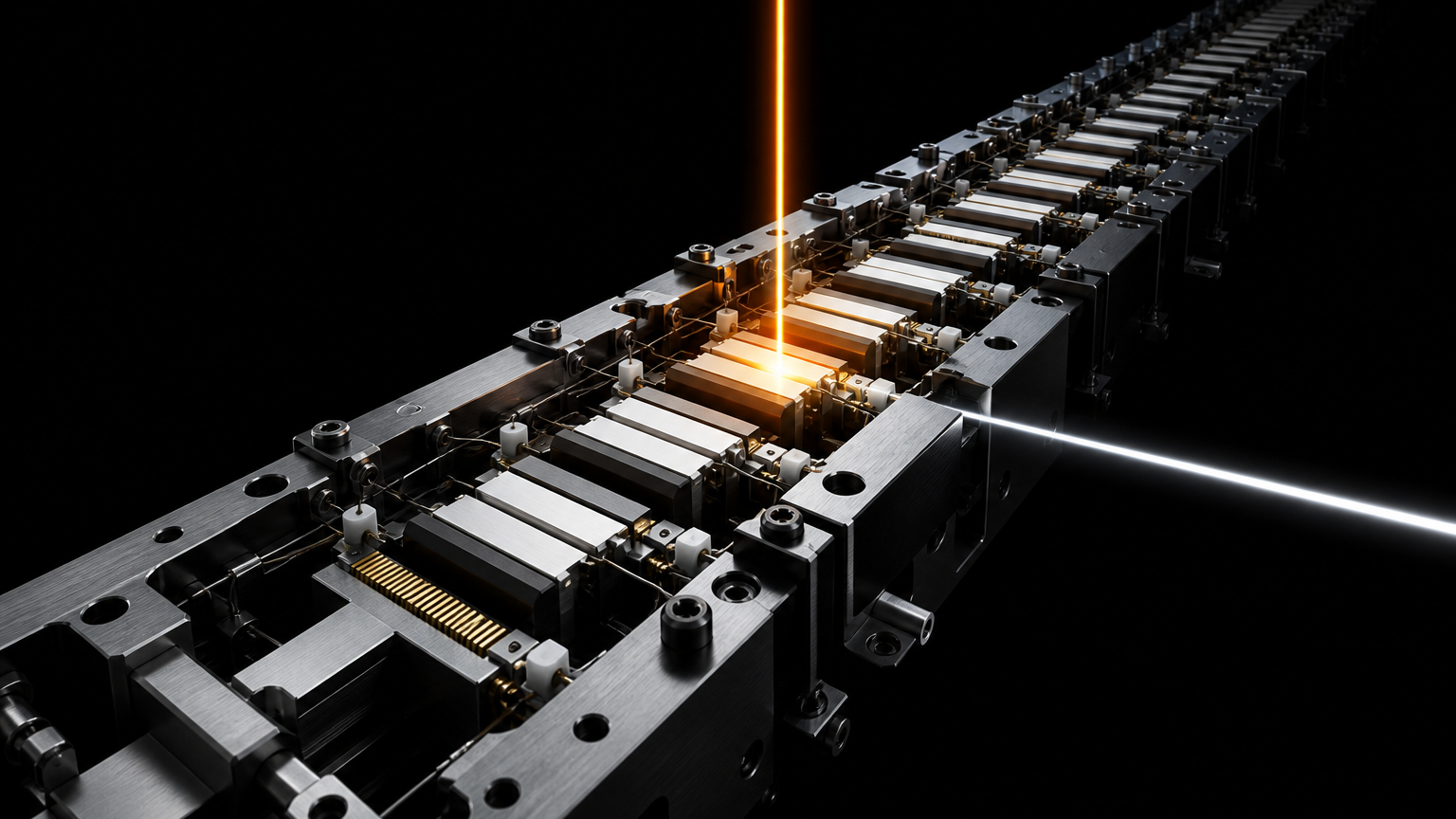
Simulating a molecule on a quantum computer means chopping its time evolution into many short slices, a technique called Trotterization. Accuracy improves as the slices get finer, and finer slices make a deeper circuit, and every additional gate in that circuit is another chance for a physical fault. Depth is what the chemistry asks for and depth is what today's hardware punishes, which is the bottleneck the field calls the deep Trotter dilemma.
A preprint from IonQ, qBraid and NVIDIA, posted in May 2026 by James Brown, Jason Iaconis, Yuri Alexeev and colleagues, reports that a combination of the Generalized Superfast Encoding, Clifford Noise Reduction and Shor-style stabilizer verification lowered the logical error rate by up to 54 percent on a trapped-ion machine. The encoding itself carries no such requirement, and Clifford Noise Reduction can be run with its stabilizer readout deferred; what the paper establishes is that the advantage over the unprotected baseline depended on mid-circuit measurement, the ability to read some qubits partway through a run, learn from them and continue with the rest.
What the number does and does not cover
The unprotected baseline is a six-qubit encoded Clifford Trotter step; the protected implementation that produced the 54 percent figure is wider, at 26 qubits and 580 gates, the extra width being the verification machinery itself. Both ran on a Barium development system similar to IonQ's forthcoming Tempo line. Clifford circuits are the well-behaved subset of quantum operations an ordinary laptop can simulate exactly, which is what makes them useful test articles: the correct answer is known in advance, so any deviation is measurable error. No molecule, binding energy or reaction barrier appears anywhere in the result, while IonQ's own account presents the same figure alongside the prospect of lower research costs and shorter time to market.
The control arm is the transferable finding
Keep the verification structure but move the stabilizer readout to the end of the circuit and it still beats having no error detection at all. What it stops doing is beating the unprotected baseline by a statistically significant margin for a single stabilizer round. Only the mid-circuit version clears that bar, which points at the timing of fault detection as the operative ingredient. For scale, published resource estimates for computing spin gaps in models of the cytochrome P450 catalytic cycle, a methodology benchmark and not a dosing or interaction predictor, run near 1,434 logical qubits and roughly 4.6 million physical qubits over 73 hours, on stated and assumption-dependent compilation figures. This Monitor records the work at TRL 3 on the simulation pillar.
The Fingerprint Band, Read by a Camera That Never Sees It
A chemical map without a dye
Infrared light between roughly 6 and 10 micrometres is absorbed by the specific chemical bonds that hold proteins, lipids and nucleic acids together, which makes the mid-infrared fingerprint band the part of the spectrum where biological material is most distinguishable without stains, antibodies or fluorescent labels. The reference protocol for the method describes it as a non-perturbative, label-free way to extract biochemical information aimed at diagnosis and at assessing how cells are functioning, and the sample survives the measurement. It has never become routine hospital equipment, and one important barrier is the detector rather than the chemistry.
The camera problem, answered sideways
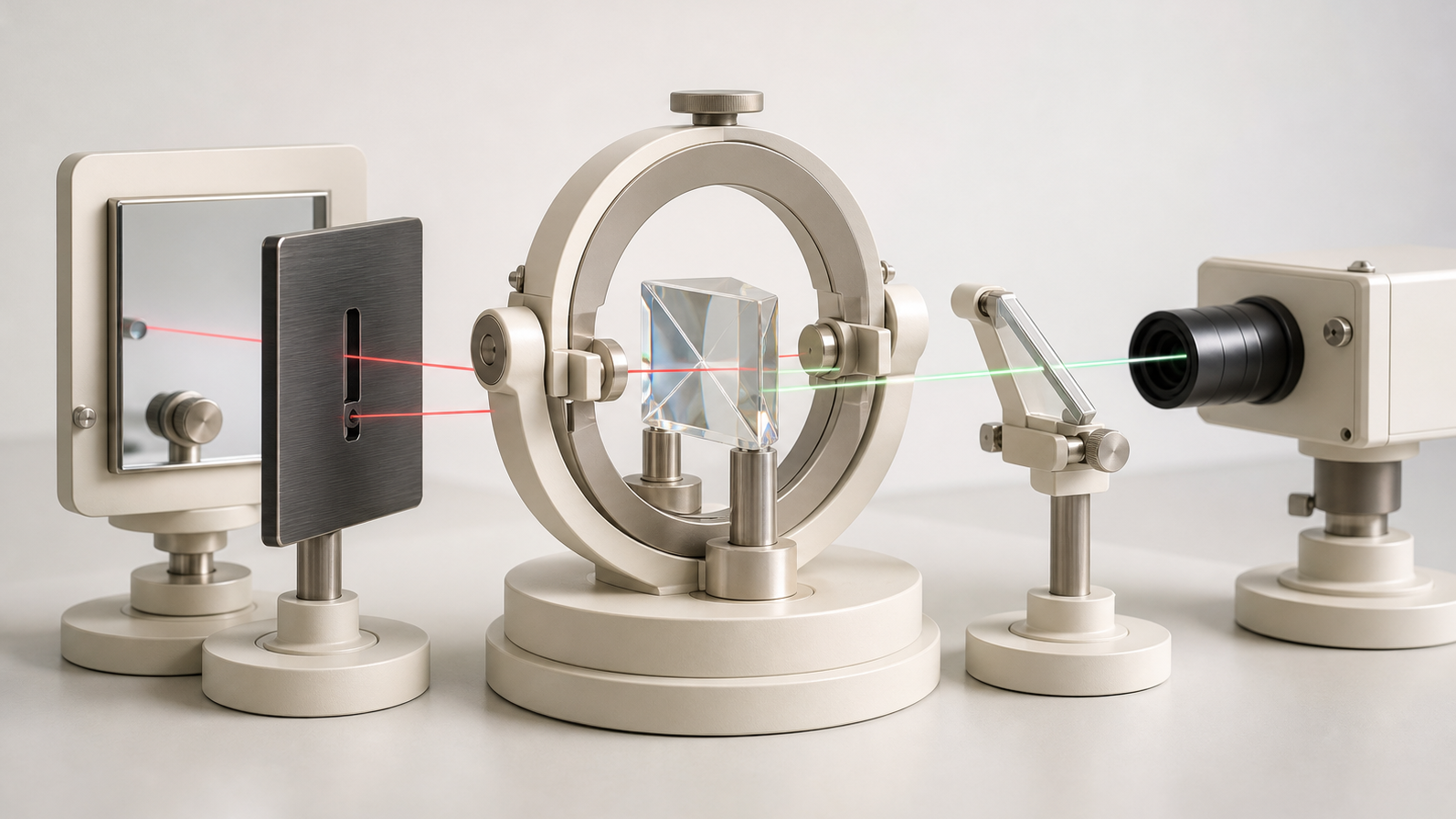
Detectors for that band are cooled, costly, and limited by the thermal glow of the room and of the instrument itself, because everything at ordinary temperature radiates in exactly the wavelengths being measured. A group at Imperial College London has now reported wide-field imaging across the full 6 to 10 micrometre range in which the infrared light is never measured at all. Correlated photon pairs are produced in a single silver thiogallate crystal used twice in a folded geometry, one partner passes through the sample, and the picture is reconstructed from the visible partners of those undetected photons on a commercial scientific silicon camera. Because the measurement happens in the visible, where the room's thermal background is effectively absent, the system detects infrared signals about a hundred times below the usual background-limited photodetection ceiling, at room temperature.
What the numbers actually allow
At 8 micrometres the images hold more than 8,000 resolvable elements at a resolution of 297 plus or minus 5 micrometres, over a circular field about 30 millimetres across, in a 10 second acquisition. The field is generous enough for a tissue section, a tablet or a culture well. The resolution is the constraint that matters: a human cell measures 10 to 20 micrometres, so that resolution is equivalent to roughly fifteen to thirty cell widths rather than to a camera pixel of that size, and the test objects were shadow masks cut from metal foil rather than biological material. This edition reads the result as a supply-chain and noise-floor contribution to an established clinical method, places it on the readiness ladder, and sets out the three specific demonstrations that would tell a hospital buyer the distance to a pathology bench is closing.
Which Blood Signal Rewards a Quantum Kernel
A screening gap a blood draw might close
Annual low-dose CT screening lowers lung cancer mortality, and most of the people who qualify for it are not up to date with it. The American Cancer Society reported in June 2024 that 18.1 percent of screening-eligible US adults were up to date in 2022 survey data, which leaves the larger share of a proven survival benefit unclaimed. Blood-based tests are attractive because collection is easier to distribute and to repeat than a CT appointment. The study compares two molecular readouts, drawn from a wider field that also includes mutation panels, circulating proteins and cell-free RNA: cell-free DNA fragmentomics, which reads the length and position of circulating fragments, and methylation, which reads chemical marks at defined genomic targets. Both produce high-dimensional, nonlinear data, and both are degraded by the heterogeneity of lung cancer.
What the Cleveland Clinic and IBM Quantum preprint reports
A team from Cleveland Clinic Research and IBM Quantum posted a preprint on August 19, 2026 asking whether a quantum kernel classifies those signals better than a conventional support vector machine. The methylation cohort covered 813 individuals with 188 cancers across 56 methylation targets; the fragmentomics cohort covered 718 individuals with 172 cancers across 473 genomic regions. Features were encoded with angle and dense-angle feature maps across circuits of 10 to 20 qubits, using three entanglement patterns, and the resulting fidelity kernels fed a precomputed-kernel support vector machine and a kernel-PCA logistic regression.
A split verdict, measured in simulation
On fragmentomics the quantum-kernel models reached held-out AUC values around 81 to 82 percent against a classical baseline near 78 to 79 percent. On methylation the ordering reversed, with the classical model centered around 83 to 84 percent and the quantum models between 80 and 82.5 percent. Widening from 20 to 40 features did not reliably help. Every kernel was computed by exact statevector simulation on ordinary computers, so no quantum processor was involved, and the authors list hardware execution under finite sampling and device noise as future work. Quentir places the work at TRL 3 of 9 on the quantum computing pillar and reads the split, rather than either half of it, as the finding.
A Village Health Kiosk, 70 Kilometers of Fiber, and 12.7 Bits a Second
Two links, two very different sets of numbers
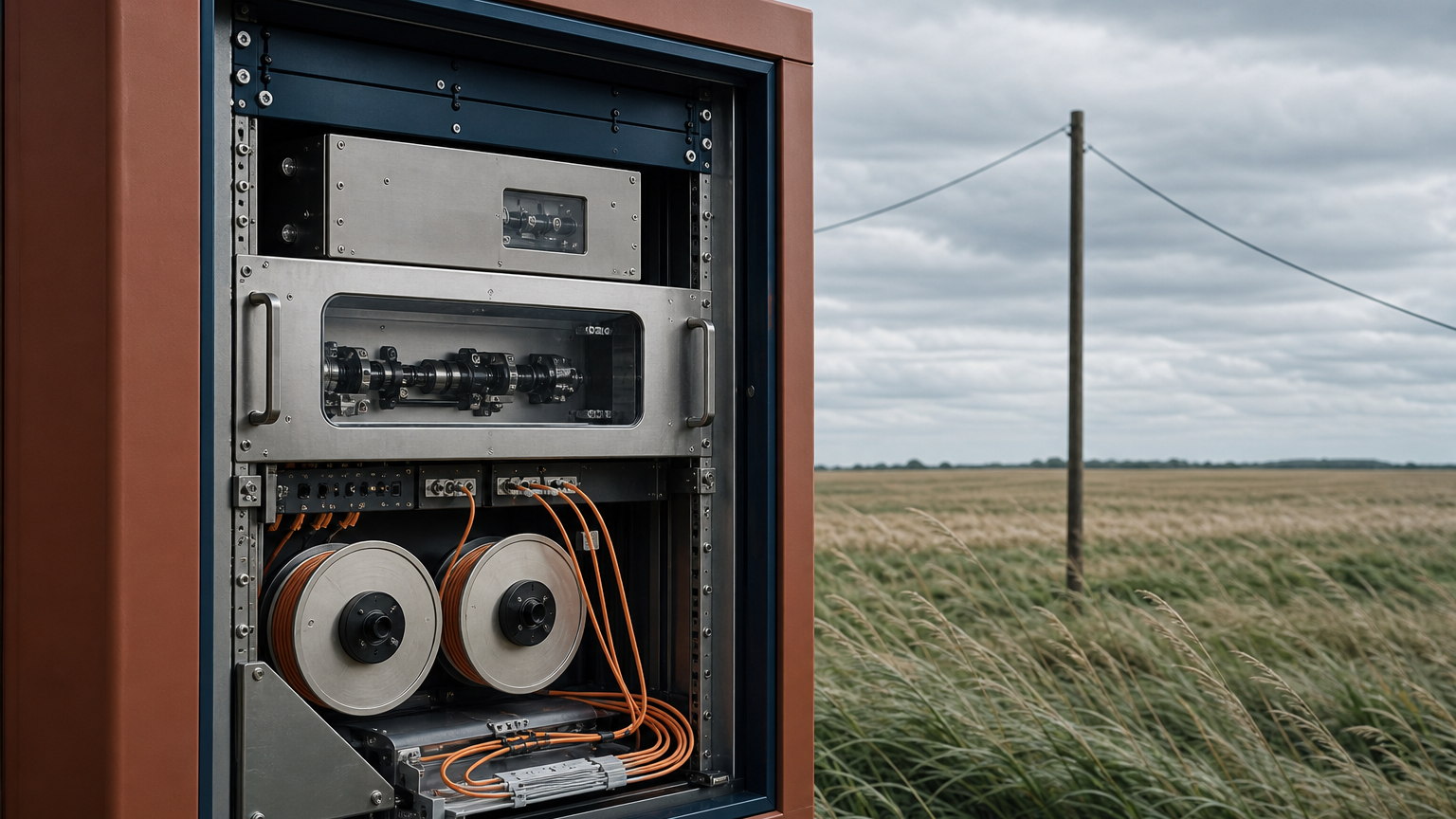
In a health kiosk in the Thuringian village of Sundhausen, a participant sat down for a fifteen-minute simulated consultation with a physician at the university hospital in Jena, and audio and video ran without interruption. The keys protecting that traffic came from polarization-entangled photon pairs sent down installed telecommunications fiber. A German research team has now published its field report, pairing entanglement-based quantum key distribution on the BBM92 protocol with end-to-end post-quantum cryptography running sntrup761 and ML-KEM-768. The network spans about 140 kilometers in total, arranged as two links through a trusted node at Erfurt: 70 kilometers from Sundhausen with 51 of them aerial, and 69 kilometers from Jena that are almost entirely buried.
The fiber construction shows up in the measurements
On the aerial-heavy village link the secure key rate averaged 12.7 bits per second with a standard deviation of 10.3, at a quantum bit error rate of 13.3 percent. On the mostly buried Jena link the same system produced 22.2 bits per second with a deviation of 4.7, at an error rate of 6.1 percent. Nearly twice the key rate on the buried link, less than half the error rate, and an error-rate spread of 0.8 points against 9.6. The authors report that error-rate variation on the aerial link correlated most strongly with wind speed. The two links were operated separately, for 22 days and 2 days respectively, so the 22-day endurance figure belongs to the village link alone, and the final hop into the hospital used previously generated keys from a local keystore.
What a hospital would actually be buying
The quantum keys were pushed straight into standard Linux VPN tunnels between adjacent nodes, with no dedicated key management system and no modification to the existing medical systems, which is the commercially load-bearing choice for buyers who cannot re-platform. Trusted nodes remain the structural caveat: four European cybersecurity agencies hold that end-to-end security cannot be achieved over long distances using fibre-based quantum key distribution, and place the clear priority on post-quantum cryptography. Set against a breach record in which vulnerability exploitation accounts for 20 percent of healthcare intrusions, a hardened regional link answers one threat model and leaves the other untouched.
Quantum entropy without the fiber
The debate usually settles into quantum key distribution versus post-quantum cryptography, and both depend on the randomness the keys are made from. Chip-scale quantum random number generators, such as Quantum eMotion's electron-tunneling design reported at 1.8 gigabits per second and already running with Becton Dickinson and GreyBox Solutions in remote patient monitoring, deliver that entropy at the endpoint itself, with no dedicated fiber, no weather exposure and no intermediate node to trust. Quantum-grade keys and quantum key distribution are separable purchases, and for most clinical endpoints the chip fits the installed base.
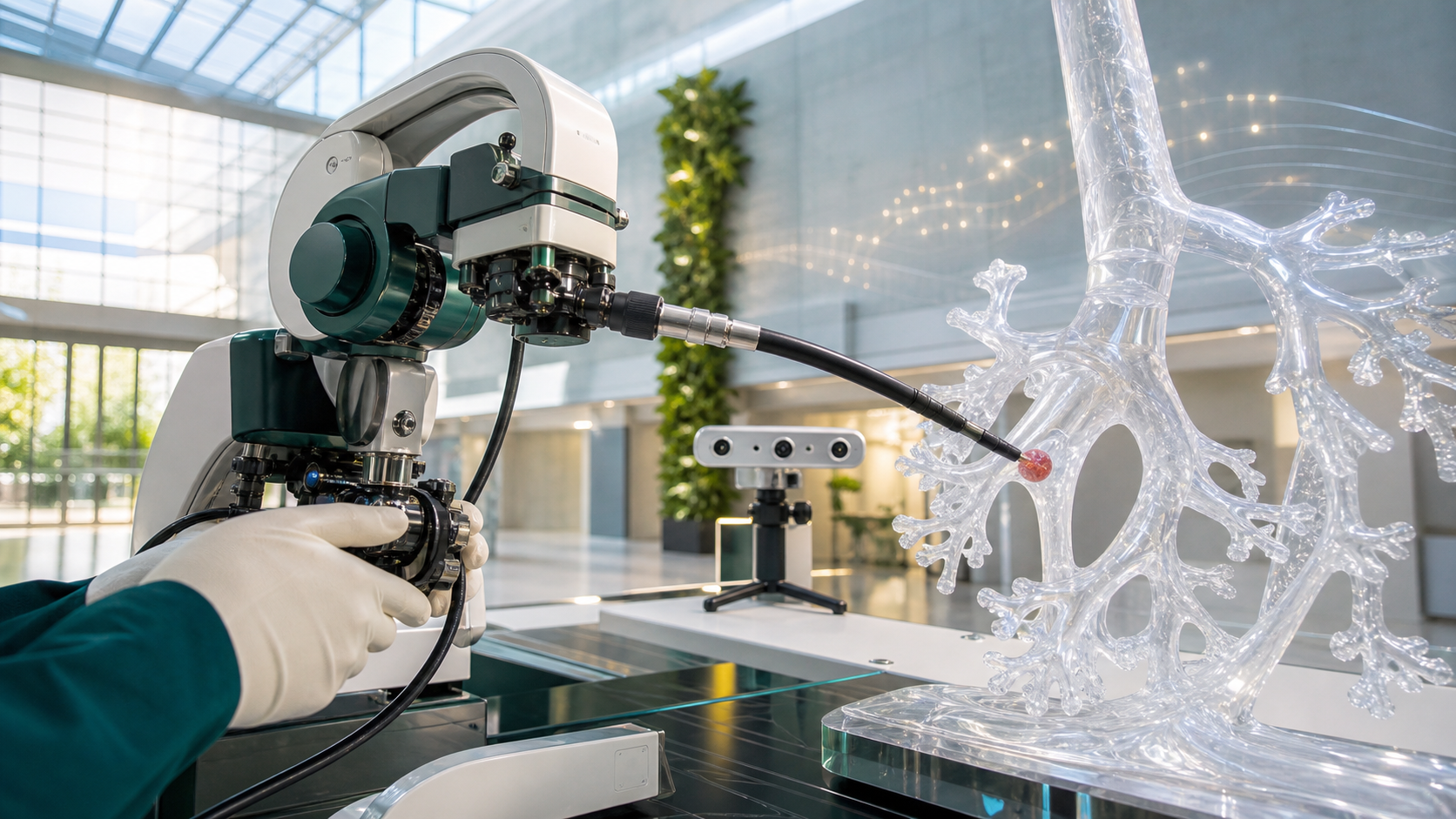
The CT Map Moves During Robotic Bronchoscopy
Why the CT map moves
A bronchoscopy route begins as a CT map of the lungs. By the time a clinician advances a scope, the patient is positioned, sedated and ventilated under different conditions. Airways can deform or partially collapse, leaving a small peripheral lesion in different coordinates relative to the planning image. This CT-to-body divergence is the engineering problem behind Johnson & Johnson's MONARCH QUEST 3 software update. The August 17 announcement describes changes to registration and navigation, a three-dimensional compass overlay, wider compatibility with cone-beam CT systems and one-click segmentation of lung nodules.
What the clearance establishes
The FDA public record lists K260382 for the MONARCH Platform, with a substantial-equivalence decision dated July 25, 2026. That places the finished update at TRL 8 of 9 under Quentir's shared readiness ladder: qualified for commercial release, with the final rung reserved for documented operational use of this exact version. The regulatory decision does not establish that the new features improve diagnostic yield or reduce complications. Johnson & Johnson's announcement relies on internal technical reviews for segmentation, registration and scope-tip estimation, without publishing a patient-level performance dataset for QUEST 3.
The clinical question remains open
A 2026 retrospective study of 331 MONARCH procedures provides an independent reference point. Adding mobile cone-beam CT did not significantly change diagnostic yield or complication rates in that single-center comparison, although procedure time fell and radiation exposure increased. The study predates QUEST 3 and cannot answer whether its AI nodule segmentation changes outcomes. It does show why a clear map is only one part of the pathway. Imaging, registration, navigation, tissue sampling and pathology all shape the result a patient ultimately receives. The version-specific outcome record will determine whether this update reduces uncertainty at the point where the scope, the lesion and the biopsy tool finally meet. Quentir reads the launch as a mature medical-device update with a valid market pathway and an unresolved question about incremental clinical benefit.
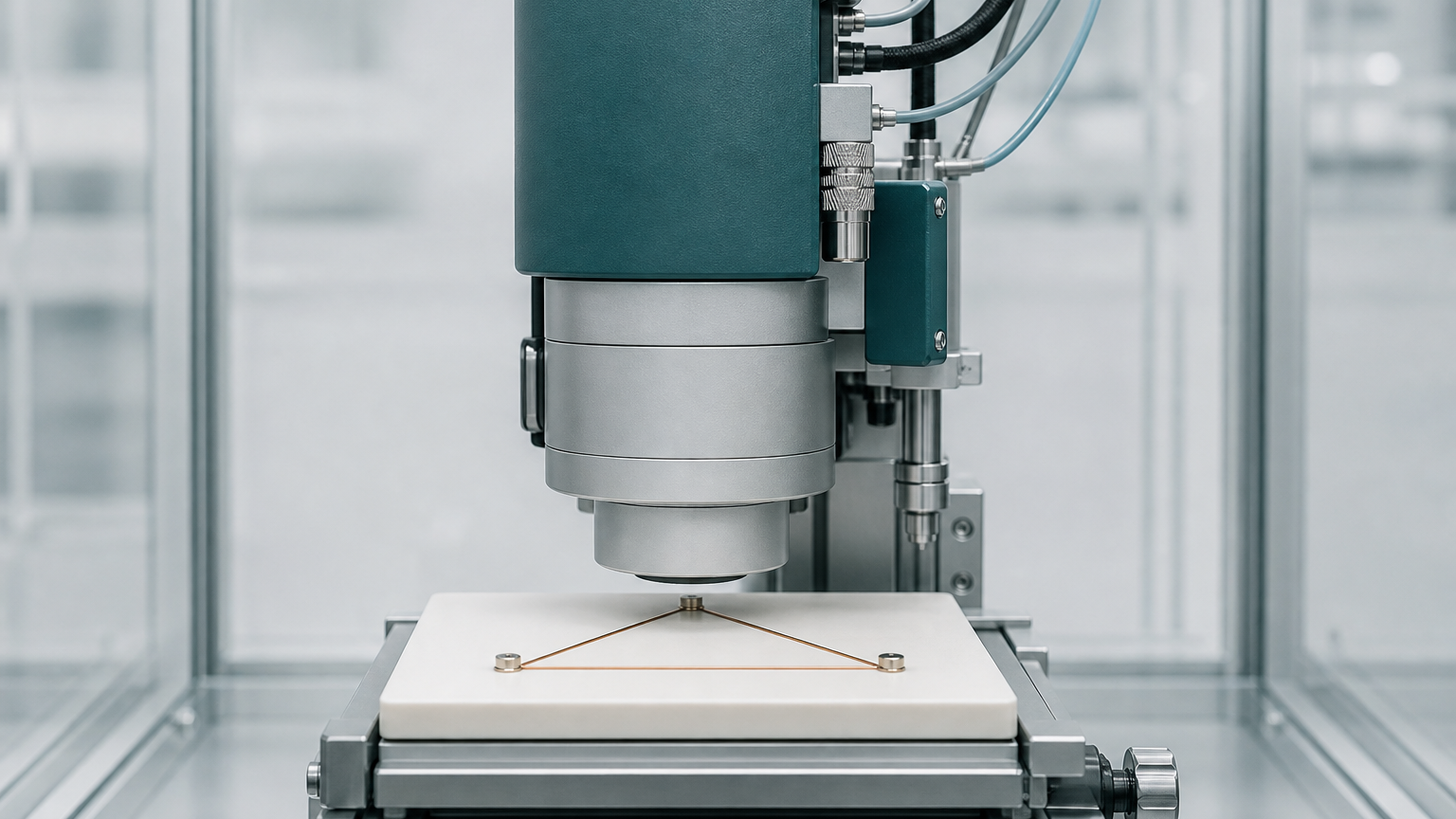
A Diamond Magnetometer Closes the Distance to Biomagnetism
A smaller gap between sensor and signal
Biomagnetic fields weaken sharply with distance, so the physical gap between a detector and the body is part of the sensitivity budget. Yuta Araki and colleagues have built a diamond NV magnetometer whose sensing head can sit about 2.0 millimeters from a sample. A compact microwave antenna helps set that geometry, while a light-trapping diamond waveguide makes more efficient use of the green laser that initializes and reads the sensor's nitrogen-vacancy centers. The integrated device addresses the heat and bulk that have limited high-sensitivity Ramsey measurements near biological samples.
What the laboratory result establishes
The peer-reviewed paper reports 2.93 picotesla per square-root hertz sensitivity across 100 to 400 hertz at 210 milliwatts of laser power. The measured temperature increase was approximately 13 kelvin. In a controlled test, the sensor detected a 77.7-picotesla field from a dry brain-field phantom at a 2.5-millimeter standoff, without signal averaging and with a signal-to-noise ratio of approximately 4.3. Quentir assesses the assembled system at TRL 4 of 9: a quantum sensing device validated in the laboratory on a phantom that imitates a brain-field pattern.
The clinical distance remains
The phantom does not reproduce movement, anatomy, variable spacing or the environmental interference of a living-subject recording. The authors also state that sub-picotesla brain signals will require further accumulation and improved sensitivity. A future magnetoencephalography or magnetocardiography instrument would need stable arrays, calibration and clinical comparisons as well. The current paper supplies no human dataset, workflow study, regulatory record or manufacturing claim. Those absences keep the result at the laboratory-instrument stage even though its geometry addresses a genuine near-body constraint. Quentir reads the paper as a bounded hardware advance. It joins optical efficiency to a short sensor-to-sample distance, reports each operating constraint quantitatively, and makes the next test easy to name: a living-subject measurement with a defined physiological signal and an established comparator.
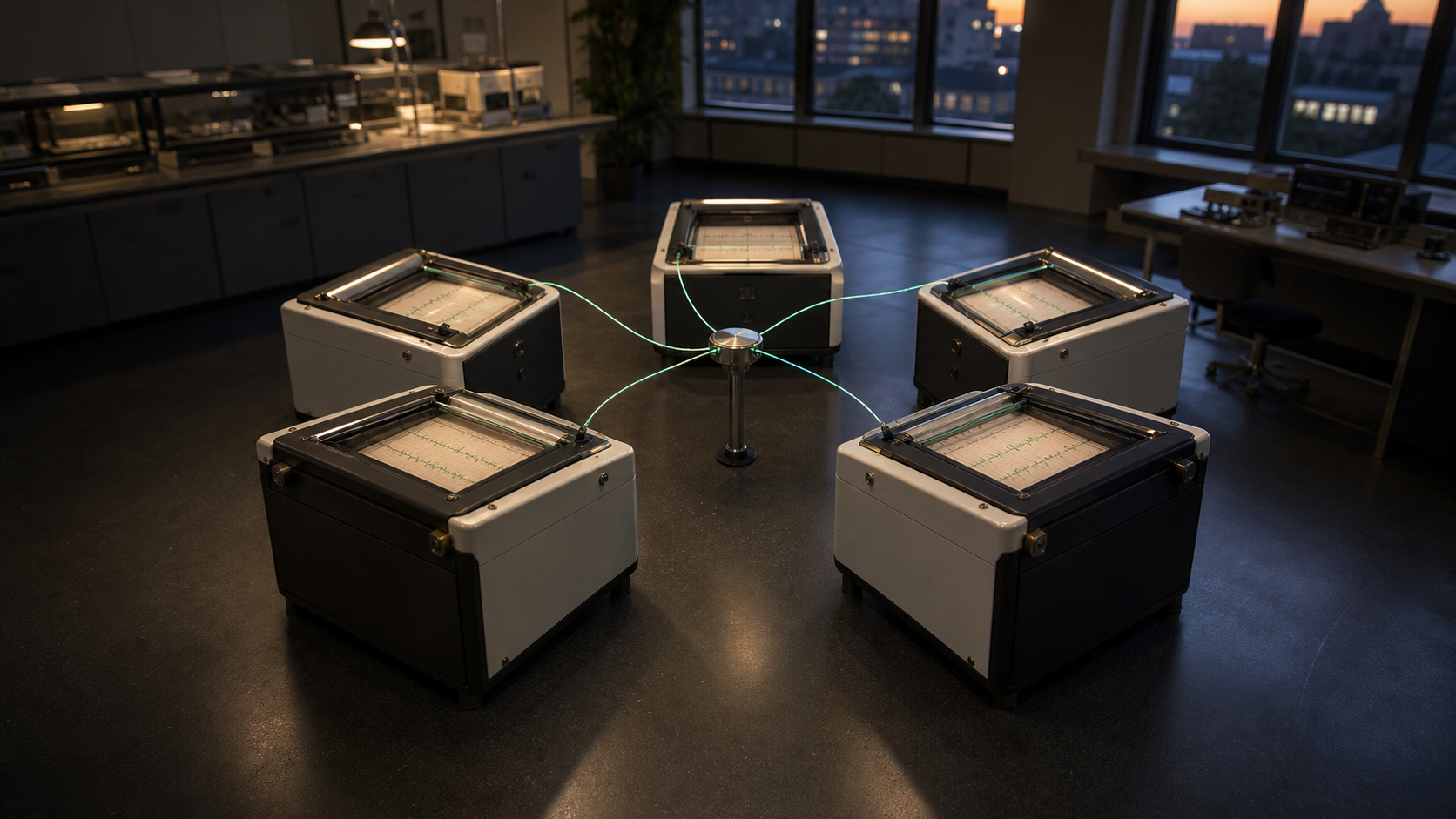
What Quantum-Inspired Buys a Federated ECG Classifier
A compact model for hospitals that cannot pool their ECGs
Hospitals, clinics and wearable makers each hold electrocardiograms they cannot simply pool, so collaborative model training moves the model instead of the data. A new preprint evaluates a hybrid quantum-inspired Kolmogorov-Arnold network for arrhythmia classification under federated averaging, where every site trains locally and transmits only model updates. Because each round's cost scales with model size, a smaller network makes the whole federation cheaper to run for every participant.
Measured savings, with clearly stated edges
On the public MIT-BIH benchmark the network used 37.35 percent fewer trainable parameters and cut communication cost by 24.89 percent; on the INCART dataset the reductions reached 44.81 and 36.41 percent, while most aggregate and minority-class metrics matched or improved on the baseline. The comparison runs against a plain multilayer perceptron on retrospective public datasets, and the federation is simulated, so the result marks a design direction rather than a clinical capability.
What the quantum label does and does not mean
The architecture borrows its learnable functions from quantum machine learning, in the form of single-qubit data re-uploading circuits, yet every calculation runs on classical computers. Quentir places this work at TRL 3 of 9 with the quantum pillar explicitly not applicable: functioning software on recorded data, no quantum processor anywhere in the loop. The honest summary is that federated ECG learning gained a smaller, cheaper collaborative classifier from quantum-derived mathematics, and the evidence record should carry it under exactly that description.
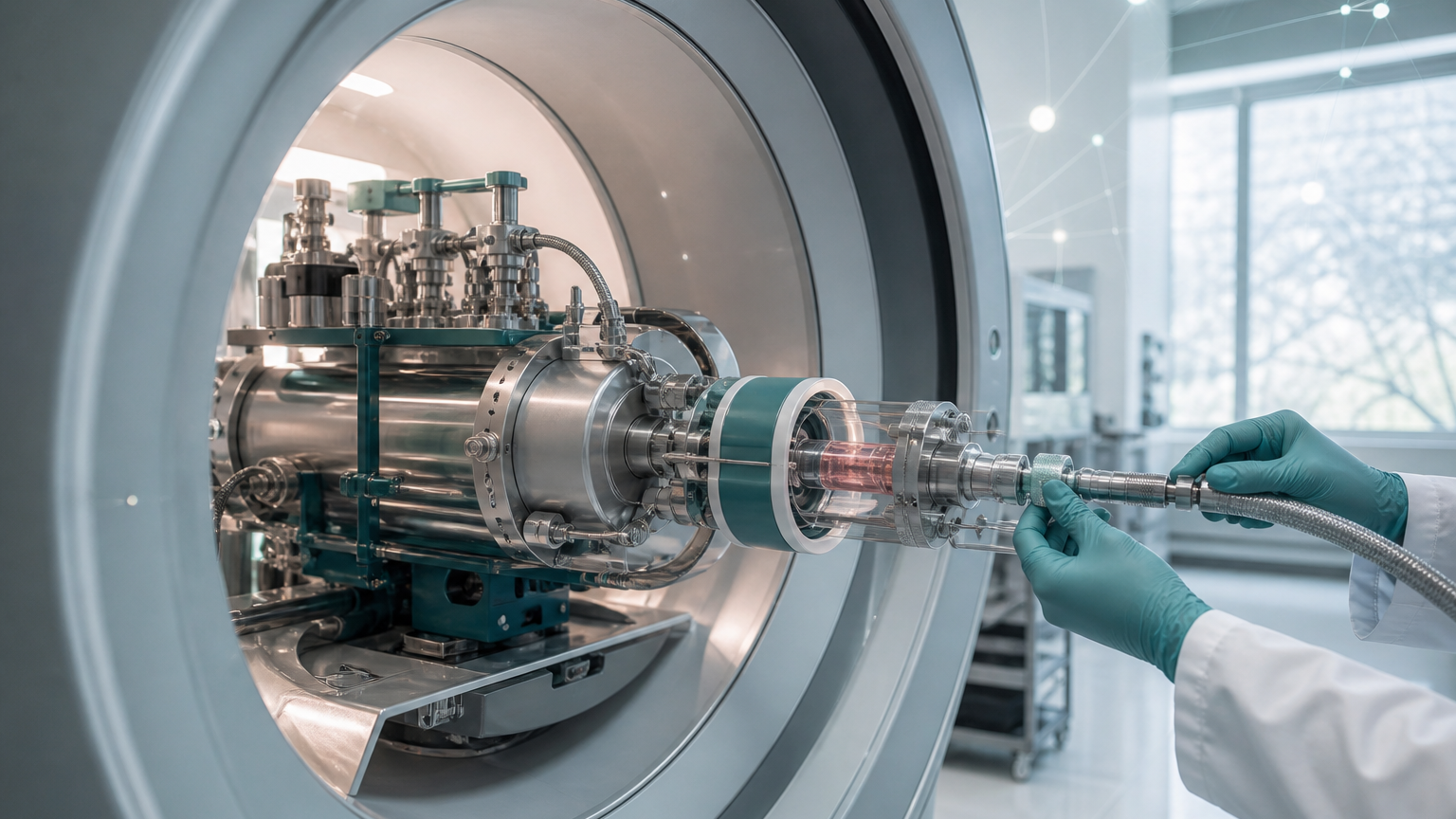
What Yonsei's Metabolic MRI Installation Has to Prove
A university project gets a deployment window
The RESQ consortium plans to install NVision's POLARIS platform at Yonsei University in early 2027. Backed by €2,572,500 in Horizon Europe funding, the three-year program joins NVision, Yonsei University, Ulm University, and Tesla Dynamic Coils. Together they are building a metabolic MRI installation for higher-resolution research on brain metastases. The public project record assigns concrete work: reproducible parahydrogen generation and storage, tailored radiofrequency pulses, compressed sensing, machine learning, and dedicated dual-tuned brain coils. These details turn a broad quantum-health ambition into a dated engineering program with named owners.
The scanner is only one part of the workflow
Hyperpolarization can strengthen the MRI signal from selected metabolic agents for a limited period, allowing researchers to study what tissue is doing alongside its anatomy. That advantage can disappear if gas preparation, sample transfer, coil performance, pulse design, or image reconstruction varies. RESQ therefore has to integrate chemistry, hardware, software, scanner time, and operating procedure. Its stated goal of doubling spatial resolution is a consortium target. The current public record does not report a completed Yonsei installation, a disease-model result, a patient study, diagnostic accuracy, or a change in treatment.
Preclinical work is the next meaningful test
Yonsei is expected to validate the workflow using preclinical brain metastasis models. That stage can show whether the complete system produces stable metabolic maps in biologically relevant models and whether smaller lesions become more visible. It cannot yet establish performance in patients. Quentir reads RESQ as a quantum-sensing implementation program at TRL 4 of 9: the underlying hyperpolarization platform operates in research settings, while the new disease-specific workflow still awaits installation and integrated preclinical validation. The decisive question for the project period ending in April 2029 is whether preparation, acquisition, coil behavior, and reconstructed images can be reproduced beyond one expert site. A portable workflow would move quantum sensing closer to useful medical infrastructure; a result dependent on one installation would leave clinical translation much farther away.
The MRI Implication of a Single Copper-Oxide Plane
The result is one atomic plane
A team led by researchers at Fudan University and the University of Science and Technology of China has fabricated a single-layer cuprate containing one superconducting copper-oxide plane. Published in Nature on August 12, the experiment reduces Bi-2201 to its ultimate two-dimensional limit. The monolayer retained superconductivity, although its optimal transition temperature was about ten percent lower than in thicker material. Fine control of oxygen content then let the researchers follow the sample from an insulating state, through an anomalous metallic regime, and into superconductivity. This is a basic-physics achievement built on delicate fabrication and a laboratory instrument designed for precise in-situ tuning.
The medical relevance begins with the magnet
MRI depends on a strong, stable magnetic field to align protons in the body before radiofrequency pulses and sensors turn their response into anatomical images. That creates an MRI materials pathway for this research, but the connection sits far upstream. The paper reports no magnet winding, imaging coil, scanner prototype, patient study, or medical-device test. Its contribution is a cleaner experimental platform for understanding how high-temperature superconductivity changes when the active material is reduced to one copper-oxide plane.
The distance to care remains useful to measure
A hospital magnet requires far more than a superconducting transition. Engineers need scalable conductors, high current under strong fields, reliable joints, mechanical strength, controlled cooling, quench protection, field homogeneity, and compatibility with a complete scanner. The new monolayer does not answer those engineering questions. It helps make the earlier materials questions more exact. Quentir reads the result as a sensing story at the laboratory-materials stage: credible MRI relevance through superconducting magnet science, paired with a clear boundary around present readiness. The next meaningful step would connect the one-plane physics to a thicker, manufacturable material with measured current or field performance.
A Paid Quantum Drug Project Meets a Four-Stage Validation Ladder
The next calculation became funded work
China Securities Journal reported on August 14 that Shenzhen Jingtong Life Science tested Boson Quantum's approach on a drug-target structure problem in June and moved to a paid quantum drug-discovery engagement in July. The client named two difficult tasks: finding the precise binding conformation of a drug-target complex and calculating its energy after binding. It also reported an advantage in conformation search. The work now covers new molecules associated with healthy aging. The article says drug-related intellectual property would be jointly owned if the project succeeds, while software and algorithm rights would remain with Boson. The account is commercially meaningful because a buyer has funded a defined computational problem, yet the public article provides no molecule list, hardware configuration, classical baseline, runtime, success metric, or laboratory confirmation.
The same report sets a demanding standard
GuoDun Quantum executive Wang Zhehui supplied a four-stage validation ladder in the same article. It begins with benchmark advantage and initial industry validation on real quantum hardware. The decisive stages are superiority to classical algorithms under equal conditions and reproducible business outcomes. The engagement is commercially concrete, but the disclosed record cannot yet assign it a validation rung because real-hardware use and a controlled comparison remain undisclosed. Funded work may support learning, access, feasibility, or method development. It establishes customer demand without settling the scientific comparison.
The medical handoff remains ahead
Quantum computation would sit near the beginning of drug development. It may help decide which molecules deserve synthesis and testing, though it cannot establish safety, dosage, biological effect, or clinical benefit. Quentir reads the account as a useful commercial milestone with a built-in limit. The reported planned IP allocation recognizes a reusable computational method on one side and, if the project succeeds, a medicine that must survive laboratory, preclinical, and clinical work on the other. Paid work has started before a reproducible pharmaceutical result. The next public milestone that changes the judgment would connect an equal-condition computational comparison to a wet-lab result that another team can understand and repeat.
A Photosensitizer Has Two Jobs Before Quantum Computing Helps
Two molecular jobs define the target
A light-activated cancer drug must absorb light in a useful therapeutic window and turn that energy into chemistry that damages a tumor. Xanadu and the University of Alberta announced on August 13 that they will develop quantum algorithms for photosensitizer design. The research partnership follows a December 2025 preprint that specifies both desired outputs: cumulative absorption and intersystem crossing rates linked to reactive-oxygen production. The paper applies proposed fault-tolerant algorithms to BODIPY derivatives, including substitutions that are difficult for standard computational chemistry. This is a sharply defined pharmaceutical calculation, although the announcement reports no new molecular result, hardware run, candidate compound, or development timeline.
The resource estimate belongs to a future machine
The preprint studies active spaces of 11 to 45 spatial orbitals and estimates a need for roughly 180 to 350 logical qubits. Logical qubits are encoded across physical qubits and require error-correction overhead, so that estimate cannot be compared directly with headline physical-qubit counts. Xanadu therefore places the work in fault-tolerant quantum computing, while Professor Alex Brown contributes expertise in photodynamic therapy chemistry and the excited-state processes that classical methods struggle to capture. The partnership joins an algorithm team and a chemistry group around a named failure point in simulation. Its technology readiness remains early because no calculation has yet been reported on suitable hardware or checked against laboratory measurements.
Clinical usefulness still runs through the laboratory
Photodynamic therapy is an established local treatment for selected cancers and precancers, but better photosensitizer calculations must still survive pharmacology, toxicology, formulation, delivery, and trials. A future quantum result would need comparison with measured spectra, photochemical rates, and strong classical baselines. Quentir reads the partnership as a disciplined research bet: the biomedical quantities are prespecified, the molecular class is named, and the resource assumptions are public. Progress will become legible when the workflow reproduces a known molecule's behavior and then ranks unfamiliar candidates well enough to save synthesis cycles.

A One-Number Test for the Brain's Signal Carriers
One number bounds what a brain signal can carry
A preprint posted to arXiv on August 11 gives the quantum-brain debate something it has lacked: a shared standard. Eran Kopel shows that spectral distinguishability alone bounds the labels a biological oscillator can carry by its quality factor, two pi times frequency times coherence time. The ceiling holds for any substrate and any mechanism, takes no position on quantum effects in biology, and can be computed from two published quantities. Collective vibrational modes, endogenous electromagnetic fields, microtubule excitations and oscillatory phase codes now face one arithmetic instead of four separate arguments.
A proposed cortical microwave field fails by every route
Applied to a recently proposed 30 gigahertz field inside cortical columns, the screen returns a quality factor of 0.19, a linewidth five times the carrier frequency. The rescue of a driven, spectrally narrow emitter requires a resonant cavity the model's own geometry forbids, and an independent metabolic-power bound is exceeded by five to nine orders of magnitude. Of eleven screened carriers, only the low-frequency neural rhythms pass. High-frequency molecular carriers fall to brevity, and the fragility argument the debate assumed proves unnecessary.
Braintech rides the rhythms that pass
Closed-loop EEG platforms already work in the frequency range the screen favors, portable designs keep maturing, and national programs are putting dates on commercial neurotechnology. Quentir reads the screen as inexpensive governance for an expensive decade: state the frequency, state the coherence time, and accept the ceiling they imply, with quantum sensing as the measurement arm being developed to pin those numbers down in living tissue.
Korea Moves Medical AI Oversight Upstream
Trust moves from one product to its maker
South Korea's Ministry of Food and Drug Safety has issued an 81-page guide for an organization-level medical AI certification. The assessment covers software quality, safety management, protection against electronic intrusion, and AI controls across the manufacturer. Applicants must provide manuals, procedures, development records, and material on transparency and explainability. Review combines document assessment with an on-site investigation. The result applies to the certified organizational unit for three years, giving MFDS a way to examine how a maker develops, tests, monitors, maintains, and changes AI software across more than one product. That continuity matters when several models share one development system.
Clinical learning can continue after authorization
For eligible standalone medical-device software, certification can support a real-world evaluation pathway. Some clinical-evaluation material may initially be replaced by product information and a real-world evaluation plan. The resulting report follows after authorization, within a period that can extend to three years, and MFDS must conduct an additional review before the authorization is extended. This can shorten the distance between development and clinical use, while moving some uncertainty into hospitals. Version history, post-deployment monitoring, incident channels, and the ability to detect performance drift become part of the safety system.
The certificate has a boundary
The guide requires clinical participation, AI risk management, red-team activity, software-component records, security responsibility, training-data governance, and monitoring in clinical settings. Those controls can support disciplined development. They do not prove that every model from an organization holding the recognition performs well for every patient population or workflow. Quentir reads Korea's framework as an exchange: regulatory flexibility for a demonstrably mature operating system, paired with continued product-specific scrutiny and later real-world review. The decisive test comes after certification, when a clinician questions an output, a hospital detects drift, or an update changes the model that patients encounter. Those local signals determine whether organization-level trust remains connected to the clinical reality of one population and software version.
A Korean Pharma Webinar Names the Quantum Workload
The announcement names the computing path
KPBMA's first AI drug-discovery webinar, focused on quantum computing, is scheduled for August 13. Tech42 reports that SDT plans to present a hybrid quantum computing stack built around its QuREKA service. The announced environment links CPUs, GPUs, simulators, and quantum processors through a CUDA-Q development layer. Participants are also expected from QuantWare, Quantum Intelligence, and the Korea Research Institute of Bioscience and Biotechnology. The public account names molecular simulation, candidate search, and ADMET prediction as possible uses. Those are concrete pharmaceutical tasks, but the source remains an event preview. It provides no methods paper, dataset, benchmark table, candidate molecule, or measured advantage.
Portability can expose what the QPU contributes
The useful feature may be the ability to run one drug-discovery workload across different backends. A common development environment can keep the surrounding classical code visible while a team compares a simulator, GPU, and available QPU. That does not establish better performance. It can make the comparison easier to inspect. Runtime, accuracy, resource use, variance, and sensitivity to hardware noise all become part of the result. Pharmaceutical researchers can then ask whether the quantum step improves a defined endpoint or only changes the route used to compute it.
The pharmaceutical result is still open
ADMET covers how a drug is absorbed and distributed, how it is metabolized and excreted, and whether it is toxic. Each property depends on different data and validation methods. SDT's preview does not yet name an endpoint, baseline, or test set. Quentir therefore records two separate steps: SDT has described a multi-backend architecture, and KPBMA has created a pharmaceutical forum for it. Readiness for the announced applications remains unranked until a reported experiment shows what ran on the QPU, what stayed classical, and how the output compared with a strong existing method.
Australia Funds a Quantum Window Into Living Brain Tissue
The project begins before the clinic
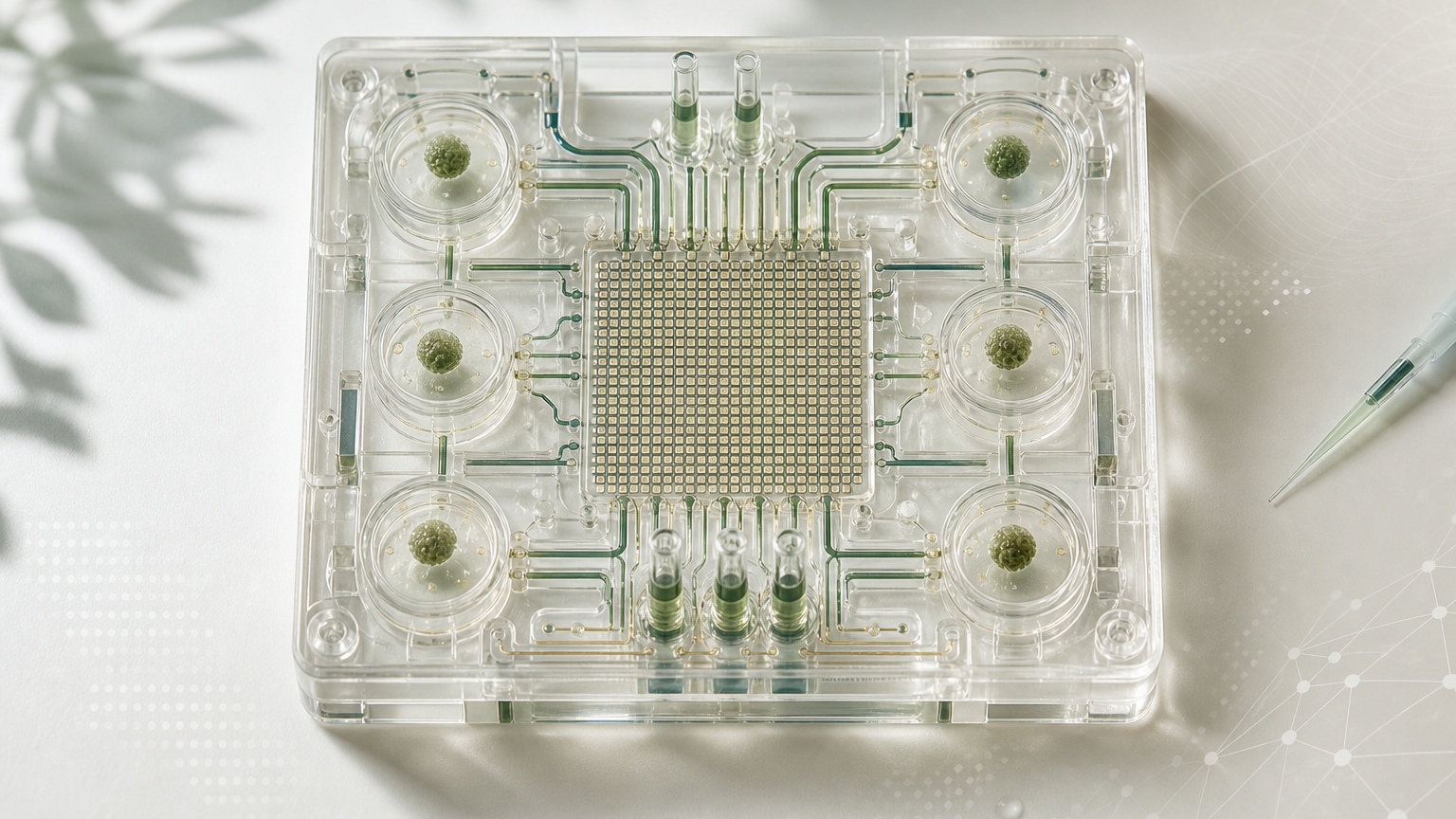
Australia has awarded AUD 2.1 million to a University of Melbourne consortium developing a brain-on-chip platform for neurological drug research. The partners are Chromos Labs, Tessara Therapeutics, Quantum Brilliance, and Axol Biosciences. Their stated plan joins human neural micro-tissue to quantum tools that measure electrical activity in real time. The target is preclinical work: observing how laboratory-grown neural tissue responds to candidate therapies before a claim reaches patients. The University announcement names Alzheimer’s disease, schizophrenia, epilepsy, and anxiety disorders as intended fields of use. A later Team France Export account repeats that list and explicitly credits the University source. The disease names describe ambition, not validation. The public record reports a funded development program and no integrated-system result or clinical study.
Electrical behavior can reveal what a final endpoint misses
Neurons communicate through changing electrical states. Continuous measurement can show when a tissue model responds, how long the response lasts, and whether activity returns to baseline. That makes the platform relevant to preclinical drug discovery, where an earlier rejection of a weak candidate can save years of work and reduce the chance that patients enter a trial built on a fragile signal. The benefit depends on control. Tissue batches vary, microfluidic conditions drift, and sensitive electronics can mistake ordinary noise for a drug effect. A useful platform will need blinded comparisons, repeatable preparation, reference measurements, and a clear path from raw signals to the claimed biological response.
The quantum component still needs a technical record
The project accounts describe quantum technology as part of the real-time measurement layer. They do not disclose the sensor architecture, detection limits, noise floor, calibration method, or comparison instrument. That keeps the readiness answer open. Quentir classifies the function as quantum sensing while withholding a numbered readiness level from a grant announcement with no reported integrated result. The next credible milestone is an assembled laboratory system tested on human neural micro-tissue, with controls that distinguish a drug response from sensor noise, tissue variability, and software choices. If that milestone lands, the project may become a better filter for neurological drug pipelines long before it becomes anything a patient or hospital encounters directly.
What the Word Quantum Means on a Hospital CT Scanner
The label describes a detector
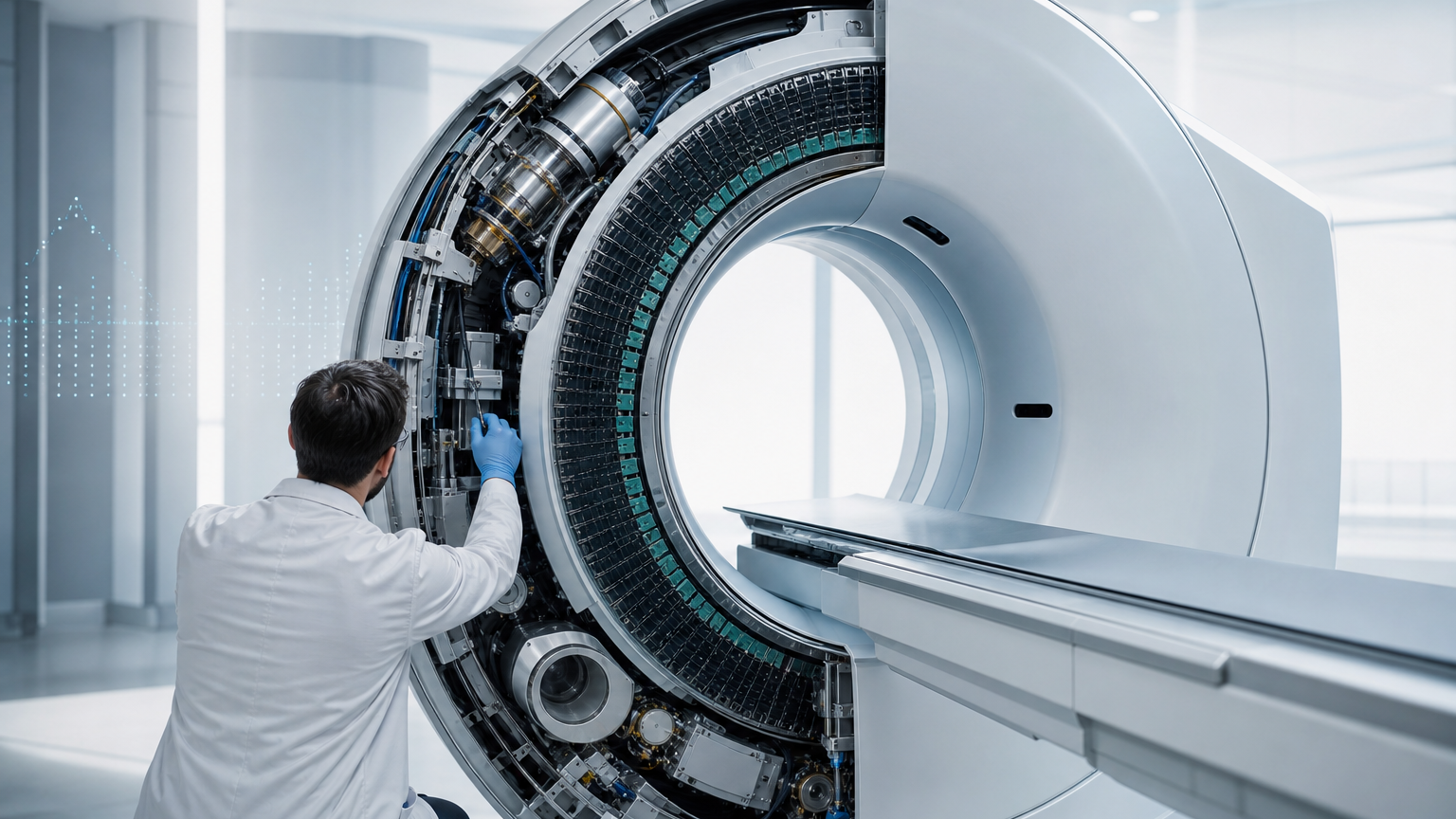
Siemens Healthineers has introduced a second generation of its photon-counting CT family in Vietnam. The NAEOTOM Alpha Class is a commercial imaging platform for hospitals, with versions aimed at routine imaging, cardiology, and tertiary or specialist centers. The word quantum points to the detector's handling of discrete X-ray photons. No qubits run a computation inside the gantry. Tiền Phong reports that all three models offer 0.2 millimeter ultra-high-resolution slices and multi-energy data. Alpha.Pro and Alpha.Peak reach temporal resolution down to 66 milliseconds, while Alpha.Peak reaches a reported scan speed of up to 737 millimeters per second.
One platform now serves three clinical settings
The product segmentation turns a physics story into a hospital procurement question. A routine radiology department, a cardiac service, and a tertiary referral center carry different case mixes, motion problems, staffing needs, and service expectations. The same detector principle can therefore produce different value across institutions. Configuration-specific comparisons remain essential: image quality for the intended examinations, radiation dose, contrast use, reconstruction performance, throughput, training, uptime, and the clinical decisions influenced by spectral information. The launch also included SOMATOM On.site, a separate mobile head-and-neck CT system. Its presence makes the distinction useful. One device changes the detector architecture; the other changes where imaging reaches a critically ill patient.
The technology is already in clinical use
Siemens says the first NAEOTOM Alpha entered clinical use in 2021. The company describes its detector as directly converting X-rays into electrical signals while measuring each photon's energy, making spectral information available with every scan. That places the underlying sensing technology at TRL 9 on the shared readiness ladder. Commercial maturity still leaves a local buying question. Hospitals need to establish which model and protocols fit their patients, clinicians, facilities, and budgets. Precise language helps: photon-counting CT is an advanced diagnostic-imaging technology grounded in quantum physics, and its performance belongs in ordinary clinical and operational comparisons.

Madrid Is Buying a Quantum Computer for Hospitals to Share
Madrid has funded a shared quantum machine
The Comunidad de Madrid plans to buy a public quantum computer, install it at the Universidad Politécnica de Madrid, and make it available to universities, research centers, hospitals, companies, and technology startups. The regional government says the system will be delivered in 2029, with about EUR 2 million allocated through that year. Hospitals are explicitly inside the intended user community. The announcement is less specific about what they will do with the machine. It names no vendor, architecture, qubit count, medical project, clinical partner, performance result, or data pathway. Madrid has therefore made a concrete infrastructure commitment while leaving the medical program open.
Hospital access arrives before clinical utility
The phrase hospital access matters because it gives clinical and biomedical institutions a place in the future regional quantum community. Access does not establish a hospital deployment or a validated healthcare use. Medical relevance could eventually emerge through molecular simulation, optimization, biomedical analysis, or another problem that researchers have not yet formulated. Any such project will also inherit healthcare's demands for sensitive-data control, reproducibility, clinical accountability, and continuity of support. A public machine may reduce one barrier to experimentation. It cannot supply the missing use case, classical comparator, or validation path.
The service around the machine will decide its value
Computerworld Spain places Madrid beside existing quantum infrastructure in Barcelona, the Basque Country, and Galicia. Madrid's distinctive claim is regional public ownership. That choice creates a scientific commons whose future rules will shape which projects receive time and support. The useful comparison is a shared imaging or genomics facility: the apparatus matters, while skilled intermediaries make it usable. By 2029, the machine's presence will be easy to verify. More informative outcomes will include whether hospital teams used it, whether projects had strong classical comparisons, whether negative results remained available, and whether public ownership widened participation. Madrid has bought time to build that institution. The first medical contribution may be a clearer map of where quantum computing helps, where it does not, and what a credible next experiment requires.
Inside the 156-Qubit Enzyme Calculation
QC Ware reports a molecular calculation on quantum hardware
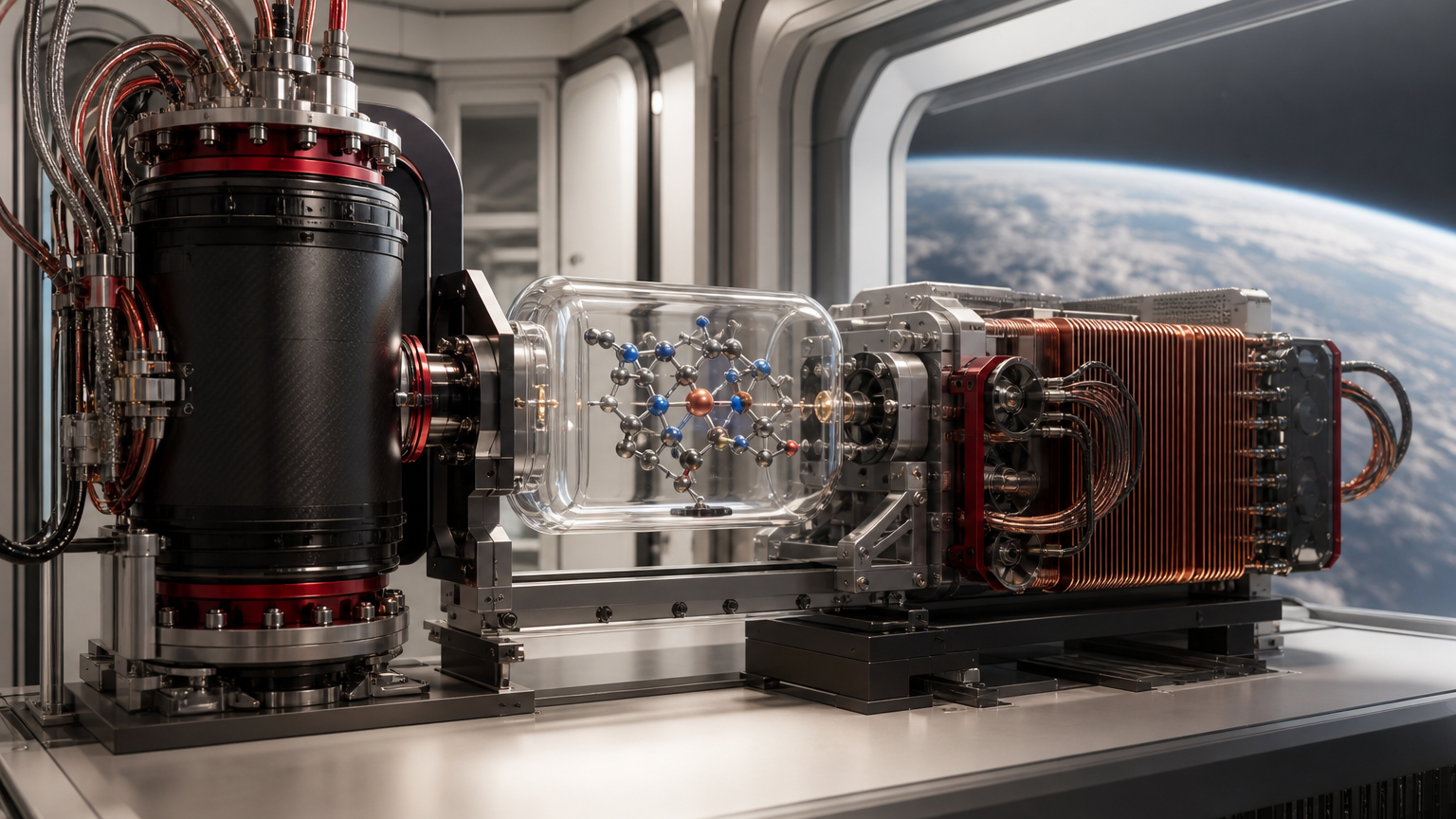
QC Ware says it calculated the electrostatic interaction energy of nitric oxide reductase by combining GPU-accelerated molecular modeling, classical chemistry methods, and quantum measurements on IBM's 156-qubit Heron processor. The enzyme is chemically demanding because its active region contains metal. The public announcement makes the electrostatic interaction energy calculation concrete, but it does not disclose the molecular partition, circuit design, measurement count, error mitigation, reference value, or final numerical error. The release therefore supports a precise statement: QC Ware reports that a medically relevant class of molecular calculation reached named quantum hardware. It does not yet show that the quantum step improved the result.
The architecture has a clear division of labor
The hybrid chemistry workflow combines Promethium, GPU-accelerated molecular modeling, classical chemistry methods, and quantum measurements. The release does not disclose how work was partitioned among them. IBM's published description of Heron and System Two provides useful architectural context: its quantum processors operate with classical runtime servers and methods that divide larger calculations. The QC Ware release is the source for the later 156-qubit hardware claim. It also says the demonstration is not currently an integrated Promethium product capability. That sentence prevents a hardware claim from being mistaken for a production service.
The missing benchmark defines the next milestone
The announcement reports no quantum advantage and offers no comparison against a strong classical workflow for the same chemical task. Qubit count cannot supply that missing result. A buyer would need comparative accuracy, resources, runtime, repeatability, and a decision consequence for chemists. The public record therefore places the work at TRL 3: a vendor-reported hardware proof of concept for one molecular property. Its product boundary is commercially informative because it separates an experimental module from the platform available today. The next persuasive record would show what the quantum measurements add at a fixed cost or error, and whether that contribution changes a research decision.
The Same Kind of AI Explanation Split the Room
One interface, two kinds of reader
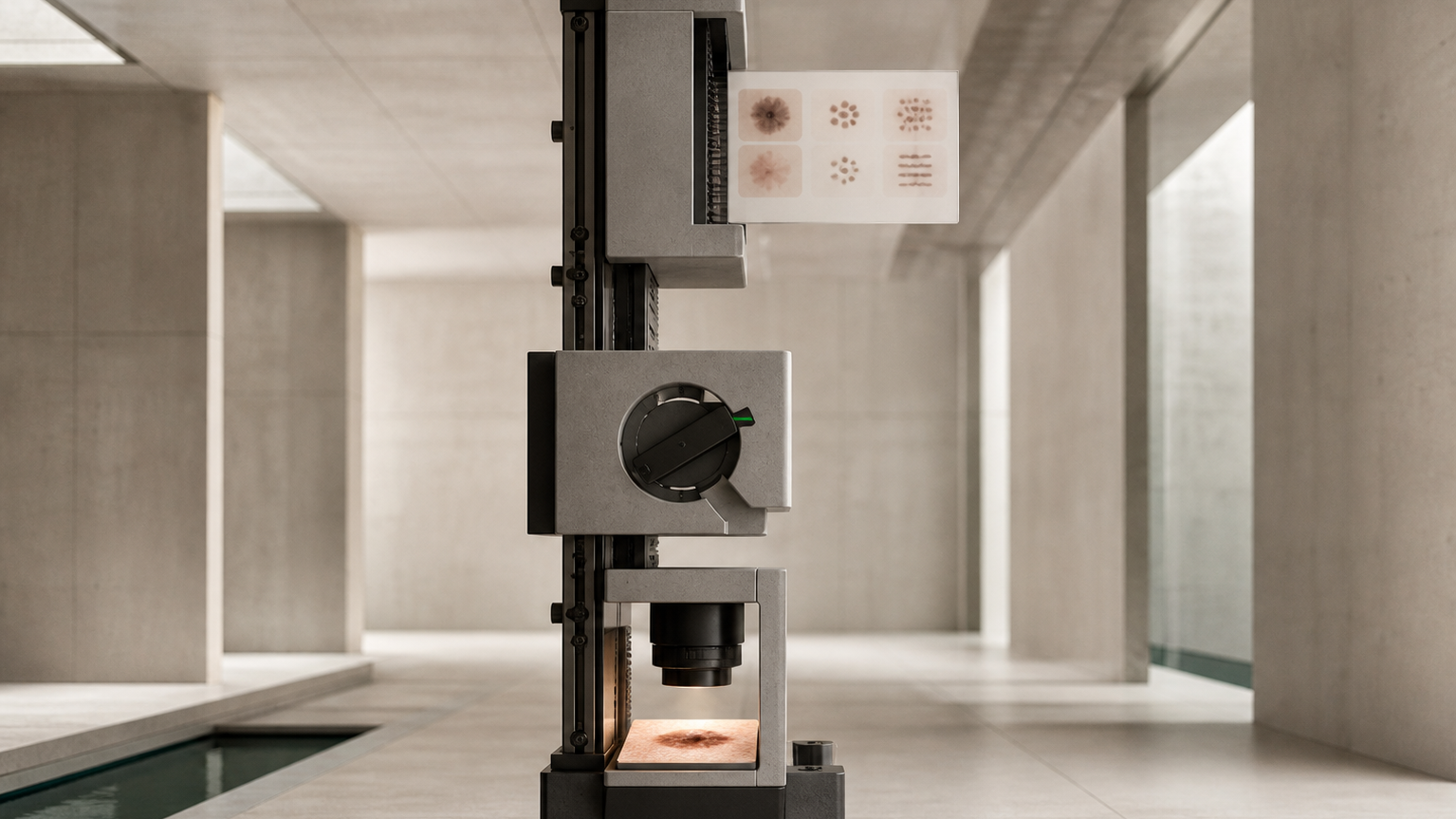
A Nature Medicine study tested four forms of AI assistance in dermatology with 623 lay participants and 153 primary care physicians. The two groups completed different diagnostic tasks, yet the pattern across the experiments was clear: help from a strong model could improve average performance while exposing the most deferential users to larger errors when the model was wrong. For non-experts, a fluent LLM rationale carried particular force. They trusted the language whether the diagnosis was right or wrong, and vague or generic accounts could feel especially convincing. The result turns automation bias into an interface problem, not only a user-training problem.
The order of the screens changed the behavior
Participants were also assigned to different sequences. Some formed an initial diagnosis before seeing the model's suggestion; others received AI assistance before making their decision. The human-first workflow preserved more room for independent reasoning, while AI-first presentation produced stronger anchoring. Clinicians were more resilient to incorrect advice and gained the least diagnostic accuracy from LLM explanations, although prose could help their confidence track accuracy. The study therefore separates explanation quality from explanation placement. A sound model and readable rationale can still have a different effect when the model speaks first.
Why this belongs in hospital technology review
FDA, Health Canada, and MHRA principles already say that transparency for machine-learning medical devices depends on the audience, context, media, timing, and communication strategy. This study gives explanation timing a concrete clinical meaning. A hospital buys more than an algorithm: it adopts a sequence in which a nurse, physician, specialist, or patient encounters the output. The experiments do not prove that any named commercial product is unsafe, and they do not cover every care setting. They do show that an average accuracy gain can hide a failure mode concentrated among people with the least independent knowledge. No quantum technology was tested. The lesson will still matter if future quantum-assisted systems make medical models faster or more capable, because computation alone cannot decide when a human should see the answer.
The Helmet That Brings Brain Mapping Closer to Childhood
A scanner that moves with the patient
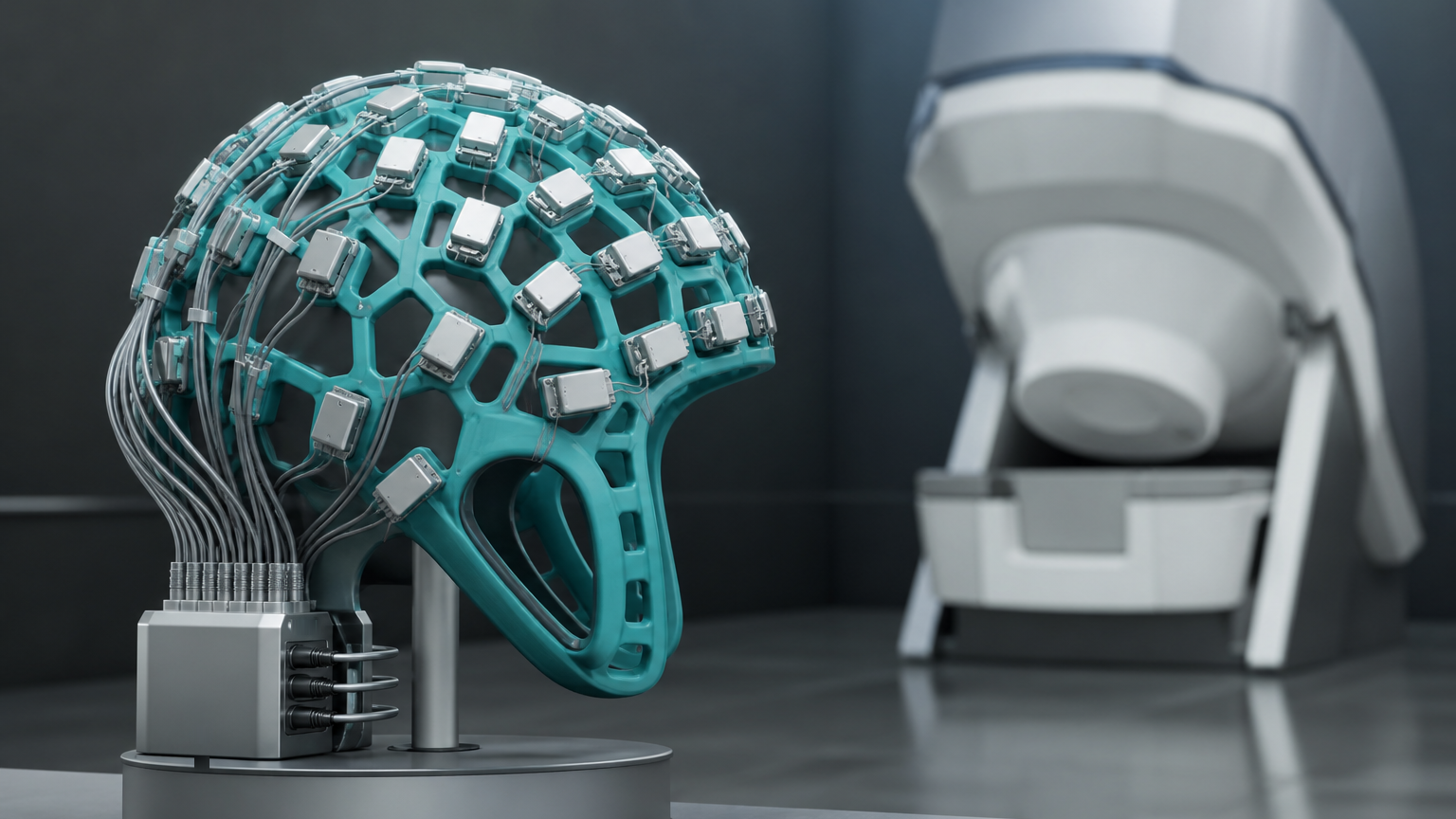
In a Wellcome impact story, Liberty can talk and move while a latticework helmet records the magnetic fields made by her brain. The seventeen-year-old is living with epilepsy, and Wellcome reports that her earlier diagnostic path included ten days in a hospital bed with electrodes placed directly on the brain. The helmet is an optically pumped magnetometer magnetoencephalography system, or OPM-MEG: a wearable brain scanner built around quantum sensors small enough to sit close to the scalp. That proximity matters for children, whose heads sit farther from the fixed detectors in conventional MEG equipment and whose movement can blur a scan.
The clinical comparison has arrived
A prospective Epilepsia study enrolled 68 people with refractory epilepsy for ninety-minute OPM-MEG recordings. The magnetic localization agreed with the epileptogenic zone defined by invasive intracranial recordings in 90 percent of the reported comparisons. Among 51 people who later underwent resection or thermocoagulation, sensitivity ranged from 73 to 85.7 percent depending on the outcome scale, while specificity remained near 65 percent. Those numbers make presurgical epilepsy mapping a clinically consequential use of wearable quantum magnetometry in the records reviewed here. They also keep the claim bounded: the system can contribute useful localization without carrying a surgical decision alone.
A pediatric clinic tests a different constraint
Wellcome reports that the United Kingdom's first dedicated pediatric OPM-MEG clinic is operating at Young Epilepsy with Great Ormond Street Hospital. The technology can fit smaller heads and tolerate more natural movement, bringing magnetic brain mapping into a setting where a rigid adult-sized scanner is especially difficult. The system still needs a shielded room, trained operators, calibration, broader multi-center validation, and regulatory qualification before ordinary hospital use. Its humane promise lies in time: earlier usable maps may shorten part of a long presurgical journey during years when seizures can disrupt development, education, and family life.