IonQ Will Supply SDT a Superion 256 Quantum Computer, Announced 21 September 2026, and a Korean Report Places It in a Cancer Center's Hybrid Data Center, With Deliveries From 2027
Quentir Medicine Monitor
Evidence-based insights for quantum medicine.
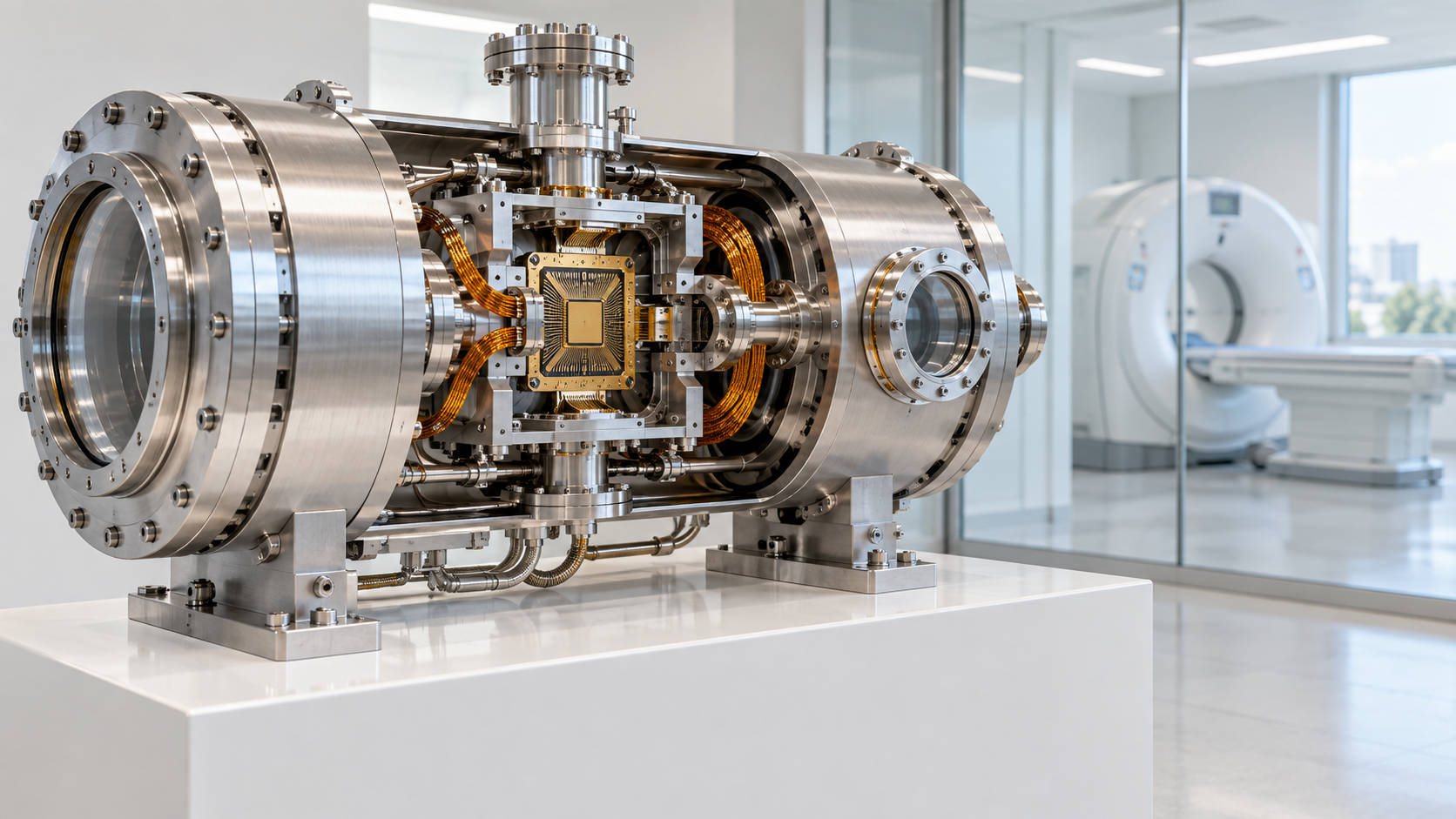
On 21 September 2026 the American quantum company IonQ and the Korean system integrator SDT announced a multi-year partnership under which IonQ will supply SDT with its newest quantum computer and a quantum memory module. The Korean newspaper Digital Times reported on 22 September, citing SDT, that the computer is meant for the hybrid data center of a cancer center in South Korea. For a hospital that buys imaging systems, sequencers and compute clusters on multi-year cycles, the announcement raises a practical question about what this machine can do for oncology.
The answer depends on dates and on the precise wording of two press accounts. IonQ will supply a Superion 256, a trapped-ion machine the company announced on 8 September 2026 and says it will begin delivering to customers in 2027. The cancer center has not been identified, and SDT says the project details will be disclosed later. What exists today is a purchase agreement, a plan for a hybrid quantum-classical data center, and a planned manufacturing site in the city of Gumi. The cited announcements report no medical workload or results.
That makes this a procurement story at an early stage, and procurement stories are where hospital leaders, research directors and health ministries decide whether to wait, pilot or budget. This Monitor sets out what each party said, what the machine is, and which questions a cancer center would need answered before the system becomes clinical research infrastructure.
The Korean detail matters because the English release and the Korean report differ in one respect that a buyer should notice. The difference concerns where the computer goes.
Karystianou's Quantum Scanner Claim on Open TV, 20 September 2026: 100,000 Times Sharper Cancer Detection, Read Against the Mainz Diamond Magnetocardiogram
Quentir Medicine Monitor
Evidence-based insights for quantum medicine.
On 20 September 2026 Maria Karystianou, the pediatrician who leads the Greek movement Elpida gia ti Dimokratia, said on the Open TV program Tora Mazi, as transcribed by the newspapers Documento and Ta Nea, that the quantum scanners of the future will have 100,000 times greater resolution in locating cancer cells and will also be able to treat. She said it while the health minister, Adonis Georgiadis, was on the public broadcaster ERT calling her a "quantum doctor". The exchange is the newest turn in a Greek argument over the words quantum medicine that began with the death of the artist Giorgos Mazonakis and a private practice in Kolonaki, Athens.
Two parts of her statement are physics and hold up. The third is a forecast with no supporting instrument or publication identified in the sources reviewed here. This Monitor separates them. The quantum scanner claim of 100,000 times sharper cancer detection has no counterpart in the sources this Monitor reviewed; a quantum sensing result published on a human body this month, a diamond magnetometer reading of a heartbeat, is a separate research example that works at the scale of the whole heart and needs hundreds to thousands of beats to do it. What the episode shows a clinician is how the phrase quantum medicine now carries two meanings in one sentence.
The Greek material is unusually complete. Named physicists, a former university rector, a patients' union and a ministry have all spoken within one week, so a reader can see where the physics ends and the sales language begins. All quotations below are this Monitor's translations from the Greek newspaper accounts, which are secondary reports of the broadcasts; no broadcast recording was reviewed.
According to LiFO's account of the interview, which carries the physics passage and the inspection passage, Karystianou opened on inspections: after the Mazonakis case, she said, the state and its inspectors must check whether a practice is licensed and whether the procedures performed there are the ones a license covers, and the minister should stop telling patients to be careful about which practice they visit. Told on air that Georgiadis had just called her a "quantum doctor" on ERT, she answered that the word is quantum physics, that quantum physics has transformed science and technology, and that lasers are entirely quantum mechanics, as is the magnetic scanner, which she attributed to the quantum spin of protons.
Sagutxoa Grows Neurons From Donated Milk Teeth in Alicante and Plans a Quantum Analysis on IBM's Quantum System Two in San Sebastián (El País, 18 September 2026)
Quentir Medicine Monitor
Evidence-based insights for quantum medicine.
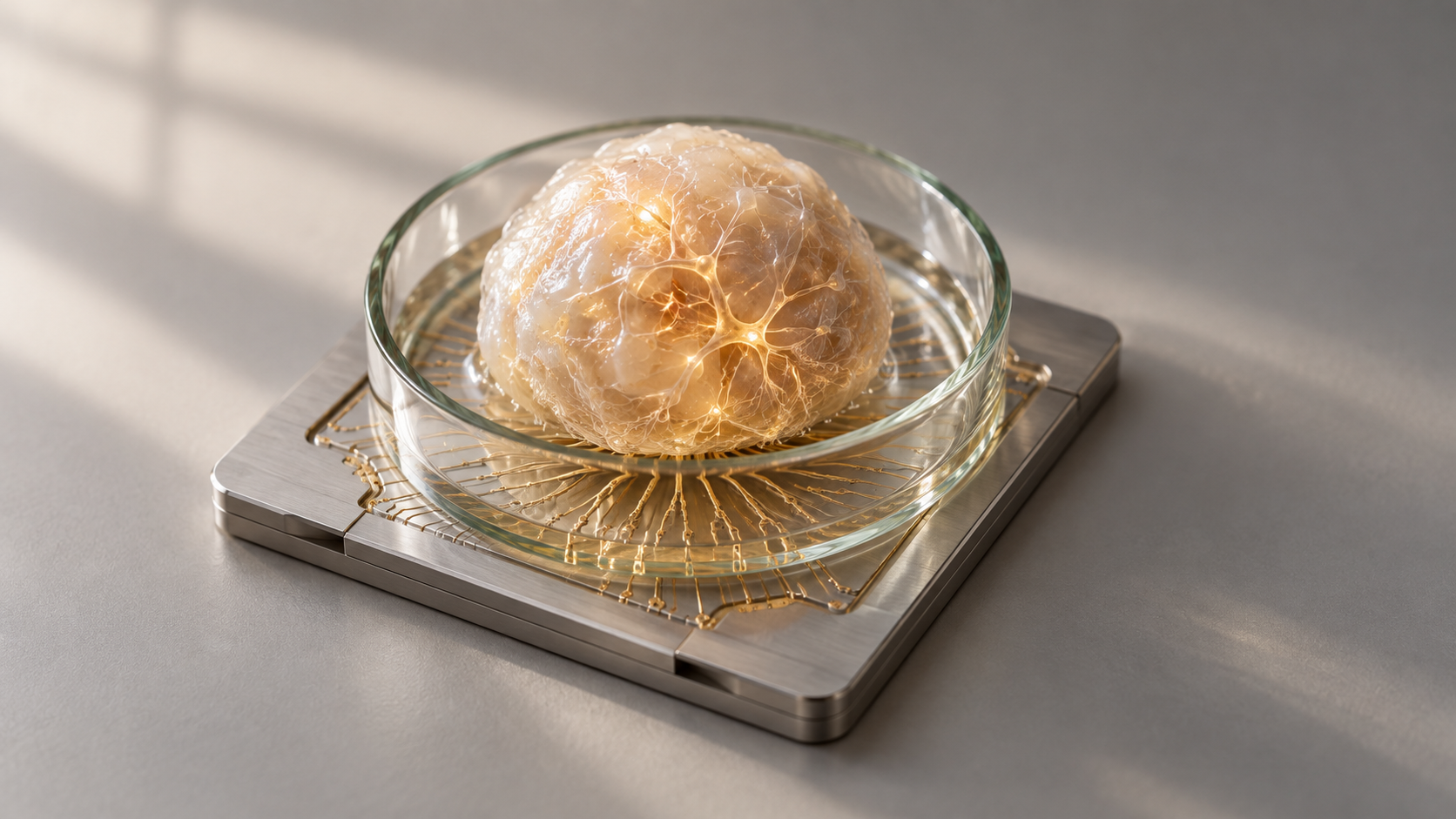
On 18 September 2026 El País reported from the Basque Country on Sagutxoa, a research project that grows human neurons from the milk teeth of children with rare neurological diseases and intends to send the measurements taken on those neurons to a quantum computer. The neuroscience half of the project has produced something concrete: a public biobank of more than 50 frozen neuronal lines. The quantum half is a plan with access to the machine through a public regional program; the reports describe no quantum hardware result.
The project is led by Salvador Martínez, professor at the Universidad Miguel Hernández and researcher at the Instituto de Neurociencias in Alicante, and is financed by the Bilbao foundation The Walk On Project with an initial budget of 120,000 euros. Its raw material is milk teeth donated by children with rare neurodegenerative diseases; the dental pulp contains neural crest progenitors that become neurons without genetic modification. The computing partner is LKS Next of the Mondragón group, which expects to use the IBM Quantum System Two installed in San Sebastián through the Basque Government's Basque Quantum infrastructure.
For a hospital neurologist or a rare-disease foundation the interesting part is the biology, which is further along than the headline suggests, and the honest part is the timeline: the foundation's president says the phase now under way should reach its first conclusions in about a year, and warns against raising false expectations.
Martínez told El País that the first task was to establish whether the pulp of a shed milk tooth contains neural crest progenitors, and that the answer was yes. The stem cells in the pulp turn into neurons naturally, without any genetic reprogramming, which is the point of difference from induced pluripotent stem cell models that rewrite a skin or blood cell's program first. In culture, he says, the neurons behave as neurons do: they form circuits, connect to one another and develop synapses, which produces very large volumes of electrophysiological, proteomic and transcriptomic data.
China's Pharmaceutical Industry 15th Five-Year Plan, Reported 18 September 2026, Lists Quantum Computing for Drug R&D; the 2021 Plan Did Not
Quentir Medicine Monitor
Evidence-based insights for quantum medicine.
On 18 September 2026 Chinese business media reported that the Ministry of Industry and Information Technology and nine other central departments had issued a five-year plan for the pharmaceutical industry that lists quantum computing among the technologies the state wants applied to drug research. The predecessor plan of December 2021 listed artificial intelligence, cloud computing and big data for the same job, and the word quantum did not appear in its published text.
The underlying document, which this Monitor knows through the reports of it rather than from the notice itself, is the 15th Five-Year Plan for the pharmaceutical industry, filed as MIIT joint planning document 2026 number 210 and covering 2026 to 2030. In its passage on frontier technologies, as quoted by the business press, it asks industry, universities, research institutes and hospitals to speed up the use of artificial intelligence, quantum computing, supercomputing and computational medicine in drug research and development. The same plan sets a target that Chinese first-in-class drugs make up at least 25 percent of the global total by 2030.
A planning document is a statement of intent, not a result. For a reader who buys for a hospital or runs a pharmaceutical research group in Europe, its value lies in what it tells you about where Chinese public money, procurement and regulatory attention will go for the rest of the decade, and in the gap between the plan's language and the evidence a physicist in Shanghai asked the same industry to produce a week earlier.
The ten signatories are the Ministry of Industry and Information Technology, the National Development and Reform Commission, the Ministry of Natural Resources, the Ministry of Agriculture and Rural Affairs, the Ministry of Commerce, the National Health Commission, the Ministry of Emergency Management, the National Healthcare Security Administration, the National Administration of Traditional Chinese Medicine and the National Medical Products Administration.
Mainz, Stuttgart, Freiburg and Q.ANT Recorded a Human Magnetocardiogram With Room-Temperature Diamond Sensors: What the 16 September 2026 Science Advances Paper Shows
Quentir Medicine Monitor
Evidence-based insights for quantum medicine.
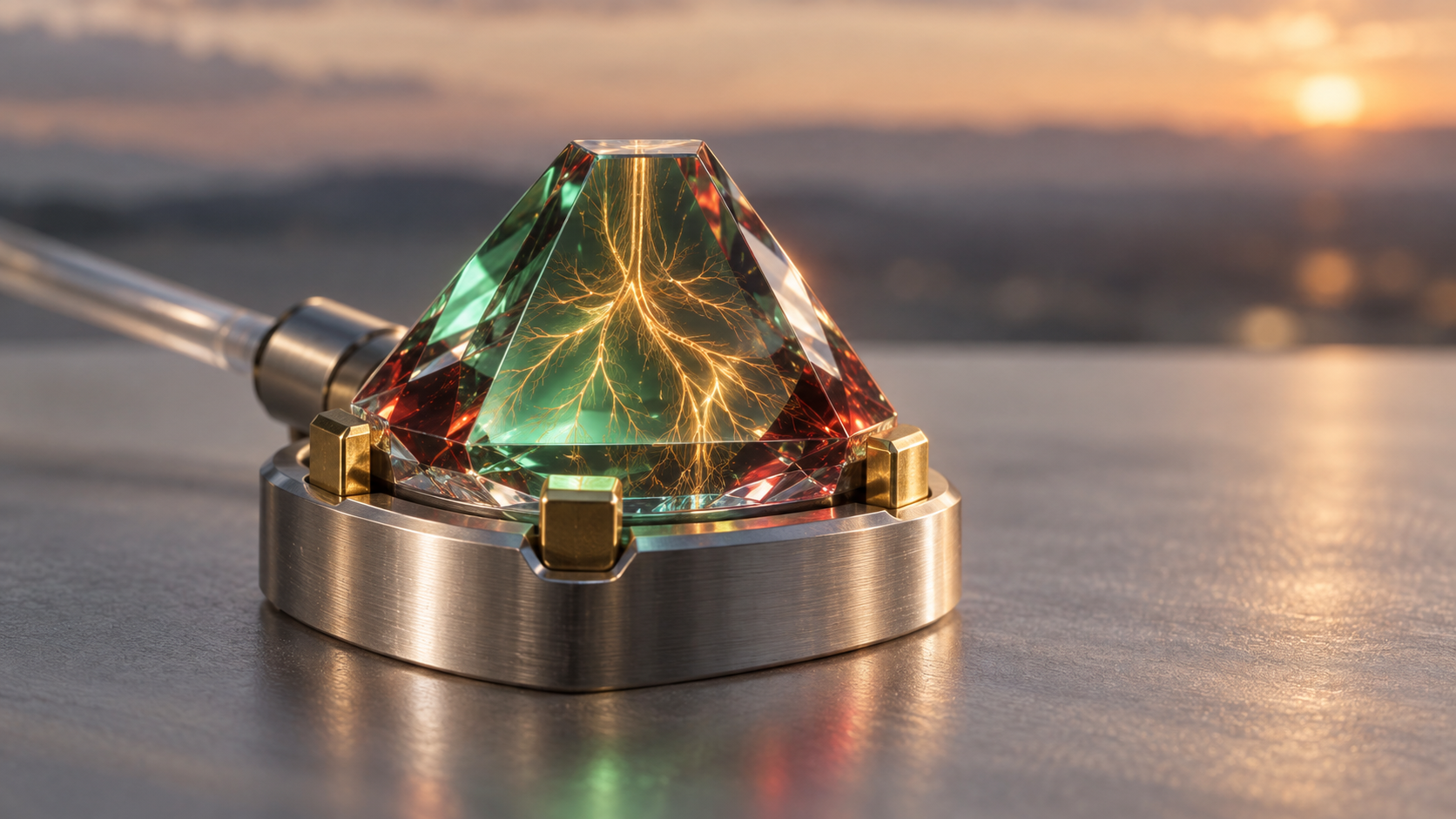
Three research groups in Germany have measured the magnetic field of a beating human heart with diamond sensing crystals smaller than half a cubic millimeter, at room temperature and without touching the skin. The paper appeared in Science Advances on 16 September 2026 under the coordination of Muhib Omar and Arne Wickenbrock of Johannes Gutenberg University Mainz, with Dmitry Budker and Jörg Wrachtrup among its 30 authors.
The instruments are diamond nitrogen-vacancy magnetometers: a nitrogen atom sitting beside a missing carbon atom in the diamond lattice, whose electron spin shifts its energy in proportion to the surrounding magnetic field. The three systems, built independently at Mainz, at the University of Stuttgart and by the Stuttgart startup Q.ANT GmbH, each produced a human magnetocardiogram in proof-of-concept self-experiments on members of the research groups, with sensitivities between 6 and 26 picotesla per square-root hertz. The result is a laboratory measurement on a handful of volunteers from the teams themselves, with no patient involved. It establishes that room-temperature diamond sensors can read the heart's field at all, after averaging, which is the step a cryogenic SQUID cleared decades ago and an optically pumped magnetometer clears with a heated vapor cell. The half-cubic-millimeter figure describes the sensing crystal, not the complete instrument with its fiber, optics and electronics, and the diamond heads recorded without touching the skin while a conventional electrocardiogram supplied the timing reference for the averaging, so the experiments did not show an electrode-free workflow.
The heart's magnetic signal is faint. The paper puts the average R-peak, the sharpest feature of each beat, at about 25 picotesla, roughly two million times weaker than the field of the Earth. That is why magnetocardiography has stayed inside hospitals that could afford superconducting detectors and the shielding around them, and why a SQUID magnetocardiograph still counts as deployable news when a Chinese manufacturer places one. The Mainz group's own line of work reached a related milestone on 6 August 2026 with a levitated-magnet sensor at 32 femtotesla per square-root hertz, a sensitivity reached only in a narrow resonance near 305 hertz, on a benchtop device that is far less suited than a diamond to sitting near a chest.
Phasecraft's 3,000-Emulation VQE Molecular Dataset With NVIDIA Was Computed on GPUs Under Wellcome Leap's Q4Bio: What the 14 September 2026 Announcement Shows
Quentir Medicine Monitor
Evidence-based insights for quantum medicine.
Phasecraft and NVIDIA announced on 14 September 2026 what Phasecraft calls the largest known database of Variational Quantum Eigensolver results for molecules, more than 3,000 emulations across thirteen molecular systems, computed on NVIDIA Hopper GPUs at the University of Nottingham. No quantum computer ran any of it, and the announcement says so in its own description of the method.
The dataset is an emulated VQE molecular dataset: for each of the 13 molecular systems, a classical GPU cluster worked out what a quantum processor of 4 to 32 qubits would return when asked for the lowest-energy state of the molecule, with most of the circuits in the 24-to-28-qubit range. Its purpose is to train Phasecraft's quantum-enhanced density functional theory method, a way of improving the standard workhorse of computational chemistry with data a quantum computer would produce. The Wellcome Leap Q4Bio program that paid for it asks whether new algorithms can deliver quantum advantage for health, and its prizes require a demonstration on a real quantum computer with more than 50 qubits. For a hospital buyer or a clinical pharmacologist the announcement describes training data for a chemistry method, produced on conventional hardware, with no named molecular systems, quantitative accuracy benchmarks or clinical results disclosed.
The Phasecraft release, datelined London and Toronto, gives four numbers: over 3,000 unique emulations, 13 molecular systems, a qubit range of 4 to 32 with "the vast majority in the 24–28 qubit regime", and "a 15x simulation speedup over prior results when modeling physical, many-body systems integral to biology and health applications". The GPUs were NVIDIA Hopper hardware hosted at the University of Nottingham, driven through NVIDIA's cuQuantum software kit. Ashley Montanaro, Phasecraft's co-founder and chief executive, is quoted on the need "to push the limits of today's most capable hardware, both conventional and quantum"; Sam Stanwyck, NVIDIA's director of quantum product, on shortening "the timeline" to useful quantum computing. The release describes the dataset as "a training foundation for quantum-enhanced molecular modeling, which could accelerate drug discovery at a scale previously out of reach, as quantum hardware develops". The conditional clause at the end carries the weight of the sentence.
IonQ and Kipu Quantum's 64-Qubit Protein-Folding Paper Took Third Place at IEEE Quantum Week 2026: Six Peptides, 46 to 61 Qubits, Four of Six Reference Energies Reached After Classical Post-Processing
Quentir Medicine Monitor
Evidence-based insights for quantum medicine.
A Kipu Quantum and IonQ paper on lattice protein folding took third place in the hybrid case-studies track at IEEE Quantum Week 2026 in Toronto, IonQ announced on 15 September 2026, and the release says the work "was used to improve computational speed and accuracy in drug discovery." The paper, on arXiv since 29 April 2026, reports something narrower: a hardware benchmark on six short peptides that reached the reference energy of a conventional solver in four cases, and only with the help of a classical consensus step.
The experiment ran six peptides of 14 to 16 residues through a 64-qubit trapped-ion processor, a barium development system IonQ describes as similar to its forthcoming Tempo line, folding each on a coarse lattice with no side chains using 46 to 61 qubits. The quantum circuits produced samples that mostly violated the backbone geometry, and it took a classical post-processing step, a consensus vote over the two thousand lowest-energy samples combined with a pool of feasible backbones, to reach the reference energy in four of the six cases; a random-start version of the same pipeline reached it in one. For a hospital buyer or a clinical pharmacologist that is the whole result: a hardware run on a benchmark, at a scale that a classical genetic algorithm solves to convergence, with the quantum contribution visible in the statistics of one part of the problem.
The IonQ release counts 857 submissions and 27 Best Paper honors at the conference, four of which went to papers with IonQ authors. Three of the four concern AI fine-tuning, distributed optimization with Oak Ridge National Laboratory and NVIDIA, and linear algebra with Synopsys. The fourth is the protein-folding paper with Kipu Quantum, which the release assigns to drug discovery. The conference's award list gives the paper third place in the Quantum End-to-End Hybrid Case Studies track, with the paper presented on Monday 14 September and the track's awards presented on Tuesday 15 September. Five of the fourteen authors are at Kipu Quantum in Berlin, one, Sebastián Romero, at ICMM-CSIC and the Autonomous University of Madrid, and eight at IonQ, among them Martin Roetteler, IonQ's vice president of quantum applications research, who is quoted in the release. The award recognizes a conference paper; it does not evaluate a drug, a target or a clinical claim, and the paper makes none.
The Hellenic Physicists' Union Called "Quantum Medicine" an Unfounded Term on 12 September 2026: What the Word Still Covers, From Wearable MEG to Korea's Quantum Nanosensor
Quentir Medicine Monitor
Evidence-based insights for quantum medicine.
On 12 September 2026 the board of the Hellenic Physicists' Union adopted a press release titled "On the abuse of the term quantum" and posted it on its website the next evening. The one-page text lists what a quantum phenomenon is, credits the second quantum revolution with applications in biology and medicine, and then calls "quantum medicine", "quantum therapy" and "quantum consciousness" unfounded terms. It traces them to Deepak Chopra in 1989, cites Chopra's own 2007 statement that the phrase was a literary metaphor, recalls the 1998 Ig Nobel prize in physics, and adds that the degrees issued by a self-styled "Quantum University" in Hawaii are unrecognized, quoting McGill University's science office. Greece's health minister Adonis Georgiadis said the same on television on 15 September in plainer words: quantum medicine recognized by science does not exist.
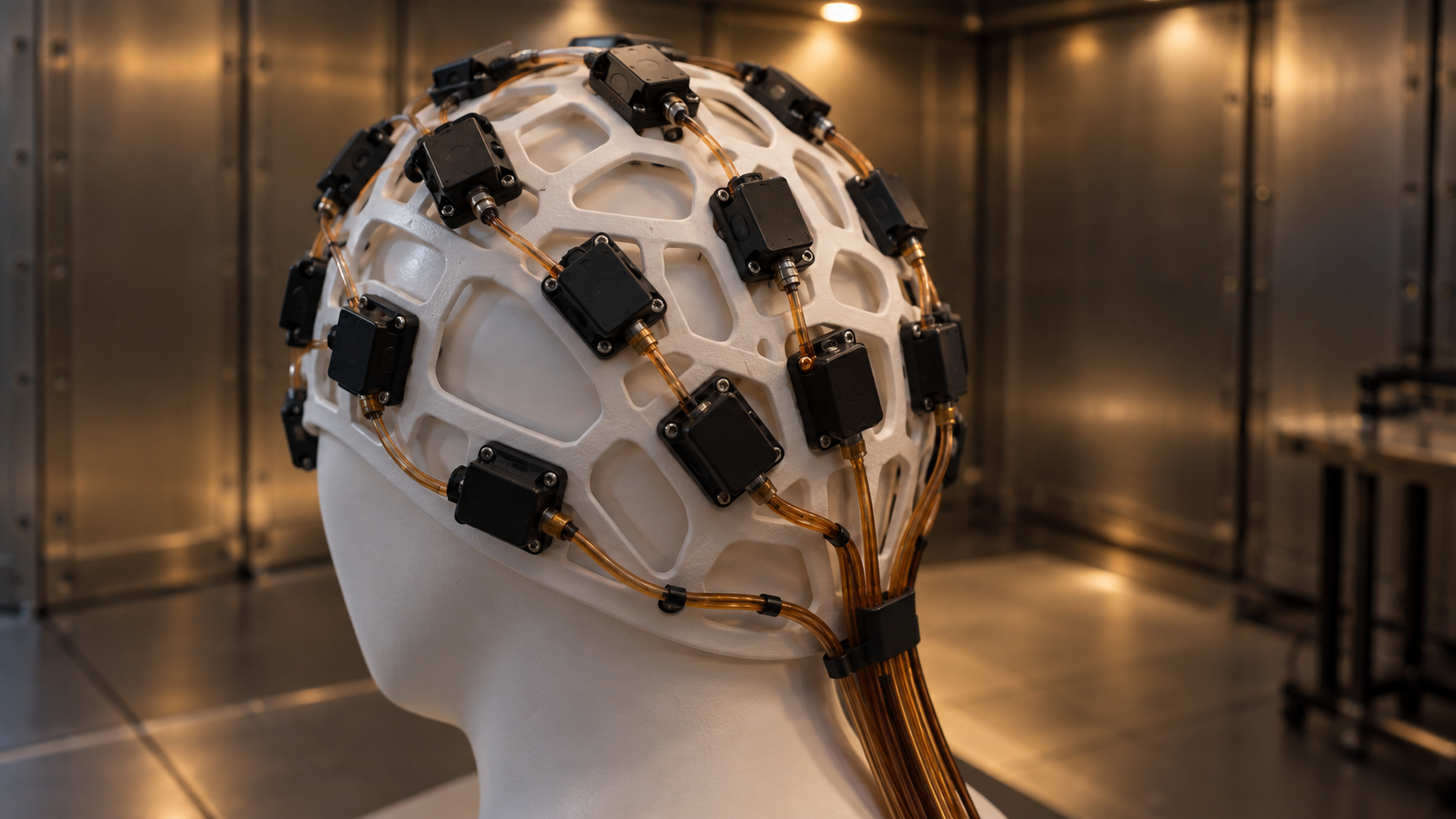
This Monitor publishes under the phrase the physicists reject, so the release deserves a careful reading, and a defensive one would miss what it concedes. The physicists are right about the word's history, and their release names no case, no clinic and no practitioner; Greek outlets reported it on 13 September alongside an Athens investigation, a connection the press drew and the release does not. The release also credits, in general terms, applications of quantum physics in biology and medicine. The Hellenic Physicists' Union statement separates a metaphor from measurable physics, and this Monitor applies that separation to two examples of its own choosing, which the union neither names nor endorses; that qualification is stated here once and holds for the whole piece. A wearable magnetoencephalography system built on optically pumped magnetometers, published in Nature in 2018, uses quantum sensing to measure brain magnetic fields and was demonstrated on healthy volunteers, with clinical use as the stated aim. A quantum nanosensor for cardiotoxicity funded by Korea's health ministry on 31 August 2026 is a funded research program with a named measurement still to be made, and no result yet. A practitioner's CV that lists a "quantum medicine" degree from an unaccredited online school is neither, and the difference is checkable by anyone who asks what was measured.
AOI Biosciences' Roughly 500 Million Yen Financing and Share Transaction of 14 September 2026 Lists Its Neo-Self Antibody Test Ahead of the Toshiba SQBM+ Quantum-Inspired Drug Platform
Quentir Medicine Monitor
Evidence-based insights for quantum medicine.
On 14 September 2026 AOI Biosciences, a diagnostics and drug-discovery company in Ibaraki, Osaka Prefecture, announced a financing and secondary-share transaction of roughly 500 million yen with existing and new investors; the company says the new-share portion takes its cumulative funding to about 1 billion yen, and it does not state how much of the 500 million is new money. The release describes two core businesses. One is a blood test for a "neo-self" autoantibody that is already sold to more than 300 Japanese medical institutions. The other is an allosteric drug-discovery method built with Toshiba on the quantum-inspired SQBM+ solver, the method whose patent Toshiba announced on 3 September and this Monitor examined on 6 September.
The release lists three planned uses for the proceeds, and that list is the useful fact for a hospital buyer or a pharma partner, with one caution: the order says nothing about how much money goes where or which business the company values more. The neo-self antibody test fills the first two entries, with domestic roll-out, Asian expansion and new autoimmune indications, and further research investment in the quantum-inspired drug discovery platform is the third. No amounts are attached to any entry. The clinical figures the release cites for the test, a pregnancy rate more than doubled and a live-birth rate 1.7 times higher, come from two Frontiers in Immunology cohort studies whose treated and untreated groups can be counted, and this note counts them.
Lu Chaoyang Called "Quantum New Drugs" a Packaged Product at the 2026 Bund Summit; Califano Calls Cancer "Quantum" as an Analogy
Quentir Medicine Monitor
Evidence-based insights for quantum medicine.
In September 2026 the word "quantum" reached medicine from two directions, and the contrast is instructive for anyone who buys for a hospital or a drug company. In Shanghai, the physicist Lu Chaoyang told the 2026 Bund Summit that some Chinese companies sell "quantum new drugs" as finished products while leading research teams still offer prize money for a practical quantum algorithm. In New York, Columbia University published a feature on 26 August in which the cancer biologist Andrea Califano called cancer a "quantum disease", a comparison with electron energy levels and no quantum hardware in it.
Califano's phrase points at two Nature Genetics papers, a pancreatic cancer dataset of hundreds of thousands of single cells, and a testable count of six cell states. The quantum new drugs that Lu Chaoyang objected to are described in a Xinmin Evening News commentary of 11 September as marketing, and the commentary supplies no product-level evidence for a buyer to assess. It also asked why the correction had to come from a scientist and why no industry regulator has set a standard for what a company may call quantum. That is the question a buyer should put to a vendor before any contract is signed.
KRIBB and Quandela Signed a Memorandum in Paris During Meetings on 7 and 8 September 2026 to Apply Photonic Quantum Computing to Drug-Candidate Discovery
Quentir Medicine Monitor
Evidence-based insights for quantum medicine.
During meetings in Paris on 7 and 8 September 2026, the Korea Research Institute of Bioscience and Biotechnology signed three memoranda of understanding, one of them with Quandela, the photonic quantum computing company founded in 2017 on research from CNRS and Université Paris-Saclay. KRIBB announced the agreements on 10 September, and the Korean daily Herald Economy carried the institute's account the same day. The signing took place during President Lee Jae-myung's state visit to France; on 8 September, Korea's science ministry and France's economy ministry exchanged a government-level memorandum on artificial intelligence, semiconductors and quantum technology at the Élysée.
The KRIBB and Quandela agreement has one stated purpose: to combine artificial intelligence and quantum computing with biological research so that finding a drug candidate takes less time and money than it does today. KRIBB puts the usual time to discover a candidate at more than ten years. The public announcement does not disclose a molecule, a disease target, a budget or a delivery date, and Quandela's own product pages describe the two machines it documents in use, Lucy at the French national computing center TGCC and Belenos in its cloud, as 12-qubit photonic machines. Read together, those two facts set the honest expectation for this partnership: a research collaboration at the stage of a signed memorandum, with no demonstrated pipeline benefit yet and no published plan for producing one.
Zhao, Preskill and Huang's 8 April 2026 Paper Puts a 68,000-Cell Blood Dataset Benchmark Under 60 Logical Qubits: What a Quantum Memory Advantage Means for Hospital Genomics
Quentir Medicine Monitor
Evidence-based insights for quantum medicine.
On 8 April 2026 seven authors from Caltech, MIT, Google Quantum AI and the startup Oratomic, among them John Preskill and Hsin-Yuan Huang, posted a 144-page proof that, for a specified family of classification and dimension-reduction tasks under stated assumptions, a quantum computer of polylogarithmic size reaches a prediction performance that any classical machine would need exponentially more memory to match. The claim reached a wider readership on 11 September 2026, when WIRED Japan explained it to museum visitors as an advantage in size, not in speed.
The paper's medical test case is a genomics one. In a numerical benchmark on the expression profiles of 68,000 peripheral blood cells, the authors report that their method separates cell types and finds the main axis of variation with a calculated requirement of fewer than 60 logical qubits, where the classical methods chosen for comparison need four to six orders of magnitude more memory units. The proposed protocol draws random samples, processes each once and discards it; the benchmark reports performance and an estimated memory requirement, and it did not run that stream on a quantum machine. The advantage the authors prove is one of memory, not speed, and that distinction decides what a hospital genomics group should make of it.
SEALSQ's 9 September 2026 Interview on Fifteen-to-Twenty-Year Medical Device Lives, and the QS7001 Page That Still Lists Kyber and Dilithium 2
Quentir Medicine Monitor
Evidence-based insights for quantum medicine.
On 9 September 2026 Carlos Moreira, founder and chief executive of the Nasdaq-listed semiconductor company SEALSQ, described in a published interview a post-quantum exposure specific to connected physical systems, among them medical devices, which he sets alongside the familiar risk of stored data waiting to be decrypted later. His reason rests on an arithmetic any hospital finance office already runs: equipment bought today could remain in service well beyond the transition date NIST has proposed.
Many connected devices stay fifteen or twenty years in service and cannot be swapped out quickly. A draft NIST report proposes that the public-key algorithms those devices ship with become disallowed after 2035, with the weaker parameter sizes deprecated five years earlier. The company's answer is a secure microcontroller called the QS7001, whose product page names medical and healthcare devices as a target market, and whose specification sheet still lists Kyber and Dilithium 2, the names those algorithms carried before NIST standardized them.
The Minimal-Basis Run Gave T4-Lysozyme the Wrong Binding Sign: What Cleveland Clinic, RIKEN and IBM Changed to Correct It
Quentir Medicine Monitor
Evidence-based insights for quantum medicine.
On 9 September 2026 Cleveland Clinic announced that a team from Cleveland Clinic, the RIKEN Center for Computational Science and IBM had reached the finals of the 2026 ACM Gordon Bell Prize, for quantum-classical electronic-structure calculations on protein-ligand complexes of 11,608 and 12,635 atoms. Four days earlier the preprint behind that entry gained a second version, and buried in it is a result that deserves more attention than the atom count.
When the team computed the binding energy of a well-studied protein-ligand pair in a minimal basis set, the answer came out too positive, which is to say it pointed the wrong way for a ligand known to bind. Recomputing it with richer orbitals in the binding region and a tighter bath threshold together corrects the sign of the binding energy, at about ten times more in total node-hours. The revision also reports a first end-to-end wall-clock time, 62.4 hours from fragment generation to energy reconstruction, for a bound-complex ground-state run.
Hefei Mandi's Magnetocardiograph, 4 and 5 August 2026: Two Unresolved Deployment Descriptions in Chinanews and Xinhua
Quentir Medicine Monitor
Evidence-based insights for quantum medicine.
On 4 August 2026 a state press tour called Vibrant China Field Study visited the Institute of Health and Medicine at the Hefei Comprehensive National Science Center and watched a magnetocardiograph acquire signal in the laboratory of Hefei Mandi Medical Technology. Two reports came out of that visit on consecutive days, both from official Chinese outlets, both describing the same machine, and they describe its stage of deployment in different words that no public source resolves.
The company builds a magnetocardiograph around a superconducting quantum interference device, the detector class that reads magnetic fields at the femtotesla scale, and a 2022 industry profile says it obtained an NMPA registration in 2019. The 4 August report describes the machine as working with ten key hospitals in scientific research collaboration and entering a pre-mass-production stage. The 5 August report describes it as installed and in use at more than ten key hospitals in deployed application, with the company's production lines running at full load. A hospital deciding whether to buy one needs to know which of those two sentences is the current state of the product.
A 280-Nanometre Diamond Reached a 682 Microkelvin Resolution Floor: Cambridge, Warwick and Cardiff, 4 September 2026
Quentir Medicine Monitor
Evidence-based insights for quantum medicine.
On 4 September 2026 a group drawn from the Cavendish Laboratory at the University of Cambridge, the University of Warwick and Cardiff University posted a preprint on nanoscale thermometry with a free-standing diamond particle. Jack W. Hart, Soham Pal, Julien R. E. Roth, Katie Ninham, Abbie H. Aleksandrova, Xander Peetroons, Soumen Mandal, Oliver A. Williams, Gavin W. Morley, Mete Atature and Helena S. Knowles report that the platform as a whole reaches roughly an order of magnitude better sensitivity than previously published nanodiamond figures.
Three numbers carry the result, and each needs its qualifier. The paper reports an extrapolated resolution floor of 682 microkelvin, a figure derived from the fitting error of the functional form rather than from a single demonstrated reading; the average error on a temperature measurement that took 83 seconds to acquire was 11.9 millikelvin. The sensor is a 280-nanometre nanodiamond ball-milled from isotopically purified carbon-12, small enough in principle to sit inside a cell and holding two nitrogen-vacancy centers rather than one. And the same paper measures the heat its own readout laser pours into the sample, finding 337 millikelvin of heating for every milliwatt of incident optical power, with an observed maximum rise of 224 millikelvin at 0.63 milliwatts, which is some 330 times the extrapolated resolution floor.
Japanese Patent 7,908,389, Registered 10 August 2026: What Toshiba and AOI Biosciences Claim for Allosteric Site Prediction, and What Quantum-Inspired SQBM+ Actually Runs On
Quentir Medicine Monitor
Evidence-based insights for quantum medicine.
On 3 September 2026 Toshiba Corporation and AOI Biosciences announced that a patent the two companies had filed together was registered in Japan on 10 August 2026. It covers an allosteric pathway prediction device: software that reads a protein's three-dimensional structure and predicts the internal routes leading to pockets that sit away from the site where the protein does its work.
Three parts of that announcement carry different weights. Japanese Patent 7,908,389 is a legal instrument whose protection runs to its granted claims in Japan, which is a separate question from whether the method finds sites nobody had found before. The supporting evidence offered in the release is one figure, accuracy of 80 percent or higher on already-known sites, reported without a definition of accuracy, a benchmark set or a paper behind it. And the optimization engine at the center of the work, Toshiba's SQBM+, is described as quantum-inspired, a term that here means the solver runs on ordinary classical computers and uses no qubits.
A Sleep App's Cough Data Showed a One-Week Lead on Flu and COVID-19 PCR Positivity in Retrospective Analysis: What UKHSA and Sleep Cycle Published on 3 September 2026
Quentir Medicine Monitor
Evidence-based insights for quantum medicine.
On 3 September 2026 the UK Health Security Agency published the results of a joint study with Sleep Cycle, a Swedish sleep-technology company, reporting that increases in coughing at night were often seen about a week before increases in influenza and COVID-19 activity in England. The underlying data came from a consumer smartphone app that listens while people sleep, and the preprint states that no raw audio is transmitted to Sleep Cycle's servers.
The claim worth reading closely is the smaller one. Across three years of weekly data the nocturnal cough measures moved almost in step with NHS 111 triage calls for acute respiratory infection, and only secondarily did they show a one-week lead in retrospective analysis over PCR positivity for influenza and COVID-19. The agency and the authors are careful about what that supports. The study looked backward at three respiratory seasons that have already happened, so what it establishes is a relationship in recorded data, and the authors write that operational usefulness would need a prospective evaluation against forecasting benchmarks in a live setting.
Quantum Foundry Copenhagen Plans a 5,300-Square-Meter Quantum Chip Factory for 2027: What the Novo Nordisk Foundation Announced on 4 September 2026
Quentir Medicine Monitor
Evidence-based insights for quantum medicine.
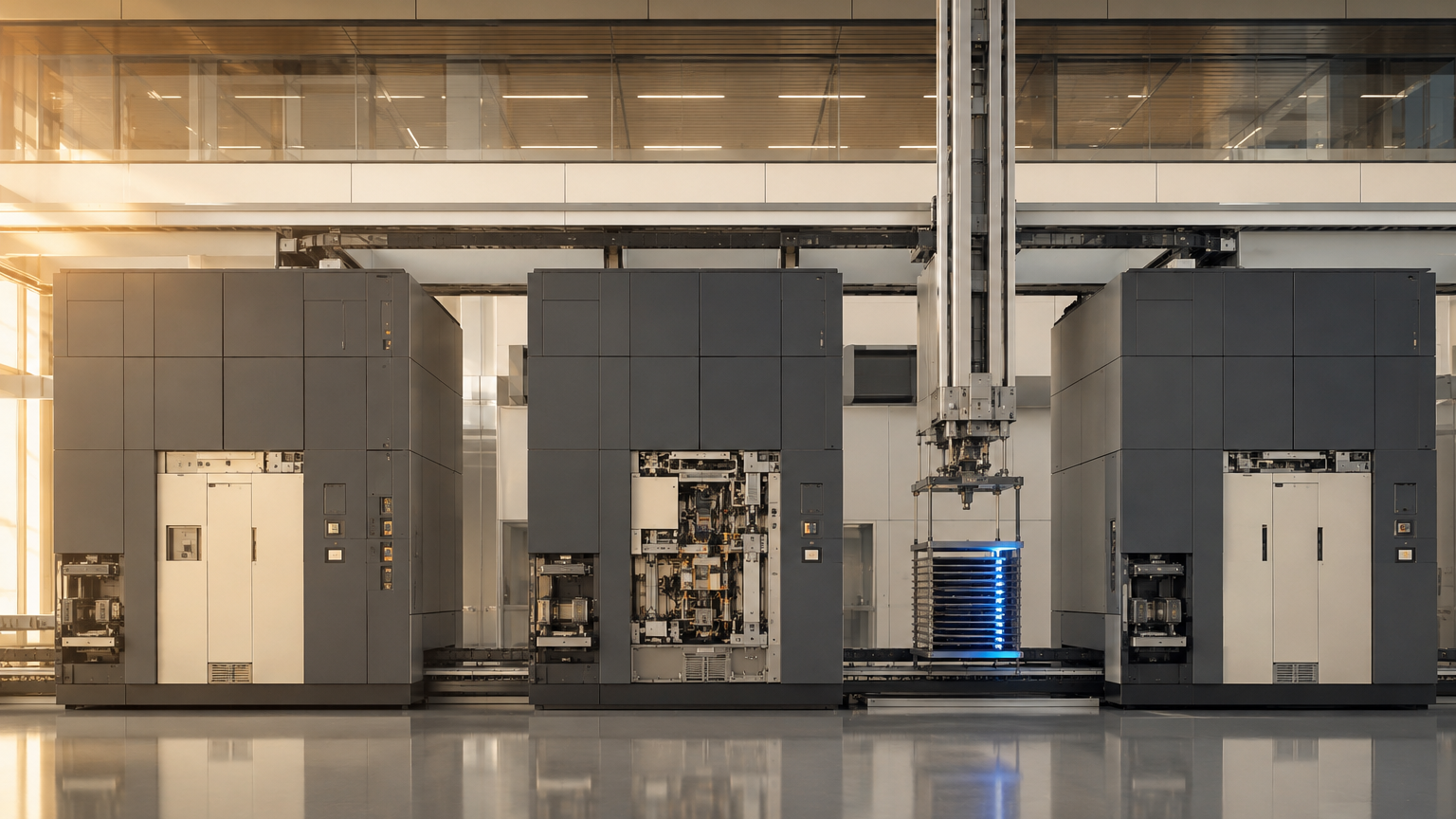
A health foundation announcing a chip plant is unusual enough to state plainly. On 4 September 2026 the Novo Nordisk Foundation and Quantum Foundry Copenhagen, the company the foundation started in 2023 and owns, said they will build a 5,300-square-meter quantum chip fabrication facility in Copenhagen, with an opening expected in 2027. The plant is to combine nanofabrication of quantum materials, characterization, testing, chip assembly and packaging, and it is to sell wafer fabrication to quantum technology vendors elsewhere in the world on commercial terms.
The foundation's own Danish announcement puts faster development of new medicine among the reasons for spending the money. Its total commitment to quantum technology now exceeds DKK 2.9 billion, about EUR 390 million, and the factory is the manufacturing end of it. Two days earlier the engineering firm Ramboll handed over the Copenhagen building that will house Magne, the machine the foundation co-owns through QuNorth. Both projects run toward the same declared destination, a fault-tolerant quantum computer in Denmark before 2034, and a clinician reading the announcement is entitled to ask what any of it does for a patient in the meantime.
OpenEvidence Released Osler, Sackett and Snow Free on 3 September 2026 and Gated Darwin on Dual-Use Grounds: What a Perfect Score on 660 MedQA Questions Shows
Quentir Medicine Monitor
Evidence-based insights for quantum medicine.
OpenEvidence assigns its quickest model about five seconds per answer and its deeper modes thirty seconds and five minutes, and on 3 September 2026 the Miami company, whose search tool is used by a majority of US physicians on its own account, split its product along that line. Three models that differ in how long they think were released free to every verified clinician, and a fourth, described as its most capable, is one a researcher must apply to use. The company's stated reason for the fourth is that a model able to reason at the frontier of virology, immunology and human genetics could also, in the wrong hands, accelerate work the world tightly governs.
The release names Darwin as the withheld model and reports that it answered a physician-cleaned set of 660 MedQA questions without a single error, along with 72.8 percent on MedXpertQA, 82.7 percent on HealthBench Professional and 87.2 percent on the NOHARM harm benchmark. The dual-use rationale is stated in one sentence and the access rule in another, and the company has published its annotations and its model's full outputs for the four benchmarks. This Monitor reads what the 660 questions and the other three scores can support, how the company chose the comparators and the judge, and what the access decision looks like beside the framework the founder of this site published for exactly this kind of choice.